The Gaudi Framework  v33r2 (a6f0ec87)
DataSvc Class Reference

Data service base class. More...

#include <GaudiKernel/DataSvc.h>

Inheritance diagram for DataSvc:
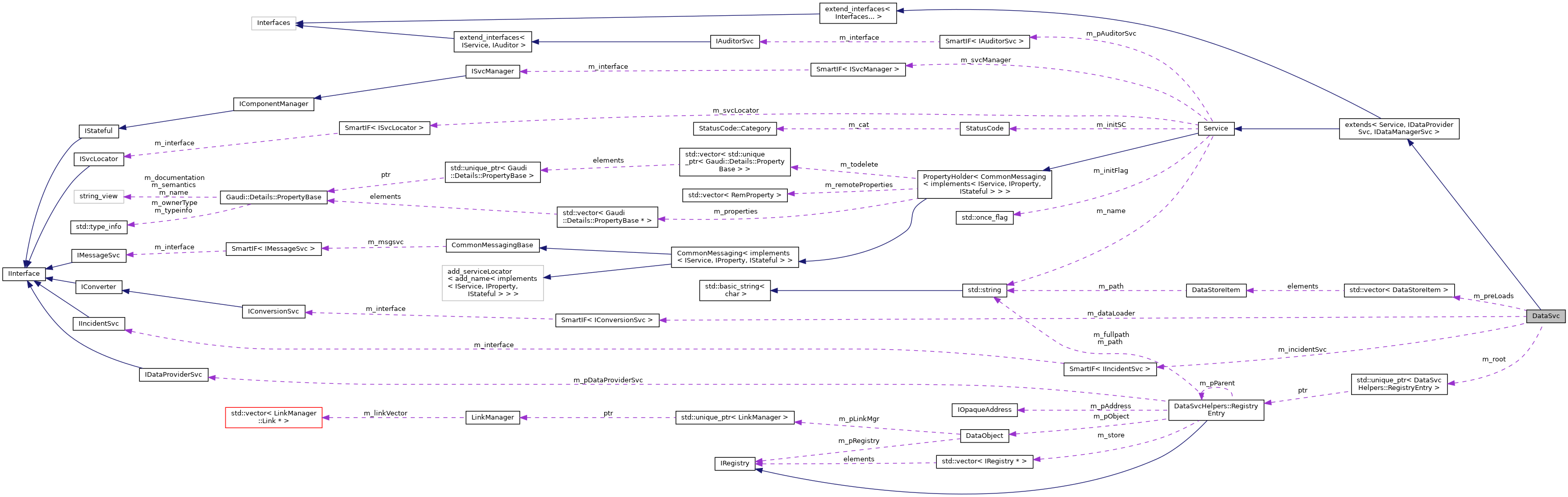
Collaboration diagram for DataSvc:

Public Member Functions

CLID rootCLID () const override
 IDataManagerSvc: Accessor for root event CLID. More...
 
const std::stringrootName () const override
 IDataManagerSvc: Accessor for root event name. More...
 
StatusCode registerAddress (std::string_view fullPath, IOpaqueAddress *pAddress) override
 IDataManagerSvc: Register object address with the data store. More...
 
StatusCode registerAddress (IRegistry *parentObj, std::string_view objectPath, IOpaqueAddress *pAddress) override
 IDataManagerSvc: Register object address with the data store. More...
 
StatusCode unregisterAddress (std::string_view fullPath) override
 IDataManagerSvc: Unregister object address from the data store. More...
 
StatusCode unregisterAddress (IRegistry *pParent, std::string_view objPath) override
 IDataManagerSvc: Unregister object address from the data store. More...
 
StatusCode objectLeaves (const DataObject *pObject, std::vector< IRegistry * > &refLeaves) override
 IDataManagerSvc: Explore the object store: retrieve all leaves attached to the object. More...
 
StatusCode objectLeaves (const IRegistry *pRegistry, std::vector< IRegistry * > &refLeaves) override
 IDataManagerSvc: Explore the object store: retrieve all leaves attached to the object. More...
 
StatusCode objectParent (const DataObject *pObject, IRegistry *&refpParent) override
 IDataManagerSvc: Explore the object store: retrieve the object's parent. More...
 
StatusCode objectParent (const IRegistry *pRegistry, IRegistry *&refpParent) override
 IDataManagerSvc: Explore the object store: retrieve the object's parent. More...
 
StatusCode clearSubTree (std::string_view sub_tree_path) override
 IDataManagerSvc: Remove all data objects below the sub tree identified by its full path name. More...
 
StatusCode clearSubTree (DataObject *pObject) override
 IDataManagerSvc: Remove all data objects below the sub tree identified by the object. More...
 
StatusCode clearStore () override
 IDataManagerSvc: Remove all data objects in the data store. More...
 
StatusCode traverseSubTree (std::string_view sub_tree_path, IDataStoreAgent *pAgent) override
 IDataManagerSvc: Analyze by traversing all data objects below the sub tree identified by its full path name. More...
 
StatusCode traverseSubTree (DataObject *pObject, IDataStoreAgent *pAgent) override
 IDataManagerSvc: Analyze by traversing all data objects below the sub tree. More...
 
StatusCode traverseTree (IDataStoreAgent *pAgent) override
 IDataManagerSvc: Analyze by traversing all data objects in the data store. More...
 
StatusCode setRoot (std::string root_name, DataObject *pRootObj) override
 Initialize data store for new event by giving new event path and root object. More...
 
virtual StatusCode i_setRoot (std::string root_name, DataObject *pRootObj)
 Initialize data store for new event by giving new event path and root object. More...
 
StatusCode setRoot (std::string root_path, IOpaqueAddress *pRootAddr) override
 Initialize data store for new event by giving new event path and address of root object. More...
 
virtual StatusCode i_setRoot (std::string root_path, IOpaqueAddress *pRootAddr)
 Initialize data store for new event by giving new event path and address of root object. More...
 
StatusCode setDataLoader (IConversionSvc *svc, IDataProviderSvc *dpsvc=nullptr) override
 IDataManagerSvc: IDataManagerSvc: Pass a default data loader to the service and optionally a data provider. More...
 
StatusCode addPreLoadItem (const DataStoreItem &item) override
 Add an item to the preload list. More...
 
StatusCode removePreLoadItem (const DataStoreItem &item) override
 Remove an item from the preload list. More...
 
StatusCode resetPreLoad () override
 Clear the preload list. More...
 
virtual StatusCode preLoad (int depth, int load_depth, DataObject *pObject)
 Execute one level of preloading and recursively load until the final level is reached. More...
 
StatusCode preLoad () override
 load all preload items of the list More...
 
StatusCode registerObject (std::string_view parentPath, std::string_view objPath, DataObject *pObject) override
 Register object with the data store. More...
 
StatusCode registerObject (DataObject *parentObj, std::string_view objPath, DataObject *pObject) override
 Register object with the data store. More...
 
StatusCode unregisterObject (std::string_view fullPath) override
 Unregister object from the data store. More...
 
StatusCode unregisterObject (DataObject *pObject) override
 Unregister object from the data store. More...
 
StatusCode unregisterObject (DataObject *pObject, std::string_view objectPath) override
 Unregister object from the data store. More...
 
StatusCode retrieveObject (IRegistry *pDirectory, std::string_view path, DataObject *&pObject) override
 Retrieve object from data store. More...
 
StatusCode findObject (std::string_view fullPath, DataObject *&pObject) override
 Find object identified by its full path in the data store. More...
 
StatusCode findObject (IRegistry *pDirectory, std::string_view path, DataObject *&pObject) override
 Find object identified by its full path in the data store. More...
 
StatusCode linkObject (IRegistry *from, std::string_view objPath, DataObject *to) override
 Add a link to another object. More...
 
StatusCode linkObject (std::string_view fullPath, DataObject *to) override
 Add a link to another object. More...
 
StatusCode unlinkObject (IRegistry *from, std::string_view objPath) override
 Remove a link to another object. More...
 
StatusCode unlinkObject (DataObject *fromObj, std::string_view objPath) override
 Remove a link to another object. More...
 
StatusCode unlinkObject (std::string_view fullPath) override
 Remove a link to another object. More...
 
StatusCode updateObject (IRegistry *pDirectory) override
 Update object identified by its directory entry. More...
 
StatusCode updateObject (DataObject *toUpdate) override
 Update object. More...
 
StatusCode initialize () override
 Service initialization. More...
 
StatusCode reinitialize () override
 Service initialization. More...
 
StatusCode finalize () override
 Service initialization. More...
 
 DataSvc (const DataSvc &)=delete
 copy constructor disabled More...
 
DataSvcoperator= (const DataSvc &)=delete
 Fake assignment operator (never implemented). More...
 
virtual StatusCode registerAddress (std::string_view fullPath, IOpaqueAddress *pAddress)=0
 Register object address with the data store. More...
 
StatusCode registerAddress (DataObject *parentObj, std::string_view objectPath, IOpaqueAddress *pAddress)
 Register object address with the data store. More...
 
virtual StatusCode registerAddress (IRegistry *parentObj, std::string_view objectPath, IOpaqueAddress *pAddress)=0
 Register object address with the data store. More...
 
virtual StatusCode unregisterAddress (std::string_view fullPath)=0
 Unregister object address from the data store. More...
 
StatusCode unregisterAddress (DataObject *pParent, std::string_view objPath)
 Unregister object address from the data store. More...
 
virtual StatusCode unregisterAddress (IRegistry *pParent, std::string_view objPath)=0
 Unregister object address from the data store. More...
 
StatusCode registerObject (std::string_view fullPath, DataObject *pObject)
 Register object with the data store. More...
 
virtual StatusCode registerObject (std::string_view parentPath, std::string_view objectPath, DataObject *pObject)=0
 Register object with the data store. More...
 
StatusCode registerObject (std::string_view parentPath, int item, DataObject *pObject)
 Register object with the data store. More...
 
virtual StatusCode registerObject (DataObject *parentObj, std::string_view objectPath, DataObject *pObject)=0
 Register object with the data store. More...
 
StatusCode registerObject (DataObject *parentObj, int item, DataObject *pObject)
 Register object with the data store. More...
 
virtual StatusCode retrieveObject (IRegistry *pDirectory, std::string_view path, DataObject *&pObject)=0
 Retrieve object identified by its directory entry. More...
 
StatusCode retrieveObject (std::string_view fullPath, DataObject *&pObject)
 Retrieve object identified by its full path from the data store. More...
 
StatusCode retrieveObject (std::string_view parentPath, std::string_view objectPath, DataObject *&pObject)
 Retrieve object from data store. More...
 
StatusCode retrieveObject (std::string_view parentPath, int item, DataObject *&pObject)
 Retrieve object from data store. More...
 
StatusCode retrieveObject (DataObject *parentObj, std::string_view objectPath, DataObject *&pObject)
 Retrieve object from data store. More...
 
StatusCode retrieveObject (DataObject *parentObj, int item, DataObject *&pObject)
 Retrieve object from data store. More...
 
virtual StatusCode findObject (IRegistry *pDirectory, std::string_view path, DataObject *&pObject)=0
 Find object identified by its directory entry. More...
 
virtual StatusCode findObject (std::string_view fullPath, DataObject *&pObject)=0
 Find object identified by its full path in the data store. More...
 
StatusCode findObject (std::string_view parentPath, std::string_view objectPath, DataObject *&pObject)
 Find object identified by its parent object and the path to the object relative to the parent. More...
 
StatusCode findObject (std::string_view parentPath, int item, DataObject *&pObject)
 Find object identified by its parent object and an integer identifier in the data store. More...
 
StatusCode findObject (DataObject *parentObj, std::string_view objectPath, DataObject *&pObject)
 Find object identified by its parent object and the path to the object relative to the parent. More...
 
StatusCode findObject (DataObject *parentObj, int item, DataObject *&pObject)
 Find object identified by its parent object and an integer identifier in the data store. More...
 
virtual StatusCode linkObject (IRegistry *from, std::string_view objPath, DataObject *toObj)=0
 Add a link to another object. More...
 
StatusCode linkObject (std::string_view fromPath, std::string_view objPath, DataObject *toObj)
 Add a link to another object. More...
 
StatusCode linkObject (DataObject *fromObj, std::string_view objPath, DataObject *toObj)
 Add a link to another object. More...
 
virtual StatusCode linkObject (std::string_view fullPath, DataObject *toObj)=0
 Add a link to another object. More...
 
virtual StatusCode unlinkObject (IRegistry *from, std::string_view objPath)=0
 Remove a link to another object. More...
 
StatusCode unlinkObject (std::string_view fromPath, std::string_view objPath)
 Remove a link to another object. More...
 
virtual StatusCode unlinkObject (DataObject *fromObj, std::string_view objPath)=0
 Remove a link to another object. More...
 
virtual StatusCode unlinkObject (std::string_view fullPath)=0
 Remove a link to another object. More...
 
- Public Member Functions inherited from extends< Service, IDataProviderSvc, IDataManagerSvc >
void * i_cast (const InterfaceID &tid) const override
 Implementation of IInterface::i_cast. More...
 
StatusCode queryInterface (const InterfaceID &ti, void **pp) override
 Implementation of IInterface::queryInterface. More...
 
std::vector< std::stringgetInterfaceNames () const override
 Implementation of IInterface::getInterfaceNames. More...
 
- Public Member Functions inherited from Service
const std::stringname () const override
 Retrieve name of the service. More...
 
StatusCode configure () override
 
StatusCode initialize () override
 
StatusCode start () override
 
StatusCode stop () override
 
StatusCode finalize () override
 
StatusCode terminate () override
 
Gaudi::StateMachine::State FSMState () const override
 
Gaudi::StateMachine::State targetFSMState () const override
 
StatusCode reinitialize () override
 
StatusCode restart () override
 
StatusCode sysInitialize () override
 Initialize Service. More...
 
StatusCode sysStart () override
 Initialize Service. More...
 
StatusCode sysStop () override
 Initialize Service. More...
 
StatusCode sysFinalize () override
 Finalize Service. More...
 
StatusCode sysReinitialize () override
 Re-initialize the Service. More...
 
StatusCode sysRestart () override
 Re-initialize the Service. More...
 
 Service (std::string name, ISvcLocator *svcloc)
 Standard Constructor. More...
 
SmartIF< ISvcLocator > & serviceLocator () const override
 Retrieve pointer to service locator. More...
 
StatusCode setProperties ()
 Method for setting declared properties to the values specified for the job. More...
 
template<class T >
StatusCode service (const std::string &name, const T *&psvc, bool createIf=true) const
 Access a service by name, creating it if it doesn't already exist. More...
 
template<class T >
StatusCode service (const std::string &name, T *&psvc, bool createIf=true) const
 
template<typename IFace = IService>
SmartIF< IFace > service (const std::string &name, bool createIf=true) const
 
template<class T >
StatusCode service (const std::string &svcType, const std::string &svcName, T *&psvc) const
 Access a service by name and type, creating it if it doesn't already exist. More...
 
template<class T >
StatusCode declareTool (ToolHandle< T > &handle, std::string toolTypeAndName, bool createIf=true)
 Declare used tool. More...
 
SmartIF< IAuditorSvc > & auditorSvc () const
 The standard auditor service.May not be invoked before sysInitialize() has been invoked. More...
 
- Public Member Functions inherited from PropertyHolder< CommonMessaging< implements< IService, IProperty, IStateful > > >
 PropertyHolder ()=default
 
Gaudi::Details::PropertyBasedeclareProperty (Gaudi::Details::PropertyBase &prop)
 Declare a property. More...
 
Gaudi::Details::PropertyBasedeclareProperty (const std::string &name, TYPE &value, const std::string &doc="none")
 Helper to wrap a regular data member and use it as a regular property. More...
 
Gaudi::Details::PropertyBasedeclareProperty (const std::string &name, Gaudi::Property< TYPE, VERIFIER, HANDLERS > &prop, const std::string &doc="none")
 Declare a PropertyBase instance setting name and documentation. More...
 
Gaudi::Details::PropertyBasedeclareRemoteProperty (const std::string &name, IProperty *rsvc, const std::string &rname="")
 Declare a remote property. More...
 
StatusCode setProperty (const Gaudi::Details::PropertyBase &p) override
 set the property form another property More...
 
StatusCode setProperty (const std::string &s) override
 set the property from the formatted string More...
 
StatusCode setProperty (const std::string &n, const std::string &v) override
 set the property from name and the value More...
 
StatusCode setProperty (const std::string &name, const TYPE &value)
 set the property form the value More...
 
StatusCode getProperty (Gaudi::Details::PropertyBase *p) const override
 get the property More...
 
const Gaudi::Details::PropertyBasegetProperty (const std::string &name) const override
 get the property by name More...
 
StatusCode getProperty (const std::string &n, std::string &v) const override
 convert the property to the string More...
 
const std::vector< Gaudi::Details::PropertyBase * > & getProperties () const override
 get all properties More...
 
bool hasProperty (const std::string &name) const override
 Return true if we have a property with the given name. More...
 
 PropertyHolder (const PropertyHolder &)=delete
 
PropertyHolderoperator= (const PropertyHolder &)=delete
 
- Public Member Functions inherited from CommonMessaging< implements< IService, IProperty, IStateful > >
MSG::Level msgLevel () const
 get the cached level (originally extracted from the embedded MsgStream) More...
 
bool msgLevel (MSG::Level lvl) const
 get the output level from the embedded MsgStream More...
 
- Public Member Functions inherited from CommonMessagingBase
virtual ~CommonMessagingBase ()=default
 Virtual destructor. More...
 
const SmartIF< IMessageSvc > & msgSvc () const
 The standard message service. More...
 
MsgStreammsgStream () const
 Return an uninitialized MsgStream. More...
 
MsgStreammsgStream (const MSG::Level level) const
 Predefined configurable message stream for the efficient printouts. More...
 
MsgStreamalways () const
 shortcut for the method msgStream(MSG::ALWAYS) More...
 
MsgStreamfatal () const
 shortcut for the method msgStream(MSG::FATAL) More...
 
MsgStreamerr () const
 shortcut for the method msgStream(MSG::ERROR) More...
 
MsgStreamerror () const
 shortcut for the method msgStream(MSG::ERROR) More...
 
MsgStreamwarning () const
 shortcut for the method msgStream(MSG::WARNING) More...
 
MsgStreaminfo () const
 shortcut for the method msgStream(MSG::INFO) More...
 
MsgStreamdebug () const
 shortcut for the method msgStream(MSG::DEBUG) More...
 
MsgStreamverbose () const
 shortcut for the method msgStream(MSG::VERBOSE) More...
 
MsgStreammsg () const
 shortcut for the method msgStream(MSG::INFO) More...
 

Protected Member Functions

bool checkRoot ()
 Check if root path is valid. More...
 
virtual IConversionSvcgetDataLoader (IRegistry *pReg)
 Retrieve customizable data loader according to registry entry to be retrieved. More...
 
virtual DataObjectcreateDefaultObject () const
 Create default objects in case forced creation of leaves is requested. More...
 
virtual StatusCode loadObject (IRegistry *pNode)
 Invoke Persistency service to create transient object from its persistent representation. More...
 
virtual StatusCode loadObject (IConversionSvc *pLoader, IRegistry *pNode)
 Invoke Persistency service to create transient object from its persistent representation. More...
 
StatusCode retrieveEntry (DataSvcHelpers::RegistryEntry *pNode, std::string_view path, DataSvcHelpers::RegistryEntry *&pEntry)
 Retrieve registry entry from store. More...
 
DataObjecthandleDataFault (IRegistry *pReg, std::string_view path="")
 Invoke data fault handling if enabled. More...
 
- Protected Member Functions inherited from Service
 ~Service () override
 Standard Destructor. More...
 
int outputLevel () const
 get the Service's output level More...
 
- Protected Member Functions inherited from PropertyHolder< CommonMessaging< implements< IService, IProperty, IStateful > > >
Gaudi::Details::PropertyBaseproperty (const std::string &name) const
 
- Protected Member Functions inherited from CommonMessaging< implements< IService, IProperty, IStateful > >
MSG::Level setUpMessaging () const
 Set up local caches. More...
 
MSG::Level resetMessaging ()
 Reinitialize internal states. More...
 
void updateMsgStreamOutputLevel (int level)
 Update the output level of the cached MsgStream. More...
 

Protected Attributes

SmartIF< IIncidentSvcm_incidentSvc = nullptr
 Pointer to incident service. More...
 
Gaudi::Property< CLIDm_rootCLID {this, "RootCLID", 110 , "CLID of root entry"}
 
Gaudi::Property< std::stringm_rootName {this, "RootName", "/Event", "name of root entry"}
 
std::unique_ptr< DataSvcHelpers::RegistryEntrym_root
 Pointer to root entry. More...
 
- Protected Attributes inherited from Service
Gaudi::StateMachine::State m_state = Gaudi::StateMachine::OFFLINE
 Service state. More...
 
Gaudi::StateMachine::State m_targetState = Gaudi::StateMachine::OFFLINE
 Service state. More...
 
Gaudi::Property< int > m_outputLevel {this, "OutputLevel", MSG::NIL, "output level"}
 
Gaudi::Property< bool > m_auditInit {this, "AuditServices", false, " unused"}
 
Gaudi::Property< bool > m_auditorInitialize {this, "AuditInitialize", false, "trigger auditor on initialize()"}
 
Gaudi::Property< bool > m_auditorStart {this, "AuditStart", false, "trigger auditor on start()"}
 
Gaudi::Property< bool > m_auditorStop {this, "AuditStop", false, "trigger auditor on stop()"}
 
Gaudi::Property< bool > m_auditorFinalize {this, "AuditFinalize", false, "trigger auditor on finalize()"}
 
Gaudi::Property< bool > m_auditorReinitialize {this, "AuditReinitialize", false, "trigger auditor on reinitialize()"}
 
Gaudi::Property< bool > m_auditorRestart {this, "AuditRestart", false, "trigger auditor on restart()"}
 
SmartIF< IAuditorSvcm_pAuditorSvc
 Auditor Service. More...
 

Private Member Functions

StatusCode i_retrieveEntry (DataSvcHelpers::RegistryEntry *parentObj, std::string_view path, DataSvcHelpers::RegistryEntry *&pEntry)
 
DataObjecti_handleDataFault (IRegistry *pReg, std::string_view path=std::string_view{})
 

Private Attributes

SmartIF< IConversionSvcm_dataLoader = nullptr
 Pointer to data loader service. More...
 
Gaudi::Property< bool > m_forceLeaves {this, "ForceLeaves", false, "force creation of default leaves on registerObject"}
 
Gaudi::Property< std::vector< std::string > > m_inhibitPathes {this, "InhibitPathes", {}, "inhibited leaves"}
 
Gaudi::Property< bool > m_enableFaultHdlr
 
Gaudi::Property< std::stringm_faultName {this, "DataFaultName", "DataFault", "Name of the data fault incident"}
 
Gaudi::Property< bool > m_enableAccessHdlr
 
Gaudi::Property< std::stringm_accessName {this, "DataAccessName", "DataAccess", "Name of the data access incident"}
 
std::vector< DataStoreItemm_preLoads
 Items to be pre-loaded. More...
 

Additional Inherited Members

- Public Types inherited from extends< Service, IDataProviderSvc, IDataManagerSvc >
using base_class = extends
 Typedef to this class. More...
 
using extend_interfaces_base = extend_interfaces< Interfaces... >
 Typedef to the base of this class. More...
 
- Public Types inherited from Service
using Factory = Gaudi::PluginService::Factory< IService *(const std::string &, ISvcLocator *)>
 
- Public Types inherited from PropertyHolder< CommonMessaging< implements< IService, IProperty, IStateful > > >
using PropertyHolderImpl = PropertyHolder< CommonMessaging< implements< IService, IProperty, IStateful > > >
 Typedef used to refer to this class from derived classes, as in. More...
 
- Public Types inherited from CommonMessaging< implements< IService, IProperty, IStateful > >
using base_class = CommonMessaging
 
- Public Types inherited from extend_interfaces< Interfaces... >
using ext_iids = typename Gaudi::interface_list_cat< typename Interfaces::ext_iids... >::type
 take union of the ext_iids of all Interfaces... More...
 

Detailed Description

Data service base class.

A data service manages the transient data stores and implements the IDataProviderSvc and IDataManagerSvc interfaces.

Author
Markus Frank
Sebastien Ponce
Version
1.0

Definition at line 52 of file DataSvc.h.

Constructor & Destructor Documentation

◆ DataSvc()

DataSvc::DataSvc ( const DataSvc )
delete

copy constructor disabled

Member Function Documentation

◆ addPreLoadItem()

StatusCode DataSvc::addPreLoadItem ( const DataStoreItem item)
override

Add an item to the preload list.

Definition at line 775 of file DataSvc.cpp.

775  {
776  auto i = std::find( begin( m_preLoads ), end( m_preLoads ), item );
777  if ( i == end( m_preLoads ) ) m_preLoads.push_back( item );
778  return StatusCode::SUCCESS;
779 }
constexpr static const auto SUCCESS
Definition: StatusCode.h:100
T push_back(T... args)
def end
Definition: IOTest.py:123
T find(T... args)
AttribStringParser::Iterator begin(const AttribStringParser &parser)
std::vector< DataStoreItem > m_preLoads
Items to be pre-loaded.
Definition: DataSvc.h:77

◆ checkRoot()

bool DataSvc::checkRoot ( )
inlineprotected

Check if root path is valid.

Definition at line 263 of file DataSvc.h.

263 { return 0 != m_root; }
std::unique_ptr< DataSvcHelpers::RegistryEntry > m_root
Pointer to root entry.
Definition: DataSvc.h:81

◆ clearStore()

StatusCode DataSvc::clearStore ( )
override

IDataManagerSvc: Remove all data objects in the data store.

Definition at line 111 of file DataSvc.cpp.

111  {
112  if ( checkRoot() ) m_root.reset();
113  return StatusCode::SUCCESS;
114 }
std::unique_ptr< DataSvcHelpers::RegistryEntry > m_root
Pointer to root entry.
Definition: DataSvc.h:81
constexpr static const auto SUCCESS
Definition: StatusCode.h:100
bool checkRoot()
Check if root path is valid.
Definition: DataSvc.h:263
T reset(T... args)

◆ clearSubTree() [1/2]

StatusCode DataSvc::clearSubTree ( std::string_view  sub_tree_path)
override

IDataManagerSvc: Remove all data objects below the sub tree identified by its full path name.

Definition at line 85 of file DataSvc.cpp.

85  {
86  DataObject* pObject = nullptr;
87  StatusCode status = findObject( sub_tree_path, pObject );
88  if ( !status.isSuccess() ) return status;
89  RegEntry* node_entry = CAST_REGENTRY( RegEntry*, pObject->registry() );
90  if ( !node_entry ) return Status::INVALID_OBJECT;
91  RegEntry* parent = node_entry->parentEntry();
92  if ( !parent ) return Status::INVALID_PARENT;
93  parent->remove( node_entry );
94  return StatusCode::SUCCESS;
95 }
IRegistry * registry() const
Get pointer to Registry.
Definition: DataObject.h:82
constexpr static const auto SUCCESS
Definition: StatusCode.h:100
This class is used for returning status codes from appropriate routines.
Definition: StatusCode.h:61
bool isSuccess() const
Definition: StatusCode.h:366
#define CAST_REGENTRY(x, y)
Definition: DataSvc.cpp:72
Definition of an entry in the transient data store.
Definition: RegistryEntry.h:46
RegistryEntry * parentEntry()
Pointer to parent registry entry.
const Gaudi::Algorithm & parent
StatusCode findObject(std::string_view fullPath, DataObject *&pObject) override
Find object identified by its full path in the data store.
Definition: DataSvc.cpp:649
A DataObject is the base class of any identifiable object on any data store.
Definition: DataObject.h:40

◆ clearSubTree() [2/2]

StatusCode DataSvc::clearSubTree ( DataObject pObject)
override

IDataManagerSvc: Remove all data objects below the sub tree identified by the object.

Definition at line 100 of file DataSvc.cpp.

100  {
101  if ( !checkRoot() ) return Status::INVALID_ROOT;
102  RegEntry* entry = CAST_REGENTRY( RegEntry*, pObject->registry() );
103  if ( !entry ) return Status::INVALID_OBJECT;
104  RegEntry* parent = entry->parentEntry();
105  if ( !parent ) return Status::INVALID_PARENT;
106  parent->remove( entry );
107  return StatusCode::SUCCESS;
108 }
IRegistry * registry() const
Get pointer to Registry.
Definition: DataObject.h:82
constexpr static const auto SUCCESS
Definition: StatusCode.h:100
bool checkRoot()
Check if root path is valid.
Definition: DataSvc.h:263
#define CAST_REGENTRY(x, y)
Definition: DataSvc.cpp:72
Definition of an entry in the transient data store.
Definition: RegistryEntry.h:46
RegistryEntry * parentEntry()
Pointer to parent registry entry.
const Gaudi::Algorithm & parent

◆ createDefaultObject()

DataObject * DataSvc::createDefaultObject ( ) const
protectedvirtual

Create default objects in case forced creation of leaves is requested.

Definition at line 870 of file DataSvc.cpp.

870 { return new DataObject(); }

◆ finalize()

StatusCode DataSvc::finalize ( )
override

Service initialization.

Service initialisation.

Definition at line 854 of file DataSvc.cpp.

854  {
855  // Nothing to do: just call base class initialisation
856  setDataLoader( nullptr ).ignore();
857  resetPreLoad().ignore();
858  clearStore().ignore();
860  return Service::finalize();
861 }
StatusCode finalize() override
Definition: Service.cpp:174
StatusCode setDataLoader(IConversionSvc *svc, IDataProviderSvc *dpsvc=nullptr) override
IDataManagerSvc: IDataManagerSvc: Pass a default data loader to the service and optionally a data pro...
Definition: DataSvc.cpp:186
SmartIF< IIncidentSvc > m_incidentSvc
Pointer to incident service.
Definition: DataSvc.h:59
const StatusCode & ignore() const
Ignore/check StatusCode.
Definition: StatusCode.h:168
void reset(TYPE *ptr=nullptr)
Set the internal pointer to the passed one disposing of the old one.
Definition: SmartIF.h:96
StatusCode resetPreLoad() override
Clear the preload list.
Definition: DataSvc.cpp:788
StatusCode clearStore() override
IDataManagerSvc: Remove all data objects in the data store.
Definition: DataSvc.cpp:111

◆ findObject() [1/8]

virtual StatusCode IDataProviderSvc::findObject

Find object identified by its directory entry.

The result will be returned in the second argument. In case the object is not present the pointer will be set to NULL. ** FASTEST ACCESS TO THE DATA STORE **

Parameters
pDirectoryPointer to the object.
pathString with relative path to directory. Ideally ""!
pObjectReference to the pointer of the object to be returned.
Returns
Status code indicating success or failure.

◆ findObject() [2/8]

virtual StatusCode IDataProviderSvc::findObject

Find object identified by its full path in the data store.

The result will be returned in the second argument. In case the object is not present the pointer will be set to NULL.

Parameters
fullPathPath name of the object.
pObjectPointer to the object to be connected.
Returns
Status code indicating success or failure.

◆ findObject() [3/8]

StatusCode IDataProviderSvc::findObject
inline

Find object identified by its parent object and the path to the object relative to the parent.

The result will be returned in the second argument. In case the object is not present the pointer will be set to NULL.

Parameters
parentPathPath to parent node of the object.
objectPathRelative path name of the object.
pObjectReference to the pointer of the object to be returned.
Returns
Status code indicating success or failure.

Definition at line 334 of file IDataProviderSvc.h.

334  {
335  DataObject* parent = nullptr;
336  StatusCode status = findObject( parentPath, parent );
337  return status.isSuccess() ? findObject( parent, objectPath, pObject ) : status;
338  }
This class is used for returning status codes from appropriate routines.
Definition: StatusCode.h:61
bool isSuccess() const
Definition: StatusCode.h:366
const Gaudi::Algorithm & parent
StatusCode findObject(std::string_view fullPath, DataObject *&pObject) override
Find object identified by its full path in the data store.
Definition: DataSvc.cpp:649
A DataObject is the base class of any identifiable object on any data store.
Definition: DataObject.h:40

◆ findObject() [4/8]

StatusCode IDataProviderSvc::findObject
inline

Find object identified by its parent object and an integer identifier in the data store.

In case the object is not present the pointer will be set to NULL.

Parameters
parentPathPath to parent node of the object.
itemItem identifier.
pObjectReference to the pointer of the object to be returned.
Returns
Status code indicating success or failure.

Definition at line 348 of file IDataProviderSvc.h.

348  {
349  return findObject( parentPath, itemToPath( item ), pObject );
350  }
StatusCode findObject(std::string_view fullPath, DataObject *&pObject) override
Find object identified by its full path in the data store.
Definition: DataSvc.cpp:649

◆ findObject() [5/8]

StatusCode IDataProviderSvc::findObject
inline

Find object identified by its parent object and the path to the object relative to the parent.

The result will be returned in the second argument. In case the object is not present the pointer will be set to NULL.

Parameters
parentObjPointer to parent node of the object.
objectPathRelative path name of the object.
pObjectReference to the pointer of the object to be returned.
Returns
Status code indicating success or failure.

Definition at line 361 of file IDataProviderSvc.h.

361  {
362  return findObject( parentObj ? parentObj->registry() : nullptr, objectPath, pObject );
363  }
StatusCode findObject(std::string_view fullPath, DataObject *&pObject) override
Find object identified by its full path in the data store.
Definition: DataSvc.cpp:649

◆ findObject() [6/8]

StatusCode IDataProviderSvc::findObject
inline

Find object identified by its parent object and an integer identifier in the data store.

In case the object is not present the pointer will be set to NULL.

Parameters
parentObjPointer to parent node of the object.
itemItem identifier.
pObjectReference to the pointer of the object to be returned.
Returns
Status code indicating success or failure.

Definition at line 373 of file IDataProviderSvc.h.

373  {
374  return findObject( parentObj, itemToPath( item ), pObject );
375  }
StatusCode findObject(std::string_view fullPath, DataObject *&pObject) override
Find object identified by its full path in the data store.
Definition: DataSvc.cpp:649

◆ findObject() [7/8]

StatusCode DataSvc::findObject ( std::string_view  fullPath,
DataObject *&  pObject 
)
override

Find object identified by its full path in the data store.

Definition at line 649 of file DataSvc.cpp.

649  {
650  pObject = nullptr;
651  if ( !checkRoot() ) return Status::INVALID_ROOT;
652  if ( path.empty() || path == m_rootName.value() ) {
653  pObject = m_root->object();
654  return !pObject ? Status::OBJ_NOT_LOADED : Status::IDataProviderSvc_NO_ERROR;
655  }
656  return findObject( path.front() != SEPARATOR ? m_root.get() : nullptr, path, pObject );
657 }
std::unique_ptr< DataSvcHelpers::RegistryEntry > m_root
Pointer to root entry.
Definition: DataSvc.h:81
constexpr char SEPARATOR
Gaudi::Property< std::string > m_rootName
Definition: DataSvc.h:62
bool checkRoot()
Check if root path is valid.
Definition: DataSvc.h:263
T get(T... args)
DataObject * object() const override
Retrive object behind the link.
StatusCode findObject(std::string_view fullPath, DataObject *&pObject) override
Find object identified by its full path in the data store.
Definition: DataSvc.cpp:649

◆ findObject() [8/8]

StatusCode DataSvc::findObject ( IRegistry pDirectory,
std::string_view  path,
DataObject *&  pObject 
)
override

Find object identified by its full path in the data store.

Retrieve object identified by its directory from the data store.

Definition at line 636 of file DataSvc.cpp.

636  {
637  pObject = nullptr;
638  IRegistry* pReg = ( pRegistry ? pRegistry : m_root.get() );
639  RegEntry* root_entry = CAST_REGENTRY( RegEntry*, pReg );
640  if ( root_entry ) {
641  if ( !path.empty() ) pReg = root_entry->find( path );
642  if ( !pReg ) return Status::INVALID_OBJ_PATH;
643  pObject = pReg->object();
644  }
645  return ( !pObject ) ? Status::OBJ_NOT_LOADED : Status::IDataProviderSvc_NO_ERROR;
646 }
std::unique_ptr< DataSvcHelpers::RegistryEntry > m_root
Pointer to root entry.
Definition: DataSvc.h:81
IRegistry * find(const IRegistry *obj) const
Try to find an object identified by its pointer.
The IRegistry represents the entry door to the environment any data object residing in a transient da...
Definition: IRegistry.h:32
virtual DataObject * object() const =0
Retrieve object behind the link.
#define CAST_REGENTRY(x, y)
Definition: DataSvc.cpp:72
Definition of an entry in the transient data store.
Definition: RegistryEntry.h:46
T get(T... args)

◆ getDataLoader()

IConversionSvc * DataSvc::getDataLoader ( IRegistry pReg)
protectedvirtual

Retrieve customizable data loader according to registry entry to be retrieved.

Reimplemented in NTupleSvc.

Definition at line 875 of file DataSvc.cpp.

875 { return m_dataLoader.get(); }
TYPE * get() const
Get interface pointer.
Definition: SmartIF.h:86
SmartIF< IConversionSvc > m_dataLoader
Pointer to data loader service.
Definition: DataSvc.h:55

◆ handleDataFault()

DataObject * DataSvc::handleDataFault ( IRegistry pReg,
std::string_view  path = "" 
)
protected

Invoke data fault handling if enabled.

Parameters
pReg[IN] Pointer to missing registry entry
path[IN] Sub-path of requested object from pReg
Returns
Object corresponding to the specified leaf

Definition at line 434 of file DataSvc.cpp.

434  {
435  return i_handleDataFault( pReg, path );
436 }
DataObject * i_handleDataFault(IRegistry *pReg, std::string_view path=std::string_view{})
Definition: DataSvc.cpp:438

◆ i_handleDataFault()

DataObject * DataSvc::i_handleDataFault ( IRegistry pReg,
std::string_view  path = std::string_view{} 
)
private

Definition at line 438 of file DataSvc.cpp.

438  {
439  if ( m_enableFaultHdlr ) {
440  IRegistry* pLeaf = nullptr;
441  if ( pReg && path.empty() ) {
442  DataIncident incident( name(), m_faultName, pReg->identifier() );
443  m_incidentSvc->fireIncident( incident );
444  return pReg->object();
445  }
446  if ( pReg ) {
447  std::string p = pReg->identifier();
448  if ( path.front() != SEPARATOR ) p += SEPARATOR;
449  p.append( path.data(), path.size() );
450  DataIncident incident( name(), m_faultName, p );
451  m_incidentSvc->fireIncident( incident );
452  pLeaf = m_root->findLeaf( p );
453  } else {
455  if ( path.front() != SEPARATOR ) p += SEPARATOR;
456  p.append( path.data(), path.size() );
457  DataIncident incident( name(), m_faultName, p );
458  m_incidentSvc->fireIncident( incident );
459  pLeaf = m_root->findLeaf( p );
460  }
461  if ( pLeaf ) { return pLeaf->object(); }
462  }
463  return nullptr;
464 }
std::unique_ptr< DataSvcHelpers::RegistryEntry > m_root
Pointer to root entry.
Definition: DataSvc.h:81
constexpr char SEPARATOR
RegistryEntry * findLeaf(std::string_view path) const
Find identified leaf in this registry node.
Gaudi::Property< bool > m_enableFaultHdlr
Definition: DataSvc.h:68
STL class.
const std::string & name() const override
Retrieve name of the service.
Definition: Service.cpp:284
virtual void fireIncident(const Incident &incident)=0
Fire an Incident.
Gaudi::Property< std::string > m_faultName
Definition: DataSvc.h:70
T append(T... args)
SmartIF< IIncidentSvc > m_incidentSvc
Pointer to incident service.
Definition: DataSvc.h:59
The IRegistry represents the entry door to the environment any data object residing in a transient da...
Definition: IRegistry.h:32
const std::string & identifier() const override
Full identifier (or key)
virtual DataObject * object() const =0
Retrieve object behind the link.
virtual const id_type & identifier() const =0
Full identifier (or key)
Data service incident class.

◆ i_retrieveEntry()

StatusCode DataSvc::i_retrieveEntry ( DataSvcHelpers::RegistryEntry parentObj,
std::string_view  path,
DataSvcHelpers::RegistryEntry *&  pEntry 
)
private

Definition at line 541 of file DataSvc.cpp.

541  {
542  // A.Valassi 16.08.2001 avoid core dump if store is empty
543  if ( !checkRoot() ) return StatusCode( Status::INVALID_ROOT, true );
544 
545  static constexpr auto empty = std::string_view{};
546  auto sep = find( path, SEPARATOR, 1 );
547  pEntry = nullptr;
548 
549  if ( !parentObj ) {
550  if ( path.empty() || path == m_rootName.value() ) {
551  parentObj = m_root.get();
552  path = empty;
553  } else if ( path.front() != SEPARATOR ) {
554  parentObj = m_root.get();
555  } else if ( sep != std::string_view::npos ) {
556  if ( !m_root->object() ) {
557  RegEntry* r = nullptr;
558  auto status = i_retrieveEntry( m_root.get(), empty, r );
559  if ( !status.isSuccess() ) return status;
560  }
561  parentObj = m_root.get();
562  path = path.substr( sep );
563  } else {
564  return Status::INVALID_OBJ_PATH;
565  }
566  sep = find( path, SEPARATOR, 1 );
567  }
568 
569  StatusCode status = StatusCode( Status::INVALID_ROOT, true );
570  if ( sep != std::string_view::npos ) { // the string contains a separator (after pos 0)
571  if ( !parentObj->object() ) { // if the parent object has not been loaded yet, load it now
572  status = loadObject( parentObj );
573  if ( !status.isSuccess() ) return status;
574  }
575  auto p_path = path.substr( 0, sep );
576  RegEntry* root_entry = parentObj->findLeaf( p_path );
577  if ( !root_entry && m_enableFaultHdlr ) {
578  // If not even the parent is there, an incident
579  // to load the parent must be fired...
580  i_handleDataFault( parentObj, p_path );
581  root_entry = parentObj->findLeaf( p_path );
582  }
583  if ( root_entry ) {
584  DataObject* pO = root_entry->object();
585  if ( !pO ) {
586  // Object is not loaded: load the object if at all possible
587  status = loadObject( root_entry );
588  if ( !status.isSuccess() ) return status;
589  }
590  if ( root_entry->isSoft() ) { root_entry = CAST_REGENTRY( RegEntry*, pO->registry() ); }
591  return i_retrieveEntry( root_entry, path.substr( sep ), pEntry );
592  }
593  return status;
594  } else if ( path.empty() ) {
595  pEntry = parentObj;
596  } else {
597  if ( !parentObj->object() ) { // if the parent object has not been loaded yet, load it now
598  status = loadObject( parentObj );
599  if ( !status.isSuccess() ) return status;
600  }
601  // last leave in search: find leaf and load
602  pEntry = parentObj->findLeaf( path );
603  // If no registry entry was found, trigger incident for action-on-demand
604  if ( !pEntry && m_enableFaultHdlr ) {
605  i_handleDataFault( parentObj, path );
606  pEntry = ( path.empty() ? parentObj : parentObj->findLeaf( path ) );
607  }
608  }
609 
610  // Check results and return
611  if ( !pEntry ) return Status::INVALID_OBJ_PATH;
612  if ( !pEntry->object() ) return loadObject( pEntry );
613 
614  if ( m_enableAccessHdlr ) {
615  // Fire data access incident
616  // I do not know if this is a good idea....
617  // This fires too often!
618  //
619  // DataIncident incident(name(), m_accessName, pEntry->identifier());
620  // m_incidentSvc->fireIncident(incident);
621  return StatusCode::SUCCESS;
622  }
623  return StatusCode::SUCCESS;
624 }
std::unique_ptr< DataSvcHelpers::RegistryEntry > m_root
Pointer to root entry.
Definition: DataSvc.h:81
IRegistry * registry() const
Get pointer to Registry.
Definition: DataObject.h:82
constexpr char SEPARATOR
RegistryEntry * findLeaf(std::string_view path) const
Find identified leaf in this registry node.
Gaudi::Property< std::string > m_rootName
Definition: DataSvc.h:62
virtual StatusCode loadObject(IRegistry *pNode)
Invoke Persistency service to create transient object from its persistent representation.
Definition: DataSvc.cpp:469
constexpr static const auto SUCCESS
Definition: StatusCode.h:100
Gaudi::Property< bool > m_enableFaultHdlr
Definition: DataSvc.h:68
bool checkRoot()
Check if root path is valid.
Definition: DataSvc.h:263
DataObject * i_handleDataFault(IRegistry *pReg, std::string_view path=std::string_view{})
Definition: DataSvc.cpp:438
This class is used for returning status codes from appropriate routines.
Definition: StatusCode.h:61
StatusCode i_retrieveEntry(DataSvcHelpers::RegistryEntry *parentObj, std::string_view path, DataSvcHelpers::RegistryEntry *&pEntry)
Definition: DataSvc.cpp:541
bool isSuccess() const
Definition: StatusCode.h:366
#define CAST_REGENTRY(x, y)
Definition: DataSvc.cpp:72
Definition of an entry in the transient data store.
Definition: RegistryEntry.h:46
T get(T... args)
T find(T... args)
DataObject * object() const override
Retrive object behind the link.
Gaudi::Property< bool > m_enableAccessHdlr
Definition: DataSvc.h:72
bool isSoft() const
Is the link soft or hard.
A DataObject is the base class of any identifiable object on any data store.
Definition: DataObject.h:40

◆ i_setRoot() [1/2]

StatusCode DataSvc::i_setRoot ( std::string  root_path,
DataObject pRootObj 
)
virtual

Initialize data store for new event by giving new event path and root object.

Does not clear the store before reinitializing it. This could lead to errors and should be handle with care. Use setRoot if unsure

Definition at line 151 of file DataSvc.cpp.

151  {
152  if ( pRootObj ) {
153  m_root = std::make_unique<RegEntry>( std::move( root_path ) );
154  m_root->makeHard( pRootObj );
155  m_root->setDataSvc( this );
156  // No done with GaudiHive. preLoad().ignore();
157  }
158  return StatusCode::SUCCESS;
159 }
std::unique_ptr< DataSvcHelpers::RegistryEntry > m_root
Pointer to root entry.
Definition: DataSvc.h:81
constexpr static const auto SUCCESS
Definition: StatusCode.h:100
void setDataSvc(IDataProviderSvc *s)
Set the transient data store.
Definition: RegistryEntry.h:99
T move(T... args)
void makeHard(DataObject *pObject)
Initialize link as hard link.

◆ i_setRoot() [2/2]

StatusCode DataSvc::i_setRoot ( std::string  root_path,
IOpaqueAddress pRootAddr 
)
virtual

Initialize data store for new event by giving new event path and address of root object.

Does not clear the store before reinitializing it. This could lead to errors and should be handle with care. Use setRoot if unsure

Definition at line 175 of file DataSvc.cpp.

175  {
176  if ( pRootAddr ) {
177  m_root = std::make_unique<RegEntry>( std::move( root_path ) );
178  m_root->makeHard( pRootAddr );
179  m_root->setDataSvc( this );
180  // Not done with GaudiHive. preLoad().ignore();
181  }
182  return StatusCode::SUCCESS;
183 }
std::unique_ptr< DataSvcHelpers::RegistryEntry > m_root
Pointer to root entry.
Definition: DataSvc.h:81
constexpr static const auto SUCCESS
Definition: StatusCode.h:100
void setDataSvc(IDataProviderSvc *s)
Set the transient data store.
Definition: RegistryEntry.h:99
T move(T... args)
void makeHard(DataObject *pObject)
Initialize link as hard link.

◆ initialize()

StatusCode DataSvc::initialize ( )
override

Service initialization.

Definition at line 821 of file DataSvc.cpp.

821  {
822  // Nothing to do: just call base class initialisation
824  if ( UNLIKELY( !sc.isSuccess() ) ) return sc;
825  m_incidentSvc = service( "IncidentSvc", true );
826  if ( UNLIKELY( !m_incidentSvc ) ) { error() << "Failed to access incident service." << endmsg; }
827  return sc;
828 }
#define UNLIKELY(x)
Definition: Kernel.h:106
StatusCode initialize() override
Definition: Service.cpp:70
MsgStream & error() const
shortcut for the method msgStream(MSG::ERROR)
This class is used for returning status codes from appropriate routines.
Definition: StatusCode.h:61
SmartIF< IIncidentSvc > m_incidentSvc
Pointer to incident service.
Definition: DataSvc.h:59
bool isSuccess() const
Definition: StatusCode.h:366
StatusCode service(const std::string &name, const T *&psvc, bool createIf=true) const
Access a service by name, creating it if it doesn't already exist.
Definition: Service.h:93
MsgStream & endmsg(MsgStream &s)
MsgStream Modifier: endmsg. Calls the output method of the MsgStream.
Definition: MsgStream.h:202

◆ linkObject() [1/6]

StatusCode IDataProviderSvc::linkObject
inline

Add a link to another object.

Both objects must already be registered with the data store. Once linked, the object can only be unregistered after unlinking.

Parameters
fromPathPath to the object the link originates.
objPathPath of the entry to be linked relative to from.
toObjPointer to the object the link points to.
Returns
Status code indicating success or failure.

Definition at line 489 of file IDataProviderSvc.h.

489  {
490  DataObject* pO = nullptr;
491  StatusCode status = retrieveObject( fromPath, pO );
492  return status.isSuccess() ? linkObject( pO->registry(), objPath, toObj ) : status;
493  }
IRegistry * registry() const
Get pointer to Registry.
Definition: DataObject.h:82
This class is used for returning status codes from appropriate routines.
Definition: StatusCode.h:61
bool isSuccess() const
Definition: StatusCode.h:366
StatusCode linkObject(IRegistry *from, std::string_view objPath, DataObject *to) override
Add a link to another object.
Definition: DataSvc.cpp:709
A DataObject is the base class of any identifiable object on any data store.
Definition: DataObject.h:40
StatusCode retrieveObject(IRegistry *pDirectory, std::string_view path, DataObject *&pObject) override
Retrieve object from data store.
Definition: DataSvc.cpp:627

◆ linkObject() [2/6]

virtual StatusCode IDataProviderSvc::linkObject

Add a link to another object.

Both objects must already be registered with the data store. Once linked, the object can only be unregistered after unlinking.

Parameters
fromPointer to data directory the link originates.
objPathPath of the entry to be linked relative to from.
toObjPointer to the object the link points to.
Returns
Status code indicating success or failure.

◆ linkObject() [3/6]

StatusCode IDataProviderSvc::linkObject
inline

Add a link to another object.

Both objects must already be registered with the data store. Once linked, the object can only be unregistered after unlinking.

Parameters
fromObjPointer to the object the link originates.
objPathPath of the entry to be linked relative to from.
toObjPointer to the object the link points to.
Returns
Status code indicating success or failure.

Definition at line 590 of file IDataProviderSvc.h.

590  {
591  if ( fromObj ) {
592  IRegistry* from_entry = fromObj->registry();
593  if ( from_entry ) return linkObject( from_entry, objPath, toObj );
594  }
595  return Status::INVALID_PARENT;
596 }
The IRegistry represents the entry door to the environment any data object residing in a transient da...
Definition: IRegistry.h:32
StatusCode linkObject(IRegistry *from, std::string_view objPath, DataObject *to) override
Add a link to another object.
Definition: DataSvc.cpp:709

◆ linkObject() [4/6]

virtual StatusCode IDataProviderSvc::linkObject

Add a link to another object.

Both objects must already be registered with the data store. Once linked, the object can only be unregistered after unlinking.

Parameters
fullPathFull path of the entry to be linked.
toObjPointer to the object the link points to.
Returns
Status code indicating success or failure.

◆ linkObject() [5/6]

StatusCode DataSvc::linkObject ( IRegistry from,
std::string_view  objPath,
DataObject to 
)
override

Add a link to another object.

Definition at line 709 of file DataSvc.cpp.

709  {
710  if ( !checkRoot() ) return Status::INVALID_ROOT;
711  try {
712  RegEntry* from_entry = CAST_REGENTRY( RegEntry*, from );
713  if ( from_entry ) {
714  // First check if both objects are already registered to the store
715  RegEntry* to_entry = m_root->findLeaf( to );
716  if ( !to_entry ) return Status::INVALID_OBJECT;
717  auto sep = objPath.rfind( SEPARATOR );
718  if ( sep > 0 && sep != std::string_view::npos ) { // in case the objPath is a sub-directory itself
719  DataObject* pO = nullptr;
720  StatusCode sc = retrieveObject( from, objPath.substr( 0, sep ), pO );
721  return sc.isSuccess() ? linkObject( pO->registry(), objPath.substr( sep ), to ) : sc;
722  }
723  // Now register the soft link
724  StatusCode status = from_entry->add( to_string( objPath ), to, true );
725  return status.isSuccess() ? Status::IDataProviderSvc_NO_ERROR : Status::DOUBL_OBJ_PATH;
726  }
727  } catch ( ... ) {}
728  return Status::INVALID_PARENT;
729 }
std::unique_ptr< DataSvcHelpers::RegistryEntry > m_root
Pointer to root entry.
Definition: DataSvc.h:81
IRegistry * registry() const
Get pointer to Registry.
Definition: DataObject.h:82
constexpr char SEPARATOR
T to_string(T... args)
RegistryEntry * findLeaf(std::string_view path) const
Find identified leaf in this registry node.
bool checkRoot()
Check if root path is valid.
Definition: DataSvc.h:263
This class is used for returning status codes from appropriate routines.
Definition: StatusCode.h:61
bool isSuccess() const
Definition: StatusCode.h:366
#define CAST_REGENTRY(x, y)
Definition: DataSvc.cpp:72
Definition of an entry in the transient data store.
Definition: RegistryEntry.h:46
StatusCode linkObject(IRegistry *from, std::string_view objPath, DataObject *to) override
Add a link to another object.
Definition: DataSvc.cpp:709
StatusCode add(std::string name, DataObject *pObject, bool is_soft=false)
Add entry to data store.
A DataObject is the base class of any identifiable object on any data store.
Definition: DataObject.h:40
StatusCode retrieveObject(IRegistry *pDirectory, std::string_view path, DataObject *&pObject) override
Retrieve object from data store.
Definition: DataSvc.cpp:627

◆ linkObject() [6/6]

StatusCode DataSvc::linkObject ( std::string_view  fullPath,
DataObject to 
)
override

Add a link to another object.

Definition at line 732 of file DataSvc.cpp.

732  {
733  if ( fullPath.empty() ) return Status::INVALID_OBJ_PATH;
734  if ( fullPath.front() != SEPARATOR ) { return linkObject( m_rootName.value(), fullPath, to ); }
735  auto sep = fullPath.rfind( SEPARATOR );
736  return linkObject( fullPath.substr( 0, sep ), fullPath.substr( sep ), to );
737 }
constexpr char SEPARATOR
Gaudi::Property< std::string > m_rootName
Definition: DataSvc.h:62
StatusCode linkObject(IRegistry *from, std::string_view objPath, DataObject *to) override
Add a link to another object.
Definition: DataSvc.cpp:709

◆ loadObject() [1/2]

StatusCode DataSvc::loadObject ( IRegistry pNode)
protectedvirtual

Invoke Persistency service to create transient object from its persistent representation.

Definition at line 469 of file DataSvc.cpp.

469  {
470  IConversionSvc* pLoader = getDataLoader( pRegistry );
471  return loadObject( pLoader, pRegistry );
472 }
virtual StatusCode loadObject(IRegistry *pNode)
Invoke Persistency service to create transient object from its persistent representation.
Definition: DataSvc.cpp:469
virtual IConversionSvc * getDataLoader(IRegistry *pReg)
Retrieve customizable data loader according to registry entry to be retrieved.
Definition: DataSvc.cpp:875

◆ loadObject() [2/2]

StatusCode DataSvc::loadObject ( IConversionSvc pLoader,
IRegistry pNode 
)
protectedvirtual

Invoke Persistency service to create transient object from its persistent representation.

Definition at line 477 of file DataSvc.cpp.

477  {
478  StatusCode status = Status::INVALID_OBJ_ADDR;
479  DataObject* pObject = nullptr;
480  if ( !pLoader ) { // Precondition: Data loader must be present
481  return handleDataFault( pRegistry ) ? StatusCode::SUCCESS : StatusCode( Status::NO_DATA_LOADER );
482  }
483  if ( !pRegistry ) { // Precondition: Directory must be valid
484  return handleDataFault( pRegistry ) ? StatusCode::SUCCESS : StatusCode( Status::INVALID_OBJ_ADDR );
485  }
486 
487  VERMSG << "Requested object " << pRegistry->identifier() << endmsg;
488 
489  if ( m_enableAccessHdlr ) {
490  // Fire data access incident
491  DataIncident incident( name(), m_accessName, pRegistry->identifier() );
492  m_incidentSvc->fireIncident( incident );
493  }
494  if ( !m_inhibitPathes.empty() ) {
495  auto inhibit = std::find( m_inhibitPathes.begin(), m_inhibitPathes.end(), pRegistry->identifier() );
496  if ( inhibit != m_inhibitPathes.end() ) { return Status::NO_ACCESS; }
497  }
498  IOpaqueAddress* pAddress = pRegistry->address();
499  if ( !pAddress ) { // Precondition:
500  return Status::INVALID_OBJ_ADDR; // Address must be valid
501  }
502  try {
503  status = pLoader->createObj( pAddress, pObject ); // Call data loader
504  if ( status.isSuccess() ) {
505 
506  VERMSG << "Object " << pRegistry->identifier() << " created" << endmsg;
507 
508  RegEntry* pEntry = CAST_REGENTRY( RegEntry*, pRegistry );
509  pEntry->setObject( pObject );
510 
511  VERMSG << "Filling object " << pRegistry->identifier() << endmsg;
512  status = pLoader->fillObjRefs( pAddress, pObject );
513  }
514  } catch ( const GaudiException& exc ) {
515  if ( handleDataFault( pRegistry ) ) { return StatusCode::SUCCESS; }
516  throw GaudiException( "GaudiException in loadObject() " + pRegistry->identifier(), name(), StatusCode::FAILURE,
517  exc );
518  } catch ( const std::exception& x ) {
519  if ( handleDataFault( pRegistry ) ) { return StatusCode::SUCCESS; }
520  throw GaudiException( "std::exception in loadObject() " + pRegistry->identifier() + ": " +
521  System::typeinfoName( typeid( x ) ) + ", " + x.what(),
523  } catch ( ... ) {
524  if ( handleDataFault( pRegistry ) ) { return StatusCode::SUCCESS; }
525  throw GaudiException( "UNKN exception in loadObject() " + pRegistry->identifier(), name(), StatusCode::FAILURE );
526  }
527  if ( !status.isSuccess() ) {
528  if ( handleDataFault( pRegistry ) ) { return StatusCode::SUCCESS; }
529  }
530  ON_VERBOSE if ( status.isSuccess() ) {
531  verbose() << "Object " << pRegistry->identifier() << " successfully loaded" << endmsg;
532  }
533  return status;
534 }
#define VERMSG
Definition: DataSvc.cpp:80
Define general base for Gaudi exception.
virtual StatusCode createObj(IOpaqueAddress *pAddress, DataObject *&refpObject)=0
Create the transient representation of an object.
GAUDI_API const std::string typeinfoName(const std::type_info &)
Get platform independent information about the class type.
Definition: System.cpp:308
Gaudi::Property< std::string > m_accessName
Definition: DataSvc.h:74
constexpr static const auto SUCCESS
Definition: StatusCode.h:100
const std::string & name() const override
Retrieve name of the service.
Definition: Service.cpp:284
DataObject * handleDataFault(IRegistry *pReg, std::string_view path="")
Invoke data fault handling if enabled.
Definition: DataSvc.cpp:434
virtual void fireIncident(const Incident &incident)=0
Fire an Incident.
void setObject(DataObject *obj)
Set/Update object address.
T what(T... args)
This class is used for returning status codes from appropriate routines.
Definition: StatusCode.h:61
SmartIF< IIncidentSvc > m_incidentSvc
Pointer to incident service.
Definition: DataSvc.h:59
MsgStream & verbose() const
shortcut for the method msgStream(MSG::VERBOSE)
bool isSuccess() const
Definition: StatusCode.h:366
STL class.
#define CAST_REGENTRY(x, y)
Definition: DataSvc.cpp:72
Definition of an entry in the transient data store.
Definition: RegistryEntry.h:46
Gaudi::Property< std::vector< std::string > > m_inhibitPathes
Definition: DataSvc.h:66
T find(T... args)
virtual StatusCode fillObjRefs(IOpaqueAddress *pAddress, DataObject *pObject)=0
Resolve the references of the created transient object.
constexpr static const auto FAILURE
Definition: StatusCode.h:101
Gaudi::Property< bool > m_enableAccessHdlr
Definition: DataSvc.h:72
Data service incident class.
Opaque address interface definition.
A DataObject is the base class of any identifiable object on any data store.
Definition: DataObject.h:40
#define ON_VERBOSE
Definition: DataSvc.cpp:77
MsgStream & endmsg(MsgStream &s)
MsgStream Modifier: endmsg. Calls the output method of the MsgStream.
Definition: MsgStream.h:202

◆ objectLeaves() [1/2]

StatusCode DataSvc::objectLeaves ( const DataObject pObject,
std::vector< IRegistry * > &  refLeaves 
)
override

IDataManagerSvc: Explore the object store: retrieve all leaves attached to the object.

IDataManagerSvc: Explore an object identified by its pointer.

Definition at line 207 of file DataSvc.cpp.

207  {
208  if ( !pObject ) return Status::INVALID_OBJECT;
209  return objectLeaves( pObject->registry(), leaves );
210 }
IRegistry * registry() const
Get pointer to Registry.
Definition: DataObject.h:82
StatusCode objectLeaves(const DataObject *pObject, std::vector< IRegistry * > &refLeaves) override
IDataManagerSvc: Explore the object store: retrieve all leaves attached to the object.
Definition: DataSvc.cpp:207

◆ objectLeaves() [2/2]

StatusCode DataSvc::objectLeaves ( const IRegistry pRegistry,
std::vector< IRegistry * > &  refLeaves 
)
override

IDataManagerSvc: Explore the object store: retrieve all leaves attached to the object.

IDataManagerSvc: Explore an object identified by the pointer to the registry entry.

Definition at line 215 of file DataSvc.cpp.

215  {
216  if ( !checkRoot() ) return Status::INVALID_ROOT;
217  const RegEntry* node_entry = CAST_REGENTRY( const RegEntry*, pRegistry );
218  if ( !node_entry ) return Status::INVALID_OBJECT;
219  leaves = node_entry->leaves();
220  return StatusCode::SUCCESS;
221 }
constexpr static const auto SUCCESS
Definition: StatusCode.h:100
bool checkRoot()
Check if root path is valid.
Definition: DataSvc.h:263
const Store & leaves() const
Access the leaves of the object.
#define CAST_REGENTRY(x, y)
Definition: DataSvc.cpp:72
Definition of an entry in the transient data store.
Definition: RegistryEntry.h:46

◆ objectParent() [1/2]

StatusCode DataSvc::objectParent ( const DataObject pObject,
IRegistry *&  refpParent 
)
override

IDataManagerSvc: Explore the object store: retrieve the object's parent.

Definition at line 193 of file DataSvc.cpp.

193  {
194  if ( !pObject ) return Status::INVALID_OBJECT;
195  return objectParent( pObject->registry(), refpParent );
196 }
IRegistry * registry() const
Get pointer to Registry.
Definition: DataObject.h:82
StatusCode objectParent(const DataObject *pObject, IRegistry *&refpParent) override
IDataManagerSvc: Explore the object store: retrieve the object's parent.
Definition: DataSvc.cpp:193

◆ objectParent() [2/2]

StatusCode DataSvc::objectParent ( const IRegistry pRegistry,
IRegistry *&  refpParent 
)
override

IDataManagerSvc: Explore the object store: retrieve the object's parent.

Definition at line 198 of file DataSvc.cpp.

198  {
199  if ( !checkRoot() ) return Status::INVALID_ROOT;
200  const RegEntry* node_entry = CAST_REGENTRY( const RegEntry*, pRegistry );
201  if ( !node_entry ) return Status::INVALID_OBJECT;
202  refpParent = node_entry->parent();
203  return StatusCode::SUCCESS;
204 }
constexpr static const auto SUCCESS
Definition: StatusCode.h:100
bool checkRoot()
Check if root path is valid.
Definition: DataSvc.h:263
IRegistry * parent() const
Pointer to parent directory entry.
#define CAST_REGENTRY(x, y)
Definition: DataSvc.cpp:72
Definition of an entry in the transient data store.
Definition: RegistryEntry.h:46

◆ operator=()

DataSvc& DataSvc::operator= ( const DataSvc )
delete

Fake assignment operator (never implemented).

◆ preLoad() [1/2]

StatusCode DataSvc::preLoad ( int  depth,
int  load_depth,
DataObject pObject 
)
virtual

Execute one level of preloading and recursively load until the final level is reached.

Preload one level deep, then recursively call the next level.

Parameters
depthcurrent level of loading from requested parent
load_depthmaximum level of object loading
pObjectpointer to next level root object
Returns
Status code indicating success or failure.

Definition at line 794 of file DataSvc.cpp.

794  {
795  // unused: StatusCode sc = StatusCode::FAILURE;
796  if ( pObject && depth++ < load_depth ) {
797  RegEntry* dir = CAST_REGENTRY( RegEntry*, pObject->registry() );
798  if ( dir ) {
799  for ( const auto& i : *dir ) {
800  DataObject* pObj = nullptr;
801  StatusCode status = retrieveObject( pObject, i->name(), pObj );
802  if ( status.isSuccess() && depth < load_depth ) { preLoad( depth, load_depth, pObj ).ignore(); }
803  }
804  }
805  }
806  return StatusCode::SUCCESS;
807 }
IRegistry * registry() const
Get pointer to Registry.
Definition: DataObject.h:82
StatusCode preLoad() override
load all preload items of the list
Definition: DataSvc.cpp:810
constexpr static const auto SUCCESS
Definition: StatusCode.h:100
This class is used for returning status codes from appropriate routines.
Definition: StatusCode.h:61
bool isSuccess() const
Definition: StatusCode.h:366
#define CAST_REGENTRY(x, y)
Definition: DataSvc.cpp:72
Definition of an entry in the transient data store.
Definition: RegistryEntry.h:46
const StatusCode & ignore() const
Ignore/check StatusCode.
Definition: StatusCode.h:168
A DataObject is the base class of any identifiable object on any data store.
Definition: DataObject.h:40
StatusCode retrieveObject(IRegistry *pDirectory, std::string_view path, DataObject *&pObject) override
Retrieve object from data store.
Definition: DataSvc.cpp:627

◆ preLoad() [2/2]

StatusCode DataSvc::preLoad ( )
override

load all preload items of the list

Definition at line 810 of file DataSvc.cpp.

810  {
811  DataObject* pObj = nullptr;
812  for ( const auto& i : m_preLoads ) {
813  StatusCode sc = retrieveObject( i.path(), pObj );
814  int load_depth = i.depth();
815  if ( sc.isSuccess() && load_depth > 1 ) { preLoad( 1, load_depth, pObj ).ignore(); }
816  }
817  return StatusCode::SUCCESS;
818 }
StatusCode preLoad() override
load all preload items of the list
Definition: DataSvc.cpp:810
constexpr static const auto SUCCESS
Definition: StatusCode.h:100
This class is used for returning status codes from appropriate routines.
Definition: StatusCode.h:61
bool isSuccess() const
Definition: StatusCode.h:366
const StatusCode & ignore() const
Ignore/check StatusCode.
Definition: StatusCode.h:168
A DataObject is the base class of any identifiable object on any data store.
Definition: DataObject.h:40
StatusCode retrieveObject(IRegistry *pDirectory, std::string_view path, DataObject *&pObject) override
Retrieve object from data store.
Definition: DataSvc.cpp:627
std::vector< DataStoreItem > m_preLoads
Items to be pre-loaded.
Definition: DataSvc.h:77

◆ registerAddress() [1/5]

StatusCode DataSvc::registerAddress ( std::string_view  fullPath,
IOpaqueAddress pAddress 
)
override

IDataManagerSvc: Register object address with the data store.

Definition at line 224 of file DataSvc.cpp.

224  {
225  if ( fullPath.empty() ) return Status::INVALID_OBJ_PATH;
226  return registerAddress( fullPath.front() != SEPARATOR ? m_root.get() : nullptr, fullPath, pAddress );
227 }
std::unique_ptr< DataSvcHelpers::RegistryEntry > m_root
Pointer to root entry.
Definition: DataSvc.h:81
constexpr char SEPARATOR
StatusCode registerAddress(std::string_view fullPath, IOpaqueAddress *pAddress) override
IDataManagerSvc: Register object address with the data store.
Definition: DataSvc.cpp:224
T get(T... args)

◆ registerAddress() [2/5]

virtual StatusCode IDataManagerSvc::registerAddress

Register object address with the data store.

Connect the object identified by its pointer to the node object identified by its path.

Parameters
fullPath[IN] Path to parent node of the object.
pAddress[IN] Pointer to the object to be registered.
Returns
Status code indicating success or failure.

◆ registerAddress() [3/5]

StatusCode IDataManagerSvc::registerAddress
inline

Register object address with the data store.

Connect the object identified by its pointer to the parent object and the relative path of the object with respect to the parent.

Parameters
parentObj[IN] Pointer to parent object.
objectPath[IN] Path of the object relative to the parent node
pAddress[IN] Pointer to the object to be connected.
Returns
Status code indicating success or failure.

Definition at line 215 of file IDataManagerSvc.h.

215  {
216  return registerAddress( parentObj ? parentObj->registry() : nullptr, objectPath, pAddress );
217  }
StatusCode registerAddress(std::string_view fullPath, IOpaqueAddress *pAddress) override
IDataManagerSvc: Register object address with the data store.
Definition: DataSvc.cpp:224

◆ registerAddress() [4/5]

virtual StatusCode IDataManagerSvc::registerAddress

Register object address with the data store.

Connect the object identified by its pointer to the parent object and the relative path of the object with respect to the parent.

Parameters
parentObj[IN] Pointer to parent object.
objectPath[IN] Path of the object relative to the parent node
pAddress[IN] Pointer to the object to be connected.
Returns
Status code indicating success or failure.

◆ registerAddress() [5/5]

StatusCode DataSvc::registerAddress ( IRegistry parentObj,
std::string_view  objectPath,
IOpaqueAddress pAddress 
)
override

IDataManagerSvc: Register object address with the data store.

Definition at line 230 of file DataSvc.cpp.

230  {
231  if ( !checkRoot() ) return Status::INVALID_ROOT;
232  if ( objPath.empty() ) return Status::INVALID_OBJ_PATH;
233 
234  if ( !parentObj ) {
235  if ( objPath.front() != SEPARATOR ) { return registerAddress( m_root.get(), objPath, pAddress ); }
236  auto sep = find( objPath, SEPARATOR, 1 );
237  if ( sep == std::string_view::npos || objPath.substr( 0, sep ) != m_rootName.value() ) {
238  return Status::INVALID_PARENT;
239  }
240  return registerAddress( m_root.get(), objPath.substr( sep ), pAddress );
241  }
242  if ( objPath.front() != SEPARATOR ) { return registerAddress( parentObj, char( SEPARATOR ) + objPath, pAddress ); }
243  RegEntry* par_entry = CAST_REGENTRY( RegEntry*, parentObj );
244  if ( !par_entry ) return Status::INVALID_PARENT;
245 
246  auto sep = objPath.rfind( SEPARATOR );
247  if ( sep > 0 && sep != std::string_view::npos ) {
248  auto p_path = objPath.substr( 0, sep );
249  auto o_path = objPath.substr( sep );
250  RegEntry* p_entry = par_entry->findLeaf( p_path );
251  // Create default object leafs if the
252  // intermediate nodes are not present
253  if ( !p_entry && m_forceLeaves ) {
254  DataObject* pLeaf = createDefaultObject();
255  StatusCode sc = registerObject( par_entry->identifier(), p_path, pLeaf );
256  if ( sc.isFailure() ) delete pLeaf;
257  p_entry = par_entry->findLeaf( p_path );
258  }
259  if ( !p_entry ) return Status::INVALID_PARENT;
260  return registerAddress( p_entry, o_path, pAddress );
261  }
262  StatusCode status = par_entry->add( to_string( objPath ), pAddress );
263  return status.isSuccess() ? status : Status::DOUBL_OBJ_PATH;
264 }
std::unique_ptr< DataSvcHelpers::RegistryEntry > m_root
Pointer to root entry.
Definition: DataSvc.h:81
constexpr char SEPARATOR
T to_string(T... args)
RegistryEntry * findLeaf(std::string_view path) const
Find identified leaf in this registry node.
Gaudi::Property< std::string > m_rootName
Definition: DataSvc.h:62
Gaudi::Property< bool > m_forceLeaves
Definition: DataSvc.h:65
virtual DataObject * createDefaultObject() const
Create default objects in case forced creation of leaves is requested.
Definition: DataSvc.cpp:870
bool checkRoot()
Check if root path is valid.
Definition: DataSvc.h:263
This class is used for returning status codes from appropriate routines.
Definition: StatusCode.h:61
const std::string & identifier() const override
Full identifier (or key)
bool isSuccess() const
Definition: StatusCode.h:366
#define CAST_REGENTRY(x, y)
Definition: DataSvc.cpp:72
StatusCode registerAddress(std::string_view fullPath, IOpaqueAddress *pAddress) override
IDataManagerSvc: Register object address with the data store.
Definition: DataSvc.cpp:224
Definition of an entry in the transient data store.
Definition: RegistryEntry.h:46
T get(T... args)
T find(T... args)
StatusCode add(std::string name, DataObject *pObject, bool is_soft=false)
Add entry to data store.
StatusCode registerObject(std::string_view parentPath, std::string_view objPath, DataObject *pObject) override
Register object with the data store.
Definition: DataSvc.cpp:302
bool isFailure() const
Definition: StatusCode.h:145
A DataObject is the base class of any identifiable object on any data store.
Definition: DataObject.h:40

◆ registerObject() [1/7]

virtual StatusCode IDataProviderSvc::registerObject

Register object with the data store.

Connect the object identified by its pointer to the parent object and the relative path of the object with respect to the parent.

Parameters
parentObjPointer to parent object.
objectPathPath of the object relative to the parent node
pObjectPointer to the object to be connected.
Returns
Status code indicating success or failure.

◆ registerObject() [2/7]

StatusCode IDataProviderSvc::registerObject
inline

Register object with the data store.

Connect the object identified by its pointer to the node object identified by its pointer.

Parameters
parentObjPointer to parent object.
itemitem number of the object linked to the parent
pObjectPointer to the object to be connected.
Returns
Status code indicating success or failure.

Definition at line 117 of file IDataProviderSvc.h.

117  {
118  return registerObject( parentObj, itemToPath( item ), pObject );
119  }
StatusCode registerObject(std::string_view parentPath, std::string_view objPath, DataObject *pObject) override
Register object with the data store.
Definition: DataSvc.cpp:302

◆ registerObject() [3/7]

StatusCode IDataProviderSvc::registerObject
inline

Register object with the data store.

Connect the object identified by its pointer to the parent object and an integer identifier.

Parameters
parentPathPath to parent node of the object.
itemitem number of the object linked to the parent
pObjectPointer to the object to be registered.
Returns
Status code indicating success or failure.

Definition at line 95 of file IDataProviderSvc.h.

95  {
96  return registerObject( parentPath, itemToPath( item ), pObject );
97  }
StatusCode registerObject(std::string_view parentPath, std::string_view objPath, DataObject *pObject) override
Register object with the data store.
Definition: DataSvc.cpp:302

◆ registerObject() [4/7]

StatusCode IDataProviderSvc::registerObject
inline

Register object with the data store.

Connect the object identified by its pointer to the node object identified by its path.

Parameters
fullPathPath to parent node of the object.
pObjectPointer to the object to be registered.
Returns
Status code indicating success or failure.

Definition at line 72 of file IDataProviderSvc.h.

72  {
73  return registerObject( nullptr, fullPath, pObject );
74  }
StatusCode registerObject(std::string_view parentPath, std::string_view objPath, DataObject *pObject) override
Register object with the data store.
Definition: DataSvc.cpp:302

◆ registerObject() [5/7]

virtual StatusCode IDataProviderSvc::registerObject

Register object with the data store.

Connect the object identified by the path to the parent object and the path of the object itself relative to the specified parent.

Parameters
parentPathPath to parent node of the object.
objectPathPath of the object relative to the parent node
pObjectPointer to the object to be registered.
Returns
Status code indicating success or failure.

◆ registerObject() [6/7]

StatusCode DataSvc::registerObject ( std::string_view  parentPath,
std::string_view  objPath,
DataObject pObject 
)
override

Register object with the data store.

Definition at line 302 of file DataSvc.cpp.

302  {
303  DataObject* pO = nullptr;
304  StatusCode status = retrieveObject( parentPath, pO );
305  if ( !status.isSuccess() && m_forceLeaves ) {
306  pO = createDefaultObject();
307  status = registerObject( parentPath, pO );
308  if ( !status.isSuccess() ) pO->release();
309  }
310  return status.isSuccess() ? registerObject( pO, objPath, pObject ) : status;
311 }
Gaudi::Property< bool > m_forceLeaves
Definition: DataSvc.h:65
virtual DataObject * createDefaultObject() const
Create default objects in case forced creation of leaves is requested.
Definition: DataSvc.cpp:870
This class is used for returning status codes from appropriate routines.
Definition: StatusCode.h:61
bool isSuccess() const
Definition: StatusCode.h:366
virtual unsigned long release()
release reference to object
Definition: DataObject.cpp:56
StatusCode registerObject(std::string_view parentPath, std::string_view objPath, DataObject *pObject) override
Register object with the data store.
Definition: DataSvc.cpp:302
A DataObject is the base class of any identifiable object on any data store.
Definition: DataObject.h:40
StatusCode retrieveObject(IRegistry *pDirectory, std::string_view path, DataObject *&pObject) override
Retrieve object from data store.
Definition: DataSvc.cpp:627

◆ registerObject() [7/7]

StatusCode DataSvc::registerObject ( DataObject parentObj,
std::string_view  objPath,
DataObject pObject 
)
override

Register object with the data store.

Definition at line 314 of file DataSvc.cpp.

314  {
315  if ( !checkRoot() ) return Status::INVALID_ROOT;
316 
317  if ( !parentObj ) {
318  if ( !objPath.empty() ) {
319  if ( objPath.front() != SEPARATOR ) { return registerObject( m_rootName.value(), objPath, pObject ); }
320  auto sep = find( objPath, SEPARATOR, 1 );
321  if ( sep != std::string_view::npos ) {
322  return registerObject( objPath.substr( 0, sep ), objPath.substr( sep ), pObject );
323  }
324  }
325  return Status::INVALID_OBJ_PATH;
326  }
327  RegEntry* node_entry = CAST_REGENTRY( RegEntry*, parentObj->registry() );
328  if ( node_entry ) {
329  StatusCode status = Status::INVALID_PARENT;
330  auto sep = find( objPath, SEPARATOR, 1 );
331  if ( sep != std::string_view::npos ) {
332  auto p_path = objPath.substr( 0, sep );
333  auto o_path = objPath.substr( sep );
334  RegEntry* par_entry = node_entry->findLeaf( p_path );
335  // Create default object leafs if the
336  // intermediate nodes are not present
337  if ( !par_entry && m_forceLeaves ) {
338  DataObject* pLeaf = createDefaultObject();
339  StatusCode sc = registerObject( parentObj, p_path, pLeaf );
340  if ( !sc.isSuccess() ) delete pLeaf;
341  par_entry = node_entry->findLeaf( p_path );
342  } else if ( par_entry && !par_entry->object() ) {
343  status = i_retrieveEntry( node_entry, p_path, par_entry );
344  if ( !status.isSuccess() && !par_entry->address() && m_forceLeaves ) {
345  DataObject* pLeaf = createDefaultObject();
346  StatusCode sc = registerObject( parentObj, p_path, pLeaf );
347  if ( !sc.isSuccess() ) delete pLeaf;
348  par_entry = node_entry->findLeaf( p_path );
349  }
350  }
351  node_entry = par_entry;
352  if ( node_entry ) {
353  DataObject* obj = node_entry->object();
354  if ( obj ) status = registerObject( obj, o_path, pObject );
355  }
356  } else {
357  RegEntry* leaf = node_entry->findLeaf( objPath );
358  if ( !leaf ) {
359  status = node_entry->add( to_string( objPath ), pObject );
360  } else {
361  DataObject* obj = leaf->object();
362  if ( !obj ) {
363  if ( !pObject ) {
364  error() << "registerObject: trying to register null DataObject" << endmsg;
365  return StatusCode::FAILURE;
366  }
367  pObject->setRegistry( leaf );
368  leaf->setAddress( nullptr );
369  leaf->setObject( pObject );
370  status = StatusCode::SUCCESS;
371  } else {
372  status = Status::DOUBL_OBJ_PATH;
373  }
374  }
375  }
376  return status;
377  }
378  return Status::INVALID_PARENT;
379 }
IRegistry * registry() const
Get pointer to Registry.
Definition: DataObject.h:82
constexpr char SEPARATOR
T to_string(T... args)
RegistryEntry * findLeaf(std::string_view path) const
Find identified leaf in this registry node.
Gaudi::Property< std::string > m_rootName
Definition: DataSvc.h:62
constexpr static const auto SUCCESS
Definition: StatusCode.h:100
Gaudi::Property< bool > m_forceLeaves
Definition: DataSvc.h:65
void setRegistry(IRegistry *pRegistry)
Set pointer to Registry.
Definition: DataObject.h:80
virtual DataObject * createDefaultObject() const
Create default objects in case forced creation of leaves is requested.
Definition: DataSvc.cpp:870
bool checkRoot()
Check if root path is valid.
Definition: DataSvc.h:263
void setAddress(IOpaqueAddress *pAddress) override
Set/Update Opaque address.
MsgStream & error() const
shortcut for the method msgStream(MSG::ERROR)
void setObject(DataObject *obj)
Set/Update object address.
IOpaqueAddress * address() const override
Retrieve opaque storage address.
This class is used for returning status codes from appropriate routines.
Definition: StatusCode.h:61
StatusCode i_retrieveEntry(DataSvcHelpers::RegistryEntry *parentObj, std::string_view path, DataSvcHelpers::RegistryEntry *&pEntry)
Definition: DataSvc.cpp:541
bool isSuccess() const
Definition: StatusCode.h:366
#define CAST_REGENTRY(x, y)
Definition: DataSvc.cpp:72
Definition of an entry in the transient data store.
Definition: RegistryEntry.h:46
T find(T... args)
StatusCode add(std::string name, DataObject *pObject, bool is_soft=false)
Add entry to data store.
DataObject * object() const override
Retrive object behind the link.
constexpr static const auto FAILURE
Definition: StatusCode.h:101
StatusCode registerObject(std::string_view parentPath, std::string_view objPath, DataObject *pObject) override
Register object with the data store.
Definition: DataSvc.cpp:302
A DataObject is the base class of any identifiable object on any data store.
Definition: DataObject.h:40
MsgStream & endmsg(MsgStream &s)
MsgStream Modifier: endmsg. Calls the output method of the MsgStream.
Definition: MsgStream.h:202

◆ reinitialize()

StatusCode DataSvc::reinitialize ( )
override

Service initialization.

Service reinitialization.

Definition at line 831 of file DataSvc.cpp.

831  {
832  // the finalize part is copied here
833  setDataLoader( nullptr ).ignore();
834  resetPreLoad().ignore();
835  clearStore().ignore();
837  // re-initialize the base class
839  if ( UNLIKELY( !sc.isSuccess() ) ) {
840  error() << "Unable to reinitialize base class" << endmsg;
841  return sc;
842  }
843  // the initialize part is copied here
844  m_incidentSvc = service( "IncidentSvc", true );
845  if ( UNLIKELY( !m_incidentSvc ) ) {
846  error() << "Failed to access incident service." << endmsg;
847  return StatusCode::FAILURE;
848  }
849  // return
850  return StatusCode::SUCCESS;
851 }
#define UNLIKELY(x)
Definition: Kernel.h:106
StatusCode setDataLoader(IConversionSvc *svc, IDataProviderSvc *dpsvc=nullptr) override
IDataManagerSvc: IDataManagerSvc: Pass a default data loader to the service and optionally a data pro...
Definition: DataSvc.cpp:186
constexpr static const auto SUCCESS
Definition: StatusCode.h:100
MsgStream & error() const
shortcut for the method msgStream(MSG::ERROR)
This class is used for returning status codes from appropriate routines.
Definition: StatusCode.h:61
SmartIF< IIncidentSvc > m_incidentSvc
Pointer to incident service.
Definition: DataSvc.h:59
StatusCode reinitialize() override
Definition: Service.cpp:247
bool isSuccess() const
Definition: StatusCode.h:366
const StatusCode & ignore() const
Ignore/check StatusCode.
Definition: StatusCode.h:168
constexpr static const auto FAILURE
Definition: StatusCode.h:101
StatusCode service(const std::string &name, const T *&psvc, bool createIf=true) const
Access a service by name, creating it if it doesn't already exist.
Definition: Service.h:93
void reset(TYPE *ptr=nullptr)
Set the internal pointer to the passed one disposing of the old one.
Definition: SmartIF.h:96
StatusCode resetPreLoad() override
Clear the preload list.
Definition: DataSvc.cpp:788
MsgStream & endmsg(MsgStream &s)
MsgStream Modifier: endmsg. Calls the output method of the MsgStream.
Definition: MsgStream.h:202
StatusCode clearStore() override
IDataManagerSvc: Remove all data objects in the data store.
Definition: DataSvc.cpp:111

◆ removePreLoadItem()

StatusCode DataSvc::removePreLoadItem ( const DataStoreItem item)
override

Remove an item from the preload list.

Definition at line 782 of file DataSvc.cpp.

782  {
784  return StatusCode::SUCCESS;
785 }
constexpr static const auto SUCCESS
Definition: StatusCode.h:100
T remove(T... args)
T erase(T... args)
def end
Definition: IOTest.py:123
AttribStringParser::Iterator begin(const AttribStringParser &parser)
std::vector< DataStoreItem > m_preLoads
Items to be pre-loaded.
Definition: DataSvc.h:77

◆ resetPreLoad()

StatusCode DataSvc::resetPreLoad ( )
override

Clear the preload list.

Definition at line 788 of file DataSvc.cpp.

788  {
790  return StatusCode::SUCCESS;
791 }
constexpr static const auto SUCCESS
Definition: StatusCode.h:100
T erase(T... args)
def end
Definition: IOTest.py:123
AttribStringParser::Iterator begin(const AttribStringParser &parser)
std::vector< DataStoreItem > m_preLoads
Items to be pre-loaded.
Definition: DataSvc.h:77

◆ retrieveEntry()

StatusCode DataSvc::retrieveEntry ( DataSvcHelpers::RegistryEntry pNode,
std::string_view  path,
DataSvcHelpers::RegistryEntry *&  pEntry 
)
protected

Retrieve registry entry from store.

Definition at line 537 of file DataSvc.cpp.

537  {
538  return i_retrieveEntry( parentObj, path, pEntry );
539 }
StatusCode i_retrieveEntry(DataSvcHelpers::RegistryEntry *parentObj, std::string_view path, DataSvcHelpers::RegistryEntry *&pEntry)
Definition: DataSvc.cpp:541

◆ retrieveObject() [1/7]

virtual StatusCode IDataProviderSvc::retrieveObject

Retrieve object identified by its directory entry.

The result will be returned in the second argument. In case the object is not present it will be loaded and converted if possible. ** FASTEST ACCESS TO THE DATA STORE **

Parameters
pDirectoryPointer to the object.
pathString with relative path to directory. Ideally ""!
pObjectReference to the pointer of the object to be returned.
Returns
Status code indicating success or failure.

◆ retrieveObject() [2/7]

StatusCode IDataProviderSvc::retrieveObject
inline

Retrieve object from data store.

The object to be retrieved is identified by the path of the parent object and the relative path with respect to the node. In case the object is not present it will be loaded and converted if possible.

Parameters
parentPathPath to parent node of the object.
objectPathPath of the object relative to the parent.
pObjectReference to the pointer of the object to be returned.
Returns
Status code indicating success or failure.

Definition at line 257 of file IDataProviderSvc.h.

257  {
258  DataObject* parent = nullptr;
259  StatusCode status = retrieveObject( parentPath, parent );
260  return status.isSuccess() ? retrieveObject( parent, objectPath, pObject ) : status;
261  }
This class is used for returning status codes from appropriate routines.
Definition: StatusCode.h:61
bool isSuccess() const
Definition: StatusCode.h:366
const Gaudi::Algorithm & parent
A DataObject is the base class of any identifiable object on any data store.
Definition: DataObject.h:40
StatusCode retrieveObject(IRegistry *pDirectory, std::string_view path, DataObject *&pObject) override
Retrieve object from data store.
Definition: DataSvc.cpp:627

◆ retrieveObject() [3/7]

StatusCode IDataProviderSvc::retrieveObject
inline

Retrieve object from data store.

The object to be retrieved is identified by the pointer to the parent object and the relative path with respect to the node. In case the object is not present it will be loaded and converted if possible.

Parameters
parentObjPointer to parent node of the object.
objectPathPath of the object relative to the parent.
pObjectReference to the pointer of the object to be returned.
Returns
Status code indicating success or failure.

Definition at line 287 of file IDataProviderSvc.h.

287  {
288  return retrieveObject( parentObj ? parentObj->registry() : nullptr, objectPath, pObject );
289  }
StatusCode retrieveObject(IRegistry *pDirectory, std::string_view path, DataObject *&pObject) override
Retrieve object from data store.
Definition: DataSvc.cpp:627

◆ retrieveObject() [4/7]

StatusCode IDataProviderSvc::retrieveObject
inline

Retrieve object identified by its full path from the data store.

The result will be returned in the second argument. In case the object is not present it will be loaded and converted if possible.

Parameters
fullPathPath name of the object.
pObjectReference to the pointer of the object to be returned.
Returns
Status code indicating success or failure.

Definition at line 243 of file IDataProviderSvc.h.

243  {
244  return retrieveObject( static_cast<IRegistry*>( nullptr ), fullPath, pObject );
245  }
StatusCode retrieveObject(IRegistry *pDirectory, std::string_view path, DataObject *&pObject) override
Retrieve object from data store.
Definition: DataSvc.cpp:627

◆ retrieveObject() [5/7]

StatusCode IDataProviderSvc::retrieveObject
inline

Retrieve object from data store.

The object to be retrieved is identified by the pointer to the parent object and an integer identifier. In case the object is not present it will be loaded and converted if possible.

Parameters
parentObjPointer to parent node of the object.
itemItem identifier.
pObjectReference to the pointer of the object to be returned.
Returns
Status code indicating success or failure.

Definition at line 301 of file IDataProviderSvc.h.

301  {
302  return retrieveObject( parentObj, itemToPath( item ), pObject );
303  }
StatusCode retrieveObject(IRegistry *pDirectory, std::string_view path, DataObject *&pObject) override
Retrieve object from data store.
Definition: DataSvc.cpp:627

◆ retrieveObject() [6/7]

StatusCode IDataProviderSvc::retrieveObject
inline

Retrieve object from data store.

The object to be retrieved is identified by the path to the parent object and an integer identifier. In case the object is not present it will be loaded and converted if possible.

Parameters
parentPathPath to parent node of the object.
itemItem identifier.
pObjectReference to the pointer of the object to be returned.
Returns
Status code indicating success or failure.

Definition at line 273 of file IDataProviderSvc.h.

273  {
274  return retrieveObject( parentPath, itemToPath( item ), pObject );
275  }
StatusCode retrieveObject(IRegistry *pDirectory, std::string_view path, DataObject *&pObject) override
Retrieve object from data store.
Definition: DataSvc.cpp:627

◆ retrieveObject() [7/7]

StatusCode DataSvc::retrieveObject ( IRegistry pDirectory,
std::string_view  path,
DataObject *&  pObject 
)
override

Retrieve object from data store.

Retrieve object identified by its directory from the data store.

Definition at line 627 of file DataSvc.cpp.

627  {
628  pObject = nullptr;
629  RegEntry * result = nullptr, *parent = CAST_REGENTRY( RegEntry*, pRegistry );
630  StatusCode status = i_retrieveEntry( parent, path, result );
631  if ( status.isSuccess() ) pObject = result->object();
632  return status;
633 }
This class is used for returning status codes from appropriate routines.
Definition: StatusCode.h:61
StatusCode i_retrieveEntry(DataSvcHelpers::RegistryEntry *parentObj, std::string_view path, DataSvcHelpers::RegistryEntry *&pEntry)
Definition: DataSvc.cpp:541
bool isSuccess() const
Definition: StatusCode.h:366
#define CAST_REGENTRY(x, y)
Definition: DataSvc.cpp:72
Definition of an entry in the transient data store.
Definition: RegistryEntry.h:46
DataObject * object() const override
Retrive object behind the link.
const Gaudi::Algorithm & parent

◆ rootCLID()

CLID DataSvc::rootCLID ( ) const
override

IDataManagerSvc: Accessor for root event CLID.

CLID for root Event.

Definition at line 864 of file DataSvc.cpp.

864 { return (CLID)m_rootCLID; }
Gaudi::Property< CLID > m_rootCLID
Definition: DataSvc.h:61
unsigned int CLID
Class ID definition.
Definition: ClassID.h:18

◆ rootName()

const std::string & DataSvc::rootName ( ) const
override

IDataManagerSvc: Accessor for root event name.

Name for root Event.

Definition at line 867 of file DataSvc.cpp.

867 { return m_rootName; }
Gaudi::Property< std::string > m_rootName
Definition: DataSvc.h:62

◆ setDataLoader()

StatusCode DataSvc::setDataLoader ( IConversionSvc svc,
IDataProviderSvc dpsvc = nullptr 
)
override

IDataManagerSvc: IDataManagerSvc: Pass a default data loader to the service and optionally a data provider.

IDataManagerSvc: Pass a default data loader to the service.

Definition at line 186 of file DataSvc.cpp.

186  {
187  m_dataLoader = pDataLoader;
188  if ( m_dataLoader ) m_dataLoader->setDataProvider( dpsvc ? dpsvc : this ).ignore();
189  return StatusCode::SUCCESS;
190 }
virtual StatusCode setDataProvider(IDataProviderSvc *pService)=0
Set Data provider service.
constexpr static const auto SUCCESS
Definition: StatusCode.h:100
const StatusCode & ignore() const
Ignore/check StatusCode.
Definition: StatusCode.h:168
SmartIF< IConversionSvc > m_dataLoader
Pointer to data loader service.
Definition: DataSvc.h:55

◆ setRoot() [1/2]

StatusCode DataSvc::setRoot ( std::string  root_path,
DataObject pRootObj 
)
override

Initialize data store for new event by giving new event path and root object.

Takes care to clear the store before reinitializing it

Definition at line 141 of file DataSvc.cpp.

141  {
142  clearStore().ignore();
143  return i_setRoot( std::move( root_path ), pRootObj );
144 }
T move(T... args)
const StatusCode & ignore() const
Ignore/check StatusCode.
Definition: StatusCode.h:168
virtual StatusCode i_setRoot(std::string root_name, DataObject *pRootObj)
Initialize data store for new event by giving new event path and root object.
Definition: DataSvc.cpp:151
StatusCode clearStore() override
IDataManagerSvc: Remove all data objects in the data store.
Definition: DataSvc.cpp:111

◆ setRoot() [2/2]

StatusCode DataSvc::setRoot ( std::string  root_path,
IOpaqueAddress pRootAddr 
)
override

Initialize data store for new event by giving new event path and address of root object.

Takes care to clear the store before reinitializing it

Definition at line 165 of file DataSvc.cpp.

165  {
166  clearStore().ignore();
167  return i_setRoot( std::move( root_path ), pRootAddr );
168 }
T move(T... args)
const StatusCode & ignore() const
Ignore/check StatusCode.
Definition: StatusCode.h:168
virtual StatusCode i_setRoot(std::string root_name, DataObject *pRootObj)
Initialize data store for new event by giving new event path and root object.
Definition: DataSvc.cpp:151
StatusCode clearStore() override
IDataManagerSvc: Remove all data objects in the data store.
Definition: DataSvc.cpp:111

◆ traverseSubTree() [1/2]

StatusCode DataSvc::traverseSubTree ( std::string_view  sub_tree_path,
IDataStoreAgent pAgent 
)
override

IDataManagerSvc: Analyze by traversing all data objects below the sub tree identified by its full path name.

IDataManagerSvc: Analyse by traversing all data objects below the sub tree identified by its full path name.

Definition at line 119 of file DataSvc.cpp.

119  {
120  DataObject* pO = nullptr;
121  StatusCode status = findObject( sub_tree_path, pO );
122  return status.isSuccess() ? traverseSubTree( pO, pAgent ) : status;
123 }
StatusCode traverseSubTree(std::string_view sub_tree_path, IDataStoreAgent *pAgent) override
IDataManagerSvc: Analyze by traversing all data objects below the sub tree identified by its full pat...
Definition: DataSvc.cpp:119
This class is used for returning status codes from appropriate routines.
Definition: StatusCode.h:61
bool isSuccess() const
Definition: StatusCode.h:366
StatusCode findObject(std::string_view fullPath, DataObject *&pObject) override
Find object identified by its full path in the data store.
Definition: DataSvc.cpp:649
A DataObject is the base class of any identifiable object on any data store.
Definition: DataObject.h:40

◆ traverseSubTree() [2/2]

StatusCode DataSvc::traverseSubTree ( DataObject pObject,
IDataStoreAgent pAgent 
)
override

IDataManagerSvc: Analyze by traversing all data objects below the sub tree.

IDataManagerSvc: Analyse by traversing all data objects below the sub tree.

Definition at line 126 of file DataSvc.cpp.

126  {
127  RegEntry* entry = CAST_REGENTRY( RegEntry*, pObject->registry() );
128  return entry ? entry->traverseTree( pAgent ) : Status::INVALID_OBJECT;
129 }
IRegistry * registry() const
Get pointer to Registry.
Definition: DataObject.h:82
StatusCode traverseTree(IDataStoreAgent *pAgent, int level=0)
traverse data tree
#define CAST_REGENTRY(x, y)
Definition: DataSvc.cpp:72
Definition of an entry in the transient data store.
Definition: RegistryEntry.h:46

◆ traverseTree()

StatusCode DataSvc::traverseTree ( IDataStoreAgent pAgent)
override

IDataManagerSvc: Analyze by traversing all data objects in the data store.

IDataManagerSvc: Analyse by traversing all data objects in the data store.

Definition at line 132 of file DataSvc.cpp.

132  {
133  if ( !checkRoot() ) return Status::INVALID_ROOT;
134  return m_root->traverseTree( pAgent );
135 }
std::unique_ptr< DataSvcHelpers::RegistryEntry > m_root
Pointer to root entry.
Definition: DataSvc.h:81
StatusCode traverseTree(IDataStoreAgent *pAgent, int level=0)
traverse data tree
bool checkRoot()
Check if root path is valid.
Definition: DataSvc.h:263

◆ unlinkObject() [1/7]

virtual StatusCode IDataProviderSvc::unlinkObject

Remove a link to another object.

Both objects must be registered with the data store. This entry point can be used to unlink objects e.g. in order to unregister them.

Parameters
fullPathFull path of the entry to be linked.
Returns
Status code indicating success or failure.

◆ unlinkObject() [2/7]

StatusCode IDataProviderSvc::unlinkObject
inline

Remove a link to another object.

Both objects must be registered with the data store. This entry point can be used to unlink objects e.g. in order to unregister them.

Parameters
fromPathPath to the object the link originates.
objPathPath of the entry to be linked relative to from.
Returns
Status code indicating success or failure.

Definition at line 532 of file IDataProviderSvc.h.

532  {
533  DataObject* pObject = nullptr;
534  StatusCode status = findObject( fromPath, pObject );
535  return status.isSuccess() ? unlinkObject( pObject->registry(), objPath ) : status;
536  }
IRegistry * registry() const
Get pointer to Registry.
Definition: DataObject.h:82
StatusCode unlinkObject(IRegistry *from, std::string_view objPath) override
Remove a link to another object.
Definition: DataSvc.cpp:740
This class is used for returning status codes from appropriate routines.
Definition: StatusCode.h:61
bool isSuccess() const
Definition: StatusCode.h:366
StatusCode findObject(std::string_view fullPath, DataObject *&pObject) override
Find object identified by its full path in the data store.
Definition: DataSvc.cpp:649
A DataObject is the base class of any identifiable object on any data store.
Definition: DataObject.h:40

◆ unlinkObject() [3/7]

virtual StatusCode IDataProviderSvc::unlinkObject

Remove a link to another object.

Both objects must be registered with the data store. This entry point can be used to unlink objects e.g. in order to unregister them.

Parameters
fromPointer to data directory the link originates.
objPathPath of the entry to be linked relative to from.
Returns
Status code indicating success or failure.

◆ unlinkObject() [4/7]

virtual StatusCode IDataProviderSvc::unlinkObject

Remove a link to another object.

Both objects must be registered with the data store. This entry point can be used to unlink objects e.g. in order to unregister them.

Parameters
fromObjPointer to the object the link originates.
objPathPath of the entry to be linked relative to from.
Returns
Status code indicating success or failure.

◆ unlinkObject() [5/7]

StatusCode DataSvc::unlinkObject ( IRegistry from,
std::string_view  objPath 
)
override

Remove a link to another object.

Definition at line 740 of file DataSvc.cpp.

740  {
741  if ( !checkRoot() ) return Status::INVALID_ROOT;
742  try {
743  RegEntry* from_entry = CAST_REGENTRY( RegEntry*, from );
744  if ( from_entry ) {
745  auto sep = objPath.rfind( SEPARATOR );
746  if ( sep > 0 && sep != std::string_view::npos ) { // in case the objPath is a sub-directory itself
747  DataObject* pO = nullptr;
748  StatusCode sc = findObject( from, objPath.substr( 0, sep ), pO );
749  return sc.isSuccess() ? unlinkObject( pO->registry(), objPath.substr( sep ) ) : sc;
750  }
751  StatusCode status = from_entry->remove( objPath );
752  if ( status.isSuccess() ) return status;
753  return Status::INVALID_OBJ_PATH;
754  }
755  } catch ( ... ) {}
756  return Status::INVALID_PARENT;
757 }
IRegistry * registry() const
Get pointer to Registry.
Definition: DataObject.h:82
constexpr char SEPARATOR
bool checkRoot()
Check if root path is valid.
Definition: DataSvc.h:263
StatusCode unlinkObject(IRegistry *from, std::string_view objPath) override
Remove a link to another object.
Definition: DataSvc.cpp:740
This class is used for returning status codes from appropriate routines.
Definition: StatusCode.h:61
StatusCode remove(std::string_view name)
Remove an entry from the store.
bool isSuccess() const
Definition: StatusCode.h:366
#define CAST_REGENTRY(x, y)
Definition: DataSvc.cpp:72
Definition of an entry in the transient data store.
Definition: RegistryEntry.h:46
StatusCode findObject(std::string_view fullPath, DataObject *&pObject) override
Find object identified by its full path in the data store.
Definition: DataSvc.cpp:649
A DataObject is the base class of any identifiable object on any data store.
Definition: DataObject.h:40

◆ unlinkObject() [6/7]

StatusCode DataSvc::unlinkObject ( DataObject fromObj,
std::string_view  objPath 
)
override

Remove a link to another object.

Definition at line 768 of file DataSvc.cpp.

768  {
769  if ( !checkRoot() ) return Status::INVALID_ROOT;
770  IRegistry* from_entry = m_root->findLeaf( from );
771  return unlinkObject( from_entry, objPath );
772 }
std::unique_ptr< DataSvcHelpers::RegistryEntry > m_root
Pointer to root entry.
Definition: DataSvc.h:81
RegistryEntry * findLeaf(std::string_view path) const
Find identified leaf in this registry node.
bool checkRoot()
Check if root path is valid.
Definition: DataSvc.h:263
StatusCode unlinkObject(IRegistry *from, std::string_view objPath) override
Remove a link to another object.
Definition: DataSvc.cpp:740
The IRegistry represents the entry door to the environment any data object residing in a transient da...
Definition: IRegistry.h:32

◆ unlinkObject() [7/7]

StatusCode DataSvc::unlinkObject ( std::string_view  fullPath)
override

Remove a link to another object.

Definition at line 760 of file DataSvc.cpp.

760  {
761  if ( fullPath.empty() ) return Status::INVALID_OBJ_PATH;
762  if ( fullPath.front() != SEPARATOR ) return unlinkObject( m_rootName.value(), fullPath );
763  auto sep = fullPath.rfind( SEPARATOR );
764  return unlinkObject( fullPath.substr( 0, sep ), fullPath.substr( sep ) );
765 }
constexpr char SEPARATOR
Gaudi::Property< std::string > m_rootName
Definition: DataSvc.h:62
StatusCode unlinkObject(IRegistry *from, std::string_view objPath) override
Remove a link to another object.
Definition: DataSvc.cpp:740

◆ unregisterAddress() [1/5]

virtual StatusCode IDataManagerSvc::unregisterAddress

Unregister object address from the data store.

The object is identified by full path name.

Parameters
fullPath[IN] Path name of the object.
Returns
Status code indicating success or failure.

◆ unregisterAddress() [2/5]

StatusCode IDataManagerSvc::unregisterAddress
inline

Unregister object address from the data store.

The object is identified by parent object and the path of the object relative to the parent.

Parameters
pParent[IN] Pointer to parent object.
objPath[IN] Path name of the object relative to the parent.
Returns
Status code indicating success or failure.

Definition at line 243 of file IDataManagerSvc.h.

243  {
244  return unregisterAddress( pParent ? pParent->registry() : nullptr, objPath );
245  }
StatusCode unregisterAddress(std::string_view fullPath) override
IDataManagerSvc: Unregister object address from the data store.
Definition: DataSvc.cpp:267

◆ unregisterAddress() [3/5]

virtual StatusCode IDataManagerSvc::unregisterAddress

Unregister object address from the data store.

The object is identified by parent object and the path of the object relative to the parent.

Parameters
pParent[IN] Pointer to parent object.
objPath[IN] Path name of the object relative to the parent.
Returns
Status code indicating success or failure.

◆ unregisterAddress() [4/5]

StatusCode DataSvc::unregisterAddress ( std::string_view  fullPath)
override

IDataManagerSvc: Unregister object address from the data store.

Definition at line 267 of file DataSvc.cpp.

267  {
268  if ( fullPath.empty() ) return Status::INVALID_OBJ_PATH;
269  return unregisterAddress( fullPath.front() != SEPARATOR ? m_root.get() : nullptr, fullPath );
270 }
std::unique_ptr< DataSvcHelpers::RegistryEntry > m_root
Pointer to root entry.
Definition: DataSvc.h:81
constexpr char SEPARATOR
StatusCode unregisterAddress(std::string_view fullPath) override
IDataManagerSvc: Unregister object address from the data store.
Definition: DataSvc.cpp:267
T get(T... args)

◆ unregisterAddress() [5/5]

StatusCode DataSvc::unregisterAddress ( IRegistry pParent,
std::string_view  objPath 
)
override

IDataManagerSvc: Unregister object address from the data store.

Definition at line 273 of file DataSvc.cpp.

273  {
274  if ( !checkRoot() ) return Status::INVALID_ROOT;
275  if ( objPath.empty() ) return Status::INVALID_OBJ_PATH;
276 
277  if ( !pParent ) {
278  if ( objPath.front() != SEPARATOR ) return unregisterAddress( m_root.get(), objPath );
279  auto sep = find( objPath, SEPARATOR, 1 );
280  if ( sep != std::string_view::npos && objPath.substr( 0, sep ) == m_rootName.value() ) {
281  return unregisterAddress( m_root.get(), objPath.substr( sep ) );
282  }
283  return Status::INVALID_PARENT;
284  }
285  if ( objPath.front() != SEPARATOR ) { return unregisterAddress( pParent, char( SEPARATOR ) + objPath ); }
286  RegEntry* node_entry = CAST_REGENTRY( RegEntry*, pParent );
287  if ( node_entry ) {
288  RegEntry* leaf_entry = node_entry->findLeaf( objPath );
289  if ( leaf_entry ) {
290  auto sep = objPath.rfind( SEPARATOR );
291  if ( sep > 0 && sep != std::string_view::npos ) {
292  return unregisterAddress( leaf_entry->parent(), objPath.substr( sep ) );
293  }
294  StatusCode status = node_entry->remove( objPath );
295  if ( status.isSuccess() ) return status;
296  }
297  }
298  return Status::INVALID_PARENT;
299 }
std::unique_ptr< DataSvcHelpers::RegistryEntry > m_root
Pointer to root entry.
Definition: DataSvc.h:81
constexpr char SEPARATOR
RegistryEntry * findLeaf(std::string_view path) const
Find identified leaf in this registry node.
Gaudi::Property< std::string > m_rootName
Definition: DataSvc.h:62
bool checkRoot()
Check if root path is valid.
Definition: DataSvc.h:263
IRegistry * parent() const
Pointer to parent directory entry.
StatusCode unregisterAddress(std::string_view fullPath) override
IDataManagerSvc: Unregister object address from the data store.
Definition: DataSvc.cpp:267
This class is used for returning status codes from appropriate routines.
Definition: StatusCode.h:61
StatusCode remove(std::string_view name)
Remove an entry from the store.
bool isSuccess() const
Definition: StatusCode.h:366
#define CAST_REGENTRY(x, y)
Definition: DataSvc.cpp:72
Definition of an entry in the transient data store.
Definition: RegistryEntry.h:46
T get(T... args)
T find(T... args)

◆ unregisterObject() [1/3]

StatusCode DataSvc::unregisterObject ( std::string_view  fullPath)
override

Unregister object from the data store.

Definition at line 382 of file DataSvc.cpp.

382  {
383  DataObject* pObject = nullptr;
384  StatusCode status = findObject( fullPath, pObject );
385  if ( status.isFailure() ) return status;
386  RegEntry* pEntry = CAST_REGENTRY( RegEntry*, pObject->registry() );
387  if ( !pEntry ) return Status::INVALID_ROOT;
388  if ( !pEntry->isEmpty() ) return Status::DIR_NOT_EMPTY;
389  RegEntry* pParent = pEntry->parentEntry();
390  if ( !pParent ) return Status::INVALID_PARENT;
391  if ( pObject ) pObject->addRef();
392  pParent->remove( pEntry );
393  return StatusCode::SUCCESS;
394 }
IRegistry * registry() const
Get pointer to Registry.
Definition: DataObject.h:82
constexpr static const auto SUCCESS
Definition: StatusCode.h:100
bool isEmpty() const
Simple check if the Container is empty.
virtual unsigned long addRef()
Add reference to object.
Definition: DataObject.cpp:63
This class is used for returning status codes from appropriate routines.
Definition: StatusCode.h:61
StatusCode remove(std::string_view name)
Remove an entry from the store.
#define CAST_REGENTRY(x, y)
Definition: DataSvc.cpp:72
Definition of an entry in the transient data store.
Definition: RegistryEntry.h:46
RegistryEntry * parentEntry()
Pointer to parent registry entry.
bool isFailure() const
Definition: StatusCode.h:145
StatusCode findObject(std::string_view fullPath, DataObject *&pObject) override
Find object identified by its full path in the data store.
Definition: DataSvc.cpp:649
A DataObject is the base class of any identifiable object on any data store.
Definition: DataObject.h:40

◆ unregisterObject() [2/3]

StatusCode DataSvc::unregisterObject ( DataObject pObject)
override

Unregister object from the data store.

Definition at line 397 of file DataSvc.cpp.

397  {
398  if ( !checkRoot() ) return Status::INVALID_ROOT;
399  RegEntry* entry = m_root->findLeaf( pObject );
400  if ( !entry ) return Status::INVALID_OBJECT;
401  RegEntry* parent = entry->parentEntry();
402  if ( !parent ) return Status::INVALID_PARENT;
403  if ( !entry->isEmpty() ) return Status::DIR_NOT_EMPTY;
404  if ( entry->object() ) entry->object()->addRef();
405  if ( parent ) parent->remove( entry );
406  return StatusCode::SUCCESS;
407 }
std::unique_ptr< DataSvcHelpers::RegistryEntry > m_root
Pointer to root entry.
Definition: DataSvc.h:81
RegistryEntry * findLeaf(std::string_view path) const
Find identified leaf in this registry node.
constexpr static const auto SUCCESS
Definition: StatusCode.h:100
bool isEmpty() const
Simple check if the Container is empty.
bool checkRoot()
Check if root path is valid.
Definition: DataSvc.h:263
virtual unsigned long addRef()
Add reference to object.
Definition: DataObject.cpp:63
Definition of an entry in the transient data store.
Definition: RegistryEntry.h:46
DataObject * object() const override
Retrive object behind the link.
RegistryEntry * parentEntry()
Pointer to parent registry entry.
const Gaudi::Algorithm & parent

◆ unregisterObject() [3/3]

StatusCode DataSvc::unregisterObject ( DataObject pObject,
std::string_view  objectPath 
)
override

Unregister object from the data store.

Definition at line 410 of file DataSvc.cpp.

410  {
411  if ( checkRoot() ) {
412  try {
413  RegEntry* parent = CAST_REGENTRY( RegEntry*, pParentObj->registry() );
414  if ( parent ) {
415  RegEntry* entry = parent->findLeaf( objectPath );
416  if ( entry ) {
417  if ( entry->isEmpty() ) {
418  if ( entry->object() ) { entry->object()->addRef(); }
419  parent->remove( entry );
420  return StatusCode::SUCCESS;
421  }
422  return Status::DIR_NOT_EMPTY;
423  }
424  return Status::INVALID_OBJECT;
425  }
426  } catch ( ... ) {}
427  return Status::INVALID_PARENT;
428  }
429  return Status::INVALID_ROOT;
430 }
constexpr static const auto SUCCESS
Definition: StatusCode.h:100
bool isEmpty() const
Simple check if the Container is empty.
bool checkRoot()
Check if root path is valid.
Definition: DataSvc.h:263
virtual unsigned long addRef()
Add reference to object.
Definition: DataObject.cpp:63
#define CAST_REGENTRY(x, y)
Definition: DataSvc.cpp:72
Definition of an entry in the transient data store.
Definition: RegistryEntry.h:46
DataObject * object() const override
Retrive object behind the link.
const Gaudi::Algorithm & parent

◆ updateObject() [1/2]

StatusCode DataSvc::updateObject ( IRegistry pDirectory)
override

Update object identified by its directory entry.

Update object.

Definition at line 660 of file DataSvc.cpp.

660  {
661  if ( !pRegistry ) { // Precondition:
662  return Status::INVALID_OBJ_ADDR; // Addres must be valid
663  }
664  DataObject* toUpdate = pRegistry->object();
665  if ( !toUpdate ) { // Try first to load
666  return loadObject( pRegistry );
667  }
668  return updateObject( toUpdate );
669 }
virtual StatusCode loadObject(IRegistry *pNode)
Invoke Persistency service to create transient object from its persistent representation.
Definition: DataSvc.cpp:469
StatusCode updateObject(IRegistry *pDirectory) override
Update object identified by its directory entry.
Definition: DataSvc.cpp:660
A DataObject is the base class of any identifiable object on any data store.
Definition: DataObject.h:40

◆ updateObject() [2/2]

StatusCode DataSvc::updateObject ( DataObject toUpdate)
override

Update object.

Definition at line 672 of file DataSvc.cpp.

672  {
673  StatusCode status = Status::INVALID_OBJ_ADDR;
674  if ( !toUpdate ) { // Precondition:
675  return Status::INVALID_OBJECT; // Address must be valid
676  }
677  IRegistry* pRegistry = toUpdate->registry(); // Precondition:
678  if ( !pRegistry ) { // Need valid registry
679  return Status::INVALID_OBJECT;
680  }
681  IOpaqueAddress* pAddress = pRegistry->address(); // Precondition:
682  if ( !pAddress ) { // Need valid address
683  return Status::INVALID_OBJ_ADDR;
684  }
685  IConversionSvc* pLoader = getDataLoader( pRegistry );
686  if ( !pLoader ) { // Precondition:
687  return Status::NO_DATA_LOADER; // Data loader must be present
688  }
689  if ( !m_inhibitPathes.empty() ) {
690  auto inhibit = std::find( m_inhibitPathes.begin(), m_inhibitPathes.end(), pRegistry->identifier() );
691  if ( inhibit != m_inhibitPathes.end() ) { return Status::NO_ACCESS; }
692  }
693  try {
694  status = pLoader->updateObj( pAddress, toUpdate ); // Call data loader
695  if ( status.isSuccess() ) { status = pLoader->updateObjRefs( pAddress, toUpdate ); }
696  } catch ( const GaudiException& exc ) {
697  throw GaudiException( "GaudiException in updateObject() " + pRegistry->name(), name(), StatusCode::FAILURE, exc );
698  } catch ( const std::exception& x ) {
699  throw GaudiException( "std::exception in updateObject() " + pRegistry->name() + ": " +
700  System::typeinfoName( typeid( x ) ) + ", " + x.what(),
702  } catch ( ... ) {
703  throw GaudiException( "UNKN exception in updateObject() " + pRegistry->name(), name(), StatusCode::FAILURE );
704  }
705  return status;
706 }
Define general base for Gaudi exception.
IRegistry * registry() const
Get pointer to Registry.
Definition: DataObject.h:82
GAUDI_API const std::string typeinfoName(const std::type_info &)
Get platform independent information about the class type.
Definition: System.cpp:308
virtual const name_type & name() const =0
Name of the directory (or key)
virtual StatusCode updateObj(IOpaqueAddress *pAddress, DataObject *refpObject)=0
Update the transient object from the other representation.
const std::string & name() const override
Retrieve name of the service.
Definition: Service.cpp:284
T what(T... args)
This class is used for returning status codes from appropriate routines.
Definition: StatusCode.h:61
virtual StatusCode updateObjRefs(IOpaqueAddress *pAddress, DataObject *pObject)=0
Update the references of an updated transient object.
The IRegistry represents the entry door to the environment any data object residing in a transient da...
Definition: IRegistry.h:32
bool isSuccess() const
Definition: StatusCode.h:366
STL class.
virtual IOpaqueAddress * address() const =0
Retrieve opaque storage address.
Gaudi::Property< std::vector< std::string > > m_inhibitPathes
Definition: DataSvc.h:66
T find(T... args)
constexpr static const auto FAILURE
Definition: StatusCode.h:101
virtual const id_type & identifier() const =0
Full identifier (or key)
Opaque address interface definition.
virtual IConversionSvc * getDataLoader(IRegistry *pReg)
Retrieve customizable data loader according to registry entry to be retrieved.
Definition: DataSvc.cpp:875

Member Data Documentation

◆ m_accessName

Gaudi::Property<std::string> DataSvc::m_accessName {this, "DataAccessName", "DataAccess", "Name of the data access incident"}
private

Definition at line 74 of file DataSvc.h.

◆ m_dataLoader

SmartIF<IConversionSvc> DataSvc::m_dataLoader = nullptr
private

Pointer to data loader service.

Definition at line 55 of file DataSvc.h.

◆ m_enableAccessHdlr

Gaudi::Property<bool> DataSvc::m_enableAccessHdlr
private
Initial value:
{this, "EnableAccessHandler", false,
"enable incidents on data access requests"}

Definition at line 72 of file DataSvc.h.

◆ m_enableFaultHdlr

Gaudi::Property<bool> DataSvc::m_enableFaultHdlr
private
Initial value:
{this, "EnableFaultHandler", false,
"enable incidents on data creation requests"}

Definition at line 68 of file DataSvc.h.

◆ m_faultName

Gaudi::Property<std::string> DataSvc::m_faultName {this, "DataFaultName", "DataFault", "Name of the data fault incident"}
private

Definition at line 70 of file DataSvc.h.

◆ m_forceLeaves

Gaudi::Property<bool> DataSvc::m_forceLeaves {this, "ForceLeaves", false, "force creation of default leaves on registerObject"}
private

Definition at line 65 of file DataSvc.h.

◆ m_incidentSvc

SmartIF<IIncidentSvc> DataSvc::m_incidentSvc = nullptr
protected

Pointer to incident service.

Definition at line 59 of file DataSvc.h.

◆ m_inhibitPathes

Gaudi::Property<std::vector<std::string> > DataSvc::m_inhibitPathes {this, "InhibitPathes", {}, "inhibited leaves"}
private

Definition at line 66 of file DataSvc.h.

◆ m_preLoads

std::vector<DataStoreItem> DataSvc::m_preLoads
private

Items to be pre-loaded.

Definition at line 77 of file DataSvc.h.

◆ m_root

std::unique_ptr<DataSvcHelpers::RegistryEntry> DataSvc::m_root
protected

Pointer to root entry.

Definition at line 81 of file DataSvc.h.

◆ m_rootCLID

Gaudi::Property<CLID> DataSvc::m_rootCLID {this, "RootCLID", 110 , "CLID of root entry"}
protected

Definition at line 61 of file DataSvc.h.

◆ m_rootName

Gaudi::Property<std::string> DataSvc::m_rootName {this, "RootName", "/Event", "name of root entry"}
protected

Definition at line 62 of file DataSvc.h.


The documentation for this class was generated from the following files: