
Gaudi Framework, version v20r4
Generated: 8 Jan 2009
|
|
|
Generated: 8 Jan 2009 |
#include <GaudiKernel/GaudiHandle.h>
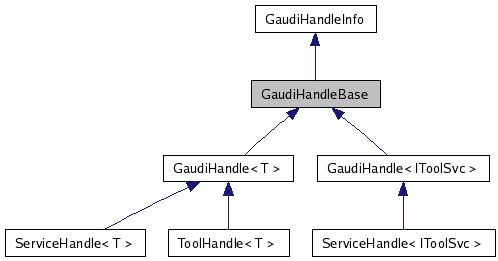
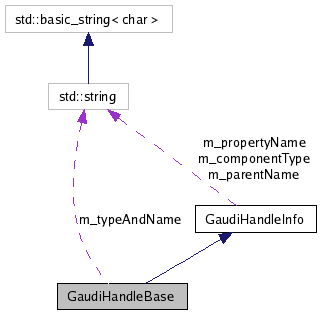
This allows better control through the framework of component loading, configuration and usage. This base class implements common features.
Definition at line 80 of file GaudiHandle.h.
Public Member Functions | |
| std::string | typeAndName () const |
| The full type and name: "type/name". | |
| std::string | type () const |
| The concrete component class name: the part before the '/'. | |
| std::string | name () const |
| The instance name: the part after the '/'. | |
| bool | empty () const |
| Check if the handle has been set to empty string (i.e. | |
| void | setTypeAndName (const std::string &myTypeAndName) |
| The component "type/name" string. | |
| void | setName (const std::string &myName) |
| Set the instance name (part after the '/') without changing the class type. | |
| const std::string | pythonPropertyClassName () const |
| Name of the componentType with "Handle" appended. | |
| const std::string | messageName () const |
| name used for printing messages | |
| virtual const std::string | pythonRepr () const |
| Python representation of handle, i.e. | |
Protected Member Functions | |
| GaudiHandleBase (const std::string &myTypeAndName, const std::string &myComponentType, const std::string &myParentName) | |
| Create a handle ('smart pointer') to a gaudi component. | |
Private Attributes | |
| std::string | m_typeAndName |
| GaudiHandleBase::GaudiHandleBase | ( | const std::string & | myTypeAndName, | |
| const std::string & | myComponentType, | |||
| const std::string & | myParentName | |||
| ) | [inline, protected] |
Create a handle ('smart pointer') to a gaudi component.
| myTypeAndName,: | "MyType/MyName" ("MyType" is short for "MyType/MyType") 'MyType' is the name of the concrete class of the component 'MyName' is to distinguish several instances of the same concrete class | |
| myComponentType,: | string indicating what type of component the handle is pointing to. For example: "PublicTool", "PrivateTool", "Service". This is used for printout and on the python side for type checking. On the python side there are classes with these names with "Handle" appended: PublicToolHandle,PrivateToolHandle,ServiceHandle | |
| myParentName,: | Name of the parent that has this handle as a member. Used in printout. |
Definition at line 96 of file GaudiHandle.h.
00098     : GaudiHandleInfo(myComponentType,myParentName)
00099   {
00100     setTypeAndName(myTypeAndName);
00101   }
| std::string GaudiHandleBase::typeAndName | ( | ) | const [inline] |
The full type and name: "type/name".
Definition at line 107 of file GaudiHandle.h.
00107                                 {
00108      return m_typeAndName;
00109   }
| std::string GaudiHandleBase::type | ( | ) | const |
The concrete component class name: the part before the '/'.
Definition at line 13 of file GaudiHandle.cpp.
00013                                       {
00014   std::string::size_type slash = m_typeAndName.find('/');
00015   if ( slash != std::string::npos ) {
00016     // return only part before /
00017     return m_typeAndName.substr(0,slash);
00018   } else {
00019     // return full string
00020     return m_typeAndName;
00021   }
00022 }
| std::string GaudiHandleBase::name | ( | ) | const |
The instance name: the part after the '/'.
Definition at line 24 of file GaudiHandle.cpp.
00024                                       {
00025   std::string::size_type slash = m_typeAndName.find('/');
00026   if ( slash == std::string::npos ) {
00027     // only type is given, or string is empty.
00028     // return default name (=type or empty, in this case full string)
00029     return m_typeAndName;
00030   } else if ( slash != m_typeAndName.length() -1 ) {
00031     // an explicit name is given, so return it
00032     return m_typeAndName.substr(slash+1);
00033   } else {
00034     // ends with /, i.e. explicit empty name.
00035     // Should probably never happen.
00036     return "";
00037   }
00038 }
| bool GaudiHandleBase::empty | ( | void | ) | const [inline] |
Check if the handle has been set to empty string (i.e.
typeAndName string is empty).
Definition at line 118 of file GaudiHandle.h.
00118                      {
00119     return m_typeAndName.empty();
00120   }
| void GaudiHandleBase::setTypeAndName | ( | const std::string & | myTypeAndName | ) |
The component "type/name" string.
Definition at line 9 of file GaudiHandle.cpp.
00009                                                                      {
00010   m_typeAndName = myTypeAndName;
00011 }
| void GaudiHandleBase::setName | ( | const std::string & | myName | ) |
Set the instance name (part after the '/') without changing the class type.
Definition at line 40 of file GaudiHandle.cpp.
00040                                                        {
00041   m_typeAndName = type() + '/' + myName;
00042 }
| const std::string GaudiHandleBase::pythonPropertyClassName | ( | ) | const [virtual] |
Name of the componentType with "Handle" appended.
Used as the python class name for the property in the genconf-generated configurables. The python class is defined in GaudiPython/python/GaudiHandles.py.
Implements GaudiHandleInfo.
Definition at line 44 of file GaudiHandle.cpp.
00044                                                                {
00045   return componentType() + "Handle";
00046 }
| const std::string GaudiHandleBase::messageName | ( | ) | const |
name used for printing messages
Definition at line 48 of file GaudiHandle.cpp.
00048                                                    {
00049   std::string propName = propertyName();
00050   if ( propName.empty() ) {
00051     propName = pythonPropertyClassName() + "('" + m_typeAndName + "')";
00052   }
00053   return parentName() + "." + propName;
00054 }
| const std::string GaudiHandleBase::pythonRepr | ( | ) | const [virtual] |
Python representation of handle, i.e.
python class name and argument. Can be used in the genconf-generated configurables. The corresponding python classes are defined in GaudiPython/GaudiHandles.py
Implements GaudiHandleInfo.
Definition at line 56 of file GaudiHandle.cpp.
00056                                                   {
00057   return pythonPropertyClassName() + "('" + m_typeAndName + "')";
00058 }
std::string GaudiHandleBase::m_typeAndName [private] |
Definition at line 145 of file GaudiHandle.h.