
|
Gaudi Framework, version v21r7p1 |
| Home | Generated: 15 Feb 2010 |
|
|
Gaudi Framework, version v21r7p1 |
| Home | Generated: 15 Feb 2010 |
#include <GaudiKernel/Algorithm.h>
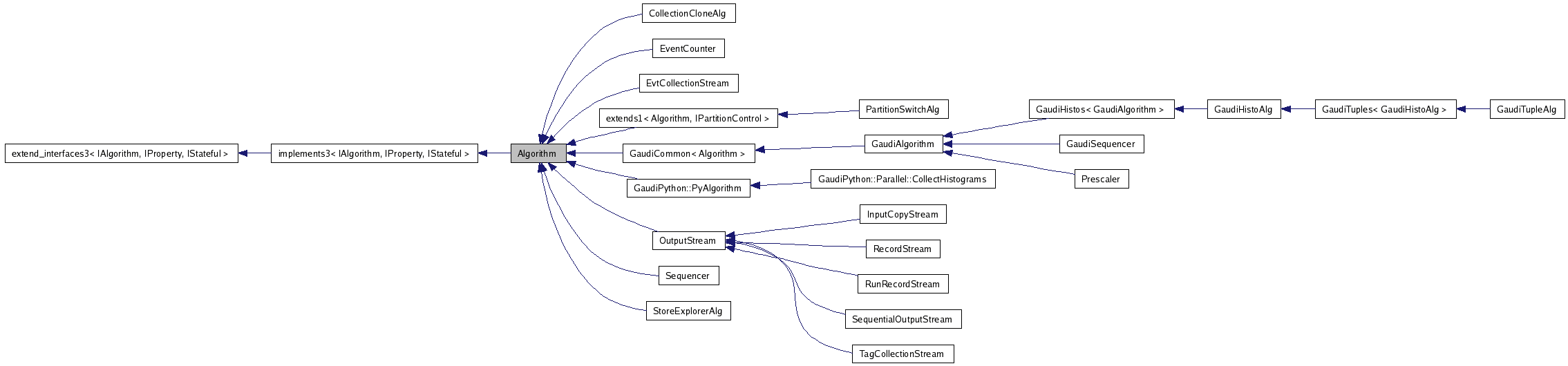
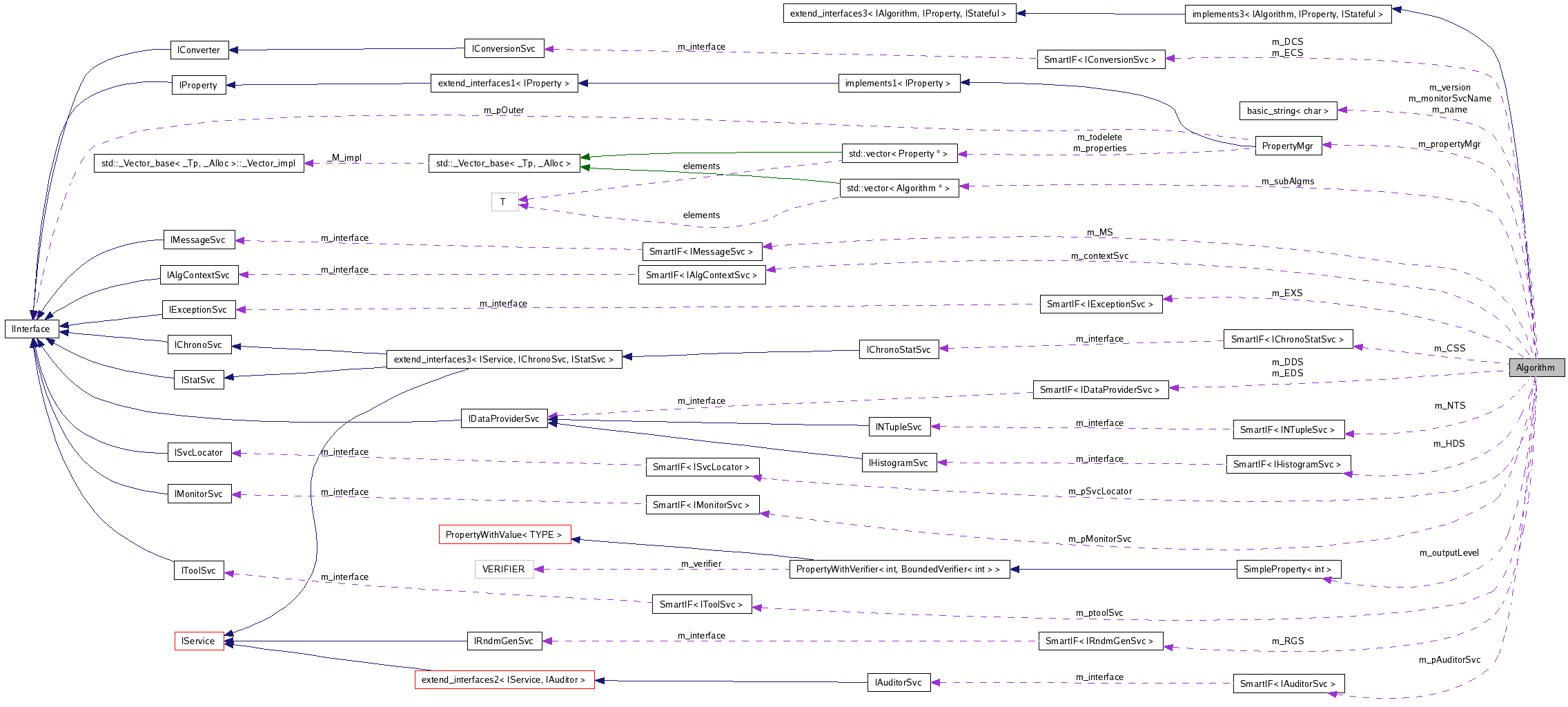
Public Member Functions | |
| Algorithm (const std::string &name, ISvcLocator *svcloc, const std::string &version=PACKAGE_VERSION) | |
| Constructor. | |
| virtual | ~Algorithm () |
| Destructor. | |
| virtual StatusCode | sysStart () |
| Reinitialization method invoked by the framework. | |
| virtual StatusCode | sysInitialize () |
| Initialization method invoked by the framework. | |
| virtual StatusCode | sysReinitialize () |
| Reinitialization method invoked by the framework. | |
| virtual StatusCode | sysRestart () |
| Restart method invoked by the framework. | |
| virtual StatusCode | sysExecute () |
| The actions to be performed by the algorithm on an event. | |
| virtual StatusCode | sysStop () |
| System stop. | |
| virtual StatusCode | sysFinalize () |
| System finalization. | |
| virtual StatusCode | sysBeginRun () |
| beginRun method invoked by the framework. | |
| virtual StatusCode | sysEndRun () |
| endRun method invoked by the framework. | |
| virtual const std::string & | name () const |
| The identifying name of the algorithm object. | |
| virtual const std::string & | version () const |
| virtual StatusCode | configure () |
| Dummy implementation of IStateful::configure() method. | |
| virtual StatusCode | terminate () |
| Dummy implementation of IStateful::terminate() method. | |
| virtual StatusCode | initialize () |
| the default (empty) implementation of IStateful::initialize() method | |
| virtual StatusCode | start () |
| the default (empty) implementation of IStateful::start() method | |
| virtual StatusCode | stop () |
| the default (empty) implementation of IStateful::stop() method | |
| virtual StatusCode | finalize () |
| the default (empty) implementation of IStateful::finalize() method | |
| virtual StatusCode | reinitialize () |
| the default (empty) implementation of IStateful::reinitialize() method | |
| virtual StatusCode | restart () |
| the default (empty) implementation of IStateful::restart() method | |
| virtual bool | isExecuted () const |
| Has this algorithm been executed since the last reset? | |
| virtual void | setExecuted (bool state) |
| Set the executed flag to the specified state. | |
| virtual void | resetExecuted () |
| Reset the executed state of the Algorithm for the duration of the current event. | |
| virtual StatusCode | beginRun () |
| Algorithm begin run. | |
| virtual StatusCode | endRun () |
| Algorithm end run. This method is called at the end of the event loop. | |
| virtual Gaudi::StateMachine::State | FSMState () const |
| returns the current state of the algorithm | |
| virtual Gaudi::StateMachine::State | targetFSMState () const |
| returns the state the algorithm will be in after the ongoing transition | |
| virtual bool | isEnabled () const |
| Is this algorithm enabled or disabled? | |
| virtual bool | filterPassed () const |
| Did this algorithm pass or fail its filter criterion for the last event? | |
| virtual void | setFilterPassed (bool state) |
| Set the filter passed flag to the specified state. | |
| template<class T> | |
| StatusCode | service (const std::string &name, T *&psvc, bool createIf=true) const |
| Access a service by name, creating it if it doesn't already exist. | |
| template<class T> | |
| StatusCode | service (const std::string &svcType, const std::string &svcName, T *&psvc) const |
| Access a service by name and type, creating it if it doesn't already exist. | |
| SmartIF< IService > | service (const std::string &name, const bool createIf=true, const bool quiet=false) const |
| Return a pointer to the service identified by name (or "type/name"). | |
| void | setOutputLevel (int level) |
| Set the output level for current algorithm. | |
| SmartIF< IAuditorSvc > & | auditorSvc () const |
| The standard auditor service.May not be invoked before sysInitialize() has been invoked. | |
| SmartIF< IChronoStatSvc > & | chronoSvc () const |
| The standard Chrono & Stat service, Return a pointer to the service if present. | |
| SmartIF< IChronoStatSvc > & | chronoStatService () const |
| Obsoleted name, kept due to the backwards compatibility. | |
| SmartIF< IDataProviderSvc > & | detSvc () const |
| The standard detector data service. | |
| SmartIF< IDataProviderSvc > & | detDataService () const |
| Obsoleted name, kept due to the backwards compatibility. | |
| SmartIF< IConversionSvc > & | detCnvSvc () const |
| The standard detector data persistency conversion service. | |
| SmartIF< IConversionSvc > & | detDataCnvService () const |
| Obsoleted name, kept due to the backwards compatibility. | |
| SmartIF< IDataProviderSvc > & | eventSvc () const |
| The standard event data service. | |
| SmartIF< IDataProviderSvc > & | evtSvc () const |
| shortcut for method eventSvc | |
| SmartIF< IDataProviderSvc > & | eventDataService () const |
| Obsoleted name, kept due to the backwards compatibility. | |
| SmartIF< IConversionSvc > & | eventCnvSvc () const |
| The standard event data persistency conversion service. | |
| SmartIF< IConversionSvc > & | eventDataCnvService () const |
| Obsoleted name, kept due to the backwards compatibility. | |
| SmartIF< IHistogramSvc > & | histoSvc () const |
| The standard histogram service. | |
| SmartIF< IHistogramSvc > & | histogramDataService () const |
| Obsoleted name, kept due to the backwards compatibility. | |
| SmartIF< IMessageSvc > & | msgSvc () const |
| The standard message service. | |
| SmartIF< IMessageSvc > & | messageService () const |
| Obsoleted name, kept due to the backwards compatibility. | |
| SmartIF< INTupleSvc > & | ntupleSvc () const |
| The standard N tuple service. | |
| SmartIF< INTupleSvc > & | ntupleService () const |
| Obsoleted name, kept due to the backwards compatibility. | |
| SmartIF< IRndmGenSvc > & | randSvc () const |
| AIDA-based NTuple service Returns a pointer to the AIDATuple service if present. | |
| SmartIF< IToolSvc > & | toolSvc () const |
| The standard ToolSvc service, Return a pointer to the service if present. | |
| SmartIF< IExceptionSvc > & | exceptionSvc () const |
| Get the exception Service. | |
| SmartIF< IAlgContextSvc > & | contextSvc () const |
| get Algorithm Context Service | |
| SmartIF< ISvcLocator > & | serviceLocator () const |
| The standard service locator. | |
| SmartIF< ISvcLocator > & | svcLoc () const |
| shortcut for method serviceLocator | |
| bool | registerContext () const |
| register for Algorithm Context Service? | |
| StatusCode | createSubAlgorithm (const std::string &type, const std::string &name, Algorithm *&pSubAlg) |
| Create a sub algorithm. | |
| std::vector< Algorithm * > * | subAlgorithms () const |
| List of sub-algorithms. Returns a pointer to a vector of (sub) Algorithms. | |
| virtual StatusCode | setProperty (const Property &p) |
| Implementation of IProperty::setProperty. | |
| virtual StatusCode | setProperty (const std::string &s) |
| Implementation of IProperty::setProperty. | |
| virtual StatusCode | setProperty (const std::string &n, const std::string &v) |
| Implementation of IProperty::setProperty. | |
| virtual StatusCode | getProperty (Property *p) const |
| Implementation of IProperty::getProperty. | |
| virtual const Property & | getProperty (const std::string &name) const |
| Implementation of IProperty::getProperty. | |
| virtual StatusCode | getProperty (const std::string &n, std::string &v) const |
| Implementation of IProperty::getProperty. | |
| virtual const std::vector < Property * > & | getProperties () const |
| Implementation of IProperty::getProperties. | |
| StatusCode | setProperties () |
| Set the algorithm's properties. | |
| template<class T> | |
| Property * | declareProperty (const std::string &name, T &property, const std::string &doc="none") const |
| Declare the named property. | |
| Property * | declareRemoteProperty (const std::string &name, IProperty *rsvc, const std::string &rname="") const |
| Declare remote named properties. | |
| SmartIF< IMonitorSvc > & | monitorSvc () const |
| Access the monitor service. | |
| template<class T> | |
| void | declareInfo (const std::string &name, const T &var, const std::string &desc) const |
| Declare monitoring information. | |
| void | declareInfo (const std::string &name, const std::string &format, const void *var, int size, const std::string &desc) const |
| Declare monitoring information (special case). | |
| template<class TYPE> | |
| StatusCode | setProperty (const std::string &name, const TYPE &value) |
| set the property form the value | |
Protected Member Functions | |
| bool | isInitialized () const |
| Has the Algorithm already been initialized? | |
| bool | isFinalized () const |
| Has the Algorithm already been finalized? | |
| int | outputLevel () const |
| retrieve the Algorithm output level | |
| IntegerProperty & | outputLevelProperty () |
| Accessor for the Message level property. | |
| void | initOutputLevel (Property &prop) |
| callback for output level property | |
Private Member Functions | |
| StatusCode | service_i (const std::string &svcName, bool createIf, const InterfaceID &iid, void **ppSvc) const |
| implementation of service method | |
| StatusCode | service_i (const std::string &svcType, const std::string &svcName, const InterfaceID &iid, void **ppSvc) const |
| Algorithm (const Algorithm &a) | |
| Private Copy constructor: NO COPY ALLOWED. | |
| Algorithm & | operator= (const Algorithm &rhs) |
| Private assignment operator: NO ASSIGNMENT ALLOWED. | |
Private Attributes | |
| std::string | m_name |
| Algorithm's name for identification. | |
| std::string | m_version |
| Algorithm's version. | |
| std::vector< Algorithm * > * | m_subAlgms |
| Sub algorithms. | |
| SmartIF< IMessageSvc > | m_MS |
| Message service. | |
| SmartIF< IDataProviderSvc > | m_EDS |
| Event data service. | |
| SmartIF< IConversionSvc > | m_ECS |
| Event conversion service. | |
| SmartIF< IDataProviderSvc > | m_DDS |
| Detector data service. | |
| SmartIF< IConversionSvc > | m_DCS |
| Detector conversion service. | |
| SmartIF< IHistogramSvc > | m_HDS |
| Histogram data service. | |
| SmartIF< INTupleSvc > | m_NTS |
| N tuple service. | |
| SmartIF< IChronoStatSvc > | m_CSS |
| Chrono & Stat Service. | |
| SmartIF< IRndmGenSvc > | m_RGS |
| Random Number Generator Service. | |
| SmartIF< IExceptionSvc > | m_EXS |
| Exception Handler Service. | |
| SmartIF< IAuditorSvc > | m_pAuditorSvc |
| Auditor Service. | |
| SmartIF< IToolSvc > | m_ptoolSvc |
| ToolSvc Service. | |
| SmartIF< IMonitorSvc > | m_pMonitorSvc |
| Online Monitoring Service. | |
| SmartIF< IAlgContextSvc > | m_contextSvc |
| Algorithm Context Service. | |
| bool | m_registerContext |
| flag to register for Algorithm Context Service | |
| std::string | m_monitorSvcName |
| Name to use for Monitor Service. | |
| SmartIF< ISvcLocator > | m_pSvcLocator |
| Pointer to service locator service. | |
| PropertyMgr * | m_propertyMgr |
| For management of properties. | |
| IntegerProperty | m_outputLevel |
| Algorithm output level. | |
| int | m_errorMax |
| Algorithm Max number of errors. | |
| int | m_errorCount |
| Algorithm error counter. | |
| BooleanProperty | m_auditInit |
| global flag for auditors | |
| bool | m_auditorInitialize |
| flag for auditors in "initialize()" | |
| bool | m_auditorReinitialize |
| flag for auditors in "Reinitialize()" | |
| bool | m_auditorRestart |
| flag for auditors in "Restart()" | |
| bool | m_auditorExecute |
| flag for auditors in "execute()" | |
| bool | m_auditorFinalize |
| flag for auditors in "finalize()" | |
| bool | m_auditorBeginRun |
| flag for auditors in "beginRun()" | |
| bool | m_auditorEndRun |
| flag for auditors in "endRun()" | |
| bool | m_auditorStart |
| flag for auditors in "initialize()" | |
| bool | m_auditorStop |
| flag for auditors in "Reinitialize()" | |
| bool | m_filterPassed |
| Filter passed flag. | |
| bool | m_isEnabled |
| Algorithm is enabled flag. | |
| bool | m_isExecuted |
| Algorithm is executed flag. | |
| Gaudi::StateMachine::State | m_state |
| Algorithm has been initialized flag. | |
| Gaudi::StateMachine::State | m_targetState |
| Algorithm has been initialized flag. | |
| bool | m_isFinalized |
| Algorithm has been finalized flag. | |
In order for a concrete algorithm class to do anything useful the methods initialize(), execute() and finalize() should be overridden.
The base class provides utility methods for accessing standard services (event data service etc.); for declaring properties which may be configured by the job options service; and for creating sub algorithms. The only base class functionality which may be used in the constructor of a concrete algorithm is the declaration of member variables as properties. All other functionality, i.e. the use of services and the creation of sub-algorithms, may be used only in initialize() and afterwards (see the Gaudi user guide).
Definition at line 62 of file Algorithm.h.
| Algorithm::Algorithm | ( | const std::string & | name, | |
| ISvcLocator * | svcloc, | |||
| const std::string & | version = PACKAGE_VERSION | |||
| ) |
Constructor.
| name | The algorithm object's name | |
| svcloc | A pointer to a service location service |
Definition at line 29 of file Algorithm.cpp.
00031   : m_name(name),
00032     m_version(version),
00033     m_registerContext ( false ) ,
00034     m_pSvcLocator(pSvcLocator),
00035     m_filterPassed(true),
00036     m_isEnabled(true),
00037     m_isExecuted(false),
00038     m_state(Gaudi::StateMachine::CONFIGURED),
00039     m_targetState(Gaudi::StateMachine::CONFIGURED)
00040 {
00041   m_propertyMgr = new PropertyMgr();
00042   m_subAlgms = new std::vector<Algorithm *>();
00043
00044   // Declare common Algorithm properties with their defaults
00045   declareProperty( "OutputLevel",        m_outputLevel = MSG::NIL);
00046   declareProperty( "Enable",             m_isEnabled = true);
00047   declareProperty( "ErrorMax",           m_errorMax  = 1);
00048   declareProperty( "ErrorCount",         m_errorCount = 0);
00049   // Auditor monitoring properties
00050
00051   // Get the default setting for service auditing from the AppMgr
00052   declareProperty( "AuditAlgorithms", m_auditInit );
00053
00054   bool audit(false);
00055   SmartIF<IProperty> appMgr(serviceLocator()->service("ApplicationMgr"));
00056   if (appMgr.isValid()) {
00057     const Property& prop = appMgr->getProperty("AuditAlgorithms");
00058     Property &pr = const_cast<Property&>(prop);
00059     if (m_name != "IncidentSvc") {
00060       setProperty( pr ).ignore();
00061     }
00062     audit = m_auditInit.value();
00063   }
00064
00065   declareProperty( "AuditInitialize"  , m_auditorInitialize   = audit ) ;
00066   declareProperty( "AuditReinitialize", m_auditorReinitialize = audit ) ;
00067   declareProperty( "AuditRestart"     , m_auditorRestart      = audit ) ;
00068   declareProperty( "AuditExecute"     , m_auditorExecute      = audit ) ;
00069   declareProperty( "AuditFinalize"    , m_auditorFinalize     = audit ) ;
00070   declareProperty( "AuditBeginRun"    , m_auditorBeginRun     = audit ) ;
00071   declareProperty( "AuditEndRun"      , m_auditorEndRun       = audit ) ;
00072   declareProperty( "AuditStart"       , m_auditorStart        = audit ) ;
00073   declareProperty( "AuditStop"        , m_auditorStop         = audit ) ;
00074
00075   declareProperty( "MonitorService"   , m_monitorSvcName      = "MonitorSvc" );
00076
00077   declareProperty
00078     ( "RegisterForContextService" ,
00079       m_registerContext  ,
00080       "The flag to enforce the registration for Algorithm Context Service") ;
00081
00082   // update handlers.
00083   m_outputLevel.declareUpdateHandler(&Algorithm::initOutputLevel, this);
00084
00085 }
| Algorithm::~Algorithm | ( | ) | [virtual] |
Destructor.
Definition at line 88 of file Algorithm.cpp.
00088                       {
00089   delete m_subAlgms;
00090   delete m_propertyMgr;
00091 }
| Algorithm::Algorithm | ( | const Algorithm & | a | ) | [private] |
Private Copy constructor: NO COPY ALLOWED.
| StatusCode Algorithm::sysStart | ( | ) | [virtual] |
Reinitialization method invoked by the framework.
This method is responsible for any reinitialization required by the framework itself. It will in turn invoke the reinitialize() method of the derived algorithm, and of any sub-algorithms which it creates.
Definition at line 180 of file Algorithm.cpp.
00180                                {
00181
00182   // Bypass the startup if already running or disabled.
00183   if ( Gaudi::StateMachine::RUNNING == FSMState() ||
00184        !isEnabled() ) return StatusCode::SUCCESS;
00185
00186   m_targetState = Gaudi::StateMachine::ChangeState(Gaudi::StateMachine::START,m_state);
00187
00188   // TODO: (MCl) where shoud we do this? initialize or start?
00189   // Reset Error count
00190   m_errorCount = 0;
00191
00192   // lock the context service
00193   Gaudi::Utils::AlgContext cnt
00194     ( this , registerContext() ? contextSvc().get() : 0 ) ;
00195
00196   StatusCode sc;
00197   // Invoke start() method of the derived class inside a try/catch clause
00198   try
00199   {
00200     { // limit the scope of the guard
00201       Gaudi::Guards::AuditorGuard guard
00202         (this,
00203          // check if we want to audit the initialize
00204          (m_auditorStart) ? auditorSvc().get() : 0,
00205          IAuditor::Start);
00206       // Invoke the start() method of the derived class
00207       sc = start();
00208     }
00209     if( sc.isFailure() ) return StatusCode::FAILURE;
00210
00211     // Now start any sub-algorithms
00212     std::vector<Algorithm *>::iterator it;
00213     StatusCode result = StatusCode::SUCCESS;
00214     for (it = m_subAlgms->begin(); it != m_subAlgms->end(); it++) {
00215       sc = (*it)->sysStart();
00216       if( sc.isFailure() ) result = sc;
00217     }
00218     if( result.isFailure() ) {
00219       MsgStream log ( msgSvc() , name() );
00220       log << MSG::ERROR << " Error starting one or several sub-algorithms"
00221           << endmsg;
00222       return result;
00223     }
00224     // Update the state.
00225     m_state = m_targetState;
00226     return StatusCode::SUCCESS;
00227   }
00228   catch ( const GaudiException& Exception )
00229   {
00230     MsgStream log ( msgSvc() , name() );
00231     log << MSG::FATAL << "in sysStart(): exception with tag=" << Exception.tag()
00232         << " is caught" << endmsg;
00233     log << MSG::ERROR << Exception << endmsg;
00234     Stat stat( chronoSvc() , Exception.tag() );
00235   }
00236   catch( const std::exception& Exception )
00237   {
00238     MsgStream log ( msgSvc() , name() );
00239     log << MSG::FATAL << "in sysStart(): standard std::exception is caught" << endmsg;
00240     log << MSG::ERROR << Exception.what()  << endmsg;
00241     Stat stat( chronoSvc() , "*std::exception*" );
00242   }
00243   catch(...)
00244   {
00245     MsgStream log ( msgSvc() , name() );
00246     log << MSG::FATAL << "in sysStart(): UNKNOWN Exception is caught" << endmsg;
00247     Stat stat( chronoSvc() , "*UNKNOWN Exception*" ) ;
00248   }
00249
00250   return StatusCode::FAILURE;
00251 }
| StatusCode Algorithm::sysInitialize | ( | ) | [virtual] |
Initialization method invoked by the framework.
This method is responsible for any bookkeeping of initialization required by the framework itself. It will in turn invoke the initialize() method of the derived algorithm, and of any sub-algorithms which it creates.
Definition at line 94 of file Algorithm.cpp.
00094                                     {
00095
00096   // Bypass the initialization if the algorithm
00097   // has already been initialized.
00098   if ( Gaudi::StateMachine::INITIALIZED <= FSMState() ) return StatusCode::SUCCESS;
00099
00100   // Set the Algorithm's properties
00101   StatusCode sc = setProperties();
00102   if( sc.isFailure() ) return StatusCode::FAILURE;
00103
00104   // Bypass the initialization if the algorithm is disabled.
00105   // Need to do this after setProperties.
00106   if ( !isEnabled( ) ) return StatusCode::SUCCESS;
00107
00108   m_targetState = Gaudi::StateMachine::ChangeState(Gaudi::StateMachine::INITIALIZE,m_state);
00109
00110   // Check current outputLevel to evetually inform the MessagsSvc
00111   //if( m_outputLevel != MSG::NIL ) {
00112   setOutputLevel( m_outputLevel );
00113   //}
00114
00115   // TODO: (MCl) where shoud we do this? initialize or start?
00116   // Reset Error count
00117   //m_errorCount = 0;
00118
00119   // lock the context service
00120   Gaudi::Utils::AlgContext cnt
00121     ( this , registerContext() ? contextSvc().get() : 0 ) ;
00122
00123   // Invoke initialize() method of the derived class inside a try/catch clause
00124   try {
00125
00126     { // limit the scope of the guard
00127       Gaudi::Guards::AuditorGuard guard
00128         ( this,
00129           // check if we want to audit the initialize
00130           (m_auditorInitialize) ? auditorSvc().get() : 0,
00131           IAuditor::Initialize);
00132       // Invoke the initialize() method of the derived class
00133       sc = initialize();
00134     }
00135     if( sc.isFailure() ) return StatusCode::FAILURE;
00136
00137     // Now initialize care of any sub-algorithms
00138     std::vector<Algorithm *>::iterator it;
00139     StatusCode result = StatusCode::SUCCESS;
00140     for (it = m_subAlgms->begin(); it != m_subAlgms->end(); it++) {
00141       sc = (*it)->sysInitialize();
00142       if( sc.isFailure() ) result = sc;
00143     }
00144     if( result.isFailure() ) {
00145       MsgStream log ( msgSvc() , name() );
00146       log << MSG::ERROR << " Error initializing one or several sub-algorithms"
00147           << endmsg;
00148       return result;
00149     }
00150     // Update the state.
00151     m_state = m_targetState;
00152     return StatusCode::SUCCESS;
00153   }
00154   catch ( const GaudiException& Exception )
00155   {
00156     MsgStream log ( msgSvc() , name() ) ;
00157     log << MSG::FATAL << " Exception with tag=" << Exception.tag()
00158         << " is caught " << endmsg;
00159     log << MSG::ERROR << Exception  << endmsg;
00160     Stat stat( chronoSvc() , Exception.tag() );
00161   }
00162   catch( const std::exception& Exception )
00163   {
00164     MsgStream log ( msgSvc() , name() ) ;
00165     log << MSG::FATAL << " Standard std::exception is caught " << endmsg;
00166     log << MSG::ERROR << Exception.what()  << endmsg;
00167     Stat stat( chronoSvc() , "*std::exception*" );
00168   }
00169   catch(...)
00170   {
00171     MsgStream log ( msgSvc() , name() ) ;
00172     log << MSG::FATAL << "UNKNOWN Exception is caught " << endmsg;
00173     Stat stat( chronoSvc() , "*UNKNOWN Exception*" ) ;
00174   }
00175
00176   return StatusCode::FAILURE;
00177 }
| StatusCode Algorithm::sysReinitialize | ( | ) | [virtual] |
Reinitialization method invoked by the framework.
This method is responsible for any reinitialization required by the framework itself. It will in turn invoke the reinitialize() method of the derived algorithm, and of any sub-algorithms which it creates.
Definition at line 254 of file Algorithm.cpp.
00254                                       {
00255
00256   // Bypass the initialization if the algorithm is disabled.
00257   if ( !isEnabled( ) ) return StatusCode::SUCCESS;
00258
00259   // Check that the current status is the correct one.
00260   if ( Gaudi::StateMachine::INITIALIZED != FSMState() ) {
00261     MsgStream log ( msgSvc() , name() );
00262     log << MSG::ERROR
00263         << "sysReinitialize(): cannot reinitialize algorithm not initialized"
00264         << endmsg;
00265     return StatusCode::FAILURE;
00266   }
00267
00268   // Check current outputLevel to evetually inform the MessagsSvc
00269   //if( m_outputLevel != MSG::NIL ) {
00270   setOutputLevel( m_outputLevel );
00271   //}
00272
00273   // Reset Error count
00274   // m_errorCount = 0; // done during start
00275
00276   // lock the context service
00277   Gaudi::Utils::AlgContext cnt
00278     ( this , registerContext() ? contextSvc().get() : 0 ) ;
00279
00280   StatusCode sc(StatusCode::SUCCESS,true);
00281   // Invoke reinitialize() method of the derived class inside a try/catch clause
00282   try {
00283     { // limit the scope of the guard
00284       Gaudi::Guards::AuditorGuard guard(this,
00285                                         // check if we want to audit the initialize
00286                                         (m_auditorReinitialize) ? auditorSvc().get() : 0,
00287                                         IAuditor::ReInitialize);
00288       // Invoke the reinitialize() method of the derived class
00289       sc = reinitialize();
00290     }
00291     if( sc.isFailure() ) return StatusCode::FAILURE;
00292
00293     // Now initialize care of any sub-algorithms
00294     std::vector<Algorithm *>::iterator it;
00295     StatusCode result = StatusCode::SUCCESS;
00296     for (it = m_subAlgms->begin(); it != m_subAlgms->end(); it++) {
00297       sc = (*it)->sysReinitialize();
00298       if( sc.isFailure() ) result = sc;
00299     }
00300     if( result.isFailure() )
00301     {
00302       MsgStream log ( msgSvc() , name() );
00303       log << MSG::ERROR
00304           << "sysReinitialize(): Error reinitializing one or several sub-algorithms"
00305           << endmsg;
00306       return result;
00307     }
00308     return StatusCode::SUCCESS;
00309   }
00310   catch ( const GaudiException& Exception )
00311   {
00312     MsgStream log ( msgSvc() , name() );
00313     log << MSG::FATAL << "sysReinitialize(): Exception with tag=" << Exception.tag()
00314         << " is caught" << endmsg;
00315     log << MSG::ERROR << Exception  << endmsg;
00316     Stat stat( chronoSvc() , Exception.tag() );
00317   }
00318   catch( const std::exception& Exception )
00319   {
00320     MsgStream log ( msgSvc() , name() );
00321     log << MSG::FATAL << "sysReinitialize(): Standard std::exception is caught" << endmsg;
00322     log << MSG::ERROR << Exception.what()  << endmsg;
00323     Stat stat( chronoSvc() , "*std::exception*" );
00324   }
00325   catch(...)
00326   {
00327     MsgStream log ( msgSvc() , name() );
00328     log << MSG::FATAL << "sysReinitialize(): UNKNOWN Exception is caught" << endmsg;
00329     Stat stat( chronoSvc() , "*UNKNOWN Exception*" ) ;
00330   }
00331
00332   return StatusCode::FAILURE;
00333 }
| StatusCode Algorithm::sysRestart | ( | ) | [virtual] |
Restart method invoked by the framework.
It will in turn invoke the restart() method of the derived algorithm, and of any sub-algorithms which it creates.
Definition at line 336 of file Algorithm.cpp.
00336                                  {
00337
00338   // Bypass the initialization if the algorithm is disabled.
00339   if ( !isEnabled( ) ) return StatusCode::SUCCESS;
00340
00341   // Check that the current status is the correct one.
00342   if ( Gaudi::StateMachine::RUNNING != FSMState() ) {
00343     MsgStream log ( msgSvc() , name() );
00344     log << MSG::ERROR
00345         << "sysRestart(): cannot restart algorithm not started"
00346         << endmsg;
00347     return StatusCode::FAILURE;
00348   }
00349
00350   // Check current outputLevel to evetually inform the MessagsSvc
00351   //if( m_outputLevel != MSG::NIL ) {
00352   setOutputLevel( m_outputLevel );
00353   //}
00354
00355   // Reset Error count
00356   m_errorCount = 0;
00357
00358   // lock the context service
00359   Gaudi::Utils::AlgContext cnt
00360     ( this , registerContext() ? contextSvc().get() : 0 ) ;
00361
00362   StatusCode sc(StatusCode::SUCCESS,true);
00363   // Invoke reinitialize() method of the derived class inside a try/catch clause
00364   try {
00365     { // limit the scope of the guard
00366       Gaudi::Guards::AuditorGuard guard(this,
00367                                         // check if we want to audit the initialize
00368                                         (m_auditorRestart) ? auditorSvc().get() : 0,
00369                                         IAuditor::ReStart);
00370       // Invoke the reinitialize() method of the derived class
00371       sc = restart();
00372     }
00373     if( sc.isFailure() ) return StatusCode::FAILURE;
00374
00375     // Now initialize care of any sub-algorithms
00376     std::vector<Algorithm *>::iterator it;
00377     StatusCode result = StatusCode::SUCCESS;
00378     for (it = m_subAlgms->begin(); it != m_subAlgms->end(); it++) {
00379       sc = (*it)->sysRestart();
00380       if( sc.isFailure() ) result = sc;
00381     }
00382     if( result.isFailure() ) {
00383       MsgStream log ( msgSvc() , name() );
00384       log << MSG::ERROR
00385           << "sysRestart(): Error restarting one or several sub-algorithms"
00386           << endmsg;
00387       return result;
00388     }
00389     return StatusCode::SUCCESS;
00390   }
00391   catch ( const GaudiException& Exception )
00392   {
00393     MsgStream log ( msgSvc() , name() );
00394     log << MSG::FATAL << "sysRestart(): Exception with tag=" << Exception.tag()
00395         << " is caught" << endmsg;
00396     log << MSG::ERROR << Exception  << endmsg;
00397     Stat stat( chronoSvc() , Exception.tag() );
00398   }
00399   catch( const std::exception& Exception )
00400   {
00401     MsgStream log ( msgSvc() , name() );
00402     log << MSG::FATAL << "sysRestart(): Standard std::exception is caught" << endmsg;
00403     log << MSG::ERROR << Exception.what()  << endmsg;
00404     Stat stat( chronoSvc() , "*std::exception*" );
00405   }
00406   catch(...)
00407   {
00408     MsgStream log ( msgSvc() , name() );
00409     log << MSG::FATAL << "sysRestart(): UNKNOWN Exception is caught" << endmsg;
00410     Stat stat( chronoSvc() , "*UNKNOWN Exception*" ) ;
00411   }
00412
00413   return StatusCode::FAILURE;
00414 }
| StatusCode Algorithm::sysExecute | ( | ) | [virtual] |
The actions to be performed by the algorithm on an event.
This method is invoked once per event for top level algorithms by the application manager. This method invokes execute() method. For sub-algorithms either the sysExecute() method or execute() method must be EXPLICITLY invoked by the parent algorithm.
Reimplemented in GaudiAlgorithm.
Definition at line 567 of file Algorithm.cpp.
00567                                  {
00568   if (!isEnabled()) {
00569     MsgStream log ( msgSvc() , name() );
00570     log << MSG::VERBOSE << ".sysExecute(): is not enabled. Skip execution" <<endmsg;
00571     return StatusCode::SUCCESS;
00572   }
00573
00574   StatusCode status;
00575
00576   // Should performance profile be performed ?
00577   // invoke execute() method of Algorithm class
00578   //   and catch all uncaught exceptions
00579
00580   // lock the context service
00581   Gaudi::Utils::AlgContext cnt
00582     ( this , registerContext() ? contextSvc().get() : 0 ) ;
00583
00584   Gaudi::Guards::AuditorGuard guard(this,
00585                                     // check if we want to audit the initialize
00586                                     (m_auditorExecute) ? auditorSvc().get() : 0,
00587                                     IAuditor::Execute,
00588                                     status);
00589   try {
00590     status = execute();
00591     setExecuted(true);  // set the executed flag
00592
00593     if (status.isFailure()) {
00594       status = exceptionSvc()->handleErr(*this,status);
00595     }
00596
00597   }
00598   catch( const GaudiException& Exception )
00599   {
00600     setExecuted(true);  // set the executed flag
00601
00602     MsgStream log ( msgSvc() , name() );
00603     if (Exception.code() == StatusCode::FAILURE) {
00604       log << MSG::FATAL;
00605     } else {
00606       log << MSG::ERROR << " Recoverable";
00607     }
00608
00609     log << " Exception with tag=" << Exception.tag()
00610         << " is caught " << endmsg;
00611
00612     log << MSG::ERROR << Exception  << endmsg;
00613
00614     Stat stat( chronoSvc() , Exception.tag() ) ;
00615     status = exceptionSvc()->handle(*this,Exception);
00616   }
00617   catch( const std::exception& Exception )
00618   {
00619     setExecuted(true);  // set the executed flag
00620
00621     MsgStream log ( msgSvc() , name() );
00622     log << MSG::FATAL << " Standard std::exception is caught " << endmsg;
00623     log << MSG::ERROR << Exception.what()  << endmsg;
00624     Stat stat( chronoSvc() , "*std::exception*" ) ;
00625     status = exceptionSvc()->handle(*this,Exception);
00626   }
00627   catch(...)
00628   {
00629     setExecuted(true);  // set the executed flag
00630
00631     MsgStream log ( msgSvc() , name() );
00632     log << MSG::FATAL << "UNKNOWN Exception is caught " << endmsg;
00633     Stat stat( chronoSvc() , "*UNKNOWN Exception*" ) ;
00634
00635     status = exceptionSvc()->handle(*this);
00636   }
00637
00638   if( status.isFailure() ) {
00639     MsgStream log ( msgSvc() , name() );
00640     // Increment the error count
00641     m_errorCount++;
00642     // Check if maximum is exeeded
00643     if( m_errorCount < m_errorMax ) {
00644       log << MSG::WARNING << "Continuing from error (cnt=" << m_errorCount
00645           << ", max=" << m_errorMax << ")" << endmsg;
00646       // convert to success
00647       status = StatusCode::SUCCESS;
00648     }
00649   }
00650   return status;
00651 }
| StatusCode Algorithm::sysStop | ( | ) | [virtual] |
System stop.
This method invokes the stop() method of a concrete algorithm and the stop() methods of all of that algorithm's sub algorithms.
Definition at line 654 of file Algorithm.cpp.
00654                               {
00655
00656   // Bypass the startup if already running or disabled.
00657   if ( Gaudi::StateMachine::INITIALIZED == FSMState() ||
00658        !isEnabled() ) return StatusCode::SUCCESS;
00659
00660   m_targetState = Gaudi::StateMachine::ChangeState(Gaudi::StateMachine::STOP,m_state);
00661
00662   // lock the context service
00663   Gaudi::Utils::AlgContext cnt
00664     ( this , registerContext() ? contextSvc().get() : 0 ) ;
00665
00666   StatusCode sc;
00667   // Invoke stop() method of the derived class inside a try/catch clause
00668   try {
00669     // Stop first any sub-algorithms (in reverse order)
00670     std::vector<Algorithm *>::reverse_iterator it;
00671     for (it = m_subAlgms->rbegin(); it != m_subAlgms->rend(); it++) {
00672       (*it)->sysStop().ignore();
00673     }
00674     { // limit the scope of the guard
00675       Gaudi::Guards::AuditorGuard guard(this,
00676                                         // check if we want to audit the initialize
00677                                         (m_auditorStop) ? auditorSvc().get() : 0,
00678                                         IAuditor::Stop);
00679
00680       // Invoke the stop() method of the derived class
00681       sc = stop();
00682     }
00683     if( sc.isFailure() ) return StatusCode::FAILURE;
00684
00685     // Update the state.
00686     m_state = m_targetState;
00687     return StatusCode::SUCCESS;
00688   }
00689   catch ( const GaudiException& Exception )  {
00690     MsgStream log ( msgSvc() , name() );
00691     log << MSG::FATAL << "in sysStop(): exception with tag=" << Exception.tag()
00692         << " is caught" << endmsg;
00693     log << MSG::ERROR << Exception << endmsg;
00694     Stat stat( chronoSvc() , Exception.tag() );
00695   }
00696   catch( const std::exception& Exception ) {
00697     MsgStream log ( msgSvc() , name() );
00698     log << MSG::FATAL << "in sysStop(): standard std::exception is caught" << endmsg;
00699     log << MSG::ERROR << Exception.what()  << endmsg;
00700     Stat stat( chronoSvc() , "*std::exception*" );
00701   }
00702   catch(...) {
00703     MsgStream log ( msgSvc() , name() );
00704     log << MSG::FATAL << "in sysStop(): UNKNOWN Exception is caught" << endmsg;
00705     Stat stat( chronoSvc() , "*UNKNOWN Exception*" ) ;
00706   }
00707
00708   return StatusCode::FAILURE;
00709 }
| StatusCode Algorithm::sysFinalize | ( | ) | [virtual] |
System finalization.
This method invokes the finalize() method of a concrete algorithm and the finalize() methods of all of that algorithm's sub algorithms.
Definition at line 711 of file Algorithm.cpp.
00711                                   {
00712
00713   // Bypass the finalialization if the algorithm hasn't been initilized.
00714   if ( Gaudi::StateMachine::CONFIGURED == FSMState() ||
00715        !isEnabled() ) return StatusCode::SUCCESS;
00716
00717   m_targetState = Gaudi::StateMachine::ChangeState(Gaudi::StateMachine::FINALIZE,m_state);
00718
00719   // lock the context service
00720   Gaudi::Utils::AlgContext cnt
00721     ( this , registerContext() ? contextSvc().get() : 0 ) ;
00722
00723   // Invoke finalize() method of the derived class inside a try/catch clause
00724   StatusCode sc = StatusCode::SUCCESS;
00725   try {
00726     // Order changed (bug #3903 overview: finalize and nested algorithms)
00727     // Finalize first any sub-algoithms (it can be done more than once)
00728     std::vector<Algorithm *>::iterator it;
00729     bool fail(false);
00730     for (it = m_subAlgms->begin(); it != m_subAlgms->end(); it++) {
00731       if (!(*it)->sysFinalize().isSuccess()) {
00732         fail = true;
00733       }
00734     }
00735
00736     { // limit the scope of the guard
00737       Gaudi::Guards::AuditorGuard guard(this,
00738                                         // check if we want to audit the initialize
00739                                         (m_auditorFinalize) ? auditorSvc().get() : 0,
00740                                         IAuditor::Finalize);
00741       // Invoke the finalize() method of the derived class
00742       sc = finalize();
00743     }
00744     if( !sc.isSuccess() || fail )  return StatusCode::FAILURE;
00745
00746     // Release all sub-algorithms
00747     for (it = m_subAlgms->begin(); it != m_subAlgms->end(); it++) {
00748       (*it)->release();
00749     }
00750     // Indicate that this Algorithm has been finalized to prevent duplicate attempts
00751     m_state = m_targetState;
00752     return sc;
00753   }
00754   catch( const GaudiException& Exception )
00755   {
00756     MsgStream log ( msgSvc() , name() );
00757     log << MSG::FATAL << " Exception with tag=" << Exception.tag()
00758         << " is caught " << endmsg;
00759     log << MSG::ERROR << Exception  << endmsg;
00760     Stat stat( chronoSvc() , Exception.tag() ) ;
00761   }
00762   catch( const std::exception& Exception )
00763   {
00764     MsgStream log ( msgSvc() , name() );
00765     log << MSG::FATAL << " Standard std::exception is caught " << endmsg;
00766     log << MSG::ERROR << Exception.what()  << endmsg;
00767     Stat stat( chronoSvc() , "*std::exception*" ) ;
00768   }
00769   catch( ... )
00770   {
00771     MsgStream log ( msgSvc() , name() );
00772     log << MSG::FATAL << "UNKNOWN Exception is caught " << endmsg;
00773     Stat stat( chronoSvc() , "*UNKNOWN Exception*" ) ;
00774   }
00775   return StatusCode::FAILURE ;
00776 }
| StatusCode Algorithm::sysBeginRun | ( | ) | [virtual] |
beginRun method invoked by the framework.
This method is responsible for any beginRun actions required by the framework itself. It will in turn invoke the beginRun() method of the derived algorithm, and of any sub-algorithms which it creates.
Definition at line 417 of file Algorithm.cpp.
00417                                   {
00418
00419   // Bypass the beginRun if the algorithm is disabled.
00420   if ( !isEnabled( ) ) return StatusCode::SUCCESS;
00421
00422   // Check current outputLevel to evetually inform the MessagsSvc
00423   //if( m_outputLevel != MSG::NIL ) {
00424   setOutputLevel( m_outputLevel );
00425   //}
00426
00427   // Reset Error count
00428   m_errorCount = 0;
00429
00430   // lock the context service
00431   Gaudi::Utils::AlgContext cnt
00432     ( this , registerContext() ? contextSvc().get() : 0 ) ;
00433
00434   StatusCode sc;
00435   // Invoke beginRun() method of the derived class inside a try/catch clause
00436   try {
00437     { // limit the scope of the guard
00438       Gaudi::Guards::AuditorGuard guard(this,
00439                                         // check if we want to audit the initialize
00440                                         (m_auditorBeginRun) ? auditorSvc().get() : 0,
00441                                         IAuditor::BeginRun);
00442       // Invoke the beginRun() method of the derived class
00443       sc = beginRun();
00444     }
00445     if( sc.isFailure() ) return StatusCode::FAILURE;
00446
00447     // Now call beginRun for any sub-algorithms
00448     std::vector<Algorithm *>::iterator it;
00449     StatusCode result = StatusCode::SUCCESS;
00450     for (it = m_subAlgms->begin(); it != m_subAlgms->end(); it++) {
00451       sc = (*it)->sysBeginRun();
00452       if( sc.isFailure() ) result = sc;
00453     }
00454     if( result.isFailure() )
00455     {
00456       MsgStream log ( msgSvc() , name() );
00457       log << MSG::ERROR << " Error executing BeginRun for one or several sub-algorithms"
00458           << endmsg;
00459       return result;
00460     }
00461     return StatusCode::SUCCESS;
00462   }
00463   catch ( const GaudiException& Exception )
00464   {
00465     MsgStream log ( msgSvc() , name() );
00466     log << MSG::FATAL << " Exception with tag=" << Exception.tag()
00467         << " is caught " << endmsg;
00468     log << MSG::ERROR << Exception  << endmsg;
00469     Stat stat( chronoSvc() , Exception.tag() );
00470   }
00471   catch( const std::exception& Exception )
00472   {
00473     MsgStream log ( msgSvc() , name() );
00474     log << MSG::FATAL << " Standard std::exception is caught " << endmsg;
00475     log << MSG::ERROR << Exception.what()  << endmsg;
00476     Stat stat( chronoSvc() , "*std::exception*" );
00477   }
00478   catch(...)
00479   {
00480     MsgStream log ( msgSvc() , name() );
00481     log << MSG::FATAL << "UNKNOWN Exception is caught " << endmsg;
00482     Stat stat( chronoSvc() , "*UNKNOWN Exception*" ) ;
00483   }
00484   return StatusCode::FAILURE;
00485 }
| StatusCode Algorithm::sysEndRun | ( | ) | [virtual] |
endRun method invoked by the framework.
This method is responsible for any endRun actions required by the framework itself. It will in turn invoke the endRun() method of the derived algorithm, and of any sub-algorithms which it creates.
Definition at line 492 of file Algorithm.cpp.
00492                                 {
00493
00494   // Bypass the endRun if the algorithm is disabled.
00495   if ( !isEnabled( ) ) return StatusCode::SUCCESS;
00496
00497   // Check current outputLevel to eventually inform the MessagsSvc
00498   //if( m_outputLevel != MSG::NIL ) {
00499   setOutputLevel( m_outputLevel );
00500   //}
00501
00502   // Reset Error count
00503   m_errorCount = 0;
00504
00505   // lock the context service
00506   Gaudi::Utils::AlgContext cnt
00507     ( this , registerContext() ? contextSvc().get() : 0 ) ;
00508
00509   // Invoke endRun() method of the derived class inside a try/catch clause
00510   StatusCode sc;
00511   try {
00512     { // limit the scope of the guard
00513       Gaudi::Guards::AuditorGuard guard(this,
00514                                         // check if we want to audit the initialize
00515                                         (m_auditorEndRun) ? auditorSvc().get() : 0,
00516                                         IAuditor::EndRun);
00517       // Invoke the endRun() method of the derived class
00518       sc = endRun();
00519     }
00520     if( sc.isFailure() ) return StatusCode::FAILURE;
00521
00522     // Now call endRun for any sub-algorithms
00523     std::vector<Algorithm *>::iterator it;
00524     StatusCode result = StatusCode::SUCCESS;
00525     for (it = m_subAlgms->begin(); it != m_subAlgms->end(); it++) {
00526       sc = (*it)->sysEndRun();
00527       if( sc.isFailure() ) result = sc;
00528     }
00529     if( result.isFailure() )
00530     {
00531       MsgStream log ( msgSvc() , name() );
00532       log << MSG::ERROR << " Error calling endRun for one or several sub-algorithms"
00533           << endmsg;
00534       return result;
00535     }
00536     return StatusCode::SUCCESS;
00537   }
00538   catch ( const GaudiException& Exception )
00539   {
00540     MsgStream log ( msgSvc() , name() );
00541     log << MSG::FATAL << " Exception with tag=" << Exception.tag()
00542         << " is caught " << endmsg;
00543     log << MSG::ERROR << Exception  << endmsg;
00544     Stat stat( chronoSvc() , Exception.tag() );
00545   }
00546   catch( const std::exception& Exception )
00547   {
00548     MsgStream log ( msgSvc() , name() );
00549     log << MSG::FATAL << " Standard std::exception is caught " << endmsg;
00550     log << MSG::ERROR << Exception.what()  << endmsg;
00551     Stat stat( chronoSvc() , "*std::exception*" );
00552   }
00553   catch(...)
00554   {
00555     MsgStream log ( msgSvc() , name() );
00556     log << MSG::FATAL << "UNKNOWN Exception is caught " << endmsg;
00557     Stat stat( chronoSvc() , "*UNKNOWN Exception*" ) ;
00558   }
00559   return StatusCode::FAILURE;
00560 }
| const std::string & Algorithm::name | ( | ) | const [virtual] |
The identifying name of the algorithm object.
This is the name of a particular instantiation of an algorithm object as opposed to the name of the algorithm itself, e.g. "LinearTrackFit" may be the name of a concrete algorithm class, whereas "ApproxTrackFit" and "BestTrackFit" may be two instantiations of the class configured to find tracks with different fit criteria.
Definition at line 817 of file Algorithm.cpp.
00817                                        {
00818   return m_name;
00819 }
| const std::string & Algorithm::version | ( | ) | const [virtual] |
| virtual StatusCode Algorithm::configure | ( | ) | [inline, virtual] |
Dummy implementation of IStateful::configure() method.
Definition at line 148 of file Algorithm.h.
00148 { return StatusCode::SUCCESS ; }
| virtual StatusCode Algorithm::terminate | ( | ) | [inline, virtual] |
Dummy implementation of IStateful::terminate() method.
Definition at line 150 of file Algorithm.h.
00150 { return StatusCode::SUCCESS ; }
| virtual StatusCode Algorithm::initialize | ( | ) | [inline, virtual] |
the default (empty) implementation of IStateful::initialize() method
Reimplemented in EventCounter, GaudiAlgorithm, GaudiHistoAlg, GaudiSequencer, GaudiTupleAlg, Prescaler, Sequencer, GaudiPython::PyAlgorithm, PartitionSwitchAlg, StoreExplorerAlg, CollectionCloneAlg, EvtCollectionStream, OutputStream, TagCollectionStream, GaudiCommon< Algorithm >, GaudiHistos< GaudiAlgorithm >, and GaudiTuples< GaudiHistoAlg >.
Definition at line 153 of file Algorithm.h.
00153 { return StatusCode::SUCCESS ; }
| virtual StatusCode Algorithm::start | ( | ) | [inline, virtual] |
the default (empty) implementation of IStateful::start() method
Reimplemented in Sequencer, and GaudiPython::PyAlgorithm.
Definition at line 155 of file Algorithm.h.
00155 { return StatusCode::SUCCESS ; }
| virtual StatusCode Algorithm::stop | ( | ) | [inline, virtual] |
the default (empty) implementation of IStateful::stop() method
Reimplemented in Sequencer, and GaudiPython::PyAlgorithm.
Definition at line 157 of file Algorithm.h.
00157 { return StatusCode::SUCCESS ; }
| virtual StatusCode Algorithm::finalize | ( | void | ) | [inline, virtual] |
the default (empty) implementation of IStateful::finalize() method
Reimplemented in EventCounter, GaudiAlgorithm, GaudiHistoAlg, GaudiSequencer, GaudiTupleAlg, Prescaler, Sequencer, GaudiPython::PyAlgorithm, PartitionSwitchAlg, StoreExplorerAlg, CollectionCloneAlg, EvtCollectionStream, OutputStream, RecordStream, RunRecordStream, TagCollectionStream, GaudiCommon< Algorithm >, GaudiHistos< GaudiAlgorithm >, and GaudiTuples< GaudiHistoAlg >.
Definition at line 159 of file Algorithm.h.
00159 { return StatusCode::SUCCESS ; }
| StatusCode Algorithm::reinitialize | ( | ) | [virtual] |
the default (empty) implementation of IStateful::reinitialize() method
Reimplemented in Sequencer.
Definition at line 778 of file Algorithm.cpp.
00778                                    {
00779   /* @TODO
00780    * MCl 2008-10-23: the implementation of reinitialize as finalize+initialize
00781    *                 is causing too many problems
00782    *
00783   // Default implementation is finalize+initialize
00784   StatusCode sc = finalize();
00785   if (sc.isFailure()) {
00786     MsgStream log ( msgSvc() , name() );
00787     log << MSG::ERROR << "reinitialize(): cannot be finalized" << endmsg;
00788     return sc;
00789   }
00790   sc = initialize();
00791   if (sc.isFailure()) {
00792     MsgStream log ( msgSvc() , name() );
00793     log << MSG::ERROR << "reinitialize(): cannot be initialized" << endmsg;
00794     return sc;
00795   }
00796   */
00797   return StatusCode::SUCCESS;
00798 }
| StatusCode Algorithm::restart | ( | ) | [virtual] |
the default (empty) implementation of IStateful::restart() method
Definition at line 800 of file Algorithm.cpp.
00800                               {
00801   // Default implementation is stop+start
00802   StatusCode sc = stop();
00803   if (sc.isFailure()) {
00804     MsgStream log ( msgSvc() , name() );
00805     log << MSG::ERROR << "restart(): cannot be stopped" << endmsg;
00806     return sc;
00807   }
00808   sc = start();
00809   if (sc.isFailure()) {
00810     MsgStream log ( msgSvc() , name() );
00811     log << MSG::ERROR << "restart(): cannot be started" << endmsg;
00812     return sc;
00813   }
00814   return StatusCode::SUCCESS;
00815 }
| bool Algorithm::isExecuted | ( | ) | const [virtual] |
Has this algorithm been executed since the last reset?
Definition at line 825 of file Algorithm.cpp.
00825                                  {
00826   return m_isExecuted;
00827 }
| void Algorithm::setExecuted | ( | bool | state | ) | [virtual] |
Set the executed flag to the specified state.
Definition at line 829 of file Algorithm.cpp.
00829                                         {
00830   m_isExecuted = state;
00831 }
| void Algorithm::resetExecuted | ( | ) | [virtual] |
Reset the executed state of the Algorithm for the duration of the current event.
Reimplemented in GaudiSequencer, and Sequencer.
Definition at line 833 of file Algorithm.cpp.
00833                               {
00834   m_isExecuted   = false;
00835   m_filterPassed = true;
00836 }
| StatusCode Algorithm::beginRun | ( | ) | [virtual] |
Algorithm begin run.
This method is called at the beginning of the event loop.
Reimplemented in GaudiSequencer, Sequencer, and GaudiPython::PyAlgorithm.
Definition at line 487 of file Algorithm.cpp.
00487                                {
00488   return StatusCode::SUCCESS;
00489 }
| StatusCode Algorithm::endRun | ( | ) | [virtual] |
Algorithm end run. This method is called at the end of the event loop.
Reimplemented in GaudiSequencer, Sequencer, and GaudiPython::PyAlgorithm.
Definition at line 562 of file Algorithm.cpp.
00562                              {
00563   return StatusCode::SUCCESS;
00564 }
| virtual Gaudi::StateMachine::State Algorithm::FSMState | ( | ) | const [inline, virtual] |
returns the current state of the algorithm
Definition at line 186 of file Algorithm.h.
00186 { return m_state; }
| virtual Gaudi::StateMachine::State Algorithm::targetFSMState | ( | ) | const [inline, virtual] |
returns the state the algorithm will be in after the ongoing transition
Definition at line 189 of file Algorithm.h.
00189 { return m_targetState; }
| bool Algorithm::isEnabled | ( | ) | const [virtual] |
Is this algorithm enabled or disabled?
Definition at line 838 of file Algorithm.cpp.
00838                                 {
00839   return m_isEnabled;
00840 }
| bool Algorithm::filterPassed | ( | ) | const [virtual] |
Did this algorithm pass or fail its filter criterion for the last event?
Definition at line 842 of file Algorithm.cpp.
00842                                    {
00843   return m_filterPassed;
00844 }
| void Algorithm::setFilterPassed | ( | bool | state | ) | [virtual] |
Set the filter passed flag to the specified state.
Definition at line 846 of file Algorithm.cpp.
00846                                             {
00847   m_filterPassed = state;
00848 }
| StatusCode Algorithm::service | ( | const std::string & | name, | |
| T *& | psvc, | |||
| bool | createIf = true | |||
| ) | const [inline] |
Access a service by name, creating it if it doesn't already exist.
Definition at line 203 of file Algorithm.h.
| StatusCode Algorithm::service | ( | const std::string & | svcType, | |
| const std::string & | svcName, | |||
| T *& | psvc | |||
| ) | const [inline] |
Access a service by name and type, creating it if it doesn't already exist.
Definition at line 209 of file Algorithm.h.
00210                                       {
00211     return service_i(svcType, svcName, T::interfaceID(), (void**)&psvc);
00212   }
| SmartIF< IService > Algorithm::service | ( | const std::string & | name, | |
| const bool | createIf = true, |
|||
| const bool | quiet = false | |||
| ) | const |
Return a pointer to the service identified by name (or "type/name").
Definition at line 1170 of file Algorithm.cpp.
01170                                                                                                        {
01171   const ServiceLocatorHelper helper(*serviceLocator(), *this);
01172   return helper.service(name, quiet, createIf);
01173 }
| void Algorithm::setOutputLevel | ( | int | level | ) |
| SmartIF<IAuditorSvc>& Algorithm::auditorSvc | ( | ) | const |
The standard auditor service.May not be invoked before sysInitialize() has been invoked.
| SmartIF<IChronoStatSvc>& Algorithm::chronoSvc | ( | ) | const |
| m_CSS m_DCS m_ECS m_EXS m_RGS m_contextSvc SmartIF< IChronoStatSvc > & Algorithm::chronoStatService | ( | ) | const |
Obsoleted name, kept due to the backwards compatibility.
Definition at line 903 of file Algorithm.cpp.
00903                                                             {
00904   return chronoSvc();
00905 }
| SmartIF<IDataProviderSvc>& Algorithm::detSvc | ( | ) | const |
The standard detector data service.
May not be invoked before sysInitialize() has been invoked.
| SmartIF< IDataProviderSvc > & Algorithm::detDataService | ( | ) | const |
Obsoleted name, kept due to the backwards compatibility.
Definition at line 907 of file Algorithm.cpp.
00907                                                            {
00908   return detSvc();
00909 }
| SmartIF<IConversionSvc>& Algorithm::detCnvSvc | ( | ) | const |
The standard detector data persistency conversion service.
May not be invoked before sysInitialize() has been invoked.
| SmartIF< IConversionSvc > & Algorithm::detDataCnvService | ( | ) | const |
Obsoleted name, kept due to the backwards compatibility.
Definition at line 911 of file Algorithm.cpp.
00911                                                             {
00912   return detCnvSvc();
00913 }
| SmartIF<IDataProviderSvc>& Algorithm::eventSvc | ( | ) | const |
The standard event data service.
May not be invoked before sysInitialize() has been invoked.
| SmartIF<IDataProviderSvc>& Algorithm::evtSvc | ( | ) | const [inline] |
shortcut for method eventSvc
Definition at line 253 of file Algorithm.h.
00253 { return eventSvc() ; }
| SmartIF< IDataProviderSvc > & Algorithm::eventDataService | ( | ) | const |
Obsoleted name, kept due to the backwards compatibility.
Definition at line 915 of file Algorithm.cpp.
00915                                                              {
00916   return eventSvc();
00917 }
| SmartIF<IConversionSvc>& Algorithm::eventCnvSvc | ( | ) | const |
The standard event data persistency conversion service.
May not be invoked before sysInitialize() has been invoked.
| SmartIF< IConversionSvc > & Algorithm::eventDataCnvService | ( | ) | const |
Obsoleted name, kept due to the backwards compatibility.
Definition at line 919 of file Algorithm.cpp.
00919                                                               {
00920   return eventCnvSvc();
00921 }
| SmartIF<IHistogramSvc>& Algorithm::histoSvc | ( | ) | const |
The standard histogram service.
May not be invoked before sysInitialize() has been invoked.
| SmartIF< IHistogramSvc > & Algorithm::histogramDataService | ( | ) | const |
Obsoleted name, kept due to the backwards compatibility.
Definition at line 923 of file Algorithm.cpp.
00923                                                               {
00924   return histoSvc();
00925 }
| SmartIF< IMessageSvc > & Algorithm::msgSvc | ( | ) | const |
The standard message service.
Returns a pointer to the standard message service. May not be invoked before sysInitialize() has been invoked.
Definition at line 876 of file Algorithm.cpp.
00876                                               {
00877   if ( !m_MS.isValid() ) {
00878     //can not use service() method (infinite recursion!)
00879     m_MS = serviceLocator(); // default message service
00880     if( !m_MS.isValid() ) {
00881       throw GaudiException("Service [MessageSvc] not found", name(), StatusCode::FAILURE);
00882     }
00883   }
00884   return m_MS;
00885 }
| SmartIF< IMessageSvc > & Algorithm::messageService | ( | ) | const |
Obsoleted name, kept due to the backwards compatibility.
Definition at line 927 of file Algorithm.cpp.
00927                                                       {
00928   return msgSvc();
00929 }
| SmartIF<INTupleSvc>& Algorithm::ntupleSvc | ( | ) | const |
The standard N tuple service.
Returns a pointer to the N tuple service if present.
| SmartIF< INTupleSvc > & Algorithm::ntupleService | ( | ) | const |
Obsoleted name, kept due to the backwards compatibility.
Definition at line 931 of file Algorithm.cpp.
00931                                                     {
00932   return ntupleSvc();
00933 }
| SmartIF<IRndmGenSvc>& Algorithm::randSvc | ( | ) | const |
The standard ToolSvc service, Return a pointer to the service if present.
| SmartIF<IExceptionSvc>& Algorithm::exceptionSvc | ( | ) | const |
Get the exception Service.
| SmartIF<IAlgContextSvc>& Algorithm::contextSvc | ( | ) | const |
| SmartIF< ISvcLocator > & Algorithm::serviceLocator | ( | ) | const |
The standard service locator.
Returns a pointer to the service locator service. This service may be used by an algorithm to request any services it requires in addition to those provided by default.
Definition at line 1071 of file Algorithm.cpp.
01071                                                       {
01072   return *const_cast<SmartIF<ISvcLocator>*>(&m_pSvcLocator);
01073 }
| SmartIF<ISvcLocator>& Algorithm::svcLoc | ( | ) | const [inline] |
shortcut for method serviceLocator
Definition at line 315 of file Algorithm.h.
00315 { return serviceLocator() ; }
| bool Algorithm::registerContext | ( | ) | const [inline] |
register for Algorithm Context Service?
Definition at line 318 of file Algorithm.h.
00318 { return m_registerContext ; }
| StatusCode Algorithm::createSubAlgorithm | ( | const std::string & | type, | |
| const std::string & | name, | |||
| Algorithm *& | pSubAlg | |||
| ) |
Create a sub algorithm.
A call to this method creates a child algorithm object. Note that the returned pointer is to Algorithm (as opposed to IAlgorithm), and thus the methods of IProperty are also available for the direct setting of the sub-algorithm's properties. Using this mechanism instead of creating daughter algorithms directly via the new operator is prefered since then the framework may take care of all of the necessary book-keeping.
| type | The concrete algorithm class of the sub algorithm | |
| name | The name to be given to the sub algorithm | |
| pSubAlg | Set to point to the newly created algorithm object |
Definition at line 1096 of file Algorithm.cpp.
01098                                                                     {
01099   if( m_pSvcLocator == 0 ) return StatusCode::FAILURE;
01100
01101   SmartIF<IAlgManager> am(m_pSvcLocator);
01102   if ( !am.isValid() ) return StatusCode::FAILURE;
01103
01104   // Maybe modify the AppMgr interface to return Algorithm* ??
01105   IAlgorithm *tmp;
01106   StatusCode sc = am->createAlgorithm
01107     (type, name+getGaudiThreadIDfromName(Algorithm::name()), tmp);
01108   if( sc.isFailure() ) return StatusCode::FAILURE;
01109
01110   try{
01111     pSubAlgorithm = dynamic_cast<Algorithm*>(tmp);
01112     m_subAlgms->push_back(pSubAlgorithm);
01113   } catch(...){
01114     sc = StatusCode::FAILURE;
01115   }
01116   return sc;
01117 }
| std::vector< Algorithm * > * Algorithm::subAlgorithms | ( | ) | const |
List of sub-algorithms. Returns a pointer to a vector of (sub) Algorithms.
Definition at line 850 of file Algorithm.cpp.
00850                                                        {
00851   return m_subAlgms;
00852 }
| StatusCode Algorithm::setProperty | ( | const Property & | p | ) | [virtual] |
Implementation of IProperty::setProperty.
Definition at line 1121 of file Algorithm.cpp.
01121                                                    {
01122   return m_propertyMgr->setProperty(p);
01123 }
| StatusCode Algorithm::setProperty | ( | const std::string & | s | ) | [virtual] |
Implementation of IProperty::setProperty.
Definition at line 1124 of file Algorithm.cpp.
01124                                                     {
01125   return m_propertyMgr->setProperty(s);
01126 }
| StatusCode Algorithm::setProperty | ( | const std::string & | n, | |
| const std::string & | v | |||
| ) | [virtual] |
Implementation of IProperty::setProperty.
Definition at line 1127 of file Algorithm.cpp.
01127                                                                         {
01128   return m_propertyMgr->setProperty(n,v);
01129 }
| StatusCode Algorithm::getProperty | ( | Property * | p | ) | const [virtual] |
Implementation of IProperty::getProperty.
Definition at line 1130 of file Algorithm.cpp.
01130                                                    {
01131   return m_propertyMgr->getProperty(p);
01132 }
| const Property & Algorithm::getProperty | ( | const std::string & | name | ) | const [virtual] |
Implementation of IProperty::getProperty.
Definition at line 1133 of file Algorithm.cpp.
01133                                                                   {
01134   return m_propertyMgr->getProperty(name);
01135 }
| StatusCode Algorithm::getProperty | ( | const std::string & | n, | |
| std::string & | v | |||
| ) | const [virtual] |
Implementation of IProperty::getProperty.
Definition at line 1136 of file Algorithm.cpp.
01136                                                                          {
01137   return m_propertyMgr->getProperty(n,v);
01138 }
| const std::vector< Property * > & Algorithm::getProperties | ( | ) | const [virtual] |
Implementation of IProperty::getProperties.
Definition at line 1139 of file Algorithm.cpp.
01139                                                             {
01140   return m_propertyMgr->getProperties();
01141 }
| StatusCode Algorithm::setProperties | ( | ) |
Set the algorithm's properties.
This method requests the job options service to set the values of any declared properties. The method is invoked from within sysInitialize() by the framework and does not need to be explicitly called by a concrete algorithm.
Definition at line 1076 of file Algorithm.cpp.
01076                                     {
01077   if( m_pSvcLocator != 0 )    {
01078     SmartIF<IJobOptionsSvc> jos(m_pSvcLocator->service("JobOptionsSvc"));
01079     if( jos.isValid() ) {
01080       // set first generic Properties
01081       StatusCode sc = jos->setMyProperties( getGaudiThreadGenericName(name()), this );
01082       if( sc.isFailure() ) return StatusCode::FAILURE;
01083
01084       // set specific Properties
01085       if (isGaudiThreaded(name())) {
01086         if(jos->setMyProperties( name(), this ).isFailure()) {
01087           return StatusCode::FAILURE;
01088         }
01089       }
01090       return sc;
01091     }
01092   }
01093   return StatusCode::FAILURE;
01094 }
| Property* Algorithm::declareProperty | ( | const std::string & | name, | |
| T & | property, | |||
| const std::string & | doc = "none" | |||
| ) | const [inline] |
Declare the named property.
  MyAlg ( const std::string& name ,
          ISvcLocator*       pSvc )
     : Algorithm ( name , pSvc )
     , m_property1   ( ... )
     , m_property2   ( ... )
   {
     // declare the property
     declareProperty( "Property1" , m_property1 , "Doc fro property #1" ) ;

     // declare the property and attach the handler  to it
     declareProperty( "Property2" , m_property2 , "Doc for property #2" )
        -> declareUpdateHandler( &MyAlg::handler_2 ) ;

   }
| name | the property name | |
| property | the property itself, | |
| doc | the documentation string |
Definition at line 393 of file Algorithm.h.
00396   {
00397     return m_propertyMgr->declareProperty(name, property, doc);
00398   }
| Property* Algorithm::declareRemoteProperty | ( | const std::string & | name, | |
| IProperty * | rsvc, | |||
| const std::string & | rname = "" | |||
| ) | const [inline] |
Declare remote named properties.
Definition at line 402 of file Algorithm.h.
00405   {
00406     return m_propertyMgr -> declareRemoteProperty ( name , rsvc , rname );
00407   }
| SmartIF<IMonitorSvc>& Algorithm::monitorSvc | ( | ) | const [inline] |
Access the monitor service.
| NULL | No monitor service is present | |
| non-NULL | A monitor service is present and available to be used |
Definition at line 418 of file Algorithm.h.
00419   {
00420     // If not already located try to locate it without forcing a creation
00421     if ( !m_pMonitorSvc.isValid() ){
00422       m_pMonitorSvc = service(m_monitorSvcName, false, true); // do not create and be quiet
00423     }
00424     return m_pMonitorSvc;
00425   }
| void Algorithm::declareInfo | ( | const std::string & | name, | |
| const T & | var, | |||
| const std::string & | desc | |||
| ) | const [inline] |
Declare monitoring information.
| name | Monitoring information name known to the external system | |
| var | Monitoring Listener address (the item to monitor...) | |
| desc | Textual description of the information being monitored |
Definition at line 433 of file Algorithm.h.
00436   {
00437     IMonitorSvc* mS = monitorSvc().get();
00438     if ( mS ) mS->declareInfo(name, var, desc, this);
00439   }
| void Algorithm::declareInfo | ( | const std::string & | name, | |
| const std::string & | format, | |||
| const void * | var, | |||
| int | size, | |||
| const std::string & | desc | |||
| ) | const [inline] |
Declare monitoring information (special case).
| name | Monitoring information name known to the external system | |
| format | Format information | |
| var | Monitoring Listener address | |
| size | Monitoring Listener address size | |
| desc | Textual description of the information being monitored |
Definition at line 448 of file Algorithm.h.
00453   {
00454     IMonitorSvc* mS = monitorSvc().get();
00455     if ( mS ) mS->declareInfo(name, format, var, size, desc, this);
00456   }
| StatusCode Algorithm::setProperty | ( | const std::string & | name, | |
| const TYPE & | value | |||
| ) | [inline] |
set the property form the value
  std::vector<double> data = ... ;

  setProperty( "Data" , data ) ;

  std::map<std::string,double> cuts = ... ;
  setProperty( "Cuts" , cuts ) ;

  std::map<std::string,std::string> dict = ... ;
  setProperty( "Dictionary" , dict ) ;
Note: the interface IProperty allows setting of the properties either directly from other properties or from strings only
This is very convenient in resetting of the default properties in the derived classes. E.g. without this method one needs to convert everything into strings to use IProperty::setProperty
    setProperty ( "OutputLevel" , "1"    ) ;
    setProperty ( "Enable"      , "True" ) ;
    setProperty ( "ErrorMax"    , "10"   ) ;
For simple cases it is more or less ok, but for complicated properties it is just ugly..
| name | name of the property | |
| value | value of the property |
Definition at line 504 of file Algorithm.h.
00506 { return Gaudi::Utils::setProperty ( m_propertyMgr , name , value ) ; }
| bool Algorithm::isInitialized | ( | ) | const [inline, protected] |
Has the Algorithm already been initialized?
Definition at line 511 of file Algorithm.h.
00511 { return Gaudi::StateMachine::INITIALIZED == m_state; }
| bool Algorithm::isFinalized | ( | ) | const [inline, protected] |
Has the Algorithm already been finalized?
Definition at line 514 of file Algorithm.h.
00514 { return Gaudi::StateMachine::CONFIGURED == m_state; }
| int Algorithm::outputLevel | ( | ) | const [inline, protected] |
retrieve the Algorithm output level
Definition at line 517 of file Algorithm.h.
00517 { return (int)m_outputLevel ; }
| IntegerProperty& Algorithm::outputLevelProperty | ( | ) | [inline, protected] |
Accessor for the Message level property.
Definition at line 520 of file Algorithm.h.
00520 { return m_outputLevel; }
| void Algorithm::initOutputLevel | ( | Property & | prop | ) | [protected] |
callback for output level property
Protected Member Functions.
Definition at line 1147 of file Algorithm.cpp.
| StatusCode Algorithm::service_i | ( | const std::string & | svcName, | |
| bool | createIf, | |||
| const InterfaceID & | iid, | |||
| void ** | ppSvc | |||
| ) | const [private] |
implementation of service method
Definition at line 1153 of file Algorithm.cpp.
01156                                          {
01157   const ServiceLocatorHelper helper(*serviceLocator(), *this);
01158   return helper.getService(svcName, createIf, iid, ppSvc);
01159 }
| StatusCode Algorithm::service_i | ( | const std::string & | svcType, | |
| const std::string & | svcName, | |||
| const InterfaceID & | iid, | |||
| void ** | ppSvc | |||
| ) | const [private] |
Definition at line 1162 of file Algorithm.cpp.
01165                                          {
01166   const ServiceLocatorHelper helper(*serviceLocator(), *this);
01167   return helper.createService(svcType, svcName, iid, ppSvc);
01168 }
Private assignment operator: NO ASSIGNMENT ALLOWED.
std::string Algorithm::m_name [private] |
std::string Algorithm::m_version [private] |
std::vector<Algorithm *>* Algorithm::m_subAlgms [private] |
SmartIF<IMessageSvc> Algorithm::m_MS [mutable, private] |
SmartIF<IDataProviderSvc> Algorithm::m_EDS [mutable, private] |
SmartIF<IConversionSvc> Algorithm::m_ECS [mutable, private] |
SmartIF<IDataProviderSvc> Algorithm::m_DDS [mutable, private] |
SmartIF<IConversionSvc> Algorithm::m_DCS [mutable, private] |
SmartIF<IHistogramSvc> Algorithm::m_HDS [mutable, private] |
SmartIF<INTupleSvc> Algorithm::m_NTS [mutable, private] |
SmartIF<IChronoStatSvc> Algorithm::m_CSS [mutable, private] |
SmartIF<IRndmGenSvc> Algorithm::m_RGS [mutable, private] |
SmartIF<IExceptionSvc> Algorithm::m_EXS [mutable, private] |
SmartIF<IAuditorSvc> Algorithm::m_pAuditorSvc [mutable, private] |
SmartIF<IToolSvc> Algorithm::m_ptoolSvc [mutable, private] |
SmartIF<IMonitorSvc> Algorithm::m_pMonitorSvc [mutable, private] |
SmartIF<IAlgContextSvc> Algorithm::m_contextSvc [mutable, private] |
bool Algorithm::m_registerContext [private] |
std::string Algorithm::m_monitorSvcName [private] |
SmartIF<ISvcLocator> Algorithm::m_pSvcLocator [private] |
PropertyMgr* Algorithm::m_propertyMgr [private] |
IntegerProperty Algorithm::m_outputLevel [private] |
int Algorithm::m_errorMax [private] |
int Algorithm::m_errorCount [private] |
BooleanProperty Algorithm::m_auditInit [private] |
bool Algorithm::m_auditorInitialize [private] |
bool Algorithm::m_auditorReinitialize [private] |
bool Algorithm::m_auditorRestart [private] |
bool Algorithm::m_auditorExecute [private] |
bool Algorithm::m_auditorFinalize [private] |
bool Algorithm::m_auditorBeginRun [private] |
bool Algorithm::m_auditorEndRun [private] |
bool Algorithm::m_auditorStart [private] |
bool Algorithm::m_auditorStop [private] |
bool Algorithm::m_filterPassed [private] |
bool Algorithm::m_isEnabled [private] |
bool Algorithm::m_isExecuted [private] |
Gaudi::StateMachine::State Algorithm::m_state [private] |
bool Algorithm::m_isFinalized [private] |