
|
Gaudi Framework, version v21r8 |
| Home | Generated: 17 Mar 2010 |
|
|
Gaudi Framework, version v21r8 |
| Home | Generated: 17 Mar 2010 |
#include <TESSerializer.h>
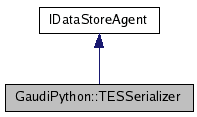
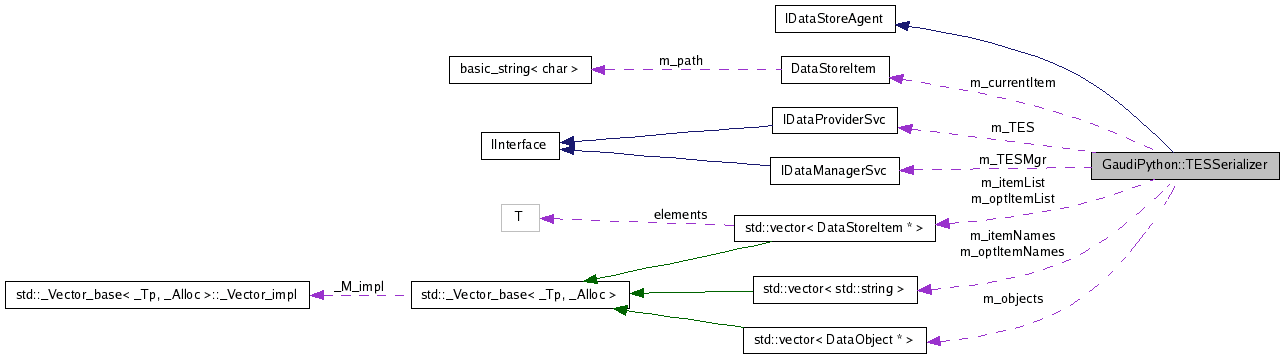
Public Member Functions | |
| TESSerializer (IDataProviderSvc *svc) | |
| void | dumpBuffer (TBufferFile &) |
| void | loadBuffer (TBufferFile &) |
| void | addItem (const std::string &path, int level) |
| void | addOptItem (const std::string &path, int level) |
| virtual bool | analyse (IRegistry *dir, int level) |
| Analysis callback. | |
Protected Member Functions | |
| void | addItem (Items &itms, const std::string &path, int level) |
Private Types | |
| typedef std::vector < DataStoreItem * > | Items |
| typedef std::vector< std::string > | ItemNames |
| typedef std::vector< DataObject * > | Objects |
Private Attributes | |
| IDataProviderSvc * | m_TES |
| TES pointer. | |
| IDataManagerSvc * | m_TESMgr |
| TES pointer. | |
| ItemNames | m_itemNames |
| Vector of item names. | |
| Items | m_itemList |
| Vector of items to be saved to this stream. | |
| ItemNames | m_optItemNames |
| Vector of item names. | |
| Items | m_optItemList |
| Vector of optional items to be saved to this stream. | |
| DataStoreItem * | m_currentItem |
| Current item while traversing the TES tree. | |
| Objects | m_objects |
| Selected list of Objects to be serialized. | |
Definition at line 19 of file TESSerializer.h.
typedef std::vector<DataStoreItem*> GaudiPython::TESSerializer::Items [private] |
Definition at line 20 of file TESSerializer.h.
typedef std::vector<std::string> GaudiPython::TESSerializer::ItemNames [private] |
Definition at line 21 of file TESSerializer.h.
typedef std::vector<DataObject*> GaudiPython::TESSerializer::Objects [private] |
Definition at line 22 of file TESSerializer.h.
| GaudiPython::TESSerializer::TESSerializer | ( | IDataProviderSvc * | svc | ) |
Definition at line 58 of file TESSerializer.cpp.
00059   : m_TES(svc)
00060 {
00061   m_TESMgr = dynamic_cast<IDataManagerSvc*>(svc);
00062 }
| void GaudiPython::TESSerializer::dumpBuffer | ( | TBufferFile & | buffer | ) |
Definition at line 64 of file TESSerializer.cpp.
00064                                                              {
00065   StatusCode status;
00066   DataObject* obj;
00067
00068   // static TBufferFile buffer(TBuffer::kWrite);        /* create a buffer */
00069   static map<string, TClass*> classes;  /* create an STL map to relate string and TClass */
00070
00071   // Clear current selection
00072   m_objects.erase(m_objects.begin(), m_objects.end());
00073
00074   // Traverse the tree and collect the requested objects
00075   for ( Items::iterator i = m_itemList.begin(); i != m_itemList.end(); i++ )    {
00076     m_currentItem = (*i);
00077     status = m_TES->retrieveObject(m_currentItem->path(), obj);
00078     if ( status.isSuccess() )  {
00079       m_TESMgr->traverseSubTree(obj, this);
00080     }
00081     else  {
00082       string text("Cannot serialize mandatory object(s) ");
00083       throw GaudiException(text + m_currentItem->path(), "", status);
00084     }
00085   }
00086   // Traverse the tree and collect the requested objects (tolerate missing items here)
00087   for ( Items::iterator i = m_optItemList.begin(); i != m_optItemList.end(); i++ )    {
00088     m_currentItem = (*i);
00089     status= m_TES->retrieveObject(m_currentItem->path(), obj);
00090     if ( status.isSuccess() )  {
00091       m_TESMgr->traverseSubTree(obj, this);
00092     }
00093   }
00094
00095   // buffer.Reset();
00096   buffer.WriteInt(m_objects.size());
00097
00098   for(Objects::iterator i = m_objects.begin(); i != m_objects.end(); ++i) {
00099     DataObject* pObj = (*i);    /* define pointer !pObj! to a data object */
00100     DataObjectPush p(pObj);             /* add the data object to the list... */
00101
00102     // We build a map so gROOT has to access the whole class database as little as possible
00103     TClass* cl;                                         /* announce a TClass */
00104     const type_info& objClass = typeid(*pObj);                  /* get the type of the data object */
00105     string objClassName = System::typeinfoName(objClass);       /* and then get the descriptive string from System */
00106
00107     /* Since we're dealing with a list of objects, we map each one, but if objects are the same, we note
00108        that they've already been mapped (ie the first 'if case below') */
00109     if (classes[objClassName])   {
00110       cl=classes[objClassName];
00111     } else {
00112       /* if a class has not been mapped: pull the class name from the objects c_str() method */
00113       const char* clName = objClassName.c_str();
00114       /* and find the relevant Tclass (cl) in gROOT */
00115       cl = gROOT->GetClass(clName);
00116       /* ... and fill in the map entry */
00117       classes[objClassName]=cl;
00118     }
00119
00120     /* but what if the object is not mapped because gROOT->GetClass cannot find clName? */
00121     if (cl==0){
00122       throw GaudiException("gROOT->GetClass cannot find clName", objClassName, StatusCode::FAILURE);
00123     }
00124     // write object to buffer in order location-name-object
00125     std::string loc=pObj->registry()->identifier();
00126     buffer.WriteString(loc.c_str());
00127     buffer.WriteString(cl->GetName());
00128     cl->Streamer(pObj,buffer);
00129     /* take care of links */
00130     LinkManager* linkMgr = pObj->linkMgr();
00131     int numLinks = linkMgr->size();
00132     buffer.WriteInt(numLinks);
00133     // now write each link
00134     for (int it = 0; it != numLinks; it++)        {
00135       const string& link = linkMgr->link(it)->path();
00136       buffer.WriteString(link.c_str());
00137     }
00138   }
00139   // return &buffer;
00140 }
| void GaudiPython::TESSerializer::loadBuffer | ( | TBufferFile & | buffer | ) |
The next is equivalent to ReadObjectAny(cl) except of the 'magic!!'
Definition at line 143 of file TESSerializer.cpp.
00143                                                              {
00144
00145   // reverse mechanism of dumps
00146   // buffer is: length of DataObjects vector, location string, type name string, the object itself, num of links, list of links
00147
00148   // not used any more...
00149   // TBufferFile buffer(TBuffer::kRead, in_buffer.BufferSize()-TMsgReserved, in_buffer.Buffer()+TMsgReserved, false);
00150
00151   int nObjects;
00152   buffer.ReadInt(nObjects);
00153
00154   for (int i=0; i<nObjects; ++i) {
00155     char text[4096];
00156     buffer.ReadString(text,sizeof(text));
00157     string location(text);
00158     buffer.ReadString(text,sizeof(text));
00159     TClass* cl = gROOT->GetClass(text);
00160
00162     DataObject* obj = (DataObject*)cl->New();
00163     DataObjectPush push(obj); // This is magic!
00164
00165     cl->Streamer(obj, buffer);
00166
00167     if ( obj ) { // Restore links
00168       int nlink = 0;
00169       LinkManager* lnkMgr = obj->linkMgr();
00170       buffer.ReadInt(nlink);
00171
00172       for (int j=0; j<nlink; ++j) {
00173         buffer.ReadString(text,sizeof(text));
00174         lnkMgr->addLink(text,0);
00175       }
00176     }
00177     StatusCode sc;
00178     sc = m_TES->registerObject(location, obj);
00179     if (sc.isFailure()) {
00180       if ( location == "/Event" ) {
00181         sc = m_TESMgr->setRoot(location, obj);
00182         if(sc.isFailure()) {
00183           string msg("Cannot set root at location ");
00184           throw GaudiException(msg+location,"", sc);
00185         }
00186       }
00187       else {
00188         string msg("Cannot register object at location ");
00189         throw GaudiException(msg+location,"", sc);
00190       }
00191     }
00192   }
00193 }
| void GaudiPython::TESSerializer::addItem | ( | const std::string & | path, | |
| int | level | |||
| ) |
Definition at line 202 of file TESSerializer.cpp.
00202                                                                          {
00203   addItem( m_itemList, path, level);
00204 }
| void GaudiPython::TESSerializer::addOptItem | ( | const std::string & | path, | |
| int | level | |||
| ) |
Definition at line 207 of file TESSerializer.cpp.
00207                                                                             {
00208   addItem( m_optItemList, path, level);
00209 }
Analysis callback.
Implements IDataStoreAgent.
Definition at line 48 of file TESSerializer.cpp.
00048                                                                   {
00049   if ( level < m_currentItem->depth() )   {
00050     if ( dir->object() != 0 )   {
00051       m_objects.push_back(dir->object());
00052       return true;
00053     }
00054   }
00055   return false;
00056 }
| void GaudiPython::TESSerializer::addItem | ( | Items & | itms, | |
| const std::string & | path, | |||
| int | level | |||
| ) | [protected] |
Definition at line 196 of file TESSerializer.cpp.
00196                                                                                       {
00197   DataStoreItem* item = new DataStoreItem(path, level);
00198   itms.push_back( item );
00199 }
Items GaudiPython::TESSerializer::m_itemList [private] |
Objects GaudiPython::TESSerializer::m_objects [private] |