
|
Gaudi Framework, version v22r0 |
| Home | Generated: 9 Feb 2011 |
|
|
Gaudi Framework, version v22r0 |
| Home | Generated: 9 Feb 2011 |
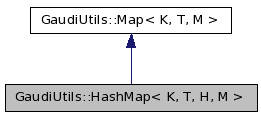
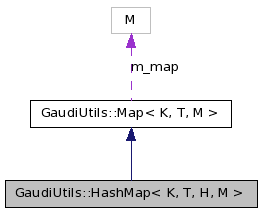
Common class providing an architecture-independent hash map. More...
#include <GaudiKernel/HashMap.h>
Public Types | |
| typedef H | hasher |
Public Member Functions | |
| hasher | hash_funct () const |
Common class providing an architecture-independent hash map.
Due to helper base class Gaudi::Utils::MapBase, this class is "python-friendly", and one can perform all python manipulaitons in intuitive way:
    >>> m = ...        ## get the map
    >>> print m        ## print the map a'la python class dict
    ...
    >>> for key in m :  print key, m[key]   ## iteration over the map
    ...
    >>> for key,value in m.iteritems() : print key, value
    ...
    >>> keys   = m.keys()                     ## get the list of keys
    >>> values = m.values ()                  ## get the list of values
    >>  items  = m.items  ()                  ## get the list of items

    >>> if 'one' in m           ## check the presence of the key in map

    >>>  v = m.get(key', None) ## return m[key] for existing key, else None

    >>>  del m[key]      ## erase the key form the map

    >>> value m[key]     ## unchecked access through the key
    ...
    >>> m.update( key, value ) ## update/insert key/value pair
__setitem__ and __getitem__ methods in python:>>> type(m).__setitem__ = Gaudi.Utils.MapBase.__setitem__ >>> type(m).__getitem__ = Gaudi.Utils.MapBase.__getitem__ >>> m[key] = value ## much more intuitive semantics for key insertion
In a similar way __delitem__ methods can be redefined.
Definition at line 108 of file HashMap.h.
| typedef H GaudiUtils::HashMap< K, T, H, M >::hasher |
| hasher GaudiUtils::HashMap< K, T, H, M >::hash_funct | ( | ) | const [inline] |
Definition at line 113 of file HashMap.h.
00113                                      {
00114 // Marco Cl.: since on windows we are using a std::map, we have to provide a different implementation
00115 // for GaudiUtils::HashMap::hash_funct(). (std::map::hash_funct does not exist)
00116 #ifdef _WIN32
00117       return hasher();
00118 #else
00119       return this->m_map.hash_funct();
00120 #endif
00121     }

