
|
Gaudi Framework, version v23r2 |
| Home | Generated: Thu Jun 28 2012 |
|
|
Gaudi Framework, version v23r2 |
| Home | Generated: Thu Jun 28 2012 |
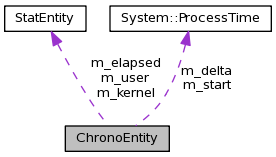
a small helper class for implementation of ChronoStatSvc service, It also could be used as some local timer More...
#include <GaudiKernel/ChronoEntity.h>
Public Member Functions | |
| ChronoEntity () | |
| default constructor | |
| ~ChronoEntity () | |
| destructor | |
| IChronoSvc::ChronoStatus | start () |
| start the current chrono | |
| IChronoSvc::ChronoStatus | stop () |
| stop the chrono | |
| IChronoSvc::ChronoTime | delta (IChronoSvc::ChronoType type) const |
| return the last delta-time of type "type" | |
| IChronoSvc::ChronoStatus | status () const |
| return the status of chrono | |
| unsigned long | nOfMeasurements () const |
| number of chrono measurements | |
| double | uMinimalTime () const |
| minimal measurement for user time | |
| double | kMinimalTime () const |
| minimal measurement for kernel time | |
| double | eMinimalTime () const |
| minimal measurement for elapsed time | |
| double | uMaximalTime () const |
| maximal measurement for user time | |
| double | kMaximalTime () const |
| maximal measurement for kernel time | |
| double | eMaximalTime () const |
| maximal measurement for elapsed time | |
| double | uTotalTime () const |
| total user time | |
| double | kTotalTime () const |
| total Kernel time | |
| double | eTotalTime () const |
| total Elapsed time | |
| double | totalTime () const |
| total time | |
| double | kMeanTime () const |
| average Kernel Time | |
| double | uMeanTime () const |
| average User Time | |
| double | eMeanTime () const |
| average Elapsed Time | |
| double | kRMSTime () const |
| r.m.s Kernel Time | |
| double | uRMSTime () const |
| r.m.s User Time | |
| double | eRMSTime () const |
| r.m.s Elapsed Time | |
| double | kMeanErrorTime () const |
| error in mean Kernel time | |
| double | uMeanErrorTime () const |
| error in mean User time | |
| double | eMeanErrorTime () const |
| error in mean Elapsed time | |
| bool | operator< (const ChronoEntity &entity) const |
| comparison operator | |
| std::string | outputUserTime () const |
| print the chrono ; | |
| std::string | outputSystemTime () const |
| print the chrono ; | |
| std::string | outputElapsedTime () const |
| print the chrono ; | |
| std::string | outputUserTime (const std::string &fmt, System::TimeType unit) const |
| print the chrono according the format and units | |
| std::string | outputSystemTime (const std::string &fmt, System::TimeType unit) const |
| print the chrono according the format and units | |
| std::string | outputElapsedTime (const std::string &fmt, System::TimeType unit) const |
| print the chrono according the format and units | |
| std::string | outputTime (IChronoSvc::ChronoType typ, const std::string &fmt, System::TimeType unit) const |
| print the chrono according the format and units | |
Protected Member Functions | |
| std::string | format (const double total, const double minimal, const double mean, const double rms, const double maximal, const unsigned long number) const |
| format | |
Private Attributes | |
| IChronoSvc::ChronoStatus | m_status |
| current status of this chrono object; | |
| System::ProcessTime | m_delta |
| delta process times | |
| System::ProcessTime | m_start |
| start stamp for current measurement of process times | |
| StatEntity | m_user |
| the actual storage of "user" time | |
| StatEntity | m_kernel |
| the actual storage of "kernel" time | |
| StatEntity | m_elapsed |
| the actual storage of "elapsed" time | |
Static Private Attributes | |
| static const System::TimeType | TimeUnit = System::microSec |
| internal unit used for the system time conversion (microseconds) | |
a small helper class for implementation of ChronoStatSvc service, It also could be used as some local timer
Definition at line 21 of file ChronoEntity.h.
| ChronoEntity::ChronoEntity | ( | ) |
default constructor
Definition at line 46 of file ChronoEntity.cpp.
  : m_status( IChronoSvc::UNKNOWN )  // current status
{}
| ChronoEntity::~ChronoEntity | ( | ) | [inline] |
| IChronoSvc::ChronoTime ChronoEntity::delta | ( | IChronoSvc::ChronoType | type ) | const [inline] |
return the last delta-time of type "type"
Definition at line 295 of file ChronoEntity.h.
{
  const IChronoSvc::ChronoTime result = -1 ;
  switch ( type )
  {
  case IChronoSvc::USER    : return m_delta.userTime<TimeUnit>();
  case IChronoSvc::KERNEL  : return m_delta.kernelTime<TimeUnit>();
  case IChronoSvc::ELAPSED : return m_delta.elapsedTime<TimeUnit>();
  default                  : return result;
  }
  // cannot reach this point
}
| double ChronoEntity::eMaximalTime | ( | ) | const [inline] |
maximal measurement for elapsed time
Definition at line 224 of file ChronoEntity.h.
{ return m_elapsed . flagMax () ; }
| double ChronoEntity::eMeanErrorTime | ( | ) | const [inline] |
error in mean Elapsed time
Definition at line 290 of file ChronoEntity.h.
{ return m_elapsed . flagMeanErr () ; }
| double ChronoEntity::eMeanTime | ( | ) | const [inline] |
average Elapsed Time
Definition at line 260 of file ChronoEntity.h.
{ return m_elapsed . flagMean () ; }
| double ChronoEntity::eMinimalTime | ( | ) | const [inline] |
minimal measurement for elapsed time
Definition at line 209 of file ChronoEntity.h.
{ return m_elapsed. flagMin () ; }
| double ChronoEntity::eRMSTime | ( | ) | const [inline] |
r.m.s Elapsed Time
Definition at line 275 of file ChronoEntity.h.
{ return m_elapsed . flagRMS () ; }
| double ChronoEntity::eTotalTime | ( | ) | const [inline] |
| std::string ChronoEntity::format | ( | const double | total, |
| const double | minimal, | ||
| const double | mean, | ||
| const double | rms, | ||
| const double | maximal, | ||
| const unsigned long | number | ||
| ) | const [protected] |
format
Definition at line 133 of file ChronoEntity.cpp.
{

  boost::format fmt("Tot=%2$5.3g%1$s %4$43s #=%3$3lu");

  long double  unit = 1.0 ;

  if     ( total / microsecond  <  500 )
  { unit = microsecond ; fmt % " [us]" ; }
  else if( total / millisecond  <  500 )
  { unit = millisecond ; fmt % " [ms]" ; }
  else if( total /      second  <  500 )
  { unit =      second ; fmt % "  [s]" ; }
  else if( total /      minute  <  500 )
  { unit =      minute ; fmt % "[min]" ; }
  else if( total /        hour  <  500 )
  { unit =        hour ; fmt % "  [h]" ; }
  else if( total /         day  <   10 )
  { unit =         day ; fmt % "[day]" ; }
  else if( total /        week  <    5 )
  { unit =        week ; fmt % "  [w]" ; }
  else if( total /       month  <   20 )
  { unit =       month ; fmt % "[mon]" ; }
  else
  { unit =        year ; fmt % "  [y]" ; }

  fmt % (double) (total / unit) % number;

  if( 1 < number )
  {
    boost::format fmt1("Ave/Min/Max=%2$5.3g(+-%3$5.3g)/%4$5.3g/%5$5.3g%1$s");
    if     ( mean / microsecond  <  500 )
    { unit = microsecond ; fmt1 % " [us]" ; }
    else if( mean / millisecond  <  500 )
    { unit = millisecond ; fmt1 % " [ms]" ; }
    else if( mean /      second  <  500 )
    { unit =      second ; fmt1 % "  [s]" ; }
    else if( mean /      minute  <  500 )
    { unit =      minute ; fmt1 % "[min]" ; }
    else if( mean /        hour  <  500 )
    { unit =        hour ; fmt1 % "  [h]" ; }
    else if( mean /         day  <   10 )
    { unit =         day ; fmt1 % "[day]" ; }
    else if( mean /        week  <    5 )
    { unit =        week ; fmt1 % "  [w]" ; }
    else if( mean /       month  <   20 )
    { unit =       month ; fmt1 % "[mon]" ; }
    else
    { unit =        year ; fmt1 % "  [y]" ; }

    fmt1 % (double) ( mean / unit ) % (double) ( rms  / unit )
         % (double) ( minimal  / unit ) % (double) ( maximal  / unit );
    fmt % fmt1.str();
  }
  else {
    fmt % "";
  }

  return fmt.str();
}
| double ChronoEntity::kMaximalTime | ( | ) | const [inline] |
maximal measurement for kernel time
Definition at line 219 of file ChronoEntity.h.
{ return m_kernel . flagMax () ; }
| double ChronoEntity::kMeanErrorTime | ( | ) | const [inline] |
error in mean Kernel time
Definition at line 280 of file ChronoEntity.h.
{ return m_kernel . flagMeanErr () ; }
| double ChronoEntity::kMeanTime | ( | ) | const [inline] |
average Kernel Time
Definition at line 250 of file ChronoEntity.h.
{ return m_kernel . flagMean () ; }
| double ChronoEntity::kMinimalTime | ( | ) | const [inline] |
minimal measurement for kernel time
Definition at line 204 of file ChronoEntity.h.
{ return m_kernel . flagMin () ; }
| double ChronoEntity::kRMSTime | ( | ) | const [inline] |
| double ChronoEntity::kTotalTime | ( | ) | const [inline] |
| unsigned long ChronoEntity::nOfMeasurements | ( | ) | const [inline] |
number of chrono measurements
Definition at line 194 of file ChronoEntity.h.
{ return m_user . nEntries() ; }
| bool ChronoEntity::operator< | ( | const ChronoEntity & | entity ) | const |
comparison operator
Definition at line 203 of file ChronoEntity.cpp.
{
  return
    ( &e           == this          ) ? false :
    ( totalTime () < e.totalTime () ) ? true  :
    ( totalTime () > e.totalTime () ) ? false :
    ( m_user       < e.m_user       ) ? true  :
    ( e.m_user     <   m_user       ) ? false :
    ( m_kernel     < e.m_kernel     ) ? true  :
    ( e.m_kernel   <   m_kernel     ) ? false :
    ( m_elapsed    < e.m_elapsed    ) ? true  :
    ( e.m_elapsed  <   m_elapsed    ) ? false : false ;
}
| std::string ChronoEntity::outputElapsedTime | ( | ) | const |
print the chrono ;
Definition at line 118 of file ChronoEntity.cpp.
{
  std::string res ("TimeElapsed: ") ;
  return res += format
    ( eTotalTime     () ,
      eMinimalTime   () ,
      eMeanTime      () ,
      eRMSTime       () ,
      eMaximalTime   () ,
      nOfMeasurements() );
}
| std::string ChronoEntity::outputElapsedTime | ( | const std::string & | fmt, |
| System::TimeType | unit | ||
| ) | const [inline] |
print the chrono according the format and units
| fmt | the format string |
| unit | the unit |
Definition at line 347 of file ChronoEntity.h.
{
  return outputTime ( IChronoSvc::ELAPSED , fmt , unit ) ;
}
| std::string ChronoEntity::outputSystemTime | ( | const std::string & | fmt, |
| System::TimeType | unit | ||
| ) | const [inline] |
print the chrono according the format and units
| fmt | the format string |
| unit | the unit |
Definition at line 332 of file ChronoEntity.h.
{
  return outputTime ( IChronoSvc::KERNEL , fmt , unit ) ;
}
| std::string ChronoEntity::outputSystemTime | ( | ) | const |
print the chrono ;
Definition at line 105 of file ChronoEntity.cpp.
{
  std::string res ("Time System : ") ;
  return res += format
    ( kTotalTime     () ,
      kMinimalTime   () ,
      kMeanTime      () ,
      kRMSTime       () ,
      kMaximalTime   () ,
      nOfMeasurements() );
}
| std::string ChronoEntity::outputTime | ( | IChronoSvc::ChronoType | typ, |
| const std::string & | fmt, | ||
| System::TimeType | unit | ||
| ) | const |
print the chrono according the format and units
The format fields are:
| typ | the chrono type |
| fmt | the format string |
| unit | the unit |
Definition at line 226 of file ChronoEntity.cpp.
{
  boost::format _fmt ( fmt ) ;
  // allow various number of arguments
  using namespace boost::io ;
  _fmt.exceptions ( all_error_bits ^ ( too_many_args_bit | too_few_args_bit ) ) ;
  //
  double _unit = microsecond ;
  switch ( unit )
  {
  case System::Year     : _unit = year        ; break ;
  case System::Month    : _unit = month       ; break ;
  case System::Day      : _unit = day         ; break ;
  case System::Hour     : _unit = hour        ; break ;
  case System::Min      : _unit = minute      ; break ;
  case System::Sec      : _unit = second      ; break ;
  case System::milliSec : _unit = millisecond ; break ;
  case System::microSec : _unit = microsecond ; break ;
  case System::nanoSec  : _unit = nanosecond  ; break ;
  default               : _unit = microsecond ; break ;
  }
  //
  const StatEntity* stat = &m_user;
  switch ( typ )
  {
  case IChronoSvc::USER    : stat = &m_user    ; break ;
  case IChronoSvc::KERNEL  : stat = &m_kernel  ; break ;
  case IChronoSvc::ELAPSED : stat = &m_elapsed ; break ;
  default                  : stat = &m_user    ; break ;
  }
  //
  _fmt
    %   ( stat -> nEntries    ()         )   // %1 : #entries
    %   ( stat -> flag        () / _unit )   // %2 : total time
    %   ( stat -> flagMean    () / _unit )   // %3 : mean time
    %   ( stat -> flagRMS     () / _unit )   // %4 : RMS  time
    %   ( stat -> flagMeanErr () / _unit )   // %5 : error in mean time
    %   ( stat -> flagMin     () / _unit )   // %6 : minimal time
    %   ( stat -> flagMax     () / _unit ) ; // %7 : maximal time
  //
  return _fmt.str() ;
}
| std::string ChronoEntity::outputUserTime | ( | const std::string & | fmt, |
| System::TimeType | unit | ||
| ) | const [inline] |
print the chrono according the format and units
| fmt | the format string |
| unit | the unit |
Definition at line 317 of file ChronoEntity.h.
{
  return outputTime ( IChronoSvc::USER , fmt , unit ) ;
}
| std::string ChronoEntity::outputUserTime | ( | ) | const |
print the chrono ;
Definition at line 91 of file ChronoEntity.cpp.
{
  std::string res ("Time User   : ") ;
  return res += format
    ( uTotalTime     () ,
      uMinimalTime   () ,
      uMeanTime      () ,
      uRMSTime       () ,
      uMaximalTime   () ,
      nOfMeasurements() );
}
| IChronoSvc::ChronoStatus ChronoEntity::start | ( | ) |
start the current chrono
Definition at line 53 of file ChronoEntity.cpp.
{
  if ( IChronoSvc::RUNNING == m_status ) { return m_status ; }
  //
  // following lines could be platform dependent!
  //
  // Store in object the measured times
  m_start = System::getProcessTime();

  m_status = IChronoSvc::RUNNING;

  return m_status ;
}
| IChronoSvc::ChronoStatus ChronoEntity::status | ( | ) | const [inline] |
| IChronoSvc::ChronoStatus ChronoEntity::stop | ( | ) |
stop the chrono
Definition at line 69 of file ChronoEntity.cpp.
{
  if ( IChronoSvc::RUNNING != m_status ) { return m_status ; }

  // following lines could be platform dependent!
  m_delta = System::getProcessTime() - m_start;

  // update the counters:

  m_user     += m_delta.userTime<TimeUnit>();
  m_kernel   += m_delta.kernelTime<TimeUnit>();
  m_elapsed  += m_delta.elapsedTime<TimeUnit>();

  // set new status

  m_status = IChronoSvc::STOPPED;

  return m_status ;
}
| double ChronoEntity::totalTime | ( | ) | const [inline] |
| double ChronoEntity::uMaximalTime | ( | ) | const [inline] |
maximal measurement for user time
Definition at line 214 of file ChronoEntity.h.
{ return m_user . flagMax () ; }
| double ChronoEntity::uMeanErrorTime | ( | ) | const [inline] |
error in mean User time
Definition at line 285 of file ChronoEntity.h.
{ return m_user . flagMeanErr () ; }
| double ChronoEntity::uMeanTime | ( | ) | const [inline] |
| double ChronoEntity::uMinimalTime | ( | ) | const [inline] |
minimal measurement for user time
Definition at line 198 of file ChronoEntity.h.
{ return m_user . flagMin () ; }
| double ChronoEntity::uRMSTime | ( | ) | const [inline] |
| double ChronoEntity::uTotalTime | ( | ) | const [inline] |
System::ProcessTime ChronoEntity::m_delta [private] |
delta process times
Definition at line 172 of file ChronoEntity.h.
StatEntity ChronoEntity::m_elapsed [private] |
the actual storage of "elapsed" time
Definition at line 180 of file ChronoEntity.h.
StatEntity ChronoEntity::m_kernel [private] |
the actual storage of "kernel" time
Definition at line 178 of file ChronoEntity.h.
System::ProcessTime ChronoEntity::m_start [private] |
start stamp for current measurement of process times
Definition at line 174 of file ChronoEntity.h.
current status of this chrono object;
Definition at line 170 of file ChronoEntity.h.
StatEntity ChronoEntity::m_user [private] |
the actual storage of "user" time
Definition at line 176 of file ChronoEntity.h.
const System::TimeType ChronoEntity::TimeUnit = System::microSec [static, private] |
internal unit used for the system time conversion (microseconds)
Definition at line 182 of file ChronoEntity.h.

