
|
Gaudi Framework, version v23r2 |
| Home | Generated: Thu Jun 28 2012 |
|
|
Gaudi Framework, version v23r2 |
| Home | Generated: Thu Jun 28 2012 |
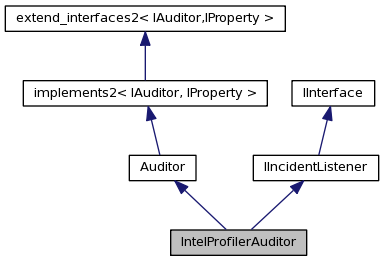
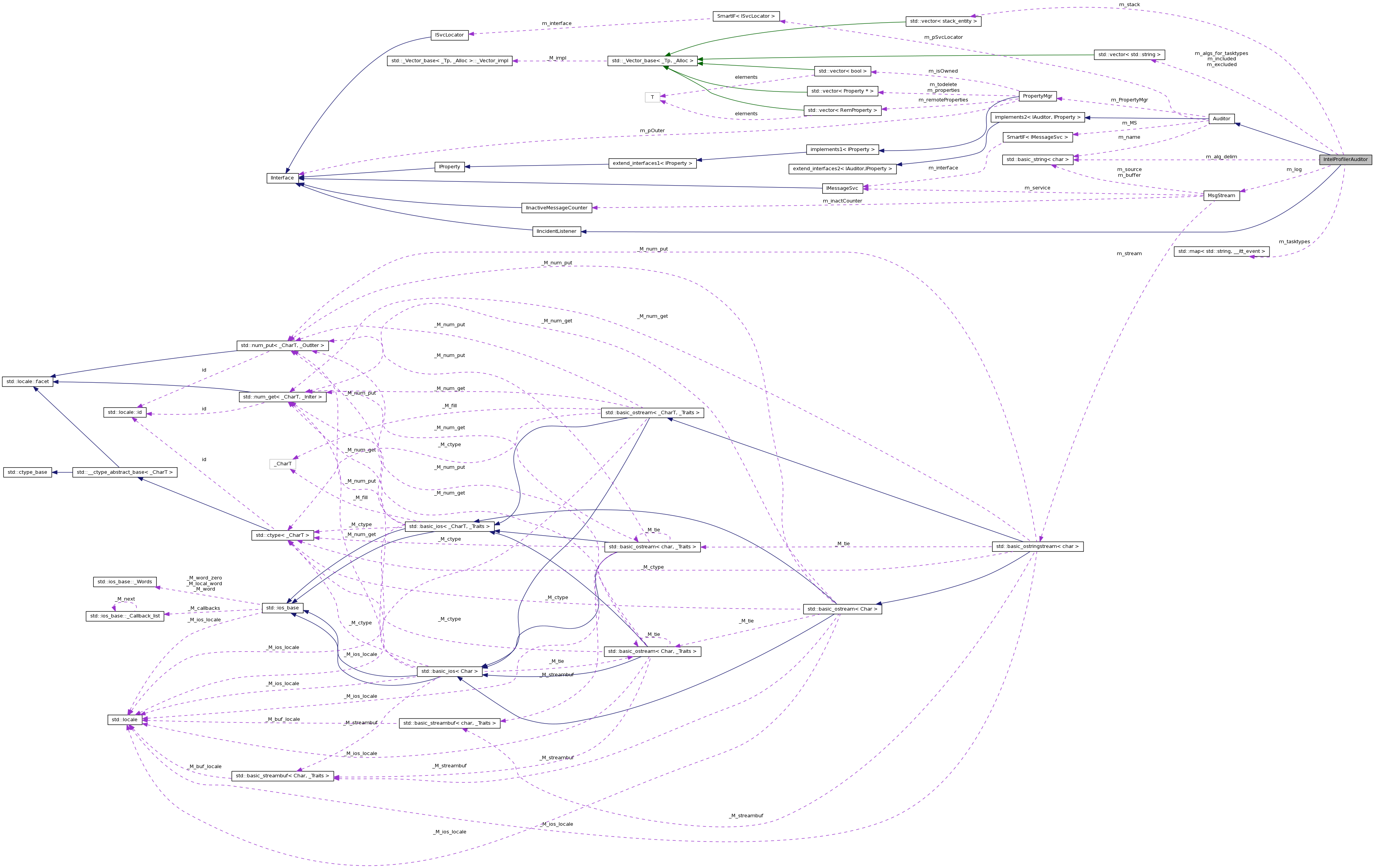
Classes | |
| struct | stack_entity |
Public Member Functions | |
| IntelProfilerAuditor (const std::string &name, ISvcLocator *pSvcLocator) | |
| StatusCode | initialize () |
| void | handle (const Incident &incident) |
| Inform that a new incident has occurred. | |
| void | before (StandardEventType type, INamedInterface *i) |
| The following methods are meant to be implemented by the child class... | |
| void | after (StandardEventType type, INamedInterface *i, const StatusCode &sc) |
Private Member Functions | |
| void | start_profiling_component (const std::string &name) |
| void | skip_profiling_component (const std::string &name) |
| void | start () |
| void | pause () |
| void | resume () |
| void | stop () |
| bool | hasIncludes () const |
| bool | isIncluded (const std::string &name) const |
| bool | isExcluded (const std::string &name) const |
| bool | isRunning () const |
| int | stackLevel () const |
| std::string | stackIndent (bool newLevel=false) const |
| std::string | taskTypeName (const std::string &component_name) const |
Private Attributes | |
| int | m_nStartFromEvent |
| int | m_nStopAtEvent |
| std::vector< std::string > | m_excluded |
| std::vector< std::string > | m_included |
| std::vector< std::string > | m_algs_for_tasktypes |
| std::string | m_alg_delim |
| bool | m_enable_frames |
| int | m_frames_rate |
| MsgStream | m_log |
| int | m_nEvents |
| __itt_domain * | domain |
| bool | m_isStarted |
| std::vector< stack_entity > | m_stack |
| TaskTypes | m_tasktypes |
Definition at line 35 of file IntelProfilerAuditor.cpp.
| IntelProfilerAuditor::IntelProfilerAuditor | ( | const std::string & | name, |
| ISvcLocator * | pSvcLocator | ||
| ) |
Definition at line 121 of file IntelProfilerAuditor.cpp.
                            : Auditor(name, pSvcLocator), m_log(msgSvc(), name)
    ,m_nEvents(0), m_isStarted(false) {
  // ## Properties
  declareProperty("IncludeAlgorithms", m_included,
    "Names of included algorithms."
  );
  declareProperty("ExcludeAlgorithms", m_excluded,
    "Names of excluded algorithms."
  );
  declareProperty("StartFromEventN", m_nStartFromEvent = 1,
    "After what event we stop profiling. "
    "If 0 than we also profile finalization stage."
  );
  declareProperty("StopAtEventN", m_nStopAtEvent = 0,
    "After what event we stop profiling. "
    "If 0 than we also profile finalization stage. Default = 0."
  );
  declareProperty("ComponentsForTaskTypes", m_algs_for_tasktypes,
    "Algorithm name, for which intel amplifier task type will be created."
    "By default all algorithms have a corresponding task type.");
  declareProperty("TaskTypeNameDelimeter", m_alg_delim = " ",
    "The String delimiter between sequences/algorithms names in "
    "\"Task Type\" grouping at Amplifier. Default=\" \"."
  );
  declareProperty("EnableFrames", m_enable_frames = false,
    "Enable frames (needed for detecting slow events). Default=false."
  );
  declareProperty("FramesRate", m_frames_rate = 100,
    "Frames rate. The recommended maximum rate for calling the Frame API is "
    "1000 frames (events) per second. A higher rate may result in large product"
    " memory consumption and slow finalization. "
    "You need update \"slow-frames-threshold\" and \"fast-frames-threshold\" "
    "parameters of amplxe-cl tool to separate slow, medium and fast events. "
    "For use frames you need to switch on \"EnableFrames\". "
    "Default=100"
  );
}
| void IntelProfilerAuditor::after | ( | StandardEventType | type, |
| INamedInterface * | i, | ||
| const StatusCode & | sc | ||
| ) | [virtual] |
Reimplemented from Auditor.
Definition at line 396 of file IntelProfilerAuditor.cpp.
                                                {
  // Skip unnecessary event types
  if (!((type == IAuditor::Execute) && m_isStarted)) return;

  if ((m_nEvents+1) % m_frames_rate == 0) {
    __itt_frame_end_v3(domain, NULL);
  }

  // Name of the current component
  const std::string& name = i->name();
  stack_entity state = m_stack.back();
  // Remove component from stack.
  m_stack.pop_back();


  if (state.event != 0) {
     m_log << MSG::DEBUG << stackIndent(true) << "End event for "
      << name << endmsg;
    __itt_event_end(state.event);

    if (state.parent_event != 0) {
      m_log << MSG::DEBUG << stackIndent() << "Resume event for "
        << state.parent_event << endmsg;
      __itt_event_start(state.parent_event);
    }
  }

  if (m_stack.empty()) {
    // Pause if there are no parent components (top algorithm).
    pause();
  } else if (state.status) {
    // If the profiling is running and we have parent component that is
    // paused then pause the profiling.
    if (!m_stack.back().status) {
      pause();
    }
  }else {
    // If the profiling was stopped, but the parent component should be profiled
    // then resume profiling.
    if (m_stack.back().status) {
      resume();
    }
  }
}
| void IntelProfilerAuditor::before | ( | StandardEventType | evt, |
| INamedInterface * | obj | ||
| ) | [virtual] |
The following methods are meant to be implemented by the child class...
Reimplemented from Auditor.
Definition at line 349 of file IntelProfilerAuditor.cpp.
                                                                            {
  // Skip unnecessary event types.
  if (!((type == IAuditor::Execute) && m_isStarted)) return;

  // Name of the current component.
  const std::string& name = i->name();
  //m_log << MSG::DEBUG <<  "Before: " << name << " " << type << endmsg;

  if (isRunning()) {
    if (isExcluded(name)) {
      // If profiling is running and component is explicitly excluded
      // then skip component.
      skip_profiling_component(name);
    }else{
      // If profiling is running and component is'not explicitly excluded
      // then start profiling for component (add to stack).
      start_profiling_component(name);
    }
  }else {
    if (hasIncludes()) {
      // If the profiling is not running and  "includes" is explicitly defined ...
      if (isIncluded(name)) {
        // and the current component is in the include's list then start the
        // component profiling.
        start_profiling_component(name);
      } else{
        // and the current component is not in the includes list then skip
        // a profiling of the component.
        skip_profiling_component(name);
      }
    }else {
        // If "Includes" property isn't present and the component is ...
        if (isExcluded(name)) {
          // in the excludes list then skip a profiling
          skip_profiling_component(name);
        }else{
          // not in the exclude list then start a profiling
          start_profiling_component(name);
        }
    }
  }
  if (m_nEvents % m_frames_rate == 0) {
    __itt_frame_begin_v3(domain, NULL);
  }

}
| void IntelProfilerAuditor::handle | ( | const Incident & | ) | [virtual] |
Inform that a new incident has occurred.
Implements IIncidentListener.
Definition at line 331 of file IntelProfilerAuditor.cpp.
                                                          {
  if (IncidentType::BeginEvent != incident.type()) return;
  // Increment the event counter
  ++m_nEvents;

  if (m_nStartFromEvent == m_nEvents) {
    m_log << MSG::INFO << "Start profiling (event #" << m_nEvents << ")"
        << endmsg;
    start();
  }

  if (m_nStopAtEvent == m_nEvents) {
    m_log << MSG::INFO << "Stop profiling (event #" << m_nEvents << ")"
        << endmsg;
    stop();
  }
}
| bool IntelProfilerAuditor::hasIncludes | ( | ) | const [private] |
Definition at line 236 of file IntelProfilerAuditor.cpp.
                                             {
  return !m_included.empty();
}
| StatusCode IntelProfilerAuditor::initialize | ( | ) | [virtual] |
Reimplemented from Auditor.
Definition at line 276 of file IntelProfilerAuditor.cpp.
                                            {
  m_log.setLevel(outputLevel());
  m_log << MSG::INFO << "Initialised" << endmsg;

  IIncidentSvc * inSvc = NULL;
  const StatusCode sc = serviceLocator()->service("IncidentSvc", inSvc);
  if (sc.isFailure())
    return sc;
  // Useful to start profiling only after some event, we don't need profile
  // initialization stage. For that we need to count events with BeginEvent
  // listener.
  inSvc->addListener(this, IncidentType::BeginEvent);
  // If the end event number don't setup we finish profiling at the end
  // of loop. We don't need profiling finalization stage.
  inSvc->addListener(this, IncidentType::EndProcessing);

  std::string str_excluded, str_included, str_eventtypes;
  BOOST_FOREACH(const std::string& name, m_excluded)
  {
    str_excluded += " " + name;
  }
  BOOST_FOREACH(const std::string& name, m_included)
  {
    str_included += " " + name;
  }

  BOOST_FOREACH(const std::string& name, m_algs_for_tasktypes)
  {
    str_eventtypes += " " + name;
  }

  if (!m_included.empty()) {
    m_log << MSG::INFO << "Included algorithms (" << m_included.size()
      << "): " << str_included << endmsg;
  }

  if (!m_excluded.empty()){
    m_log << MSG::INFO << "Excluded algorithms (" << m_excluded.size()
      << "): " << str_excluded << endmsg;
  }

  if (!m_algs_for_tasktypes.empty()){
    m_log << MSG::INFO << "Event types (" << m_algs_for_tasktypes.size()
      << "): " << str_eventtypes << endmsg;
  }

  // Create a profiler domain for detection of slow events.
  domain = __itt_domain_create("Event loop");
  domain->flags = m_enable_frames;

  return StatusCode::SUCCESS;
}
| bool IntelProfilerAuditor::isExcluded | ( | const std::string & | name ) | const [private] |
Definition at line 245 of file IntelProfilerAuditor.cpp.
                                                                 {
  return std::find(m_excluded.begin(), m_excluded.end(), name) !=
    m_excluded.end();
}
| bool IntelProfilerAuditor::isIncluded | ( | const std::string & | name ) | const [private] |
Definition at line 240 of file IntelProfilerAuditor.cpp.
                                                                 {
  return std::find(m_included.begin(), m_included.end(), name) !=
    m_included.end();
}
| bool IntelProfilerAuditor::isRunning | ( | ) | const [private] |
| void IntelProfilerAuditor::pause | ( | ) | [private] |
Definition at line 217 of file IntelProfilerAuditor.cpp.
                                 {
  if (!m_isStarted) return;
  m_log << MSG::DEBUG << stackIndent() << "Pause" << endmsg;
  __itt_pause();
}
| void IntelProfilerAuditor::resume | ( | ) | [private] |
Definition at line 211 of file IntelProfilerAuditor.cpp.
                                  {
  if (!m_isStarted) return;
  m_log << MSG::DEBUG << stackIndent() << "Resume" << endmsg;
  __itt_resume();
}
| void IntelProfilerAuditor::skip_profiling_component | ( | const std::string & | name ) | [private] |
Definition at line 223 of file IntelProfilerAuditor.cpp.
                                                                         {
  if (!m_isStarted) return;
  m_stack.push_back(stack_entity(name, false));
  m_log << MSG::DEBUG << stackIndent() << "Skip component "
    << name << endmsg;
}
| std::string IntelProfilerAuditor::stackIndent | ( | bool | newLevel = false ) |
const [private] |
Definition at line 258 of file IntelProfilerAuditor.cpp.
                                                              {
  std::stringstream indent(std::stringstream::out);
  indent << std::setw(stackLevel()*2+(newLevel?2:0)) << " ";
  return indent.str();
}
| int IntelProfilerAuditor::stackLevel | ( | ) | const [private] |
Definition at line 254 of file IntelProfilerAuditor.cpp.
| void IntelProfilerAuditor::start | ( | ) | [private] |
Definition at line 160 of file IntelProfilerAuditor.cpp.
                                 {
  m_isStarted = true;
  __itt_resume();
}
| void IntelProfilerAuditor::start_profiling_component | ( | const std::string & | name ) | [private] |
Definition at line 165 of file IntelProfilerAuditor.cpp.
                                                                          {
  if (!m_isStarted) return;
  std::string typeName = taskTypeName(name);
  __itt_event taskId = 0;
  TaskTypes::const_iterator iter = m_tasktypes.find(typeName);
  if( iter != m_tasktypes.end()) {
    taskId = iter->second;
  }

  if(!taskId && m_algs_for_tasktypes.empty()) {
    // Create event
    taskId = __itt_event_create(typeName.c_str(), typeName.size());
    m_tasktypes.insert(TaskTypes::value_type(typeName, taskId));
  }

  stack_entity state = stack_entity(name, true, taskId);
  stack_entity* parent = !m_stack.empty()?&m_stack.back():NULL;

  if (parent != NULL) {
    if (parent->event) {
       state.parent_event = parent->event;
    } else {
      state.parent_event = parent->parent_event;
    }
  }

  if (taskId && state.parent_event) {
    m_log << MSG::DEBUG << stackIndent() << "Pause event " <<
      state.parent_event << endmsg;
    __itt_event_end(state.parent_event);
  }
  m_stack.push_back(state);

  m_log << MSG::DEBUG << stackIndent() << "Start profiling component "
    << typeName << endmsg;

  if (taskId) {
     // Start event
    m_log << MSG::DEBUG << stackIndent() << "Start event type "
      << state.event << " for "  << typeName << endmsg;
    __itt_event_start(state.event);
  }

  __itt_resume();
}
| void IntelProfilerAuditor::stop | ( | ) | [private] |
Definition at line 230 of file IntelProfilerAuditor.cpp.
                                {
  if (!m_isStarted) return;
  m_isStarted = false;
  __itt_pause();
}
| std::string IntelProfilerAuditor::taskTypeName | ( | const std::string & | component_name ) | const [private] |
Definition at line 265 of file IntelProfilerAuditor.cpp.
                                                                        {
  std::string result;
  std::string delim = "";
  BOOST_FOREACH(const stack_entity& value,
     m_stack) {
    result += delim+value.name;
    delim = m_alg_delim;
  }
  return result+m_alg_delim+component_name;
}
__itt_domain* IntelProfilerAuditor::domain [private] |
Definition at line 93 of file IntelProfilerAuditor.cpp.
std::string IntelProfilerAuditor::m_alg_delim [private] |
Definition at line 78 of file IntelProfilerAuditor.cpp.
Definition at line 75 of file IntelProfilerAuditor.cpp.
bool IntelProfilerAuditor::m_enable_frames [private] |
Definition at line 80 of file IntelProfilerAuditor.cpp.
Definition at line 71 of file IntelProfilerAuditor.cpp.
int IntelProfilerAuditor::m_frames_rate [private] |
Definition at line 86 of file IntelProfilerAuditor.cpp.
Definition at line 73 of file IntelProfilerAuditor.cpp.
bool IntelProfilerAuditor::m_isStarted [private] |
Definition at line 95 of file IntelProfilerAuditor.cpp.
MsgStream IntelProfilerAuditor::m_log [private] |
Definition at line 89 of file IntelProfilerAuditor.cpp.
int IntelProfilerAuditor::m_nEvents [private] |
Definition at line 91 of file IntelProfilerAuditor.cpp.
int IntelProfilerAuditor::m_nStartFromEvent [private] |
Definition at line 66 of file IntelProfilerAuditor.cpp.
int IntelProfilerAuditor::m_nStopAtEvent [private] |
Definition at line 69 of file IntelProfilerAuditor.cpp.
std::vector<stack_entity> IntelProfilerAuditor::m_stack [private] |
Definition at line 97 of file IntelProfilerAuditor.cpp.
TaskTypes IntelProfilerAuditor::m_tasktypes [private] |
Definition at line 99 of file IntelProfilerAuditor.cpp.

