
|
Gaudi Framework, version v23r2 |
| Home | Generated: Thu Jun 28 2012 |
|
|
Gaudi Framework, version v23r2 |
| Home | Generated: Thu Jun 28 2012 |
Performance Monitoring Auditor that uses Perfmon2 library to monitor algorithms. More...
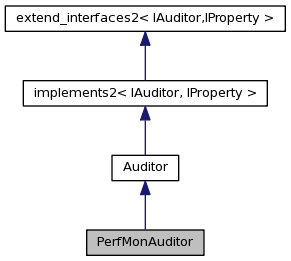
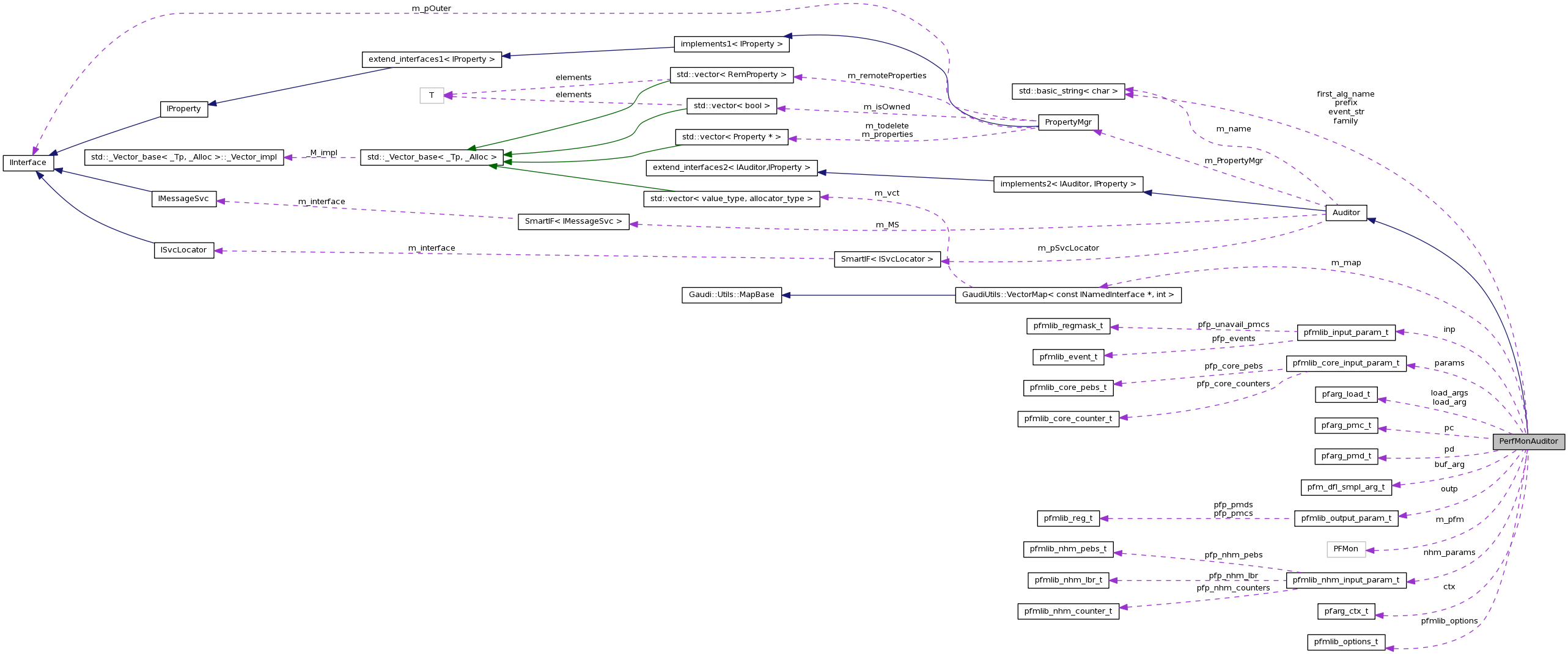
Public Member Functions | |
| virtual void | before (StandardEventType evt, INamedInterface *alg) |
| The following methods are meant to be implemented by the child class... | |
| virtual void | after (StandardEventType evt, INamedInterface *alg, const StatusCode &sc) |
| virtual StatusCode | initialize () |
| virtual StatusCode | finalize () |
| int | is_nehalem () |
| PerfMonAuditor (const std::string &name, ISvcLocator *pSvc) | |
| virtual | ~PerfMonAuditor () |
Private Types | |
| typedef GaudiUtils::VectorMap < const INamedInterface *, int > | Map |
Private Member Functions | |
| void | i_beforeInitialize (INamedInterface *alg) |
| void | i_afterInitialize (INamedInterface *alg) |
| void | i_beforeExecute (INamedInterface *alg) |
| void | i_afterExecute (INamedInterface *alg) |
| PerfMonAuditor () | |
| PerfMonAuditor (const PerfMonAuditor &) | |
| PerfMonAuditor & | operator= (const PerfMonAuditor &) |
| void | startpm () |
| void | pausepm () |
| void | stoppm () |
| void | finalizepm () |
| int | detect_unavail_pmu_regs (int fd, pfmlib_regmask_t *r_pmcs, pfmlib_regmask_t *r_pmds) |
| int | detect_unavail_pmcs (int fd, pfmlib_regmask_t *r_pmcs) |
| void | pfm_bv_set (uint64_t *bv, uint16_t rnum) |
| int | pfm_bv_isset (uint64_t *bv, uint16_t rnum) |
| void | pfm_bv_copy (uint64_t *d, uint64_t *j, uint16_t n) |
| void | start_smpl () |
| void | stop_smpl () |
| void | finalize_smpl () |
Static Private Member Functions | |
| static void | process_smpl_buf (pfm_dfl_smpl_hdr_t *hdr, size_t entry_size) |
| static void | sigio_handler (int, struct siginfo *, struct sigcontext *) |
Private Attributes | |
| PFMon & | m_pfm |
| Map | m_map |
| int | m_indent |
| bool | m_inEvent |
| int | is_nehalem_ret |
| pfmlib_input_param_t | inp |
| pfmlib_output_param_t | outp |
| pfarg_ctx_t | ctx |
| pfarg_pmd_t | pd [NUM_PMDS] |
| pfarg_pmc_t | pc [NUM_PMCS] |
| pfarg_load_t | load_arg |
| int | fd |
| unsigned int | i |
| int | ret |
| std::string | event_str [MAX_NUMBER_OF_PROGRAMMABLE_COUNTERS] |
| std::string | prefix |
| std::string | family |
| char | event_cstr [MAX_NUMBER_OF_PROGRAMMABLE_COUNTERS][MAX_EVENT_NAME_LENGTH] |
| char | prefix_cstr [MAX_PREFIX_NAME_LENGTH] |
| unsigned int | ph_ev_count |
| bool | inv [MAX_NUMBER_OF_PROGRAMMABLE_COUNTERS] |
| unsigned int | cmask [MAX_NUMBER_OF_PROGRAMMABLE_COUNTERS] |
| unsigned int | start_at_event |
| pfmlib_core_input_param_t | params |
| pfmlib_nhm_input_param_t | nhm_params |
| int | used_counters_number |
| bool | nehalem |
| bool | westmere |
| bool | core |
| bool | sampling |
| pfm_dfl_smpl_arg_t | buf_arg |
| pfarg_load_t | load_args |
| void * | buf_addr |
| unsigned | num_counters |
| unsigned int | max_pmd |
| pfmlib_options_t | pfmlib_options |
| int | level |
| bool | first_alg |
| std::string | first_alg_name |
| bool | event_count_reached |
Performance Monitoring Auditor that uses Perfmon2 library to monitor algorithms.
Definition at line 196 of file PerfMonAuditor.cpp.
typedef GaudiUtils::VectorMap<const INamedInterface*,int> PerfMonAuditor::Map [private] |
Definition at line 350 of file PerfMonAuditor.cpp.
| PerfMonAuditor::PerfMonAuditor | ( | const std::string & | name, |
| ISvcLocator * | pSvc | ||
| ) | [inline] |
Definition at line 268 of file PerfMonAuditor.cpp.
                                                          :     // standard constructor
   Auditor(name, pSvc),
   m_pfm(PFMon::instance()),
   m_map(),
   m_indent(0),
   m_inEvent(false)
  {
is_nehalem_ret = is_nehalem();
declareProperty("EVENT0", event_str[0]);
declareProperty("EVENT1", event_str[1]);
declareProperty("EVENT2", event_str[2]);
declareProperty("EVENT3", event_str[3]);
declareProperty("FAMILY", family);
declareProperty("PREFIX", prefix);
declareProperty("INV0", inv[0]);
declareProperty("INV1", inv[1]);
declareProperty("INV2", inv[2]);
declareProperty("INV3", inv[3]);
declareProperty("CMASK0", cmask[0]);
declareProperty("CMASK1", cmask[1]);
declareProperty("CMASK2", cmask[2]);
declareProperty("CMASK3", cmask[3]);
declareProperty("SP0", sp[0]);
declareProperty("SP1", sp[1]);
declareProperty("SP2", sp[2]);
declareProperty("SP3", sp[3]);
declareProperty("SAMPLE", sampling);
declareProperty("START_AT_EVENT", start_at_event);
declareProperty("IS_NEHALEM", is_nehalem_ret);

// MsgStream log(msgSvc(), name());

/*
// loading functions from PFM library
  void* handle = dlopen("libpfm.so", RTLD_NOW);
    if (!handle) {
//      log << MSG::ERROR << "Cannot open library: " << dlerror() << endmsg;
    }
  typedef void (*hello_t)();
    hello_t hello = (hello_t) dlsym(handle, "hello");
    if (!hello) {
//        log << MSG::ERROR << "Cannot load symbol 'hello': " << dlerror() << endmsg;
        dlclose(handle);
    }

    pfm_start = (pfm_start_t) dlsym(handle, "pfm_start");
    pfm_stop = (pfm_stop_t) dlsym(handle, "pfm_stop");
    pfm_self_stop = (pfm_self_stop_t) dlsym(handle, "pfm_stop"); //it's the same
    pfm_restart = (pfm_restart_t) dlsym(handle, "pfm_restart");
    //pfm_read_pmds = (pfm_read_pmds_t) dlsym(handle, "pfm_read_pmds");
    pfm_initialize = (pfm_initialize_t) dlsym(handle, "pfm_initialize");
    pfm_find_full_event = (pfm_find_full_event_t) dlsym(handle, "pfm_find_full_event");
    pfm_dispatch_events = (pfm_dispatch_events_t) dlsym(handle, "pfm_dispatch_events");
    pfm_create_context = (pfm_create_context_t) dlsym(handle, "pfm_create_context");
    pfm_write_pmcs = (pfm_write_pmcs_t) dlsym(handle, "pfm_write_pmcs");
    pfm_write_pmds = (pfm_write_pmds_t) dlsym(handle, "pfm_write_pmds");
    pfm_load_context = (pfm_load_context_t) dlsym(handle, "pfm_load_context");
    pfm_strerror = (pfm_strerror_t) dlsym(handle, "pfm_strerror");
    pfm_set_options = (pfm_set_options_t) dlsym(handle, "pfm_set_options");
    pfm_get_num_counters = (pfm_get_num_counters_t) dlsym(handle, "pfm_get_num_counters");
    // use it to do the calculation
//    log << MSG::INFO << "Calling hello..." << endmsg;
//    hello();

    // close the library
//    log << MSG::INFO << "Closing library..." << endmsg;
    dlclose(handle);
*/


  }
| virtual PerfMonAuditor::~PerfMonAuditor | ( | ) | [inline, virtual] |
Definition at line 342 of file PerfMonAuditor.cpp.
{} // virtual destructor
| PerfMonAuditor::PerfMonAuditor | ( | ) | [private] |
| PerfMonAuditor::PerfMonAuditor | ( | const PerfMonAuditor & | ) | [private] |
| void PerfMonAuditor::after | ( | StandardEventType | evt, |
| INamedInterface * | alg, | ||
| const StatusCode & | sc | ||
| ) | [virtual] |
Reimplemented from Auditor.
Definition at line 1065 of file PerfMonAuditor.cpp.
{
 switch(evt)
 {
  case IAuditor::Initialize:
   i_afterInitialize(alg);
   break;
  case IAuditor::Execute:
   i_afterExecute(alg);
   break;
  default:
   break;
 }
 return;
}
| void PerfMonAuditor::before | ( | StandardEventType | evt, |
| INamedInterface * | obj | ||
| ) | [virtual] |
The following methods are meant to be implemented by the child class...
Reimplemented from Auditor.
Definition at line 1049 of file PerfMonAuditor.cpp.
{
 switch(evt)
 {
  case IAuditor::Initialize:
   i_beforeInitialize(alg);
   break;
  case IAuditor::Execute:
   i_beforeExecute(alg);
   break;
  default:
   break;
 }
 return;
}
| int PerfMonAuditor::detect_unavail_pmcs | ( | int | fd, |
| pfmlib_regmask_t * | r_pmcs | ||
| ) | [inline, private] |
Definition at line 389 of file PerfMonAuditor.cpp.
{return detect_unavail_pmu_regs(fd, r_pmcs, NULL);}
| int PerfMonAuditor::detect_unavail_pmu_regs | ( | int | fd, |
| pfmlib_regmask_t * | r_pmcs, | ||
| pfmlib_regmask_t * | r_pmds | ||
| ) | [private] |
| StatusCode PerfMonAuditor::finalize | ( | ) | [virtual] |
Reimplemented from Auditor.
Definition at line 1041 of file PerfMonAuditor.cpp.
{
 if(sampling == 0) finalizepm();
 else finalize_smpl();
 return Auditor::finalize();
}
| void PerfMonAuditor::finalize_smpl | ( | ) | [private] |
Definition at line 919 of file PerfMonAuditor.cpp.
{
   MsgStream log(msgSvc(), name());
   char filename[MAX_OUTPUT_FILENAME_LENGTH];
   bzero(filename, MAX_OUTPUT_FILENAME_LENGTH);
   char to_cat[50];
   gzFile outfile;
   int err;
   for(int i=0; i<used_counters_number; i++)
   {
    sprintf(filename, "%s_%s", prefix_cstr, event_cstr[i]);
    for(int j=0; j<(int)strlen(filename); j++)
    {
     if(filename[j]==':')
     {
      filename[j]='-';
     }
    }
    bzero(to_cat, 50);
    if(inv[i])
    {
     strcpy(to_cat, "_INV_1");
    }
    if(cmask[i]>0)
    {
     sprintf(to_cat, "%s_CMASK_%d", to_cat, cmask[i]);
    }
    sprintf(filename, "%s%s.txt.gz", filename, to_cat);
    outfile = gzopen(filename, "wb");
    if(outfile!=NULL)
    {
     if(nehalem)
     {
      gzprintf(outfile, "NHM ");
     }
     else if(westmere)
     {
      gzprintf(outfile, "WSM ");
     }
     else if(core)
     {
      gzprintf(outfile, "CORE ");
     }
     if(gzprintf(outfile, "%s %d %d %d\n", event_cstr[i], cmask[i], inv[i], sp[i]) < (int)strlen(event_cstr[i]))
     {
      log << MSG::ERROR << "ERROR: gzputs err: " << gzerror(outfile, &err) << ". Aborting..." << endmsg;
     }
     for(std::map<std::string, std::map<unsigned long, unsigned int> >::iterator it=samples[i].begin(); it!=samples[i].end(); it++)
     {
      unsigned long long sum = 0;
      for(std::map<unsigned long, unsigned int>::iterator jt=(it->second).begin(); jt!=(it->second).end(); jt++)
      {
       sum += jt->second;
      }
      if(gzprintf(outfile, "%s%%%llu\n", (it->first).c_str(), sum) < (int)((it->first).length()))
      {
       log << MSG::ERROR << "ERROR: gzputs err: " << gzerror(outfile, &err) << ". Aborting..." << endmsg;
      }
      for(std::map<unsigned long, unsigned int>::iterator jt=(it->second).begin(); jt!=(it->second).end(); jt++)
      {
       char sym_name[SYM_NAME_MAX_LENGTH];
       bzero(sym_name, SYM_NAME_MAX_LENGTH);
       const char *libName;
       const char *symbolName;
       int libOffset = 0;
       int offset = 0;
       void *sym_addr = IgHookTrace::tosymbol((void *)(jt->first));
       if(sym_addr != NULL)
       {
        bool success = IgHookTrace::symbol(sym_addr, symbolName, libName, offset, libOffset);
        if(success)
        {
         if(symbolName!=NULL && strlen(symbolName)>0)
         {
          strcpy(sym_name, symbolName);
          strcat(sym_name, " ");
         }
         else
         {
          strcpy(sym_name, "??? ");
         }
         if(libName!=NULL && strlen(libName)>0)
         {
          strcat(sym_name, libName);
          strcat(sym_name, " ");
         }
         else
         {
          strcat(sym_name, "??? ");
         }
         sprintf(sym_name, "%s%d ", sym_name, libOffset);
         if(strlen(sym_name)<=0)
         {
          log << MSG::ERROR << "ERROR: Symbol name length is zero. Aborting..." << endmsg;
         }
        }
        else
        {
         strcpy(sym_name,"??? ??? 0 ");
        }
       }
       else
       {
        strcpy(sym_name,"??? ??? 0 ");
       }
       if(gzprintf(outfile, "%s %d\n", sym_name, jt->second) < (int)strlen(sym_name))
       {
        log << MSG::ERROR << "ERROR: gzputs err: " << gzerror(outfile, &err) << endmsg;
       }
      }
     }
    }
    else
    {
     log << MSG::ERROR << "ERROR: Could not open file: " << filename << ". Aborting..." << endmsg;
    }
    gzclose(outfile);
   }
  }
| void PerfMonAuditor::finalizepm | ( | ) | [private] |
Definition at line 542 of file PerfMonAuditor.cpp.
{
 MsgStream log(msgSvc(), name());
   log << MSG::INFO << "start of finalizepm ucn:" << used_counters_number << endmsg;
   char filename[MAX_OUTPUT_FILENAME_LENGTH];
   char to_cat[50];
   FILE *outfile;
   for(int i=0; i<used_counters_number; i++)
   {
    bzero(filename, MAX_OUTPUT_FILENAME_LENGTH);
    sprintf(filename, "%s_%s", prefix_cstr, event_cstr[i]);
    for(int j=0; j<(int)strlen(filename); j++)
    {
     if(filename[j]==':')
     {
      filename[j]='-';
     }
    }
    bzero(to_cat, 50);
    if(inv[i])
    {
     strcpy(to_cat, "_INV_1");
    }
    if(cmask[i]>0)
    {
     sprintf(to_cat, "%s_CMASK_%d", to_cat, cmask[i]);
    }
    sprintf(filename, "%s%s.txt", filename, to_cat);
    log << MSG::INFO << "Filename:" << filename << endmsg;
    outfile = fopen(filename, "w");
    if(nehalem)
    {
     fprintf(outfile, "NHM ");
    }
    else if(westmere)
    {
     fprintf(outfile, "WSM ");
    }
    else if(core)
    {
     fprintf(outfile, "CORE ");
    }
    fprintf(outfile, "%s %d %d %d\n", event_cstr[i], cmask[i], inv[i], sp[i]);
    for(std::map<std::string, std::vector<unsigned long int> >::iterator it=(results[i]).begin(); it!=(results[i]).end(); it++)
    {
     fprintf(outfile, "%s\n", (it->first).c_str());
     for(std::vector<unsigned long int>::iterator j=(it->second).begin(); j!=(it->second).end(); j++)
     {
      fprintf(outfile, "%lu\n", *j);
     }
    }
    fclose(outfile);
   }
}
| void PerfMonAuditor::i_afterExecute | ( | INamedInterface * | alg ) | [private] |
Definition at line 1144 of file PerfMonAuditor.cpp.
{
 MsgStream log(msgSvc(), name());
 if(alg == 0)
 {
  return;
 }// log << MSG::INFO << "after:inside! " << alg->name() << endmsg;

 if(event_count_reached)
 {
   //log << MSG::INFO << "after:inside! " << alg->name() << endmsg;

  if(sampling == 0) stoppm();
  else stop_smpl();
  alg_stack.pop();
  --m_indent;
  if(!alg_stack.empty())
  {
   if(sampling == 0) startpm();
   else start_smpl(); //resuming father algorithm counting
   }
 }
 return;
}
| void PerfMonAuditor::i_afterInitialize | ( | INamedInterface * | alg ) | [private] |
Definition at line 1090 of file PerfMonAuditor.cpp.
{
 if(alg == 0)
 {
  return;
 }
 return;
}
| void PerfMonAuditor::i_beforeExecute | ( | INamedInterface * | alg ) | [private] |
Definition at line 1099 of file PerfMonAuditor.cpp.
{
 MsgStream log(msgSvc(), name());
 if(alg == 0)
 {
  return;
 }
 //log << MSG::INFO << "before:inside! " << alg->name() << endmsg;
 if(first_alg)
 {
  first_alg = false;
  first_alg_name = alg->name();
  //log << MSG::INFO << "first_alg_name= " << alg->name() << endmsg;
 }
 if(!event_count_reached)
 {
  if(!first_alg_name.compare(alg->name()))
  {
   ph_ev_count++;
   //log << MSG::INFO << "EVENT COUNT: " << ph_ev_count << endmsg;
   if(ph_ev_count==start_at_event)
   {
    event_count_reached = true;
    //log << MSG::INFO << "!!! EVENT COUNT REACHED: " << ph_ev_count << endmsg;
   }
  }
 }
 if(event_count_reached)
 {
   //log << MSG::INFO << "before:inside! " << alg->name() << endmsg;

  if(!alg_stack.empty())
  {
   if(sampling == 0) pausepm(); //pausing father algorithm counting
   else stop_smpl();
  }
  ++m_indent;
  std::vector <unsigned long int> zeroes(4,0);
  alg_stack.push(std::make_pair(alg, zeroes));
  if(sampling == 0) startpm();
  else start_smpl();
 }
 return;
}
| void PerfMonAuditor::i_beforeInitialize | ( | INamedInterface * | alg ) | [private] |
Definition at line 1081 of file PerfMonAuditor.cpp.
{
 if(alg == 0)
 {
  return;
 }
 return;
}
| StatusCode PerfMonAuditor::initialize | ( | ) | [virtual] |
Reimplemented from Auditor.
Definition at line 597 of file PerfMonAuditor.cpp.
{
 MsgStream log(msgSvc(), name());

 if (!m_pfm.loaded) {
  log << MSG::ERROR << "pfm library could not be loaded" << endmsg;
  return false;
 }

 log << MSG::INFO << "Initializing..." << endmsg;
 StatusCode sc = Auditor::initialize() ;
 if(sc.isFailure())
 {
  return sc;
 }
   used_counters_number = 0;
   for(int i=0; i<MAX_NUMBER_OF_PROGRAMMABLE_COUNTERS; i++)
   {
    if(event_str[i].length()>0) used_counters_number++;
   }
   for(int i=0; i<MAX_NUMBER_OF_PROGRAMMABLE_COUNTERS; i++)
   {
    strcpy(event_cstr[i], event_str[i].c_str());
   }
   strcpy(prefix_cstr, prefix.c_str());

 if(m_pfm.pfm_initialize() != PFMLIB_SUCCESS)
 {
 log << MSG::ERROR << "Cannot initialize perfmon!!" << endmsg;
 }
 ph_ev_count = 0;
 first_alg = true;
 event_count_reached = false;
 nehalem = false;
 core = false;
 westmere = false;
 if(family.compare("CORE")==0) core = true;
 else if(family.compare("NEHALEM")==0) nehalem = true;
 else if(family.compare("WESTMERE")==0) westmere = true;
 else
 {
  log << MSG::ERROR << "ERROR: Unsupported processor family " << family  << ". aborting..." << endmsg;
 }

 log << MSG::INFO << "Initialized!" << endmsg;
 return StatusCode::SUCCESS ;
}
| int PerfMonAuditor::is_nehalem | ( | ) | [inline] |
Definition at line 213 of file PerfMonAuditor.cpp.
| PerfMonAuditor& PerfMonAuditor::operator= | ( | const PerfMonAuditor & | ) | [private] |
| void PerfMonAuditor::pausepm | ( | ) | [private] |
Definition at line 521 of file PerfMonAuditor.cpp.
| void PerfMonAuditor::pfm_bv_copy | ( | uint64_t * | d, |
| uint64_t * | j, | ||
| uint16_t | n | ||
| ) | [inline, private] |
Definition at line 392 of file PerfMonAuditor.cpp.
| int PerfMonAuditor::pfm_bv_isset | ( | uint64_t * | bv, |
| uint16_t | rnum | ||
| ) | [inline, private] |
Definition at line 391 of file PerfMonAuditor.cpp.
| void PerfMonAuditor::pfm_bv_set | ( | uint64_t * | bv, |
| uint16_t | rnum | ||
| ) | [inline, private] |
Definition at line 390 of file PerfMonAuditor.cpp.
| void PerfMonAuditor::process_smpl_buf | ( | pfm_dfl_smpl_hdr_t * | hdr, |
| size_t | entry_size | ||
| ) | [static, private] |
Definition at line 649 of file PerfMonAuditor.cpp.
{
   pfm_dfl_smpl_entry_t *ent;
   size_t pos, count;
   uint64_t entry;
   if(hdr->hdr_overflows == last_overflow && hdr->hdr_count == last_count)
   {
    printf("skipping identical set of samples...\n");
    return;
   }
   count = hdr->hdr_count;
   ent = (pfm_dfl_smpl_entry_t *)(hdr+1);
   pos = (unsigned long)ent;
   entry = collected_samples;
   while(count--)
   {
    //if(ent->ovfl_pmd>=0 && ent->ovfl_pmd<=3)
    if(ent->ovfl_pmd<=3)
    {
     ((samples[ent->ovfl_pmd])[(alg_stack.top().first)->name()])[(unsigned long)(ent->ip)]++;
    }
    pos += entry_size;
    ent = (pfm_dfl_smpl_entry_t *)pos;
    entry++;
   }
   collected_samples = entry;
   last_overflow = hdr->hdr_overflows;
   if (last_count != hdr->hdr_count && (last_count || last_overflow == 0))
   {
    collected_partial += hdr->hdr_count;
   }
   last_count = hdr->hdr_count;
 return;
}
| void PerfMonAuditor::sigio_handler | ( | int | , |
| struct siginfo * | , | ||
| struct sigcontext * | |||
| ) | [static, private] |
Definition at line 690 of file PerfMonAuditor.cpp.
{
   //MsgStream log(msgSvc(), name());
   PFMon& pfm = PFMon::instance();
   pfarg_msg_t msg;
   int fd = ctx_fd;
   int r;
   if(fd != ctx_fd)
   {
    //log << MSG::ERROR << "ERROR: handler does not get valid file descriptor. Aborting..." << endmsg;
   }
   if(pfm.pfm_read_pmds(fd, pd_smpl+1, 1) == -1)
   {
    //log << MSG::ERROR << "ERROR: pfm_read_pmds: " << strerror(errno) << ". Aborting..." << endmsg;
   }
   while(true)
   {
    r = read(fd, &msg, sizeof(msg));
    if(r!=sizeof(msg))
    {
     if(r==-1 && errno==EINTR)
     {
      printf("read interrupted, retrying\n");
      continue;
     }
     //log << MSG::ERROR << "ERROR: cannot read overflow message: " << strerror(errno) << ". Aborting..." << endmsg;
    }
    break;
   }
   switch(msg.type)
   {
    case PFM_MSG_OVFL: // the sampling buffer is full
     process_smpl_buf(hdr, entry_size);
     ovfl_count++;
     if(pfm.pfm_restart(fd))
     {
      if(errno!=EBUSY)
      {
       //log << MSG::ERROR << "ERROR: pfm_restart error errno " << errno << ". Aborting..." << endmsg;
      }
      else
      {
       printf("pfm_restart: task probably terminated \n");
      }
     }
     break;
    default:
     //log << MSG::ERROR << "ERROR: unknown message type " << msg.type << ". Aborting..." << endmsg;
     break;
   }

}
| void PerfMonAuditor::start_smpl | ( | ) | [private] |
Definition at line 752 of file PerfMonAuditor.cpp.
{
MsgStream log(msgSvc(), name());
ovfl_count = 0;
num_smpl_pmds = 0;
last_overflow = ~0;
max_pmd = 0;
memset(&pfmlib_options, 0, sizeof(pfmlib_options));
pfmlib_options.pfm_debug = 0;
pfmlib_options.pfm_verbose = 0;
m_pfm.pfm_set_options(&pfmlib_options);
ret = m_pfm.pfm_initialize();
if(ret != PFMLIB_SUCCESS)
{
log << MSG::ERROR << "ERROR: Cannot initialize library: " << m_pfm.pfm_strerror(ret) << ". Aborting..." << endmsg;
}
struct sigaction act;
memset(&act, 0, sizeof(act));
act.sa_handler = (sig_t)sigio_handler; // dlopen() ==>
//act.sa_handler = (sig_t)&sigio_handler;
sigaction(SIGIO, &act, 0);
memset(&ctx, 0, sizeof(ctx));
memset(&buf_arg, 0, sizeof(buf_arg));
memset(&inp,0, sizeof(inp));
memset(&outp,0, sizeof(outp));
memset(pd_smpl, 0, sizeof(pd_smpl));
memset(pc, 0, sizeof(pc));
memset(&load_args, 0, sizeof(load_args));
m_pfm.pfm_get_num_counters(&num_counters);
memset(¶ms, 0, sizeof(params));
memset(&nhm_params, 0, sizeof(nhm_params));
for(int i=0; i<used_counters_number; i++)
{
ret = m_pfm.pfm_find_full_event(event_cstr[i], &inp.pfp_events[i]);
if(ret != PFMLIB_SUCCESS)
{
log << MSG::ERROR << "ERROR: cannot find event: " << event_cstr[i] << ". Aborting..." << endmsg;
}
}
inp.pfp_dfl_plm = PFM_PLM3;
inp.pfp_event_count = 4;
for(int i=0; i<used_counters_number; i++)
{
if(inv[i])
{
(params.pfp_core_counters[i]).flags |= PFM_CORE_SEL_INV;
(nhm_params.pfp_nhm_counters[i]).flags |= PFM_NHM_SEL_INV;
}
if(cmask[i]>0)
{
(params.pfp_core_counters[i]).cnt_mask = cmask[i];
(nhm_params.pfp_nhm_counters[i]).cnt_mask = cmask[i];
}
}
if(nehalem || westmere)
{
ret = m_pfm.pfm_dispatch_events(&inp, &nhm_params, &outp, NULL);
}
else
{
ret = m_pfm.pfm_dispatch_events(&inp, ¶ms, &outp, NULL);
}
if(ret != PFMLIB_SUCCESS)
{
log << MSG::ERROR << "ERROR: cannot configure events: " << m_pfm.pfm_strerror(ret) << ". Aborting..." << endmsg;
}
for(unsigned int i=0; i<outp.pfp_pmc_count; i++)
{
pc[i].reg_num = outp.pfp_pmcs[i].reg_num;
pc[i].reg_value = outp.pfp_pmcs[i].reg_value;
}
for(unsigned int i=0; i<outp.pfp_pmd_count; i++)
{
pd_smpl[i].reg_num = outp.pfp_pmds[i].reg_num;
if(i)
{
pfm_bv_set(pd_smpl[0].reg_smpl_pmds, pd_smpl[i].reg_num);
if(pd_smpl[i].reg_num>max_pmd)
{
max_pmd = pd_smpl[i].reg_num;
}
num_smpl_pmds++;
}
}
for(int i=0; i<used_counters_number; i++)
{
pd_smpl[i].reg_flags |= PFM_REGFL_OVFL_NOTIFY | PFM_REGFL_RANDOM;
pfm_bv_copy(pd_smpl[i].reg_reset_pmds, pd_smpl[i].reg_smpl_pmds, max_pmd);
pd_smpl[i].reg_value = (uint64_t)(sp[i] * -1);
pd_smpl[i].reg_short_reset = (uint64_t)(sp[i] * -1);
pd_smpl[i].reg_long_reset = (uint64_t)(sp[i] * -1);
pd_smpl[i].reg_random_seed = 5; //tocheck
pd_smpl[i].reg_random_mask = 0xff; //tocheck
}
entry_size = sizeof(pfm_dfl_smpl_entry_t)+(num_smpl_pmds<<3);
ctx.ctx_flags = 0;
buf_arg.buf_size = 3*getpagesize()+512;
ctx_fd = m_pfm.pfm_create_context(&ctx, (char *)FMT_NAME, &buf_arg, sizeof(buf_arg));
if(ctx_fd==-1)
{
if(errno==ENOSYS)
{
log << MSG::ERROR << "ERROR: Your kernel does not have performance monitoring support! Aborting..." << endmsg;
}
log << MSG::ERROR << "ERROR: Can't create PFM context " << strerror(errno) << ". Aborting..." << endmsg;
}
buf_addr = mmap(NULL, (size_t)buf_arg.buf_size, PROT_READ, MAP_PRIVATE, ctx_fd, 0);
if(buf_addr==MAP_FAILED)
{
log << MSG::ERROR << "ERROR: cannot mmap sampling buffer: " << strerror(errno) << ". Aborting..." << endmsg;
}
hdr = (pfm_dfl_smpl_hdr_t *)buf_addr;
if(PFM_VERSION_MAJOR(hdr->hdr_version)<1)
{
log << MSG::ERROR << "ERROR: invalid buffer format version. Aborting..." << endmsg;
}
if(m_pfm.pfm_write_pmcs(ctx_fd, pc, outp.pfp_pmc_count))
{
log << MSG::ERROR << "ERROR: pfm_write_pmcs error errno " << strerror(errno) << ". Aborting..." << endmsg;
}
if(m_pfm.pfm_write_pmds(ctx_fd, pd_smpl, outp.pfp_pmd_count))
{
log << MSG::ERROR << "ERROR: pfm_write_pmds error errno " << strerror(errno) << ". Aborting..." << endmsg;
}
load_args.load_pid = getpid();
if(m_pfm.pfm_load_context(ctx_fd, &load_args))
{
log << MSG::ERROR << "ERROR: pfm_load_context error errno " << strerror(errno) << ". Aborting..." << endmsg;
}
ret = fcntl(ctx_fd, F_SETFL, fcntl(ctx_fd, F_GETFL, 0) | O_ASYNC);
if(ret == -1)
{
log << MSG::ERROR << "ERROR: cannot set ASYNC: " << strerror(errno) << ". Aborting..." << endmsg;
}
ret = fcntl(ctx_fd, F_SETOWN, getpid());
if(ret == -1)
{
log << MSG::ERROR << "ERROR: cannot setown: " << strerror(errno) << ". Aborting..." << endmsg;
}
//pfm_self_start(ctx_fd); ==>
m_pfm.pfm_start(ctx_fd, NULL);
}
| void PerfMonAuditor::startpm | ( | ) | [private] |
Definition at line 416 of file PerfMonAuditor.cpp.
{
MsgStream log(msgSvc(), name());
memset(&ctx,0, sizeof(ctx));
memset(&inp,0, sizeof(inp));
memset(&outp,0, sizeof(outp));
memset(pd, 0, sizeof(pd));
memset(pc, 0, sizeof(pc));
memset(&load_arg, 0, sizeof(load_arg));
memset(¶ms, 0, sizeof(params));
memset(&nhm_params, 0, sizeof(nhm_params));
for(int i=0; i<used_counters_number; i++)
{
ret = m_pfm.pfm_find_full_event(event_cstr[i], &inp.pfp_events[i]);
if(ret != PFMLIB_SUCCESS)
{
log << MSG::ERROR << "ERROR: cannot find event: " << event_cstr[i] << ". Aborting..." << endmsg;
}
}
inp.pfp_dfl_plm = PFM_PLM3;
inp.pfp_event_count = 4;
for(int i=0; i<used_counters_number; i++)
{
if(inv[i])
{
(params.pfp_core_counters[i]).flags |= PFM_CORE_SEL_INV;
(nhm_params.pfp_nhm_counters[i]).flags |= PFM_NHM_SEL_INV;
}
if(cmask[i]>0)
{
(params.pfp_core_counters[i]).cnt_mask = cmask[i];
(nhm_params.pfp_nhm_counters[i]).cnt_mask = cmask[i];
}
}
if(nehalem || westmere)
{
ret = m_pfm.pfm_dispatch_events(&inp, &nhm_params, &outp, NULL);
}
else
{
ret = m_pfm.pfm_dispatch_events(&inp, ¶ms, &outp, NULL);
}
if(ret != PFMLIB_SUCCESS)
{
log << MSG::ERROR << "ERROR: cannot dispatch events: " << m_pfm.pfm_strerror(ret) << ". Aborting..." << endmsg;
}
for(unsigned int i=0; i<outp.pfp_pmc_count; i++)
{
pc[i].reg_num = outp.pfp_pmcs[i].reg_num;
pc[i].reg_value = outp.pfp_pmcs[i].reg_value;
}
for(unsigned int i=0; i<outp.pfp_pmd_count; i++)
{
pd[i].reg_num = outp.pfp_pmds[i].reg_num;
pd[i].reg_value = 0;
}
fd = m_pfm.pfm_create_context(&ctx, NULL, 0, 0);
if(fd == -1)
{
log << MSG::ERROR << "ERROR: Context not created. Aborting..." << endmsg;
}
if(m_pfm.pfm_write_pmcs(fd, pc, outp.pfp_pmc_count) == -1)
{
log << MSG::ERROR << "ERROR: Could not write pmcs. Aborting..." << endmsg;
}
if(m_pfm.pfm_write_pmds(fd, pd, outp.pfp_pmd_count) == -1)
{
log << MSG::ERROR << "ERROR: Could not write pmds. Aborting..." << endmsg;
}
load_arg.load_pid = getpid();
if(m_pfm.pfm_load_context(fd, &load_arg) == -1)
{
log << MSG::ERROR << "ERROR: Could not load context. Aborting..." << endmsg;
// MsgStream log(msgSvc(), name());
// log << MSG::ERROR << "Could not read pmds" << endmsg;
}
m_pfm.pfm_start(fd, NULL);
}
| void PerfMonAuditor::stop_smpl | ( | ) | [private] |
Definition at line 900 of file PerfMonAuditor.cpp.
| void PerfMonAuditor::stoppm | ( | ) | [private] |
Definition at line 504 of file PerfMonAuditor.cpp.
{
 MsgStream log(msgSvc(), name());
 m_pfm.pfm_stop(fd);
 if(m_pfm.pfm_read_pmds(fd, pd, inp.pfp_event_count) == -1)
 {
  log << MSG::ERROR << "Could not read pmds" << endmsg;
 }
   for(int i=0; i<used_counters_number; i++)
   {
 results[i][(alg_stack.top().first)->name()].push_back(alg_stack.top().second[i] + pd[i].reg_value);
   }

 close(fd);
}
void* PerfMonAuditor::buf_addr [private] |
Definition at line 401 of file PerfMonAuditor.cpp.
pfm_dfl_smpl_arg_t PerfMonAuditor::buf_arg [private] |
Definition at line 399 of file PerfMonAuditor.cpp.
unsigned int PerfMonAuditor::cmask[MAX_NUMBER_OF_PROGRAMMABLE_COUNTERS] [private] |
Definition at line 378 of file PerfMonAuditor.cpp.
bool PerfMonAuditor::core [private] |
Definition at line 385 of file PerfMonAuditor.cpp.
pfarg_ctx_t PerfMonAuditor::ctx [private] |
Definition at line 360 of file PerfMonAuditor.cpp.
bool PerfMonAuditor::event_count_reached [private] |
Definition at line 411 of file PerfMonAuditor.cpp.
char PerfMonAuditor::event_cstr[MAX_NUMBER_OF_PROGRAMMABLE_COUNTERS][MAX_EVENT_NAME_LENGTH] [private] |
Definition at line 374 of file PerfMonAuditor.cpp.
std::string PerfMonAuditor::event_str[MAX_NUMBER_OF_PROGRAMMABLE_COUNTERS] [private] |
Definition at line 371 of file PerfMonAuditor.cpp.
std::string PerfMonAuditor::family [private] |
Definition at line 373 of file PerfMonAuditor.cpp.
int PerfMonAuditor::fd [private] |
Definition at line 364 of file PerfMonAuditor.cpp.
bool PerfMonAuditor::first_alg [private] |
Definition at line 409 of file PerfMonAuditor.cpp.
std::string PerfMonAuditor::first_alg_name [private] |
Definition at line 410 of file PerfMonAuditor.cpp.
unsigned int PerfMonAuditor::i [private] |
Definition at line 365 of file PerfMonAuditor.cpp.
pfmlib_input_param_t PerfMonAuditor::inp [private] |
Definition at line 358 of file PerfMonAuditor.cpp.
bool PerfMonAuditor::inv[MAX_NUMBER_OF_PROGRAMMABLE_COUNTERS] [private] |
Definition at line 377 of file PerfMonAuditor.cpp.
int PerfMonAuditor::is_nehalem_ret [private] |
Definition at line 356 of file PerfMonAuditor.cpp.
int PerfMonAuditor::level [private] |
Definition at line 407 of file PerfMonAuditor.cpp.
pfarg_load_t PerfMonAuditor::load_arg [private] |
Definition at line 363 of file PerfMonAuditor.cpp.
pfarg_load_t PerfMonAuditor::load_args [private] |
Definition at line 400 of file PerfMonAuditor.cpp.
int PerfMonAuditor::m_indent [private] |
Definition at line 352 of file PerfMonAuditor.cpp.
bool PerfMonAuditor::m_inEvent [private] |
Definition at line 353 of file PerfMonAuditor.cpp.
Map PerfMonAuditor::m_map [private] |
Definition at line 351 of file PerfMonAuditor.cpp.
PFMon& PerfMonAuditor::m_pfm [private] |
Definition at line 229 of file PerfMonAuditor.cpp.
unsigned int PerfMonAuditor::max_pmd [private] |
Definition at line 403 of file PerfMonAuditor.cpp.
bool PerfMonAuditor::nehalem [private] |
Definition at line 383 of file PerfMonAuditor.cpp.
Definition at line 381 of file PerfMonAuditor.cpp.
unsigned PerfMonAuditor::num_counters [private] |
Definition at line 402 of file PerfMonAuditor.cpp.
pfmlib_output_param_t PerfMonAuditor::outp [private] |
Definition at line 359 of file PerfMonAuditor.cpp.
Definition at line 380 of file PerfMonAuditor.cpp.
pfarg_pmc_t PerfMonAuditor::pc[NUM_PMCS] [private] |
Definition at line 362 of file PerfMonAuditor.cpp.
pfarg_pmd_t PerfMonAuditor::pd[NUM_PMDS] [private] |
Definition at line 361 of file PerfMonAuditor.cpp.
Definition at line 404 of file PerfMonAuditor.cpp.
unsigned int PerfMonAuditor::ph_ev_count [private] |
Definition at line 376 of file PerfMonAuditor.cpp.
std::string PerfMonAuditor::prefix [private] |
Definition at line 372 of file PerfMonAuditor.cpp.
char PerfMonAuditor::prefix_cstr[MAX_PREFIX_NAME_LENGTH] [private] |
Definition at line 375 of file PerfMonAuditor.cpp.
int PerfMonAuditor::ret [private] |
Definition at line 366 of file PerfMonAuditor.cpp.
bool PerfMonAuditor::sampling [private] |
Definition at line 387 of file PerfMonAuditor.cpp.
unsigned int PerfMonAuditor::start_at_event [private] |
Definition at line 379 of file PerfMonAuditor.cpp.
int PerfMonAuditor::used_counters_number [private] |
Definition at line 382 of file PerfMonAuditor.cpp.
bool PerfMonAuditor::westmere [private] |
Definition at line 384 of file PerfMonAuditor.cpp.

