
|
Gaudi Framework, version v23r4 |
| Home | Generated: Mon Sep 17 2012 |
|
|
Gaudi Framework, version v23r4 |
| Home | Generated: Mon Sep 17 2012 |
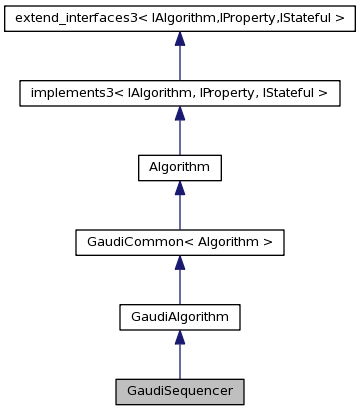
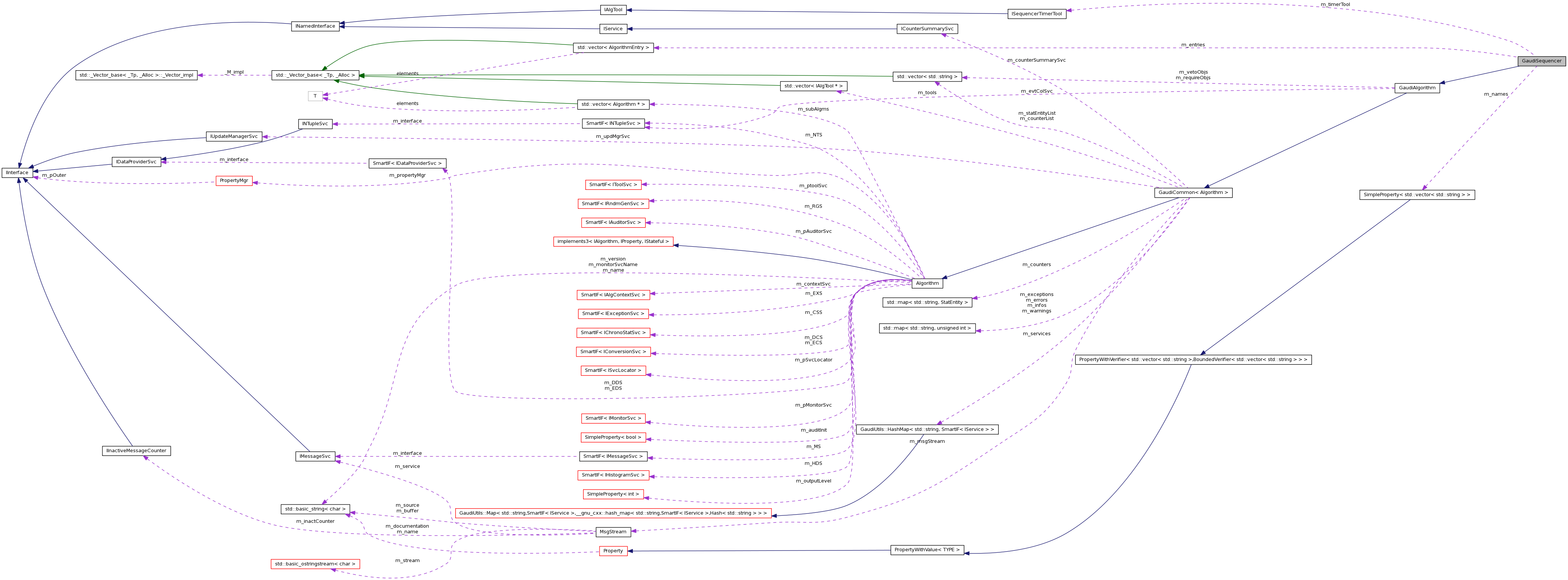
Sequencer for executing several algorithms, stopping when one is faulty. More...
#include <GaudiSequencer.h>
Classes | |
| class | AlgorithmEntry |
Public Member Functions | |
| GaudiSequencer (const std::string &name, ISvcLocator *pSvcLocator) | |
| Standard constructor. | |
| virtual | ~GaudiSequencer () |
| Destructor. | |
| virtual StatusCode | initialize () |
| Algorithm initialization. | |
| virtual StatusCode | execute () |
| Algorithm execution. | |
| virtual StatusCode | finalize () |
| Algorithm finalization. | |
| virtual StatusCode | beginRun () |
| Algorithm beginRun. | |
| virtual StatusCode | endRun () |
| Algorithm endRun. | |
| void | resetExecuted () |
| Called before an event processing. | |
| void | membershipHandler (Property &theProp) |
| for asynchronous changes in the list of algorithms | |
Protected Member Functions | |
| StatusCode | decodeNames () |
| Decode a vector of string. | |
Private Member Functions | |
| GaudiSequencer (const GaudiSequencer &a) | |
| Private copy, copy not allowed. | |
| GaudiSequencer & | operator= (const GaudiSequencer &a) |
| Private assignment operator: This is not allowed. | |
Private Attributes | |
| StringArrayProperty | m_names |
| Input string, list of algorithms. | |
| std::vector< AlgorithmEntry > | m_entries |
| List of algorithms to process. | |
| bool | m_modeOR |
| Indicates that the OR is wanted instead of AND. | |
| bool | m_shortCircuit |
| Indicates whether to stop processing as soon as possible, or to always execute _all_ subalgorithms. | |
| bool | m_ignoreFilter |
| True if one continues always. | |
| bool | m_isInitialized |
| Indicate that we are ready. | |
| bool | m_measureTime |
| Flag to measure time. | |
| bool | m_returnOK |
| Forces the sequencer to return a good status. | |
| ISequencerTimerTool * | m_timerTool |
| Pointer to the timer tool. | |
| int | m_timer |
| Timer number for the sequencer. | |
Sequencer for executing several algorithms, stopping when one is faulty.
Default behaviour (ModeOR=False) is to execute all algorithms until one returns filterPassed() = False. If ShortCircuit is set to False, then all algorithms will be executed.
In OR mode, the logic is opposite. All algorithms until one returns filterPassed() = True. To then exit one must onter-intuitively set ShortCircuit to False. If the default value ShortCircuit=True is left then all algorithms will be executed.
Definition at line 27 of file GaudiSequencer.h.
| GaudiSequencer::GaudiSequencer | ( | const std::string & | name, |
| ISvcLocator * | pSvcLocator | ||
| ) |
Standard constructor.
Definition at line 20 of file GaudiSequencer.cpp.
  : GaudiAlgorithm ( name , pSvcLocator )
  , m_timerTool( 0 )
{
  declareProperty( "Members"             , m_names                  );
  declareProperty( "ModeOR"              , m_modeOR         = false );
  declareProperty( "IgnoreFilterPassed"  , m_ignoreFilter   = false );
  declareProperty( "MeasureTime"         , m_measureTime    = false );
  declareProperty( "ReturnOK"            , m_returnOK       = false );
  declareProperty( "ShortCircuit"        , m_shortCircuit   = true  );

  m_names.declareUpdateHandler (& GaudiSequencer::membershipHandler, this );
}
| GaudiSequencer::~GaudiSequencer | ( | ) | [virtual] |
| GaudiSequencer::GaudiSequencer | ( | const GaudiSequencer & | a ) | [private] |
Private copy, copy not allowed.
| StatusCode GaudiSequencer::beginRun | ( | ) | [virtual] |
Algorithm beginRun.
Reimplemented from Algorithm.
Definition at line 160 of file GaudiSequencer.cpp.
                                      {

  if ( !isEnabled() ) return StatusCode::SUCCESS;

  if (msgLevel(MSG::DEBUG)) debug() << "==> beginRun" << endmsg;
  return StatusCode::SUCCESS;
}
| StatusCode GaudiSequencer::decodeNames | ( | ) | [protected] |
Decode a vector of string.
Definition at line 199 of file GaudiSequencer.cpp.
                                         {

  StatusCode final = StatusCode::SUCCESS;
  m_entries.clear();

  //== Get the "Context" option if in the file...
  IJobOptionsSvc* jos = svc<IJobOptionsSvc>( "JobOptionsSvc" );
  bool addedContext = false;  //= Have we added the context ?
  bool addedRootInTES = false;  //= Have we added the rootInTES ?
  bool addedGlobalTimeOffset = false;  //= Have we added the globalTimeOffset ?


  //= Get the Application manager, to see if algorithm exist
  IAlgManager* appMgr = svc<IAlgManager>("ApplicationMgr");
  const std::vector<std::string>& nameVector = m_names.value();
  std::vector<std::string>::const_iterator it;
  for ( it = nameVector.begin(); nameVector.end() != it; it++ ) {
    const Gaudi::Utils::TypeNameString typeName(*it);
    const std::string &theName = typeName.name();
    const std::string &theType = typeName.type();

    //== Check wether the specified algorithm already exists. If not, create it
    StatusCode result = StatusCode::SUCCESS;
    SmartIF<IAlgorithm> myIAlg = appMgr->algorithm(typeName, false); // do not create it now
    if ( !myIAlg.isValid() ) {
      //== Set the Context if not in the jobOptions list
      if ( ""  != context() ||
           ""  != rootInTES() ||
           0.0 != globalTimeOffset() ) {
        bool foundContext = false;
        bool foundRootInTES = false;
        bool foundGlobalTimeOffset = false;
        const std::vector<const Property*>* properties = jos->getProperties( theName );
        if ( 0 != properties ) {
          // Iterate over the list to set the options
          for ( std::vector<const Property*>::const_iterator itProp = properties->begin();
               itProp != properties->end();
               itProp++ )   {
            const StringProperty* sp = dynamic_cast<const StringProperty*>(*itProp);
            if ( 0 != sp )    {
              if ( "Context" == (*itProp)->name() ) {
                foundContext = true;
              }
              if ( "RootInTES" == (*itProp)->name() ) {
                foundRootInTES = true;
              }
              if ( "GlobalTimeOffset" == (*itProp)->name() ) {
                foundGlobalTimeOffset = true;
              }
            }
          }
        }
        if ( !foundContext && "" != context() ) {
          StringProperty contextProperty( "Context", context() );
          jos->addPropertyToCatalogue( theName, contextProperty ).ignore();
          addedContext = true;
        }
        if ( !foundRootInTES && "" != rootInTES() ) {
          StringProperty rootInTESProperty( "RootInTES", rootInTES() );
          jos->addPropertyToCatalogue( theName, rootInTESProperty ).ignore();
          addedRootInTES = true;
        }
        if ( !foundGlobalTimeOffset && 0.0 != globalTimeOffset() ) {
          DoubleProperty globalTimeOffsetProperty( "GlobalTimeOffset", globalTimeOffset() );
          jos->addPropertyToCatalogue( theName, globalTimeOffsetProperty ).ignore();
          addedGlobalTimeOffset = true;
        }
      }

      Algorithm *myAlg = 0;
      result = createSubAlgorithm( theType, theName, myAlg );
      // (MCl) this should prevent bug #35199... even if I didn't manage to
      // reproduce it with a simple test.
      if (result.isSuccess()) myIAlg = myAlg;
    } else {
      Algorithm *myAlg = dynamic_cast<Algorithm*>(myIAlg.get());
      if (myAlg) {
        subAlgorithms()->push_back(myAlg);
        // when the algorithm is not created, the ref count is short by one, so we have to fix it.
        myAlg->addRef();
      }
    }

    //== Remove the property, in case this is not a GaudiAlgorithm...
    if ( addedContext ) {
      jos->removePropertyFromCatalogue( theName, "Context" ).ignore();
      addedContext = false;
    }
    if ( addedRootInTES ) {
      jos->removePropertyFromCatalogue( theName, "RootInTES" ).ignore();
      addedRootInTES = false;
    }
    if ( addedGlobalTimeOffset ) {
      jos->removePropertyFromCatalogue( theName, "GlobalTimeOffset" ).ignore();
      addedGlobalTimeOffset = false;
    }

    // propagate the sub-algorithm into own state.
    if ( result.isSuccess () &&
         Gaudi::StateMachine::INITIALIZED <= FSMState() &&
         myIAlg.isValid   () &&
         Gaudi::StateMachine::INITIALIZED  > myIAlg->FSMState() )
    {
      StatusCode sc = myIAlg->sysInitialize() ;
      if  ( sc.isFailure() ) { result = sc ; }
    }

    // propagate the sub-algorithm into own state.
    if ( result.isSuccess () &&
         Gaudi::StateMachine::RUNNING <= FSMState() &&
         myIAlg.isValid   () &&
         Gaudi::StateMachine::RUNNING  > myIAlg->FSMState() )
    {
      StatusCode sc = myIAlg->sysStart () ;
      if  ( sc.isFailure() ) { result = sc ; }
    }

    //== Is it an Algorithm ?  Strange test...
    if ( result.isSuccess() ) {
      // TODO: (MCl) it is possible to avoid the dynamic_cast in most of the
      //             cases by keeping the result of createSubAlgorithm.
      Algorithm*  myAlg = dynamic_cast<Algorithm*>(myIAlg.get());
      if (myAlg!=0) {
        // Note: The reference counting is kept by the system of sub-algorithms
        m_entries.push_back( AlgorithmEntry( myAlg ) );
        if (msgLevel(MSG::DEBUG)) debug () << "Added algorithm " << theName << endmsg;
      } else {
        warning() << theName << " is not an Algorithm - failed dynamic_cast"
                  << endmsg;
        final = StatusCode::FAILURE;
      }
    } else {
      warning() << "Unable to find or create " << theName << endmsg;
      final = result;
    }

  }

  release(appMgr).ignore();
  release(jos).ignore();

  //== Print the list of algorithms
  MsgStream& msg = info();
  if ( m_modeOR ) msg << "OR ";
  msg << "Member list: ";
  std::vector<AlgorithmEntry>::iterator itE;
  for ( itE = m_entries.begin(); m_entries.end() != itE; itE++ ) {
    Algorithm* myAlg = (*itE).algorithm();
    std::string myAlgType = System::typeinfoName( typeid( *myAlg) ) ;
    if ( myAlg->name() == myAlgType ) {
      msg << myAlg->name();
    } else {
      msg << myAlgType << "/" << myAlg->name();
    }
    if ( itE+1 != m_entries.end() ) msg << ", ";
  }
  if ( "" != context() ) msg << ", with context '" << context() << "'";
  if ( "" != rootInTES() ) msg << ", with rootInTES '" << rootInTES() << "'";
  if ( 0.0 != globalTimeOffset() ) msg << ", with globalTimeOffset " << globalTimeOffset();
  msg << endmsg;

  return final;

}
| StatusCode GaudiSequencer::endRun | ( | ) | [virtual] |
Algorithm endRun.
Reimplemented from Algorithm.
Definition at line 171 of file GaudiSequencer.cpp.
                                    {

  if ( !isEnabled() ) return StatusCode::SUCCESS;

  if (msgLevel(MSG::DEBUG)) debug() << "==> endRun" << endmsg;
  return StatusCode::SUCCESS;
}
| StatusCode GaudiSequencer::execute | ( | ) | [virtual] |
Algorithm execution.
Reimplemented from GaudiAlgorithm.
Definition at line 82 of file GaudiSequencer.cpp.
                                   {

  if ( m_measureTime ) m_timerTool->start( m_timer );

  if (msgLevel(MSG::DEBUG)) debug() << "==> Execute" << endmsg;

  StatusCode result = StatusCode::SUCCESS;

  bool seqPass = !m_modeOR; //  for OR, result will be false, unless (at least) one is true
                            //  for AND, result will be true, unless (at least) one is false
                            //    also see comment below ....

  std::vector<AlgorithmEntry>::const_iterator itE;
  for ( itE = m_entries.begin(); m_entries.end() != itE; ++itE ) {
    Algorithm* myAlg = itE->algorithm();
    if ( ! myAlg->isEnabled() ) continue;
    if ( ! myAlg->isExecuted() ) {
      if ( m_measureTime ) m_timerTool->start( itE->timer() );
      result = myAlg->sysExecute();
      if ( m_measureTime ) m_timerTool->stop( itE->timer() );
      myAlg->setExecuted( true );
      if ( ! result.isSuccess() ) break;  //== Abort and return bad status
    }
    //== Check the returned status
    if ( !m_ignoreFilter ) {
      bool passed = myAlg->filterPassed();
      if (msgLevel(MSG::VERBOSE))
        verbose() << "Algorithm " << myAlg->name() << " returned filter passed "
                  << (passed ? "true" : "false") << endmsg;
      if ( itE->reverse() ) passed = !passed;


      //== indicate our own result. For OR, exit as soon as true.
      //        If no more, will exit with false.
      //== for AND, exit as soon as false. Else, will be true (default)

      // if not short-circuiting, make sure we latch iPass to 'true' in
      // OR mode (i.e. it is sufficient for one item to be true in order
      // to be true at the end, and thus we start out at 'false'), and latch
      // to 'false' in AND mode (i.e. it is sufficient for one item to
      // be false to the false in the end, and thus we start out at 'true')
      // -- i.e. we should not just blindly return the 'last' passed status!

      // or to put it another way: in OR mode, we don't care about things
      // which are false, as they leave our current state alone (provided
      // we stared as 'false'!), and in AND mode, we keep our current
      // state until someone returns 'false' (provided we started as 'true')
      if ( m_modeOR ? passed : !passed ) {
        seqPass = passed;
        if (msgLevel(MSG::VERBOSE))
          verbose() << "SeqPass is now " << (seqPass ? "true" : "false") << endmsg;
        if (m_shortCircuit) break;
      }
    }

  }
  if (msgLevel(MSG::VERBOSE))
      verbose() << "SeqPass is " << (seqPass ? "true" : "false") << endmsg;
  if ( !m_ignoreFilter && !m_entries.empty() ) setFilterPassed( seqPass );
  setExecuted( true );

  if ( m_measureTime ) m_timerTool->stop( m_timer );

  return m_returnOK ? StatusCode::SUCCESS : result;
}
| StatusCode GaudiSequencer::finalize | ( | ) | [virtual] |
Algorithm finalization.
Reimplemented from GaudiAlgorithm.
Definition at line 151 of file GaudiSequencer.cpp.
                                    {

  if (msgLevel(MSG::DEBUG)) debug() << "==> Finalize" << endmsg;
  return  GaudiAlgorithm::finalize();
}
| StatusCode GaudiSequencer::initialize | ( | ) | [virtual] |
Algorithm initialization.
Reimplemented from GaudiAlgorithm.
Definition at line 42 of file GaudiSequencer.cpp.
                                      {
  GaudiAlgorithm::initialize();

  if (msgLevel(MSG::DEBUG)) debug() << "==> Initialise" << endmsg;

  StatusCode status = decodeNames();
  if ( !status.isSuccess() ) return status;

  m_timerTool = tool<ISequencerTimerTool>( "SequencerTimerTool" );
  if ( m_timerTool->globalTiming() ) m_measureTime = true;

  if ( m_measureTime ) {
    m_timer = m_timerTool->addTimer( name() );
    m_timerTool->increaseIndent();
  } else {
    release( m_timerTool );
    m_timerTool = 0;
  }

  //== Initialize the algorithms
  std::vector<AlgorithmEntry>::iterator itE;
  for ( itE = m_entries.begin(); m_entries.end() != itE; itE++ ) {
    if ( m_measureTime ) {
      itE->setTimer( m_timerTool->addTimer( itE->algorithm()->name() ) );
    }

    status = itE->algorithm()->sysInitialize();
    if ( !status.isSuccess() ) {
      return Error( "Can not initialize " + itE->algorithm()->name(),
                    status );
    }
  }
  if ( m_measureTime ) m_timerTool->decreaseIndent();

  return StatusCode::SUCCESS;
}
| void GaudiSequencer::membershipHandler | ( | Property & | theProp ) |
for asynchronous changes in the list of algorithms
Definition at line 371 of file GaudiSequencer.cpp.
{
  // no action for not-yet initialized sequencer
  if ( Gaudi::StateMachine::INITIALIZED > FSMState() ) { return ; } // RETURN

  decodeNames().ignore();

  if  ( !m_measureTime ) { return ; }                                // RETURN

  // add the entries into timer table:

  if ( 0 == m_timerTool )
  { m_timerTool = tool<ISequencerTimerTool>( "SequencerTimerTool" ) ; }

  if ( m_timerTool->globalTiming() ) m_measureTime = true;

  m_timer = m_timerTool->addTimer( name() );
  m_timerTool->increaseIndent();

  for ( std::vector<AlgorithmEntry>::iterator itE = m_entries.begin() ;
        m_entries.end() != itE; ++itE )
  {
    itE->setTimer( m_timerTool->addTimer( itE->algorithm()->name() ) );
  }

  m_timerTool->decreaseIndent();

}
| GaudiSequencer& GaudiSequencer::operator= | ( | const GaudiSequencer & | a ) | [private] |
Private assignment operator: This is not allowed.
| void GaudiSequencer::resetExecuted | ( | ) | [virtual] |
Called before an event processing.
Reimplemented from Algorithm.
Definition at line 182 of file GaudiSequencer.cpp.
                                     {
  Algorithm::resetExecuted();
  // algorithm doesn't call resetExecuted of subalgos! should it???
  std::vector<AlgorithmEntry>::const_iterator itE;
  for ( itE = m_entries.begin(); m_entries.end() != itE; ++itE ) {
    itE->algorithm()->resetExecuted();
  }
}
std::vector<AlgorithmEntry> GaudiSequencer::m_entries [private] |
List of algorithms to process.
Definition at line 82 of file GaudiSequencer.h.
bool GaudiSequencer::m_ignoreFilter [private] |
True if one continues always.
Definition at line 87 of file GaudiSequencer.h.
bool GaudiSequencer::m_isInitialized [private] |
Indicate that we are ready.
Definition at line 88 of file GaudiSequencer.h.
bool GaudiSequencer::m_measureTime [private] |
Flag to measure time.
Definition at line 89 of file GaudiSequencer.h.
bool GaudiSequencer::m_modeOR [private] |
Indicates that the OR is wanted instead of AND.
Definition at line 83 of file GaudiSequencer.h.
StringArrayProperty GaudiSequencer::m_names [private] |
Input string, list of algorithms.
Definition at line 81 of file GaudiSequencer.h.
bool GaudiSequencer::m_returnOK [private] |
Forces the sequencer to return a good status.
Definition at line 90 of file GaudiSequencer.h.
bool GaudiSequencer::m_shortCircuit [private] |
Indicates whether to stop processing as soon as possible, or to always execute _all_ subalgorithms.
In MOdeOR=True the behaviour is the exact opposite.
Definition at line 84 of file GaudiSequencer.h.
int GaudiSequencer::m_timer [private] |
Timer number for the sequencer.
Definition at line 92 of file GaudiSequencer.h.
ISequencerTimerTool* GaudiSequencer::m_timerTool [private] |
Pointer to the timer tool.
Definition at line 91 of file GaudiSequencer.h.

