|
| virtual StatusCode | handle (const GslError &error) const |
| | handle the GSL error
|
| |
| virtual GslErrorHandler | handler () const |
| | retrieve the current GSL error handler
|
| |
| virtual GslErrorHandler | setHandler (GslErrorHandler handler) const |
| | set new GSL error handler
|
| |
| virtual StatusCode | status (const int error) const |
| | transform GSL error code to Gaudi status code
|
| |
| virtual StatusCode | initialize () |
| | standard service initialization
|
| |
| virtual StatusCode | finalize () |
| | standard service finalization
|
| |
| | GslSvc (const std::string &name, ISvcLocator *svc) |
| | Standard constructor.
|
| |
| virtual | ~GslSvc () |
| | destructor, virtual and protected
|
| |
| | extends1 (A1 a1, A2 a2, A3 a3) |
| | Templated constructor with 3 arguments.
|
| |
| | extends1 (A1 a1, A2 a2) |
| | Templated constructor with 2 arguments.
|
| |
| | extends1 (A1 a1) |
| | Templated constructor with 1 argument.
|
| |
| | extends1 () |
| | Default constructor.
|
| |
| virtual void * | i_cast (const InterfaceID &tid) const |
| | Implementation of IInterface::i_cast.
|
| |
| virtual StatusCode | queryInterface (const InterfaceID &ti, void **pp) |
| | Implementation of IInterface::queryInterface.
|
| |
| virtual std::vector< std::string > | getInterfaceNames () const |
| | Implementation of IInterface::getInterfaceNames.
|
| |
| virtual | ~extends1 () |
| | Virtual destructor.
|
| |
| virtual unsigned long | release () |
| | Release Interface instance.
|
| |
| virtual const std::string & | name () const |
| | Retrieve name of the service.
|
| |
| virtual StatusCode | configure () |
| |
| virtual StatusCode | start () |
| |
| virtual StatusCode | stop () |
| |
| virtual StatusCode | terminate () |
| |
| virtual Gaudi::StateMachine::State | FSMState () const |
| |
| virtual Gaudi::StateMachine::State | targetFSMState () const |
| |
| virtual StatusCode | reinitialize () |
| |
| virtual StatusCode | restart () |
| |
| virtual StatusCode | sysInitialize () |
| | Initialize Service.
|
| |
| virtual StatusCode | sysStart () |
| | Initialize Service.
|
| |
| virtual StatusCode | sysStop () |
| | Initialize Service.
|
| |
| virtual StatusCode | sysFinalize () |
| | Finalize Service.
|
| |
| virtual StatusCode | sysReinitialize () |
| | Re-initialize the Service.
|
| |
| virtual StatusCode | sysRestart () |
| | Re-initialize the Service.
|
| |
| virtual StatusCode | setProperty (const Property &p) |
| |
| virtual StatusCode | setProperty (const std::string &s) |
| |
| virtual StatusCode | setProperty (const std::string &n, const std::string &v) |
| |
| virtual StatusCode | getProperty (Property *p) const |
| |
| virtual const Property & | getProperty (const std::string &name) const |
| |
| virtual StatusCode | getProperty (const std::string &n, std::string &v) const |
| |
virtual const std::vector
< Property * > & | getProperties () const |
| |
| template<class TYPE > |
| StatusCode | setProperty (const std::string &name, const TYPE &value) |
| | set the property form the value
|
| |
| | Service (const std::string &name, ISvcLocator *svcloc) |
| | Standard Constructor.
|
| |
| SmartIF< ISvcLocator > & | serviceLocator () const |
| | Retrieve pointer to service locator.
|
| |
| StatusCode | setProperties () |
| | Method for setting declared properties to the values specified for the job.
|
| |
| template<class T > |
| StatusCode | service (const std::string &name, const T *&psvc, bool createIf=true) const |
| | Access a service by name, creating it if it doesn't already exist.
|
| |
| template<class T > |
| StatusCode | service (const std::string &name, T *&psvc, bool createIf=true) const |
| |
| template<class T > |
| StatusCode | service (const std::string &svcType, const std::string &svcName, T *&psvc) const |
| | Access a service by name and type, creating it if it doesn't already exist.
|
| |
| template<class T > |
| Property * | declareProperty (const std::string &name, T &property, const std::string &doc="none") const |
| | Declare the named property.
|
| |
| Property * | declareRemoteProperty (const std::string &name, IProperty *rsvc, const std::string &rname="") const |
| | Declare remote named properties.
|
| |
| SmartIF< IAuditorSvc > & | auditorSvc () const |
| | The standard auditor service.May not be invoked before sysInitialize() has been invoked.
|
| |
| | CommonMessaging (const A1 &a1, const A2 &a2, const A3 &a3) |
| | Templated constructor with 3 arguments.
|
| |
| | CommonMessaging (const A1 &a1, const A2 &a2) |
| | Templated constructor with 2 arguments.
|
| |
| | CommonMessaging (const A1 &a1) |
| | Templated constructor with 1 argument.
|
| |
| | CommonMessaging () |
| | Default constructor.
|
| |
| virtual | ~CommonMessaging () |
| | Virtual destructor.
|
| |
| SmartIF< IMessageSvc > & | msgSvc () const |
| | The standard message service.
|
| |
| MsgStream & | msgStream () const |
| | Return an uninitialized MsgStream.
|
| |
| MsgStream & | msgStream (const MSG::Level level) const |
| | Predefined configurable message stream for the efficient printouts.
|
| |
| MsgStream & | always () const |
| | shortcut for the method msgStream(MSG::ALWAYS)
|
| |
| MsgStream & | fatal () const |
| | shortcut for the method msgStream(MSG::FATAL)
|
| |
| MsgStream & | err () const |
| | shortcut for the method msgStream(MSG::ERROR)
|
| |
| MsgStream & | error () const |
| | shortcut for the method msgStream(MSG::ERROR)
|
| |
| MsgStream & | warning () const |
| | shortcut for the method msgStream(MSG::WARNING)
|
| |
| MsgStream & | info () const |
| | shortcut for the method msgStream(MSG::INFO)
|
| |
| MsgStream & | debug () const |
| | shortcut for the method msgStream(MSG::DEBUG)
|
| |
| MsgStream & | verbose () const |
| | shortcut for the method msgStream(MSG::VERBOSE)
|
| |
| MsgStream & | msg () const |
| | shortcut for the method msgStream(MSG::INFO)
|
| |
| MSG::Level | msgLevel () const |
| | get the output level from the embedded MsgStream
|
| |
| bool | msgLevel (MSG::Level lvl) const |
| | get the output level from the embedded MsgStream
|
| |
| virtual | ~extend_interfaces1 () |
| | Virtual destructor.
|
| |
| | DeclareInterfaceID (IGslSvc, 2, 0) |
| | InterfaceID.
|
| |
| | DeclareInterfaceID (IService, 3, 0) |
| | InterfaceID.
|
| |
| virtual StatusCode | sysInitialize ()=0 |
| | Initialize Service.
|
| |
| virtual StatusCode | sysStart ()=0 |
| | Start Service.
|
| |
| virtual StatusCode | sysStop ()=0 |
| | Stop Service.
|
| |
| virtual StatusCode | sysFinalize ()=0 |
| | Finalize Service.
|
| |
| virtual StatusCode | sysReinitialize ()=0 |
| | Re-initialize the Service.
|
| |
| virtual StatusCode | sysRestart ()=0 |
| | Re-start the Service.
|
| |
| virtual StatusCode | configure ()=0 |
| | Configuration (from OFFLINE to CONFIGURED).
|
| |
| virtual StatusCode | start ()=0 |
| | Start (from INITIALIZED to RUNNING).
|
| |
| virtual StatusCode | stop ()=0 |
| | Stop (from RUNNING to INITIALIZED).
|
| |
| virtual StatusCode | terminate ()=0 |
| | Initialization (from CONFIGURED to OFFLINE).
|
| |
| virtual StatusCode | reinitialize ()=0 |
| | Initialization (from INITIALIZED or RUNNING to INITIALIZED, via CONFIGURED).
|
| |
| virtual StatusCode | restart ()=0 |
| | Initialization (from RUNNING to RUNNING, via INITIALIZED).
|
| |
| virtual Gaudi::StateMachine::State | FSMState () const =0 |
| | Get the current state.
|
| |
| virtual Gaudi::StateMachine::State | targetFSMState () const =0 |
| | When we are in the middle of a transition, get the state where the transition is leading us.
|
| |
| | DeclareInterfaceID (INamedInterface, 1, 0) |
| | InterfaceID.
|
| |
| virtual const std::string & | name () const =0 |
| | Retrieve the name of the instance.
|
| |
| virtual | ~INamedInterface () |
| | Virtual destructor (always needed for abstract classes).
|
| |
| virtual unsigned long | addRef ()=0 |
| | Increment the reference count of Interface instance.
|
| |
| virtual unsigned long | release ()=0 |
| | Release Interface instance.
|
| |
| virtual unsigned long | refCount () const =0 |
| | Current reference count.
|
| |
| virtual | ~IInterface () |
| | Virtual destructor.
|
| |
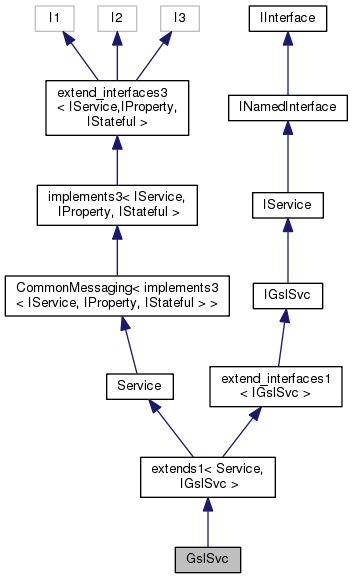
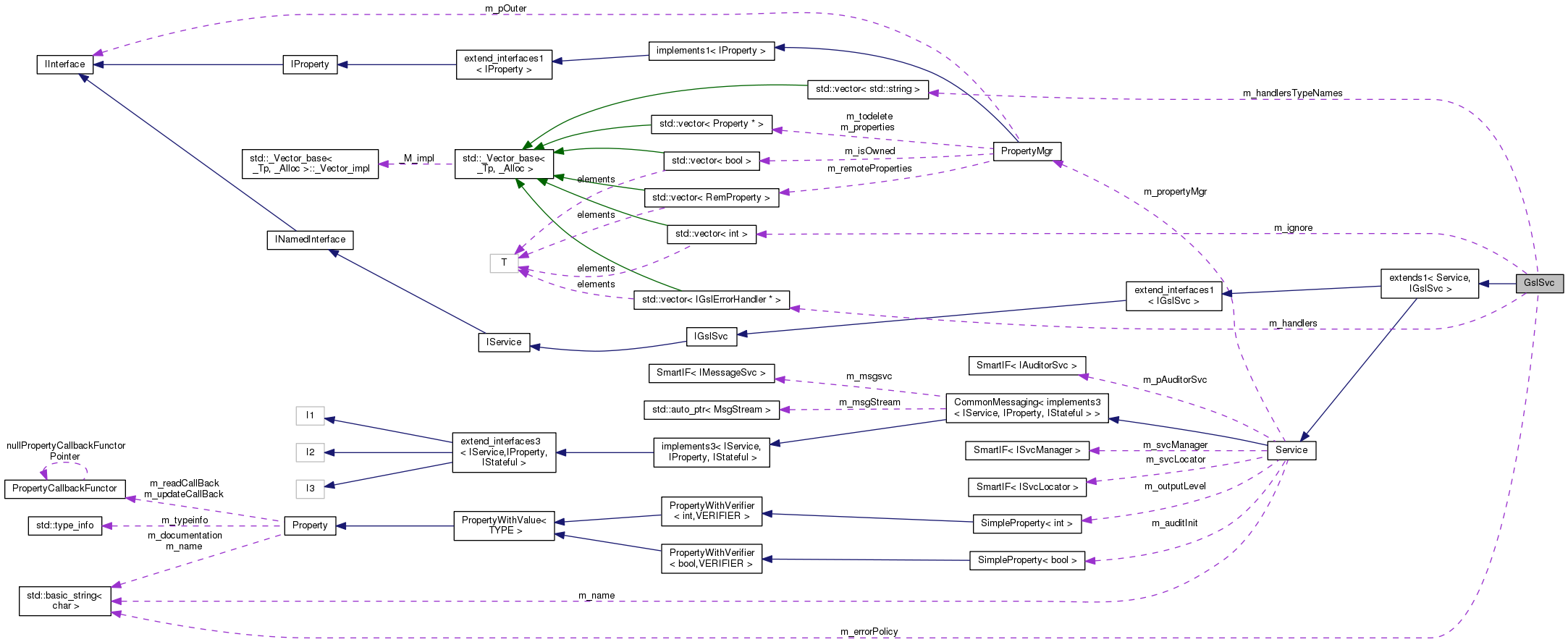
The implementation of IGslSvc interface.
The Gsl Service is teh service which perform intelligent error handling for GSL (GNU Scientific Library)
It provides a choice between different "Error Handling Policies"
Current implementation supports the several "error handling policies", which are driven by "ErrorPolicy" property of class GslSvc:
- "GSL": The simplest error policy, no action, the error hadling defined in GSL does not redefined
- "Off": The GSL empty error handling is used, what means the ignorance of all GSL errors. Program continues after any error, so the return values from any library routines must be checked. This policy is recommended by GSL team for production programs
- "Abort" The default GSL error policy, causes abort on error.
- Attention
- The error handling could be "turned off" for selected error codes (e.g. GSL_SUCCESS or GSL_CONTINUE ) using "IgnoreCodes" property. This feature is active only for "Handle" error policy.
- See Also
- GslErrorHandlers
-
GslErrorHandlers::ingnoreTheError
-
GslErrorHandlers::throwException
-
GslErrorHandlers::handleTheError
-
IGslSvc
-
IGslErrorHandler
-
GslErrorCount
-
GslErrorPrint
-
GslErrorException
- Author
- Vanya Belyaev Ivan..nosp@m.Bely.nosp@m.aev@i.nosp@m.tep..nosp@m.ru
- Date
- 29/04/2002
Definition at line 86 of file GslSvc.h.

 Public Member Functions inherited from extends1< Service, IGslSvc >
