
|
Gaudi Framework, version v23r9 |
| Home | Generated: Thu Jul 18 2013 |
|
|
Gaudi Framework, version v23r9 |
| Home | Generated: Thu Jul 18 2013 |
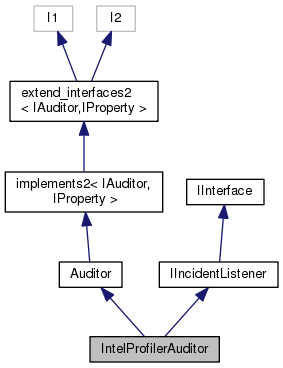
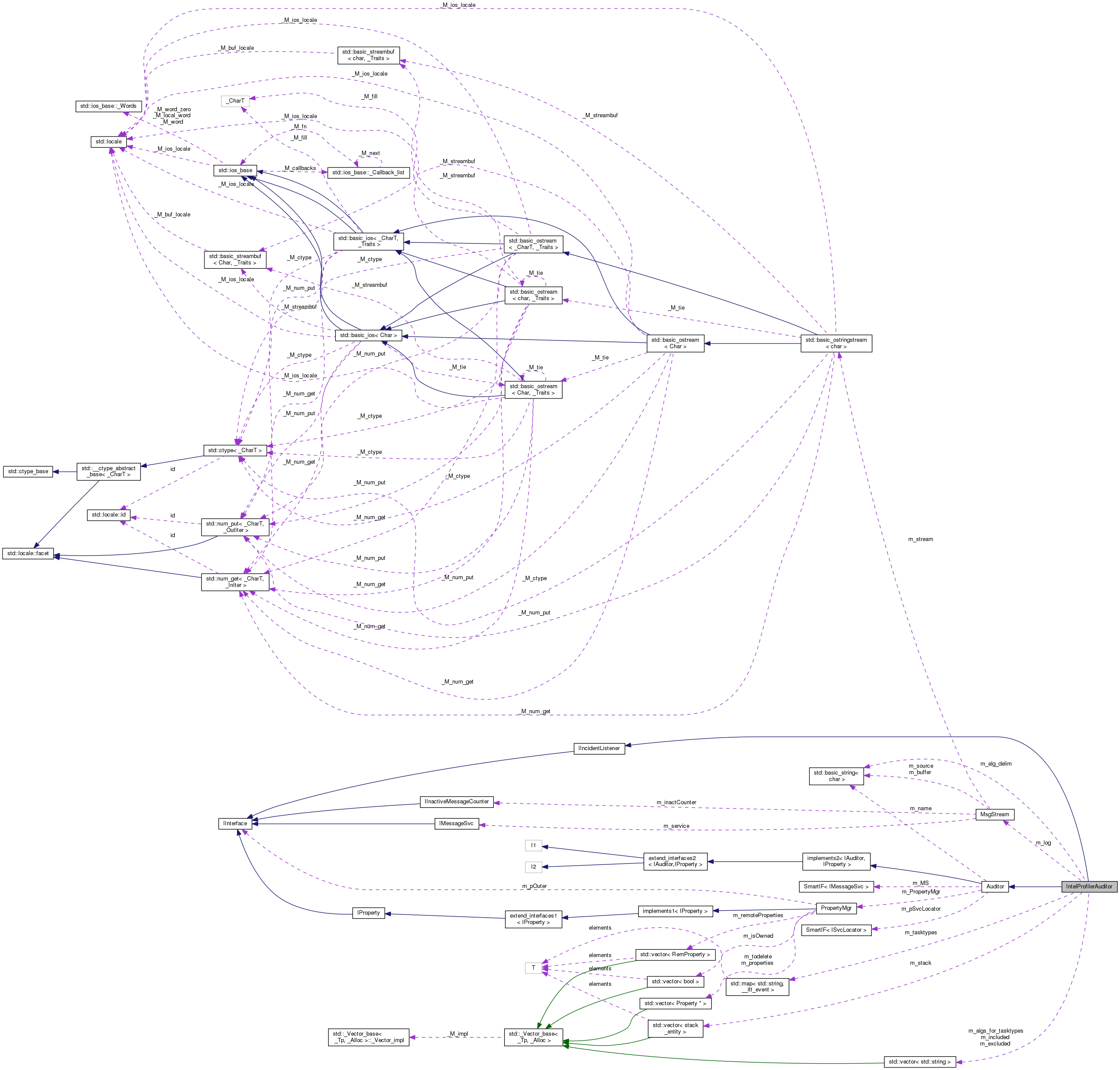
Classes | |
| struct | stack_entity |
Public Member Functions | |
| IntelProfilerAuditor (const std::string &name, ISvcLocator *pSvcLocator) | |
| StatusCode | initialize () |
| void | handle (const Incident &incident) |
| Inform that a new incident has occurred. | |
| void | before (StandardEventType type, INamedInterface *i) |
| The following methods are meant to be implemented by the child class... | |
| void | after (StandardEventType type, INamedInterface *i, const StatusCode &sc) |
 Public Member Functions inherited from Auditor Public Member Functions inherited from Auditor | |
| Auditor (const std::string &name, ISvcLocator *svcloc) | |
| Constructor. | |
| virtual | ~Auditor () |
| Destructor. | |
| StatusCode | sysInitialize () |
| Initialization method invoked by the framework. | |
| StatusCode | sysFinalize () |
| Finalization method invoked by the framework. | |
| virtual void | before (StandardEventType, const std::string &) |
| virtual void | before (CustomEventTypeRef, INamedInterface *) |
| virtual void | before (CustomEventTypeRef, const std::string &) |
| virtual void | after (StandardEventType, const std::string &, const StatusCode &) |
| virtual void | after (CustomEventTypeRef, INamedInterface *, const StatusCode &) |
| virtual void | after (CustomEventTypeRef, const std::string &, const StatusCode &) |
| virtual void | beforeInitialize (INamedInterface *) |
| virtual void | afterInitialize (INamedInterface *) |
| virtual void | beforeReinitialize (INamedInterface *) |
| virtual void | afterReinitialize (INamedInterface *) |
| virtual void | beforeExecute (INamedInterface *) |
| virtual void | afterExecute (INamedInterface *, const StatusCode &) |
| virtual void | beforeFinalize (INamedInterface *) |
| virtual void | afterFinalize (INamedInterface *) |
| virtual void | beforeBeginRun (INamedInterface *) |
| virtual void | afterBeginRun (INamedInterface *) |
| virtual void | beforeEndRun (INamedInterface *) |
| virtual void | afterEndRun (INamedInterface *) |
| virtual StatusCode | finalize () |
| virtual const std::string & | name () const |
| virtual bool | isEnabled () const |
| SmartIF< IMessageSvc > & | msgSvc () const |
| The standard message service. | |
| int | outputLevel () const |
| Retrieve the output level of current auditor. | |
| void | setOutputLevel (int level) |
| Set the output level for current auditor. | |
| SmartIF< ISvcLocator > & | serviceLocator () const |
| The standard service locator. | |
| template<class T > | |
| StatusCode | service (const std::string &name, T *&svc, bool createIf=false) const |
| Access a service by name, creating it if it doesn't already exist. | |
| virtual StatusCode | setProperty (const Property &p) |
| Set a value of a property of an auditor. | |
| virtual StatusCode | setProperty (const std::string &s) |
| Implementation of IProperty::setProperty. | |
| virtual StatusCode | setProperty (const std::string &n, const std::string &v) |
| Implementation of IProperty::setProperty. | |
| virtual StatusCode | getProperty (Property *p) const |
| Get the value of a property. | |
| virtual const Property & | getProperty (const std::string &name) const |
| Get the property by name. | |
| virtual StatusCode | getProperty (const std::string &n, std::string &v) const |
| Implementation of IProperty::getProperty. | |
| const std::vector< Property * > & | getProperties () const |
| Get all properties. | |
| template<class TYPE > | |
| StatusCode | setProperty (const std::string &name, const TYPE &value) |
| set the property form the value | |
| StatusCode | setProperties () |
| Set the auditor's properties. | |
| template<class T > | |
| Property * | declareProperty (const std::string &name, T &property, const std::string &doc="none") const |
| Declare the named property. | |
| Public Member Functions inherited from IIncidentListener | |
| DeclareInterfaceID (IIncidentListener, 2, 0) | |
| InterfaceID. | |
| Public Member Functions inherited from IInterface | |
| virtual void * | i_cast (const InterfaceID &) const =0 |
| main cast function | |
| virtual std::vector< std::string > | getInterfaceNames () const =0 |
| Returns a vector of strings containing the names of all the implemented interfaces. | |
| virtual unsigned long | addRef ()=0 |
| Increment the reference count of Interface instance. | |
| virtual unsigned long | release ()=0 |
| Release Interface instance. | |
| virtual unsigned long | refCount () const =0 |
| Current reference count. | |
| virtual StatusCode | queryInterface (const InterfaceID &ti, void **pp)=0 |
| Set the void** to the pointer to the requested interface of the instance. | |
| virtual | ~IInterface () |
| Virtual destructor. | |
Private Member Functions | |
| void | start_profiling_component (const std::string &name) |
| void | skip_profiling_component (const std::string &name) |
| void | start () |
| void | pause () |
| void | resume () |
| void | stop () |
| bool | hasIncludes () const |
| bool | isIncluded (const std::string &name) const |
| bool | isExcluded (const std::string &name) const |
| bool | isRunning () const |
| int | stackLevel () const |
| std::string | stackIndent (bool newLevel=false) const |
| std::string | taskTypeName (const std::string &component_name) const |
Private Attributes | |
| int | m_nStartFromEvent |
| int | m_nStopAtEvent |
| std::vector< std::string > | m_excluded |
| std::vector< std::string > | m_included |
| std::vector< std::string > | m_algs_for_tasktypes |
| std::string | m_alg_delim |
| bool | m_enable_frames |
| int | m_frames_rate |
| MsgStream | m_log |
| int | m_nEvents |
| __itt_domain * | domain |
| bool | m_isStarted |
| std::vector< stack_entity > | m_stack |
| TaskTypes | m_tasktypes |
Additional Inherited Members | |
| Public Types inherited from implements2< IAuditor, IProperty > | |
| typedef implements2 | base_class |
| Typedef to this class. | |
| typedef extend_interfaces2 < IAuditor, IProperty > | extend_interfaces_base |
| Typedef to the base of this class. | |
| typedef extend_interfaces_base::ext_iids | interfaces |
| MPL set of all the implemented interfaces. | |
| Public Types inherited from IInterface | |
| enum | Status { SUCCESS = 1, NO_INTERFACE, VERSMISMATCH, LAST_ERROR } |
| Return status. More... | |
| typedef Gaudi::InterfaceId < IInterface, 0, 0 > | iid |
| Interface ID. | |
| typedef mpl::set1< iid > | ext_iids |
| Extra interfaces. | |
| Static Public Member Functions inherited from IInterface | |
| static const InterfaceID & | interfaceID () |
| Return an instance of InterfaceID identifying the interface. | |
Definition at line 35 of file IntelProfilerAuditor.cpp.
| IntelProfilerAuditor::IntelProfilerAuditor | ( | const std::string & | name, |
| ISvcLocator * | pSvcLocator | ||
| ) |
Definition at line 123 of file IntelProfilerAuditor.cpp.
|
virtual |
Reimplemented from Auditor.
Definition at line 398 of file IntelProfilerAuditor.cpp.
|
virtual |
The following methods are meant to be implemented by the child class...
Reimplemented from Auditor.
Definition at line 351 of file IntelProfilerAuditor.cpp.
|
virtual |
Inform that a new incident has occurred.
Implements IIncidentListener.
Definition at line 333 of file IntelProfilerAuditor.cpp.
|
private |
Definition at line 238 of file IntelProfilerAuditor.cpp.
|
virtual |
Reimplemented from Auditor.
Definition at line 278 of file IntelProfilerAuditor.cpp.
|
private |
Definition at line 247 of file IntelProfilerAuditor.cpp.
|
private |
Definition at line 242 of file IntelProfilerAuditor.cpp.
|
private |
|
private |
Definition at line 219 of file IntelProfilerAuditor.cpp.
|
private |
Definition at line 213 of file IntelProfilerAuditor.cpp.
|
private |
Definition at line 225 of file IntelProfilerAuditor.cpp.
|
private |
Definition at line 260 of file IntelProfilerAuditor.cpp.
|
private |
Definition at line 256 of file IntelProfilerAuditor.cpp.
|
private |
Definition at line 162 of file IntelProfilerAuditor.cpp.
|
private |
Definition at line 167 of file IntelProfilerAuditor.cpp.
|
private |
Definition at line 232 of file IntelProfilerAuditor.cpp.
|
private |
Definition at line 267 of file IntelProfilerAuditor.cpp.
|
private |
Definition at line 95 of file IntelProfilerAuditor.cpp.
|
private |
Definition at line 80 of file IntelProfilerAuditor.cpp.
|
private |
Definition at line 77 of file IntelProfilerAuditor.cpp.
|
private |
Definition at line 82 of file IntelProfilerAuditor.cpp.
|
private |
Definition at line 73 of file IntelProfilerAuditor.cpp.
|
private |
Definition at line 88 of file IntelProfilerAuditor.cpp.
|
private |
Definition at line 75 of file IntelProfilerAuditor.cpp.
|
private |
Definition at line 97 of file IntelProfilerAuditor.cpp.
|
private |
Definition at line 91 of file IntelProfilerAuditor.cpp.
|
private |
Definition at line 93 of file IntelProfilerAuditor.cpp.
|
private |
Definition at line 68 of file IntelProfilerAuditor.cpp.
|
private |
Definition at line 71 of file IntelProfilerAuditor.cpp.
|
private |
Definition at line 99 of file IntelProfilerAuditor.cpp.
|
private |
Definition at line 101 of file IntelProfilerAuditor.cpp.

