Gaudi Framework, version v24r2

Home   Generated: Wed Dec 4 2013
 All Classes Namespaces Files Functions Variables Typedefs Enumerations Enumerator Properties Friends Macros Groups Pages
Public Types | Public Member Functions | Static Public Member Functions | Static Public Attributes | Private Member Functions | Private Attributes | Friends | List of all members
Gaudi::Time Class Reference

Based on seal::Time. More...

#include <GaudiKernel/Time.h>

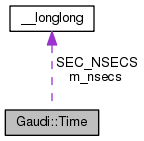
Collaboration diagram for Gaudi::Time:
Collaboration graph
[legend]

Public Types

enum  Months {
  January = 0, February = 1, March = 2, April = 3,
  May = 4, June = 5, July = 6, August = 7,
  September = 8, October = 9, November = 10, December = 11
}
 Symbolic names for months. More...
 
typedef longlong ValueType
 

Public Member Functions

 Time (void)
 Initialize an empty (zero) time value.
 
 Time (TimeSpan ts)
 Initialize time to ts nanoseconds since 00:00:00 on January 1, 1970 in UTC.
 
 Time (ValueType nsecs)
 Initialize time to nsecs nanoseconds since 00:00:00 on January 1, 1970 in UTC.
 
 Time (ValueType secs, int nsecs)
 Initialize time to secs (seconds) and nsecs (nanoseconds) summed since 00:00:00 on January 1, 1970 in UTC.
 
 Time (int year, int month, int day, int hour, int min, int sec, ValueType nsecs, bool local=true)
 
tm split (bool local, int *nsecpart=0) const
 Break up the time to the standard representation, either in UTC (if local is false) or local time (if local is true).
 
tm utc (int *nsecpart=0) const
 Break up the time to the standard library representation, keeping it in UTC.
 
tm local (int *nsecpart=0) const
 Break up the time to the standard library representation, converting it first to local time.
 
int year (bool local) const
 Get the year.
 
int month (bool local) const
 Get the month, numbered [0,11].
 
int day (bool local) const
 Get the day of month, numbered [1,31].
 
int hour (bool local) const
 Get the hour, numbered [0, 23].
 
int minute (bool local) const
 Get the minute, numbered [0, 59].
 
int second (bool local) const
 Get the seconds, numbered [0,61] (allowing one or two leap seconds, years with leap seconds can have the time Dec 31, 23:59:60 (or :61).)
 
int nsecond (void) const
 Get the nanoseconds.
 
int weekday (bool local) const
 Get the day of week, numbered [0,6] and starting from Sunday.
 
bool isdst (bool local) const
 Check whether daylight savings is in effect.
 
ValueType utcoffset (int *daylight=0) const
 Return the number of nanoseconds that needs to be added to UTC to translate this time to the local time (= nanoseconds east of UTC).
 
const char * timezone (int *daylight=0) const
 Return the local timezone name that applies at this time value.
 
Timeoperator+= (const TimeSpan &x)
 Add the specified amount to the time.
 
Timeoperator-= (const TimeSpan &x)
 Subtract the specified amount from the time.
 
ValueType ns (void) const
 Return the time as nanoseconds since 00:00:00 on January 1, 1970 in UTC.
 
std::string format (bool local, std::string spec="%c") const
 Format the time using strftime.
 
std::string nanoformat (size_t minwidth=1, size_t maxwidth=9) const
 Format the nanosecond fractional part of the time as a string.
 

Static Public Member Functions

static Time epoch (void)
 Returns the minimum time.
 
static Time max (void)
 Returns the maximum time.
 
static Time current (void)
 Returns the current time.
 
static Time build (bool local, const tm &base, TimeSpan diff=0)
 Construct a time from local time base and a delta diff.
 
static bool isLeap (int year)
 Check if the year is a leap-year.
 
static unsigned toDosDate (Time time)
 Convert the #Time t into a MS-DOS date format.
 
static Time fromDosDate (unsigned dosDate)
 Convert the MS-DOS date dosDate into a #Time.
 

Static Public Attributes

static const int SECS_PER_DAY = 86400
 Seconds in 24 hours.
 
static const int SECS_PER_HOUR = 3600
 Seconds in one hour hour.
 
static const ValueType SEC_NSECS = 1000000000
 Nanoseconds in one second.
 

Private Member Functions

void TimeAssert (bool cond, const std::string &msg="time assertion failed") const
 

Private Attributes

ValueType m_nsecs
 

Friends

class TimeSpan
 

Detailed Description

Based on seal::Time.

Calendar time in nanoseconds since 00:00:00 on January 1, 1970, Coordinated Universal Time (UTC).

#Time is represented internally as UTC time, but it can also be converted to the local time as necessary. Most methods take an argument flag local to indicate which time interpretation is desired by the client, and automatically perform the necessary adjustments. The client can also find out about the difference between UTC time and local time using the #utcoffset() method, and the time zone name with #timezone() method. Both allow the client to discover whether daylight savings is in effect.

The native representation of #Time is not well suited for human handling of time. #Time provides access in more convenient terms such as #year(), #month() and #day(); more are available through conversion into a #TimeSpan. #Time can also be converted to and from ISO C standard tm structure. Note however that unlike C's mktime() which always assumes tm in local time, #Time fully supports all conversions between local and universal time. Thus it is possible for example to build() a UTC time directly from a tm.

#Time behaves as an integral type. Differences in time values are represented as a #TimeSpan. Usual integral arithmetic works with both types. Output works in general as any other integral type, however since the #ValueType can be a wide type, it may be poorly supported by the iostream; if so, including the LongLong.h header will help. Note that the output value will usually be very large as #Time is represented in nanoseconds, not seconds! When constructing #Time values in seconds, such as when reading in, do remember to use the two-argument constructor taking seconds and nanoseconds instead of the default single-argument one.

#Time can be formatted into a string using the format() method, which uses the versatile strftime() function. Since the latter works on seconds at best (through a struct tm), the subsecond part cannot be formatted; the #nanoformat() method is provided to overcome this limitation. To combine format() and #nanoformat() output use a suitable #StringFormat pattern.

#Time is linked to the system's concept of calendar time and is therefore may not be linear nor monotonic. System time can jump arbitrarily in either direction as real time clock is corrected or the system is suspended. The local time may also jump due to daylight savings. The process' ability to sample system time can be limited for reasons such as getting swapped out. #TimeInfo provides an alternative time measurement facility not linked to calendar and guaranteed to grow monotonically – though not always linearly. Note that few systems actually provide wall-clock time in nanosecond resolution. Not all system provide an interface to get time at that resolution, let alone track it so precisely.

Because of the time warp issues, scheduling events using #Time is not straightforward. Application code should understand whether it is dealing with concrete or abstract calendar calculations, and how the events it schedules are linked to wall clock time.

For calculations on concrete calendar as perceived by people use #local() after plain #Time and #TimeSpan integer arithmetic. The method accounts for timezone and daylight savings definitions. To schedule events use build() to derive times from #local() time to get values comparable to the system time returned by #current(). The applications should know whether events are scheduled in UTC or local time—"meeting at 9:00 on Wednesday morning" when the device switches timezones may be known to be at 9:00 in the new timezone (= locked to local time), or in the timezone where the event was created (= locked to UTC). The build() and #split() methods allow either format to be used, the application just needs to know which one to use. It is also easy to convert between the two using #utcoffset().

For calculations using an abstract calendar, without timezone or daylight savings, use #Time in its native UTC representation and integer arithmetic with #Time and #TimeSpan. Do note however that "T + 24 hours" may not be the same hour the next day in the local calendar time – timezone changes and daylight savings make a difference. This may require the application to accept as user input exception rules to its usual calendar calculations.

To schedule events, one should choose between three choices: UTC time, local time, or delta time. For the first two cases system time should be polled regularly to see if any of the recorded events have expired. It is not a good idea to sleep until the next scheduled event, as the system time may jump during the nap; instead sleep small increments, recheck the current time after each nap and trigger the events that have expired. A policy must be applied when the system time warps; this can happen both forwards and backwards with both local and UTC time (daylight savings or timezone changes for mobile devices are common local time change reasons, but the system time can be updated for any reason, e.g. when the real time clock is wrong, or if the system is suspended for a long time). Some events should be executed only once in case of time warps backwards. If the time jumps forwards, several events may need to be dealt with in one go. In either case the application should guard against major time changes: long system suspends, moving mobile devices and major time updates may result in a large number of "missed" events. One possibility is to provide a user-configurable "excessive time drift limit" (e.g. N hours): if time changes by more than that, missed events are not triggered.

For the final case of using delta times, sort upcoming events by their deltas from the previous event—not by the time they are anticipated to occur. Capture current time before and after the sleep and pull events off the queue based on the difference (the sleep time may exceed the requested time). Either guard against long time warps like suspends or schedule timer events cautiously. Using #TimeInfo as schedule base solves such issues simply. To cope with backward system time jumps when using #Time as schedule base, assume that sleeps always last at least the requested time; if the time delta over the nap is less than the requested, assume time warp (this is not foolproof against interrupted system calls but works for many event scheduling situations).

See Also
#TimeInfo for monotonic time not related to the calendar. (Documentation taken from original SEAL class)
Author
Marco Clemencic
Date
2005-12-15

Definition at line 214 of file Time.h.

Member Typedef Documentation

typedef longlong Gaudi::Time::ValueType

Definition at line 217 of file Time.h.

Member Enumeration Documentation

enum Gaudi::Time::Months

Symbolic names for months.

Enumerator:
January 
February 
March 
April 
May 
June 
July 
August 
September 
October 
November 
December 

Definition at line 220 of file Time.h.

{
January = 0,
February = 1,
March = 2,
April = 3,
May = 4,
June = 5,
July = 6,
August = 7,
September = 8,
October = 9,
November = 10,
December = 11
};

Constructor & Destructor Documentation

Gaudi::Time::Time ( void  )
inline

Initialize an empty (zero) time value.

Definition at line 10 of file Time.icpp.

: m_nsecs(0) {}
Gaudi::Time::Time ( TimeSpan  ts)
inline

Initialize time to ts nanoseconds since 00:00:00 on January 1, 1970 in UTC.

Definition at line 20 of file Time.icpp.

: m_nsecs(ts.m_nsecs) {
TimeAssert( m_nsecs >= 0, "cannot create a negative time");
}
Gaudi::Time::Time ( ValueType  nsecs)
inline

Initialize time to nsecs nanoseconds since 00:00:00 on January 1, 1970 in UTC.

Definition at line 14 of file Time.icpp.

: m_nsecs(nsecs) {
TimeAssert( m_nsecs >= 0, "cannot create a negative time");
}
Gaudi::Time::Time ( ValueType  secs,
int  nsecs 
)
inline

Initialize time to secs (seconds) and nsecs (nanoseconds) summed since 00:00:00 on January 1, 1970 in UTC.

Definition at line 26 of file Time.icpp.

: m_nsecs(secs * Time::SEC_NSECS + nsecs) {
TimeAssert( m_nsecs >= 0, "cannot create a negative time");
}
Time::Time ( int  year,
int  month,
int  day,
int  hour,
int  min,
int  sec,
ValueType  nsecs,
bool  local = true 
)

Definition at line 81 of file Time.cpp.

{
tm val;
memset (&val, 0, sizeof (val));
val.tm_sec = sec;
val.tm_min = min;
val.tm_hour = hour;
val.tm_mday = day;
val.tm_mon = month;
val.tm_year = year > 1900 ? year - 1900 : year;
val.tm_isdst = -1; // FIXME?
m_nsecs = build (local, val, nsecs).m_nsecs;
}

Member Function Documentation

Time Time::build ( bool  local,
const tm &  base,
TimeSpan  diff = 0 
)
static

Construct a time from local time base and a delta diff.

Definition at line 137 of file Time.cpp.

{
tm tmp (base);
return Time (local ? mktime(&tmp) : timegm(&tmp), 0) + diff;
}
Time Time::current ( void  )
static

Returns the current time.

Return the current system time.

Definition at line 114 of file Time.cpp.

{
#ifdef WIN32
FILETIME ftime;
GetSystemTimeAsFileTime (&ftime);
return from (&ftime);
#else
timeval tv;
if (gettimeofday (&tv, 0) != 0) {
char buf[256];
tag << "errno=" << errno;
if( strerror_r(errno, buf, 256) == 0 ) {
msg << buf;
} else {
msg << "Unknown error retrieving current time";
}
throw GaudiException(msg.str(),tag.str(),StatusCode::FAILURE);
}
return Time (tv.tv_sec, tv.tv_usec * 1000);
#endif
}
int Time::day ( bool  local) const

Get the day of month, numbered [1,31].

Definition at line 186 of file Time.cpp.

{
return split (local).tm_mday;
}
Time Gaudi::Time::epoch ( void  )
inlinestatic

Returns the minimum time.

Return the time for the epoch (= zero time).

Definition at line 54 of file Time.icpp.

{
return 0LL;
}
std::string Time::format ( bool  local,
std::string  spec = "%c" 
) const

Format the time using strftime.

The additional conversion specifier f can be used to display milliseconds (extension for compatibility with MessageSvc time format).

: This doesn't account for nsecs part!

Definition at line 280 of file Time.cpp.

{
std::string result;
tm time = split (local);
// handle the special case of "%f"
std::string::size_type pos = spec.find("%f");
if (std::string::npos != pos) {
// Get the milliseconds string
// Replace all the occurrences of '%f' (if not preceded by '%')
while (std::string::npos != pos) {
if (pos != 0 && spec[pos-1] != '%') {
spec.replace(pos, 2, ms);
}
pos = spec.find("%f", pos + 1); // search for the next occurrence
}
}
const int MIN_BUF_SIZE = 128;
do
{
// Guess how much we'll expand. If we go wrong, we'll expand again. (with a minimum)
result.resize(std::max<std::string::size_type>(result.size()*2,
std::max<std::string::size_type>(spec.size()*2, MIN_BUF_SIZE))
, 0);
length = ::strftime (&result[0], result.size(), spec.c_str(), &time);
} while (! length);
result.resize (length);
return result;
}
Time Time::fromDosDate ( unsigned  dosDate)
static

Convert the MS-DOS date dosDate into a #Time.

Definition at line 361 of file Time.cpp.

{
// DOS times are generally local; treat it as UTC. This avoids
// any round-trip conversion and leaves only a presentation as an
// issue. Since not much can be known about the origin of the DOS
// times, it's generally best to present them as such (= in UTC).
struct tm localtm;
memset (&localtm, 0, sizeof (localtm));
localtm.tm_mday = (dosDate >> 16) & 0x1f;
localtm.tm_mon = ((dosDate >> 21) & 0xf) - 1;
localtm.tm_year = ((dosDate >> 25) & 0x7f) + 80;
localtm.tm_hour = (dosDate >> 11) & 0x1f;
localtm.tm_min = (dosDate >> 5) & 0x3f;
localtm.tm_sec = (dosDate & 0x1f) * 2;
localtm.tm_isdst = -1;
return Time (mktime (&localtm), 0);
}
int Time::hour ( bool  local) const

Get the hour, numbered [0, 23].

Definition at line 191 of file Time.cpp.

{
return split (local).tm_hour;
}
bool Time::isdst ( bool  local) const

Check whether daylight savings is in effect.

This really only makes sense if local is true since daylight savings is never in effect for UTC time.

Definition at line 222 of file Time.cpp.

{
return split (local).tm_isdst > 0;
}
bool Gaudi::Time::isLeap ( int  year)
inlinestatic

Check if the year is a leap-year.

Definition at line 64 of file Time.icpp.

{
return ((year % 4) == 0
&& ((year % 100) != 0
|| (year % 400) == 0));
}
tm Time::local ( int nsecpart = 0) const

Break up the time to the standard library representation, converting it first to local time.

If nsecpart is non-null, it is set to the nanosecond part that cannot be stored into tm.

Definition at line 171 of file Time.cpp.

{
return split (true, nsecpart);
}
Time Gaudi::Time::max ( void  )
inlinestatic

Returns the maximum time.

Return the maximum time.

Definition at line 59 of file Time.icpp.

{
return 0x7fffffffffffffffLL;
}
int Time::minute ( bool  local) const

Get the minute, numbered [0, 59].

Definition at line 196 of file Time.cpp.

{
return split (local).tm_min;
}
int Time::month ( bool  local) const

Get the month, numbered [0,11].

Definition at line 181 of file Time.cpp.

{
return split (local).tm_mon;
}
std::string Time::nanoformat ( size_t  minwidth = 1,
size_t  maxwidth = 9 
) const

Format the nanosecond fractional part of the time as a string.

The arguments control the representation of the resulting value. The nanosecond part is printed as fixed nine-character-wide number and then excess zeroes are stripped off at the right end. Use minwidth to force a specific number number of them to be left intact: the resulting number will have at least that many digits. Use maxwidth to truncate the value: the resulting number will have at most that many digits. Both minwidth and maxwidth must be between one and nine inclusive and minwidth must be less or equal to maxwidth.

Definition at line 323 of file Time.cpp.

{
TimeAssert( (minwidth >= 1) && (minwidth <= maxwidth) && (maxwidth <= 9),
"nanoformat options do not satisfy: 1 <= minwidth <= maxwidth <= 9");
// Calculate the nanosecond fraction. This will be < 1000000000.
int value = (int)(m_nsecs % SEC_NSECS);
buf.fill('0');
buf.width(9);
buf << value;
std::string out = buf.str();
// Find the last non-0 char before maxwidth, but after minwidth
// (Note: -1 and +1 are to account for difference between position and size.
// moreover, npos + 1 == 0, so it is correct to say that 'not found' means size of 0)
size_t len = out.find_last_not_of('0', maxwidth - 1) + 1;
// Truncate the output string to at least minwidth chars
out.resize(std::max(len, minwidth));
return out;
}
Time::ValueType Gaudi::Time::ns ( void  ) const
inline

Return the time as nanoseconds since 00:00:00 on January 1, 1970 in UTC.

Definition at line 33 of file Time.icpp.

{
return m_nsecs;
}
int Time::nsecond ( void  ) const

Get the nanoseconds.

There is no local argument since time zone and daylight savings never affects the value at the subsecond granularity.

Definition at line 210 of file Time.cpp.

{
return (int)(m_nsecs % SEC_NSECS);
}
Time & Gaudi::Time::operator+= ( const TimeSpan x)
inline

Add the specified amount to the time.

Note that #Time is always expressed in UTC.

Definition at line 39 of file Time.icpp.

{
TimeAssert( m_nsecs >= -x.m_nsecs, "time operation lead to negative time");
m_nsecs += x.m_nsecs;
return *this;
}
Time & Gaudi::Time::operator-= ( const TimeSpan x)
inline

Subtract the specified amount from the time.

Note that #Time is always expressed in UTC.

Definition at line 47 of file Time.icpp.

{
TimeAssert( m_nsecs >= x.m_nsecs, "time operation lead to negative time");
m_nsecs -= x.m_nsecs;
return *this;
}
int Time::second ( bool  local) const

Get the seconds, numbered [0,61] (allowing one or two leap seconds, years with leap seconds can have the time Dec 31, 23:59:60 (or :61).)

Definition at line 203 of file Time.cpp.

{
return split (local).tm_sec;
}
tm Time::split ( bool  local,
int nsecpart = 0 
) const

Break up the time to the standard representation, either in UTC (if local is false) or local time (if local is true).

If nsecpart is non-null, it is set to the nanosecond part that cannot be stored into tm.

Definition at line 146 of file Time.cpp.

{
if (nsecpart)
*nsecpart = (int)(m_nsecs % SEC_NSECS);
time_t val = (time_t)(m_nsecs / SEC_NSECS);
tm retval;
if (local)
localtime_r(&val, &retval);
else
gmtime_r(&val, &retval);
return retval;
}
void Gaudi::Time::TimeAssert ( bool  cond,
const std::string msg = "time assertion failed" 
) const
inlineprivate

Definition at line 299 of file Time.h.

{
if (!cond) throw TimeException(msg);
}
const char * Time::timezone ( int daylight = 0) const

Return the local timezone name that applies at this time value.

On some platforms returns the most recent timezone name (dst or non-dst one depending on the time value), not the one that applies at the time value.

Definition at line 266 of file Time.cpp.

{
tm localtm = local ();
if (daylight) *daylight = localtm.tm_isdst;
// extern "C" { extern char *tzname [2]; }
return tzname [localtm.tm_isdst > 0 ? 1 : 0];
}
unsigned Time::toDosDate ( Time  time)
static

Convert the #Time t into a MS-DOS date format.

Definition at line 346 of file Time.cpp.

{
// Use local time since DOS does too.
struct tm localtm = time.local ();
unsigned mday = localtm.tm_mday;
unsigned mon = localtm.tm_mon + 1;
unsigned year = (localtm.tm_year > 80 ? localtm.tm_year - 80 : 0);
unsigned sec = localtm.tm_sec / 2;
unsigned min = localtm.tm_min;
unsigned hour = localtm.tm_hour;
return (mday << 16 | mon << 21 | year << 25
| sec | min << 5 | hour << 11);
}
tm Time::utc ( int nsecpart = 0) const

Break up the time to the standard library representation, keeping it in UTC.

If nsecpart is non-null, it is set to the nanosecond part that cannot be stored into tm.

Definition at line 164 of file Time.cpp.

{
return split (false, nsecpart);
}
Time::ValueType Time::utcoffset ( int daylight = 0) const

Return the number of nanoseconds that needs to be added to UTC to translate this time to the local time (= nanoseconds east of UTC).

This accounts for the time zone and daylight savings settings of the local time as of the current value. If daylight is non-null, it is set to indicate daylight savings status (that is, tm.tm_isdst for the effective local time).

Definition at line 232 of file Time.cpp.

{
ValueType n = 0;
#ifndef WIN32
tm localtm = local ();
n = localtm.tm_gmtoff;
if (daylight) *daylight = localtm.tm_isdst;
#else
// Adapted from WINE.
time_t utctime = (time_t)(m_nsecs / SEC_NSECS);
tm localtm;
localtime_s(&localtm, &utctime);
int savedaylight = localtm.tm_isdst;
tm gmt;
gmtime_s(&gmt, &utctime);
gmt.tm_isdst = savedaylight;
n = utctime - mktime (&gmt);
if (daylight) *daylight = savedaylight;
#endif
return n * SEC_NSECS;
}
int Time::weekday ( bool  local) const

Get the day of week, numbered [0,6] and starting from Sunday.

Definition at line 215 of file Time.cpp.

{
return split (local).tm_wday;
}
int Time::year ( bool  local) const

Get the year.

Definition at line 176 of file Time.cpp.

{
return split (local).tm_year + 1900;
}

Friends And Related Function Documentation

friend class TimeSpan
friend

Definition at line 215 of file Time.h.

Member Data Documentation

ValueType Gaudi::Time::m_nsecs
private

Definition at line 297 of file Time.h.

const ValueType Gaudi::Time::SEC_NSECS = 1000000000
static

Nanoseconds in one second.

Definition at line 242 of file Time.h.

const int Gaudi::Time::SECS_PER_DAY = 86400
static

Seconds in 24 hours.

Definition at line 236 of file Time.h.

const int Gaudi::Time::SECS_PER_HOUR = 3600
static

Seconds in one hour hour.

Definition at line 239 of file Time.h.


The documentation for this class was generated from the following files:

Generated at Wed Dec 4 2013 14:33:20 for Gaudi Framework, version v24r2 by Doxygen version 1.8.2 written by Dimitri van Heesch, © 1997-2004