The Gaudi Framework  v30r5 (c7afbd0d)
AvalancheSchedulerSvc Class Reference

Introduction

More...

#include <src/AvalancheSchedulerSvc.h>

Inheritance diagram for AvalancheSchedulerSvc:
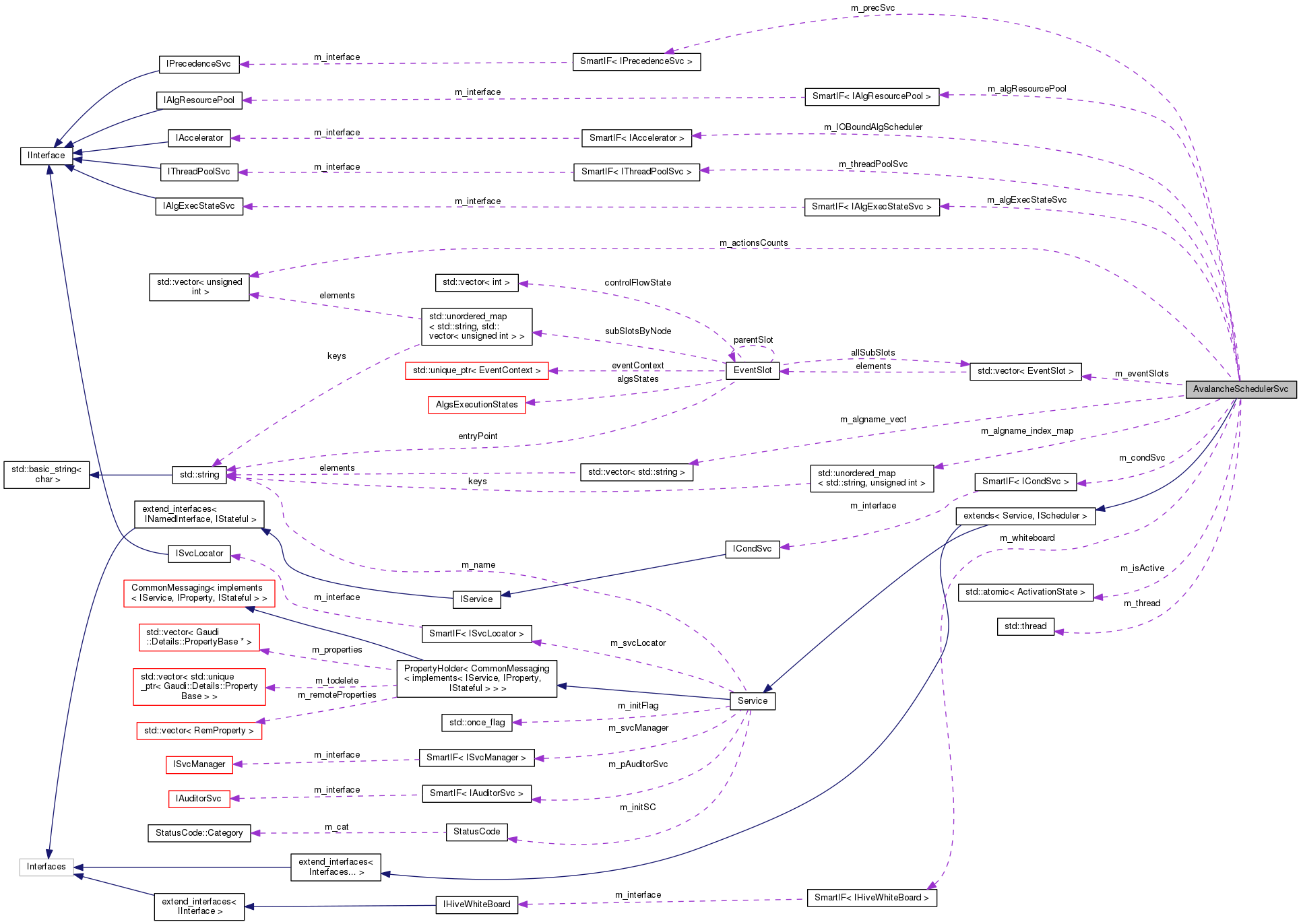
Collaboration diagram for AvalancheSchedulerSvc:

Public Member Functions

 ~AvalancheSchedulerSvc () override=default
 Destructor. More...
 
StatusCode initialize () override
 Initialise. More...
 
StatusCode finalize () override
 Finalise. More...
 
StatusCode pushNewEvent (EventContext *eventContext) override
 Make an event available to the scheduler. More...
 
StatusCode pushNewEvents (std::vector< EventContext * > &eventContexts) override
 
StatusCode popFinishedEvent (EventContext *&eventContext) override
 Blocks until an event is available. More...
 
StatusCode tryPopFinishedEvent (EventContext *&eventContext) override
 Try to fetch an event from the scheduler. More...
 
unsigned int freeSlots () override
 Get free slots number. More...
 
virtual StatusCode scheduleEventView (const EventContext *sourceContext, const std::string &nodeName, std::unique_ptr< EventContext > viewContext) override
 Method to inform the scheduler about event views. More...
 
- Public Member Functions inherited from extends< Service, IScheduler >
void * i_cast (const InterfaceID &tid) const override
 Implementation of IInterface::i_cast. More...
 
StatusCode queryInterface (const InterfaceID &ti, void **pp) override
 Implementation of IInterface::queryInterface. More...
 
std::vector< std::stringgetInterfaceNames () const override
 Implementation of IInterface::getInterfaceNames. More...
 
- Public Member Functions inherited from Service
const std::stringname () const override
 Retrieve name of the service. More...
 
StatusCode configure () override
 
StatusCode initialize () override
 
StatusCode start () override
 
StatusCode stop () override
 
StatusCode finalize () override
 
StatusCode terminate () override
 
Gaudi::StateMachine::State FSMState () const override
 
Gaudi::StateMachine::State targetFSMState () const override
 
StatusCode reinitialize () override
 
StatusCode restart () override
 
StatusCode sysInitialize () override
 Initialize Service. More...
 
StatusCode sysStart () override
 Initialize Service. More...
 
StatusCode sysStop () override
 Initialize Service. More...
 
StatusCode sysFinalize () override
 Finalize Service. More...
 
StatusCode sysReinitialize () override
 Re-initialize the Service. More...
 
StatusCode sysRestart () override
 Re-initialize the Service. More...
 
 Service (std::string name, ISvcLocator *svcloc)
 Standard Constructor. More...
 
SmartIF< ISvcLocator > & serviceLocator () const override
 Retrieve pointer to service locator. More...
 
StatusCode setProperties ()
 Method for setting declared properties to the values specified for the job. More...
 
template<class T >
StatusCode service (const std::string &name, const T *&psvc, bool createIf=true) const
 Access a service by name, creating it if it doesn't already exist. More...
 
template<class T >
StatusCode service (const std::string &name, T *&psvc, bool createIf=true) const
 
template<typename IFace = IService>
SmartIF< IFace > service (const std::string &name, bool createIf=true) const
 
template<class T >
StatusCode service (const std::string &svcType, const std::string &svcName, T *&psvc) const
 Access a service by name and type, creating it if it doesn't already exist. More...
 
template<class T >
StatusCode declareTool (ToolHandle< T > &handle, std::string toolTypeAndName, bool createIf=true)
 Declare used tool. More...
 
SmartIF< IAuditorSvc > & auditorSvc () const
 The standard auditor service.May not be invoked before sysInitialize() has been invoked. More...
 
- Public Member Functions inherited from PropertyHolder< CommonMessaging< implements< IService, IProperty, IStateful > > >
 PropertyHolder ()=default
 
Gaudi::Details::PropertyBasedeclareProperty (Gaudi::Details::PropertyBase &prop)
 Declare a property. More...
 
Gaudi::Details::PropertyBasedeclareProperty (const std::string &name, TYPE &value, const std::string &doc="none")
 Helper to wrap a regular data member and use it as a regular property. More...
 
Gaudi::Details::PropertyBasedeclareProperty (const std::string &name, Gaudi::Property< TYPE, VERIFIER, HANDLERS > &prop, const std::string &doc="none")
 Declare a PropertyBase instance setting name and documentation. More...
 
Gaudi::Details::PropertyBasedeclareRemoteProperty (const std::string &name, IProperty *rsvc, const std::string &rname="")
 Declare a remote property. More...
 
StatusCode setProperty (const Gaudi::Details::PropertyBase &p) override
 set the property form another property More...
 
StatusCode setProperty (const std::string &s) override
 set the property from the formatted string More...
 
StatusCode setProperty (const std::string &n, const std::string &v) override
 set the property from name and the value More...
 
StatusCode setProperty (const std::string &name, const TYPE &value)
 set the property form the value More...
 
StatusCode getProperty (Gaudi::Details::PropertyBase *p) const override
 get the property More...
 
const Gaudi::Details::PropertyBasegetProperty (const std::string &name) const override
 get the property by name More...
 
StatusCode getProperty (const std::string &n, std::string &v) const override
 convert the property to the string More...
 
const std::vector< Gaudi::Details::PropertyBase * > & getProperties () const override
 get all properties More...
 
bool hasProperty (const std::string &name) const override
 Return true if we have a property with the given name. More...
 
 PropertyHolder (const PropertyHolder &)=delete
 
PropertyHolderoperator= (const PropertyHolder &)=delete
 
- Public Member Functions inherited from CommonMessaging< implements< IService, IProperty, IStateful > >
MSG::Level msgLevel () const
 get the cached level (originally extracted from the embedded MsgStream) More...
 
bool msgLevel (MSG::Level lvl) const
 get the output level from the embedded MsgStream More...
 
MSG::Level outputLevel () const
 Backward compatibility function for getting the output level. More...
 
- Public Member Functions inherited from CommonMessagingBase
virtual ~CommonMessagingBase ()=default
 Virtual destructor. More...
 
const SmartIF< IMessageSvc > & msgSvc () const
 The standard message service. More...
 
MsgStreammsgStream () const
 Return an uninitialized MsgStream. More...
 
MsgStreammsgStream (const MSG::Level level) const
 Predefined configurable message stream for the efficient printouts. More...
 
MsgStreamalways () const
 shortcut for the method msgStream(MSG::ALWAYS) More...
 
MsgStreamfatal () const
 shortcut for the method msgStream(MSG::FATAL) More...
 
MsgStreamerr () const
 shortcut for the method msgStream(MSG::ERROR) More...
 
MsgStreamerror () const
 shortcut for the method msgStream(MSG::ERROR) More...
 
MsgStreamwarning () const
 shortcut for the method msgStream(MSG::WARNING) More...
 
MsgStreaminfo () const
 shortcut for the method msgStream(MSG::INFO) More...
 
MsgStreamdebug () const
 shortcut for the method msgStream(MSG::DEBUG) More...
 
MsgStreamverbose () const
 shortcut for the method msgStream(MSG::VERBOSE) More...
 
MsgStreammsg () const
 shortcut for the method msgStream(MSG::INFO) More...
 

Private Types

enum  ActivationState { INACTIVE = 0, ACTIVE = 1, FAILURE = 2 }
 
using AState = AlgsExecutionStates::State
 
using action = std::function< StatusCode()>
 

Private Member Functions

void activate ()
 Activate scheduler. More...
 
StatusCode deactivate ()
 Deactivate scheduler. More...
 
unsigned int algname2index (const std::string &algoname)
 Convert a name to an integer. More...
 
const std::stringindex2algname (unsigned int index)
 Convert an integer to a name. More...
 
StatusCode updateStates (int si=-1, int algo_index=-1, int sub_slot=-1, int source_slot=-1)
 Loop on algorithm in the slots and promote them to successive states (-1 for algo_index means skipping an update of the Control Flow state) More...
 
StatusCode promoteToScheduled (unsigned int iAlgo, int si, EventContext *)
 Algorithm promotion. More...
 
StatusCode promoteToAsyncScheduled (unsigned int iAlgo, int si, EventContext *)
 
StatusCode promoteToExecuted (unsigned int iAlgo, int si, IAlgorithm *algo, EventContext *)
 The call to this method is triggered only from within the AlgoExecutionTask. More...
 
StatusCode promoteToAsyncExecuted (unsigned int iAlgo, int si, IAlgorithm *algo, EventContext *)
 The call to this method is triggered only from within the IOBoundAlgTask. More...
 
StatusCode promoteToFinished (unsigned int iAlgo, int si)
 
bool isStalled (const EventSlot &) const
 Check if scheduling in a particular slot is in a stall. More...
 
void eventFailed (EventContext *eventContext)
 Method to execute if an event failed. More...
 
void dumpSchedulerState (int iSlot)
 Dump the state of the scheduler. More...
 

Private Attributes

Gaudi::Property< int > m_threadPoolSize
 
Gaudi::Property< std::stringm_whiteboardSvcName {this, "WhiteboardSvc", "EventDataSvc", "The whiteboard name"}
 
Gaudi::Property< std::stringm_IOBoundAlgSchedulerSvcName {this, "IOBoundAlgSchedulerSvc", "IOBoundAlgSchedulerSvc"}
 
Gaudi::Property< unsigned int > m_maxIOBoundAlgosInFlight
 
Gaudi::Property< bool > m_simulateExecution
 
Gaudi::Property< std::stringm_optimizationMode
 
Gaudi::Property< bool > m_dumpIntraEventDynamics
 
Gaudi::Property< bool > m_useIOBoundAlgScheduler
 
Gaudi::Property< bool > m_checkDeps {this, "CheckDependencies", false, "Runtime check of Algorithm Data Dependencies"}
 
Gaudi::Property< std::stringm_useDataLoader
 
Gaudi::Property< bool > m_enableCondSvc {this, "EnableConditions", false, "Enable ConditionsSvc"}
 
Gaudi::Property< bool > m_showDataDeps
 
Gaudi::Property< bool > m_showDataFlow
 
Gaudi::Property< bool > m_showControlFlow
 
std::atomic< ActivationStatem_isActive {INACTIVE}
 Flag to track if the scheduler is active or not. More...
 
std::thread m_thread
 The thread in which the activate function runs. More...
 
std::unordered_map< std::string, unsigned int > m_algname_index_map
 Map to bookkeep the information necessary to the name2index conversion. More...
 
std::vector< std::stringm_algname_vect
 Vector to bookkeep the information necessary to the index2name conversion. More...
 
SmartIF< IPrecedenceSvcm_precSvc
 A shortcut to the Precedence Service. More...
 
SmartIF< IHiveWhiteBoardm_whiteboard
 A shortcut to the whiteboard. More...
 
SmartIF< IAcceleratorm_IOBoundAlgScheduler
 A shortcut to IO-bound algorithm scheduler. More...
 
std::vector< EventSlotm_eventSlots
 Vector of events slots. More...
 
std::atomic_int m_freeSlots
 Atomic to account for asyncronous updates by the scheduler wrt the rest. More...
 
tbb::concurrent_bounded_queue< EventContext * > m_finishedEvents
 Queue of finished events. More...
 
SmartIF< IAlgExecStateSvcm_algExecStateSvc
 Algorithm execution state manager. More...
 
SmartIF< ICondSvcm_condSvc
 A shortcut to service for Conditions handling. More...
 
unsigned int m_algosInFlight = 0
 Number of algorithms presently in flight. More...
 
unsigned int m_IOBoundAlgosInFlight = 0
 Number of algorithms presently in flight. More...
 
SmartIF< IAlgResourcePoolm_algResourcePool
 Cache for the algorithm resource pool. More...
 
tbb::concurrent_bounded_queue< actionm_actionsQueue
 Queue where closures are stored and picked for execution. More...
 
std::vector< unsigned int > m_actionsCounts
 Bookkeeping of the number of actions in flight per slot. More...
 
SmartIF< IThreadPoolSvcm_threadPoolSvc
 
size_t m_maxEventsInFlight {0}
 
size_t m_maxAlgosInFlight {1}
 

Additional Inherited Members

- Public Types inherited from extends< Service, IScheduler >
using base_class = extends
 Typedef to this class. More...
 
using extend_interfaces_base = extend_interfaces< Interfaces... >
 Typedef to the base of this class. More...
 
- Public Types inherited from Service
using Factory = Gaudi::PluginService::Factory< IService *(const std::string &, ISvcLocator *)>
 
- Public Types inherited from PropertyHolder< CommonMessaging< implements< IService, IProperty, IStateful > > >
using PropertyHolderImpl = PropertyHolder< CommonMessaging< implements< IService, IProperty, IStateful > > >
 Typedef used to refer to this class from derived classes, as in. More...
 
- Public Types inherited from CommonMessaging< implements< IService, IProperty, IStateful > >
using base_class = CommonMessaging
 
- Public Types inherited from extend_interfaces< Interfaces... >
using ext_iids = typename Gaudi::interface_list_cat< typename Interfaces::ext_iids... >::type
 take union of the ext_iids of all Interfaces... More...
 
- Protected Member Functions inherited from Service
 ~Service () override
 Standard Destructor. More...
 
int outputLevel () const
 get the Service's output level More...
 
- Protected Member Functions inherited from PropertyHolder< CommonMessaging< implements< IService, IProperty, IStateful > > >
Gaudi::Details::PropertyBaseproperty (const std::string &name) const
 
- Protected Member Functions inherited from CommonMessaging< implements< IService, IProperty, IStateful > >
MSG::Level setUpMessaging () const
 Set up local caches. More...
 
MSG::Level resetMessaging ()
 Reinitialize internal states. More...
 
void updateMsgStreamOutputLevel (int level)
 Update the output level of the cached MsgStream. More...
 
- Protected Attributes inherited from Service
Gaudi::StateMachine::State m_state = Gaudi::StateMachine::OFFLINE
 Service state. More...
 
Gaudi::StateMachine::State m_targetState = Gaudi::StateMachine::OFFLINE
 Service state. More...
 
Gaudi::Property< int > m_outputLevel {this, "OutputLevel", MSG::NIL, "output level"}
 
Gaudi::Property< bool > m_auditInit {this, "AuditServices", false, "[[deprecated]] unused"}
 
Gaudi::Property< bool > m_auditorInitialize {this, "AuditInitialize", false, "trigger auditor on initialize()"}
 
Gaudi::Property< bool > m_auditorStart {this, "AuditStart", false, "trigger auditor on start()"}
 
Gaudi::Property< bool > m_auditorStop {this, "AuditStop", false, "trigger auditor on stop()"}
 
Gaudi::Property< bool > m_auditorFinalize {this, "AuditFinalize", false, "trigger auditor on finalize()"}
 
Gaudi::Property< bool > m_auditorReinitialize {this, "AuditReinitialize", false, "trigger auditor on reinitialize()"}
 
Gaudi::Property< bool > m_auditorRestart {this, "AuditRestart", false, "trigger auditor on restart()"}
 
SmartIF< IAuditorSvcm_pAuditorSvc
 Auditor Service. More...
 

Detailed Description

Introduction

The scheduler is named after its ability to generically maximize the average intra-event task occupancy by inducing avalanche-like concurrency disclosure waves in conditions of arbitrary intra-event task precedence constraints (see section 3.2 of http://cern.ch/go/7Jn7).

Task precedence management

The scheduler is driven by graph-based task precedence management. When compared to approach used in the ForwardSchedulerSvc, the following advantages can be emphasized:

(1) Faster decision making (thus lower concurrency disclosure downtime); (2) Capacity for proactive task scheduling decision making.

Point (2) allowed to implement a number of generic, non-intrusive intra-event throughput maximization scheduling strategies.

Scheduling principles

o Task scheduling prerequisites

A task is scheduled ASA all following conditions are met:

  • if a control flow (CF) graph traversal reaches the task;
  • when all data flow (DF) dependencies of the task are satisfied;
  • when the DF-ready task pool parsing mechanism (*) considers it, and:
    • a free (or re-entrant) algorithm instance to run within the task is available;
    • there is a free computational resource to run the task.

o (*) Avalanche induction strategies

The scheduler is able to maximize the intra-event throughput by applying several search strategies within the pool, prioritizing tasks according to the following types of precedence rules graph asymmetries:

(A) Local task-to-data asymmetry; (B) Local task-to-task asymmetry; (C) Global task-to-task asymmetry.

o Other mechanisms of throughput maximization

The scheduler is able to maximize the overall throughput of data processing by scheduling the CPU-blocking tasks efficiently. The mechanism can be applied to the following types of tasks:

  • I/O-bound tasks;
  • tasks with computation offloading (accelerators, GPGPUs, clouds, quantum computing devices..joke);
  • synchronization-bound tasks.

Credits

Historically, the AvalancheSchedulerSvc branched off the ForwardSchedulerSvc and in many ways built its success on ideas and code of the latter.

Author
Illya Shapoval
Version
1.0

Definition at line 100 of file AvalancheSchedulerSvc.h.

Member Typedef Documentation

Definition at line 136 of file AvalancheSchedulerSvc.h.

Member Enumeration Documentation

Constructor & Destructor Documentation

AvalancheSchedulerSvc::~AvalancheSchedulerSvc ( )
overridedefault

Destructor.

Member Function Documentation

void AvalancheSchedulerSvc::activate ( )
private

Activate scheduler.

Activate the scheduler.

From this moment on the queue of actions is checked. The checking will stop when the m_isActive flag is false and the queue is not empty. This will guarantee that all actions are executed and a stall is not created. The TBB pool must be initialised in the thread from where the tasks are launched (http://threadingbuildingblocks.org/docs/doxygen/a00342.html) The scheduler is initialised here since this method runs in a separate thread and spawns the tasks (through the execution of the lambdas)

Definition at line 368 of file AvalancheSchedulerSvc.cpp.

369 {
370 
371  ON_DEBUG debug() << "AvalancheSchedulerSvc::activate()" << endmsg;
372 
374  error() << "problems initializing ThreadPoolSvc" << endmsg;
376  return;
377  }
378 
379  // Wait for actions pushed into the queue by finishing tasks.
380  action thisAction;
382 
383  m_isActive = ACTIVE;
384 
385  // Continue to wait if the scheduler is running or there is something to do
386  ON_DEBUG debug() << "Start checking the actionsQueue" << endmsg;
387  while ( m_isActive == ACTIVE || m_actionsQueue.size() != 0 ) {
388  m_actionsQueue.pop( thisAction );
389  sc = thisAction();
390  ON_VERBOSE
391  {
392  if ( sc != StatusCode::SUCCESS )
393  verbose() << "Action did not succeed (which is not bad per se)." << endmsg;
394  else
395  verbose() << "Action succeeded." << endmsg;
396  }
397  }
398 
399  ON_DEBUG debug() << "Terminating thread-pool resources" << endmsg;
401  error() << "Problems terminating thread pool" << endmsg;
403  }
404 }
virtual StatusCode initPool(const int &poolSize)=0
Initializes the thread pool.
#define ON_DEBUG
MsgStream & verbose() const
shortcut for the method msgStream(MSG::VERBOSE)
bool isFailure() const
Definition: StatusCode.h:139
std::atomic< ActivationState > m_isActive
Flag to track if the scheduler is active or not.
virtual StatusCode terminatePool()=0
Finalize the thread pool.
std::function< StatusCode()> action
MsgStream & error() const
shortcut for the method msgStream(MSG::ERROR)
This class is used for returning status codes from appropriate routines.
Definition: StatusCode.h:51
Gaudi::Property< int > m_threadPoolSize
SmartIF< IThreadPoolSvc > m_threadPoolSvc
constexpr static const auto SUCCESS
Definition: StatusCode.h:87
MsgStream & debug() const
shortcut for the method msgStream(MSG::DEBUG)
MsgStream & endmsg(MsgStream &s)
MsgStream Modifier: endmsg. Calls the output method of the MsgStream.
Definition: MsgStream.h:209
tbb::concurrent_bounded_queue< action > m_actionsQueue
Queue where closures are stored and picked for execution.
#define ON_VERBOSE
unsigned int AvalancheSchedulerSvc::algname2index ( const std::string algoname)
inlineprivate

Convert a name to an integer.

Definition at line 446 of file AvalancheSchedulerSvc.cpp.

447 {
448  unsigned int index = m_algname_index_map[algoname];
449  return index;
450 }
std::unordered_map< std::string, unsigned int > m_algname_index_map
Map to bookkeep the information necessary to the name2index conversion.
StatusCode AvalancheSchedulerSvc::deactivate ( )
private

Deactivate scheduler.

Deactivates the scheduler.

Two actions are pushed into the queue: 1) Drain the scheduler until all events are finished. 2) Flip the status flag m_isActive to false This second action is the last one to be executed by the scheduler.

Definition at line 414 of file AvalancheSchedulerSvc.cpp.

415 {
416 
417  if ( m_isActive == ACTIVE ) {
418 
419  // Set the number of slots available to an error code
420  m_freeSlots.store( 0 );
421 
422  // Empty queue
423  action thisAction;
424  while ( m_actionsQueue.try_pop( thisAction ) ) {
425  };
426 
427  // This would be the last action
428  m_actionsQueue.push( [this]() -> StatusCode {
429  ON_VERBOSE verbose() << "Deactivating scheduler" << endmsg;
431  return StatusCode::SUCCESS;
432  } );
433  }
434 
435  return StatusCode::SUCCESS;
436 }
MsgStream & verbose() const
shortcut for the method msgStream(MSG::VERBOSE)
std::atomic< ActivationState > m_isActive
Flag to track if the scheduler is active or not.
std::atomic_int m_freeSlots
Atomic to account for asyncronous updates by the scheduler wrt the rest.
std::function< StatusCode()> action
This class is used for returning status codes from appropriate routines.
Definition: StatusCode.h:51
constexpr static const auto SUCCESS
Definition: StatusCode.h:87
MsgStream & endmsg(MsgStream &s)
MsgStream Modifier: endmsg. Calls the output method of the MsgStream.
Definition: MsgStream.h:209
tbb::concurrent_bounded_queue< action > m_actionsQueue
Queue where closures are stored and picked for execution.
#define ON_VERBOSE
void AvalancheSchedulerSvc::dumpSchedulerState ( int  iSlot)
private

Dump the state of the scheduler.

Used for debugging purposes, the state of the scheduler is dumped on screen in order to be inspected.

Definition at line 783 of file AvalancheSchedulerSvc.cpp.

784 {
785 
786  // To have just one big message
787  std::ostringstream outputMS;
788 
789  outputMS << "Dumping scheduler state\n"
790  << "=========================================================================================\n"
791  << "++++++++++++++++++++++++++++++++++++ SCHEDULER STATE ++++++++++++++++++++++++++++++++++++\n"
792  << "=========================================================================================\n\n";
793 
794  //===========================================================================
795 
796  outputMS << "------------------ Last schedule: Task/Event/Slot/Thread/State Mapping "
797  << "------------------\n\n";
798 
799  // Figure if TimelineSvc is available (used below to detect threads IDs)
800  auto timelineSvc = serviceLocator()->service<ITimelineSvc>( "TimelineSvc", false );
801  if ( !timelineSvc.isValid() || !timelineSvc->isEnabled() ) {
802  outputMS << "WARNING Enable TimelineSvc in record mode (RecordTimeline = True) to trace the mapping\n";
803  } else {
804 
805  // Figure optimal printout layout
806  size_t indt( 0 );
807  for ( auto& slot : m_eventSlots )
808  for ( auto it = slot.algsStates.begin( AState::SCHEDULED ); it != slot.algsStates.end( AState::SCHEDULED ); ++it )
809  if ( index2algname( (uint)*it ).length() > indt ) indt = index2algname( (uint)*it ).length();
810 
811  // Figure the last running schedule across all slots
812  for ( auto& slot : m_eventSlots ) {
813  for ( auto it = slot.algsStates.begin( AState::SCHEDULED ); it != slot.algsStates.end( AState::SCHEDULED );
814  ++it ) {
815 
816  const std::string algoName{index2algname( (uint)*it )};
817 
818  outputMS << " task: " << std::setw( indt ) << algoName << " evt/slot: " << slot.eventContext->evt() << "/"
819  << slot.eventContext->slot();
820 
821  // Try to get POSIX threads IDs the currently running tasks are scheduled to
822  if ( timelineSvc.isValid() ) {
823  TimelineEvent te{};
824  te.algorithm = algoName;
825  te.slot = slot.eventContext->slot();
826  te.event = slot.eventContext->evt();
827 
828  if ( timelineSvc->getTimelineEvent( te ) )
829  outputMS << " thread.id: 0x" << std::hex << te.thread << std::dec;
830  else
831  outputMS << " thread.id: [unknown]"; // this means a task has just
832  // been signed off as SCHEDULED,
833  // but has not been assigned to a thread yet
834  // (i.e., not running yet)
835  }
836  outputMS << " state: [" << m_algExecStateSvc->algExecState( algoName, *( slot.eventContext ) ) << "]\n";
837  }
838  }
839  }
840 
841  //===========================================================================
842 
843  outputMS << "\n---------------------------- Task/CF/FSM Mapping "
844  << ( 0 > iSlot ? "[all slots] --" : "[target slot] " ) << "--------------------------\n\n";
845 
846  int slotCount = -1;
847  for ( auto& slot : m_eventSlots ) {
848  ++slotCount;
849  if ( slot.complete ) continue;
850 
851  outputMS << "[ slot: "
852  << ( slot.eventContext->valid() ? std::to_string( slot.eventContext->slot() ) : "[ctx invalid]" )
853  << " event: "
854  << ( slot.eventContext->valid() ? std::to_string( slot.eventContext->evt() ) : "[ctx invalid]" )
855  << " ]:\n\n";
856 
857  if ( 0 > iSlot || iSlot == slotCount ) {
858 
859  // Snapshot of the Control Flow and FSM states
860  outputMS << m_precSvc->printState( slot ) << "\n";
861 
862  // Mention sub slots (this is expensive if the number of sub-slots is high)
863  /*if ( !slot.allSubSlots.empty() ) {
864  outputMS << "\nNumber of sub-slots: " << slot.allSubSlots.size() << "\n\n";
865  auto slotID = slot.eventContext->valid() ? std::to_string( slot.eventContext->slot() ) : "[ctx invalid]";
866  for ( auto& ss : slot.allSubSlots ) {
867  outputMS << "[ slot: " << slotID << " sub-slot entry: " << ss.entryPoint << " event: "
868  << ( ss.eventContext->valid() ? std::to_string( ss.eventContext->evt() ) : "[ctx invalid]" )
869  << " ]:\n\n";
870  outputMS << m_precSvc->printState( ss ) << "\n";
871  }
872  }*/
873  }
874  }
875 
876  //===========================================================================
877 
878  if ( 0 <= iSlot ) {
879  outputMS << "\n------------------------------ Algorithm Execution States -----------------------------\n\n";
880  m_algExecStateSvc->dump( outputMS, *( m_eventSlots[iSlot].eventContext ) );
881  }
882 
883  outputMS << "\n=========================================================================================\n"
884  << "++++++++++++++++++++++++++++++++++++++ END OF DUMP ++++++++++++++++++++++++++++++++++++++\n"
885  << "=========================================================================================\n\n";
886 
887  info() << outputMS.str() << endmsg;
888 }
SmartIF< IPrecedenceSvc > m_precSvc
A shortcut to the Precedence Service.
MsgStream & info() const
shortcut for the method msgStream(MSG::INFO)
virtual void dump(std::ostringstream &ost, const EventContext &ctx) const =0
T to_string(T...args)
std::string algorithm
Definition: ITimelineSvc.h:21
T setw(T...args)
virtual const std::string printState(EventSlot &) const =0
STL class.
StatusCode service(const Gaudi::Utils::TypeNameString &name, T *&svc, bool createIf=true)
Templated method to access a service by name.
Definition: ISvcLocator.h:79
virtual const AlgExecState & algExecState(const Gaudi::StringKey &algName, const EventContext &ctx) const =0
T length(T...args)
const std::string & index2algname(unsigned int index)
Convert an integer to a name.
T hex(T...args)
std::vector< EventSlot > m_eventSlots
Vector of events slots.
SmartIF< ISvcLocator > & serviceLocator() const override
Retrieve pointer to service locator.
Definition: Service.cpp:291
SmartIF< IAlgExecStateSvc > m_algExecStateSvc
Algorithm execution state manager.
MsgStream & endmsg(MsgStream &s)
MsgStream Modifier: endmsg. Calls the output method of the MsgStream.
Definition: MsgStream.h:209
void AvalancheSchedulerSvc::eventFailed ( EventContext eventContext)
private

Method to execute if an event failed.

It can be possible that an event fails.

In this case this method is called. It dumps the state of the scheduler and marks the event as finished.

Definition at line 761 of file AvalancheSchedulerSvc.cpp.

762 {
763  const uint slotIdx = eventContext->slot();
764 
765  error() << "Event " << eventContext->evt() << " on slot " << slotIdx << " failed" << endmsg;
766 
767  dumpSchedulerState( msgLevel( MSG::VERBOSE ) ? -1 : slotIdx );
768 
769  // dump temporal and topological precedence analysis (if enabled in the PrecedenceSvc)
771 
772  // Push into the finished events queue the failed context
773  m_eventSlots[slotIdx].complete = true;
774  m_finishedEvents.push( m_eventSlots[slotIdx].eventContext.release() );
775 }
SmartIF< IPrecedenceSvc > m_precSvc
A shortcut to the Precedence Service.
ContextID_t slot() const
Definition: EventContext.h:50
void dumpSchedulerState(int iSlot)
Dump the state of the scheduler.
ContextEvt_t evt() const
Definition: EventContext.h:49
MsgStream & error() const
shortcut for the method msgStream(MSG::ERROR)
virtual void dumpPrecedenceRules(EventSlot &)=0
Dump precedence rules.
tbb::concurrent_bounded_queue< EventContext * > m_finishedEvents
Queue of finished events.
std::vector< EventSlot > m_eventSlots
Vector of events slots.
MsgStream & endmsg(MsgStream &s)
MsgStream Modifier: endmsg. Calls the output method of the MsgStream.
Definition: MsgStream.h:209
MSG::Level msgLevel() const
get the cached level (originally extracted from the embedded MsgStream)
StatusCode AvalancheSchedulerSvc::finalize ( )
override

Finalise.

Here the scheduler is deactivated and the thread joined.

Definition at line 336 of file AvalancheSchedulerSvc.cpp.

337 {
338 
340  if ( sc.isFailure() ) warning() << "Base class could not be finalized" << endmsg;
341 
342  sc = deactivate();
343  if ( sc.isFailure() ) warning() << "Scheduler could not be deactivated" << endmsg;
344 
345  info() << "Joining Scheduler thread" << endmsg;
346  m_thread.join();
347 
348  // Final error check after thread pool termination
349  if ( m_isActive == FAILURE ) {
350  error() << "problems in scheduler thread" << endmsg;
351  return StatusCode::FAILURE;
352  }
353 
354  return sc;
355 }
constexpr static const auto FAILURE
Definition: StatusCode.h:88
StatusCode finalize() override
Definition: Service.cpp:173
MsgStream & info() const
shortcut for the method msgStream(MSG::INFO)
std::atomic< ActivationState > m_isActive
Flag to track if the scheduler is active or not.
MsgStream & error() const
shortcut for the method msgStream(MSG::ERROR)
MsgStream & warning() const
shortcut for the method msgStream(MSG::WARNING)
T join(T...args)
This class is used for returning status codes from appropriate routines.
Definition: StatusCode.h:51
StatusCode deactivate()
Deactivate scheduler.
MsgStream & endmsg(MsgStream &s)
MsgStream Modifier: endmsg. Calls the output method of the MsgStream.
Definition: MsgStream.h:209
std::thread m_thread
The thread in which the activate function runs.
unsigned int AvalancheSchedulerSvc::freeSlots ( )
override

Get free slots number.

Definition at line 533 of file AvalancheSchedulerSvc.cpp.

533 { return std::max( m_freeSlots.load(), 0 ); }
std::atomic_int m_freeSlots
Atomic to account for asyncronous updates by the scheduler wrt the rest.
T max(T...args)
const std::string & AvalancheSchedulerSvc::index2algname ( unsigned int  index)
inlineprivate

Convert an integer to a name.

Definition at line 442 of file AvalancheSchedulerSvc.cpp.

442 { return m_algname_vect[index]; }
std::vector< std::string > m_algname_vect
Vector to bookkeep the information necessary to the index2name conversion.
StatusCode AvalancheSchedulerSvc::initialize ( )
override

Initialise.

Here, among some "bureaucracy" operations, the scheduler is activated, executing the activate() function in a new thread.

In addition the algorithms list is acquired from the algResourcePool.

Definition at line 65 of file AvalancheSchedulerSvc.cpp.

66 {
67 
68  // Initialise mother class (read properties, ...)
70  if ( sc.isFailure() ) warning() << "Base class could not be initialized" << endmsg;
71 
72  // Get hold of the TBBSvc. This should initialize the thread pool
73  m_threadPoolSvc = serviceLocator()->service( "ThreadPoolSvc" );
74  if ( !m_threadPoolSvc.isValid() ) {
75  fatal() << "Error retrieving ThreadPoolSvc" << endmsg;
76  return StatusCode::FAILURE;
77  }
78 
79  // Activate the scheduler in another thread.
80  info() << "Activating scheduler in a separate thread" << endmsg;
81  m_thread = std::thread( [this]() { this->activate(); } );
82 
83  while ( m_isActive != ACTIVE ) {
84  if ( m_isActive == FAILURE ) {
85  fatal() << "Terminating initialization" << endmsg;
86  return StatusCode::FAILURE;
87  } else {
88  ON_DEBUG debug() << "Waiting for AvalancheSchedulerSvc to activate" << endmsg;
89  sleep( 1 );
90  }
91  }
92 
93  if ( m_enableCondSvc ) {
94  // Get hold of the CondSvc
95  m_condSvc = serviceLocator()->service( "CondSvc" );
96  if ( !m_condSvc.isValid() ) {
97  warning() << "No CondSvc found, or not enabled. "
98  << "Will not manage CondAlgorithms" << endmsg;
99  m_enableCondSvc = false;
100  }
101  }
102 
103  // Get the algo resource pool
104  m_algResourcePool = serviceLocator()->service( "AlgResourcePool" );
105  if ( !m_algResourcePool.isValid() ) {
106  fatal() << "Error retrieving AlgoResourcePool" << endmsg;
107  return StatusCode::FAILURE;
108  }
109 
110  m_algExecStateSvc = serviceLocator()->service( "AlgExecStateSvc" );
111  if ( !m_algExecStateSvc.isValid() ) {
112  fatal() << "Error retrieving AlgExecStateSvc" << endmsg;
113  return StatusCode::FAILURE;
114  }
115 
116  // Get Whiteboard
118  if ( !m_whiteboard.isValid() ) {
119  fatal() << "Error retrieving EventDataSvc interface IHiveWhiteBoard." << endmsg;
120  return StatusCode::FAILURE;
121  }
122 
123  // Get dedicated scheduler for I/O-bound algorithms
124  if ( m_useIOBoundAlgScheduler ) {
127  fatal() << "Error retrieving IOBoundSchedulerAlgSvc interface IAccelerator." << endmsg;
128  }
129 
130  // Set the MaxEventsInFlight parameters from the number of WB stores
132 
133  // Set the number of free slots
135 
136  // Get the list of algorithms
138  const unsigned int algsNumber = algos.size();
139  info() << "Found " << algsNumber << " algorithms" << endmsg;
140 
141  /* Dependencies
142  1) Look for handles in algo, if none
143  2) Assume none are required
144  */
145 
146  DataObjIDColl globalInp, globalOutp;
147 
148  // figure out all outputs
149  for ( IAlgorithm* ialgoPtr : algos ) {
150  Algorithm* algoPtr = dynamic_cast<Algorithm*>( ialgoPtr );
151  if ( !algoPtr ) {
152  fatal() << "Could not convert IAlgorithm into Algorithm: this will result in a crash." << endmsg;
153  }
154  for ( auto id : algoPtr->outputDataObjs() ) {
155  auto r = globalOutp.insert( id );
156  if ( !r.second ) {
157  warning() << "multiple algorithms declare " << id << " as output! could be a single instance in multiple paths "
158  "though, or control flow may guarantee only one runs...!"
159  << endmsg;
160  }
161  }
162  }
163 
164  std::ostringstream ostdd;
165  ostdd << "Data Dependencies for Algorithms:";
166 
167  std::map<std::string, DataObjIDColl> algosDependenciesMap;
168  for ( IAlgorithm* ialgoPtr : algos ) {
169  Algorithm* algoPtr = dynamic_cast<Algorithm*>( ialgoPtr );
170  if ( nullptr == algoPtr ) {
171  fatal() << "Could not convert IAlgorithm into Algorithm for " << ialgoPtr->name()
172  << ": this will result in a crash." << endmsg;
173  return StatusCode::FAILURE;
174  }
175 
176  ostdd << "\n " << algoPtr->name();
177 
178  DataObjIDColl algoDependencies;
179  if ( !algoPtr->inputDataObjs().empty() || !algoPtr->outputDataObjs().empty() ) {
180  for ( const DataObjID* idp : sortedDataObjIDColl( algoPtr->inputDataObjs() ) ) {
181  DataObjID id = *idp;
182  ostdd << "\n o INPUT " << id;
183  if ( id.key().find( ":" ) != std::string::npos ) {
184  ostdd << " contains alternatives which require resolution...\n";
185  auto tokens = boost::tokenizer<boost::char_separator<char>>{id.key(), boost::char_separator<char>{":"}};
186  auto itok = std::find_if( tokens.begin(), tokens.end(), [&]( const std::string& t ) {
187  return globalOutp.find( DataObjID{t} ) != globalOutp.end();
188  } );
189  if ( itok != tokens.end() ) {
190  ostdd << "found matching output for " << *itok << " -- updating scheduler info\n";
191  id.updateKey( *itok );
192  } else {
193  error() << "failed to find alternate in global output list"
194  << " for id: " << id << " in Alg " << algoPtr->name() << endmsg;
195  m_showDataDeps = true;
196  }
197  }
198  algoDependencies.insert( id );
199  globalInp.insert( id );
200  }
201  for ( const DataObjID* id : sortedDataObjIDColl( algoPtr->outputDataObjs() ) ) {
202  ostdd << "\n o OUTPUT " << *id;
203  if ( id->key().find( ":" ) != std::string::npos ) {
204  error() << " in Alg " << algoPtr->name() << " alternatives are NOT allowed for outputs! id: " << *id
205  << endmsg;
206  m_showDataDeps = true;
207  }
208  }
209  } else {
210  ostdd << "\n none";
211  }
212  algosDependenciesMap[algoPtr->name()] = algoDependencies;
213  }
214 
215  if ( m_showDataDeps ) {
216  info() << ostdd.str() << endmsg;
217  }
218 
219  // Check if we have unmet global input dependencies, and, optionally, heal them
220  // WARNING: this step must be done BEFORE the Precedence Service is initialized
221  if ( m_checkDeps ) {
222  DataObjIDColl unmetDep;
223  for ( auto o : globalInp )
224  if ( globalOutp.find( o ) == globalOutp.end() ) unmetDep.insert( o );
225 
226  if ( unmetDep.size() > 0 ) {
227 
228  std::ostringstream ost;
229  for ( const DataObjID* o : sortedDataObjIDColl( unmetDep ) ) {
230  ost << "\n o " << *o << " required by Algorithm: ";
231 
232  for ( const auto& p : algosDependenciesMap )
233  if ( p.second.find( *o ) != p.second.end() ) ost << "\n * " << p.first;
234  }
235 
236  if ( !m_useDataLoader.empty() ) {
237 
238  // Find the DataLoader Alg
239  IAlgorithm* dataLoaderAlg( nullptr );
240  for ( IAlgorithm* algo : algos )
241  if ( algo->name() == m_useDataLoader ) {
242  dataLoaderAlg = algo;
243  break;
244  }
245 
246  if ( dataLoaderAlg == nullptr ) {
247  fatal() << "No DataLoader Algorithm \"" << m_useDataLoader.value()
248  << "\" found, and unmet INPUT dependencies "
249  << "detected:\n"
250  << ost.str() << endmsg;
251  return StatusCode::FAILURE;
252  }
253 
254  info() << "Will attribute the following unmet INPUT dependencies to \"" << dataLoaderAlg->type() << "/"
255  << dataLoaderAlg->name() << "\" Algorithm" << ost.str() << endmsg;
256 
257  // Set the property Load of DataLoader Alg
258  Algorithm* dataAlg = dynamic_cast<Algorithm*>( dataLoaderAlg );
259  if ( !dataAlg ) {
260  fatal() << "Unable to dcast DataLoader \"" << m_useDataLoader.value() << "\" IAlg to Algorithm" << endmsg;
261  return StatusCode::FAILURE;
262  }
263 
264  for ( auto& id : unmetDep ) {
265  ON_DEBUG debug() << "adding OUTPUT dep \"" << id << "\" to " << dataLoaderAlg->type() << "/"
266  << dataLoaderAlg->name() << endmsg;
268  }
269 
270  } else {
271  fatal() << "Auto DataLoading not requested, "
272  << "and the following unmet INPUT dependencies were found:" << ost.str() << endmsg;
273  return StatusCode::FAILURE;
274  }
275 
276  } else {
277  info() << "No unmet INPUT data dependencies were found" << endmsg;
278  }
279  }
280 
281  // Get the precedence service
282  m_precSvc = serviceLocator()->service( "PrecedenceSvc" );
283  if ( !m_precSvc.isValid() ) {
284  fatal() << "Error retrieving PrecedenceSvc" << endmsg;
285  return StatusCode::FAILURE;
286  }
287  const PrecedenceSvc* precSvc = dynamic_cast<const PrecedenceSvc*>( m_precSvc.get() );
288  if ( !precSvc ) {
289  fatal() << "Unable to dcast PrecedenceSvc" << endmsg;
290  return StatusCode::FAILURE;
291  }
292 
293  // Fill the containers to convert algo names to index
294  m_algname_vect.resize( algsNumber );
295  for ( IAlgorithm* algo : algos ) {
296  const std::string& name = algo->name();
297  auto index = precSvc->getRules()->getAlgorithmNode( name )->getAlgoIndex();
298  m_algname_index_map[name] = index;
299  m_algname_vect.at( index ) = name;
300  }
301 
302  // Shortcut for the message service
303  SmartIF<IMessageSvc> messageSvc( serviceLocator() );
304  if ( !messageSvc.isValid() ) error() << "Error retrieving MessageSvc interface IMessageSvc." << endmsg;
305 
307  for ( size_t i = 0; i < m_maxEventsInFlight; ++i ) {
308  m_eventSlots.emplace_back( algsNumber, precSvc->getRules()->getControlFlowNodeCounter(), messageSvc );
309  m_eventSlots.back().complete = true;
310  }
311  m_actionsCounts.assign( m_maxEventsInFlight, 0 );
312 
313  if ( m_threadPoolSize > 1 ) {
315  }
316 
317  // Clearly inform about the level of concurrency
318  info() << "Concurrency level information:" << endmsg;
319  info() << " o Number of events in flight: " << m_maxEventsInFlight << endmsg;
320  info() << " o TBB thread pool size: " << m_threadPoolSize << endmsg;
321 
323 
325 
326  // Simulate execution flow
328 
329  return sc;
330 }
const concurrency::PrecedenceRulesGraph * getRules() const
Precedence rules accessor.
Definition: PrecedenceSvc.h:65
Gaudi::Property< bool > m_showDataFlow
#define ON_DEBUG
constexpr static const auto FAILURE
Definition: StatusCode.h:88
StatusCode initialize() override
Definition: Service.cpp:63
const unsigned int & getAlgoIndex() const
Get algorithm index.
T empty(T...args)
Gaudi::Property< std::string > m_whiteboardSvcName
SmartIF< IPrecedenceSvc > m_precSvc
A shortcut to the Precedence Service.
const std::string & name() const override
The identifying name of the algorithm object.
Definition: Algorithm.cpp:759
const std::string & name() const override
Retrieve name of the service.
Definition: Service.cpp:288
std::vector< unsigned int > m_actionsCounts
Bookkeeping of the number of actions in flight per slot.
Gaudi::Property< bool > m_showDataDeps
MsgStream & info() const
shortcut for the method msgStream(MSG::INFO)
const DataObjIDColl & outputDataObjs() const override
A service to resolve the task execution precedence.
Definition: PrecedenceSvc.h:21
void activate()
Activate scheduler.
Gaudi::Property< std::string > m_useDataLoader
virtual std::list< IAlgorithm * > getFlatAlgList()=0
Get the flat list of algorithms.
virtual StatusCode simulate(EventSlot &) const =0
Simulate execution flow.
STL class.
std::atomic< ActivationState > m_isActive
Flag to track if the scheduler is active or not.
std::unordered_map< std::string, unsigned int > m_algname_index_map
Map to bookkeep the information necessary to the name2index conversion.
T resize(T...args)
Gaudi::Property< bool > m_checkDeps
STL class.
Gaudi::Property< bool > m_useIOBoundAlgScheduler
TYPE * get() const
Get interface pointer.
Definition: SmartIF.h:82
std::atomic_int m_freeSlots
Atomic to account for asyncronous updates by the scheduler wrt the rest.
T at(T...args)
virtual void dumpDataFlow() const =0
StatusCode service(const Gaudi::Utils::TypeNameString &name, T *&svc, bool createIf=true)
Templated method to access a service by name.
Definition: ISvcLocator.h:79
MsgStream & error() const
shortcut for the method msgStream(MSG::ERROR)
SmartIF< IAlgResourcePool > m_algResourcePool
Cache for the algorithm resource pool.
MsgStream & warning() const
shortcut for the method msgStream(MSG::WARNING)
Gaudi::Property< bool > m_showControlFlow
This class is used for returning status codes from appropriate routines.
Definition: StatusCode.h:51
SmartIF< IHiveWhiteBoard > m_whiteboard
A shortcut to the whiteboard.
const DataObjIDColl & inputDataObjs() const override
std::vector< std::string > m_algname_vect
Vector to bookkeep the information necessary to the index2name conversion.
Gaudi::Property< std::string > m_IOBoundAlgSchedulerSvcName
virtual void dumpControlFlow() const =0
Dump precedence rules.
Gaudi::Property< int > m_threadPoolSize
SmartIF< IThreadPoolSvc > m_threadPoolSvc
SmartIF< IAccelerator > m_IOBoundAlgScheduler
A shortcut to IO-bound algorithm scheduler.
The IAlgorithm is the interface implemented by the Algorithm base class.
Definition: IAlgorithm.h:28
T insert(T...args)
void addDependency(const DataObjID &id, const Gaudi::DataHandle::Mode &mode) override
Base class from which all concrete algorithm classes should be derived.
Definition: Algorithm.h:79
T find_if(T...args)
T size(T...args)
T assign(T...args)
Gaudi::Property< bool > m_simulateExecution
MsgStream & debug() const
shortcut for the method msgStream(MSG::DEBUG)
bool isValid() const
Allow for check if smart pointer is valid.
Definition: SmartIF.h:68
Gaudi::Property< bool > m_enableCondSvc
T back(T...args)
SmartIF< ICondSvc > m_condSvc
A shortcut to service for Conditions handling.
std::vector< EventSlot > m_eventSlots
Vector of events slots.
bool complete
Flags completion of the event.
Definition: EventSlot.h:83
MsgStream & fatal() const
shortcut for the method msgStream(MSG::FATAL)
virtual size_t getNumberOfStores() const =0
Get the number of &#39;slots&#39;.
AlgorithmNode * getAlgorithmNode(const std::string &algoName) const
Get the AlgorithmNode from by algorithm name using graph index.
SmartIF< ISvcLocator > & serviceLocator() const override
Retrieve pointer to service locator.
Definition: Service.cpp:291
STL class.
SmartIF< IAlgExecStateSvc > m_algExecStateSvc
Algorithm execution state manager.
MsgStream & endmsg(MsgStream &s)
MsgStream Modifier: endmsg. Calls the output method of the MsgStream.
Definition: MsgStream.h:209
unsigned int getControlFlowNodeCounter() const
Get total number of control flow graph nodes.
T reserve(T...args)
T emplace_back(T...args)
std::thread m_thread
The thread in which the activate function runs.
bool AvalancheSchedulerSvc::isStalled ( const EventSlot slot) const
private

Check if scheduling in a particular slot is in a stall.

Check if we are in present of a stall condition for a particular slot.

This is the case when a slot has no actions queued in the actionsQueue, has no scheduled algorithms and has no algorithms with all of its dependencies satisfied.

Definition at line 741 of file AvalancheSchedulerSvc.cpp.

742 {
743 
744  if ( m_actionsCounts[slot.eventContext->slot()] == 0 &&
745  !slot.algsStates.containsAny( {AState::DATAREADY, AState::SCHEDULED} ) &&
746  !subSlotAlgsInStates( slot, {AState::DATAREADY, AState::SCHEDULED} ) ) {
747 
748  error() << "*** Stall detected in slot " << slot.eventContext->slot() << "! ***" << endmsg;
749 
750  return true;
751  }
752  return false;
753 }
std::vector< unsigned int > m_actionsCounts
Bookkeeping of the number of actions in flight per slot.
ContextID_t slot() const
Definition: EventContext.h:50
bool containsAny(std::initializer_list< State > l) const
check if the collection contains at least one state of any listed types
MsgStream & error() const
shortcut for the method msgStream(MSG::ERROR)
MsgStream & endmsg(MsgStream &s)
MsgStream Modifier: endmsg. Calls the output method of the MsgStream.
Definition: MsgStream.h:209
std::unique_ptr< EventContext > eventContext
Cache for the eventContext.
Definition: EventSlot.h:77
AlgsExecutionStates algsStates
Vector of algorithms states.
Definition: EventSlot.h:79
StatusCode AvalancheSchedulerSvc::popFinishedEvent ( EventContext *&  eventContext)
override

Blocks until an event is available.

Get a finished event or block until one becomes available.

Definition at line 539 of file AvalancheSchedulerSvc.cpp.

540 {
541  // ON_DEBUG debug() << "popFinishedEvent: queue size: " << m_finishedEvents.size() << endmsg;
542  if ( m_freeSlots.load() == (int)m_maxEventsInFlight || m_isActive == INACTIVE ) {
543  // ON_DEBUG debug() << "freeslots: " << m_freeSlots << "/" << m_maxEventsInFlight
544  // << " active: " << m_isActive << endmsg;
545  return StatusCode::FAILURE;
546  } else {
547  // ON_DEBUG debug() << "freeslots: " << m_freeSlots << "/" << m_maxEventsInFlight
548  // << " active: " << m_isActive << endmsg;
549  m_finishedEvents.pop( eventContext );
550  ++m_freeSlots;
551  ON_DEBUG debug() << "Popped slot " << eventContext->slot() << " (event " << eventContext->evt() << ")" << endmsg;
552  return StatusCode::SUCCESS;
553  }
554 }
#define ON_DEBUG
constexpr static const auto FAILURE
Definition: StatusCode.h:88
ContextID_t slot() const
Definition: EventContext.h:50
std::atomic< ActivationState > m_isActive
Flag to track if the scheduler is active or not.
ContextEvt_t evt() const
Definition: EventContext.h:49
std::atomic_int m_freeSlots
Atomic to account for asyncronous updates by the scheduler wrt the rest.
tbb::concurrent_bounded_queue< EventContext * > m_finishedEvents
Queue of finished events.
constexpr static const auto SUCCESS
Definition: StatusCode.h:87
MsgStream & debug() const
shortcut for the method msgStream(MSG::DEBUG)
MsgStream & endmsg(MsgStream &s)
MsgStream Modifier: endmsg. Calls the output method of the MsgStream.
Definition: MsgStream.h:209
StatusCode AvalancheSchedulerSvc::promoteToAsyncExecuted ( unsigned int  iAlgo,
int  si,
IAlgorithm algo,
EventContext eventContext 
)
private

The call to this method is triggered only from within the IOBoundAlgTask.

Definition at line 1066 of file AvalancheSchedulerSvc.cpp.

1068 {
1069  Gaudi::Hive::setCurrentContext( eventContext );
1070  StatusCode sc = m_algResourcePool->releaseAlgorithm( algo->name(), algo );
1071 
1072  if ( sc.isFailure() ) {
1073  error() << "[Asynchronous] [Event " << eventContext->evt() << ", Slot " << eventContext->slot() << "] "
1074  << "Instance of algorithm " << algo->name() << " could not be properly put back." << endmsg;
1075  return StatusCode::FAILURE;
1076  }
1077 
1079 
1080  EventSlot& thisSlot = m_eventSlots[si];
1081 
1082  ON_DEBUG debug() << "[Asynchronous] Trying to handle execution result of " << algo->name() << " on slot " << si
1083  << endmsg;
1084 
1085  const AlgExecState& algstate = m_algExecStateSvc->algExecState( algo, *eventContext );
1086  AState state = algstate.execStatus().isSuccess()
1087  ? ( algstate.filterPassed() ? AState::EVTACCEPTED : AState::EVTREJECTED )
1088  : AState::ERROR;
1089 
1090  // Update states in the appropriate slot
1091  int subSlotIndex = -1;
1092  if ( eventContext->usesSubSlot() ) {
1093  // Sub-slot
1094  subSlotIndex = eventContext->subSlot();
1095  sc = thisSlot.allSubSlots[subSlotIndex].algsStates.set( iAlgo, state );
1096  } else {
1097  // Event level (standard behaviour)
1098  sc = thisSlot.algsStates.set( iAlgo, state );
1099  }
1100 
1101  ON_VERBOSE if ( sc.isSuccess() ) verbose() << "[Asynchronous] Promoting " << algo->name() << " on slot " << si
1102  << " to " << state << endmsg;
1103 
1104  ON_DEBUG debug() << "[Asynchronous] Algorithm " << algo->name() << " executed in slot " << si
1105  << ". Algorithms scheduled are " << m_IOBoundAlgosInFlight << endmsg;
1106 
1107  // Schedule an update of the status of the algorithms
1108  ++m_actionsCounts[si];
1109  m_actionsQueue.push( [this, si, iAlgo, subSlotIndex]() {
1110  --this->m_actionsCounts[si]; // no bound check needed as decrements/increments are balanced in the current setup
1111  return this->updateStates( -1, iAlgo, subSlotIndex, si );
1112  } );
1113 
1114  return sc;
1115 }
#define ON_DEBUG
constexpr static const auto FAILURE
Definition: StatusCode.h:88
AlgsExecutionStates::State AState
Class representing an event slot.
Definition: EventSlot.h:14
unsigned int m_IOBoundAlgosInFlight
Number of algorithms presently in flight.
std::vector< unsigned int > m_actionsCounts
Bookkeeping of the number of actions in flight per slot.
ContextID_t slot() const
Definition: EventContext.h:50
bool isSuccess() const
Definition: StatusCode.h:287
MsgStream & verbose() const
shortcut for the method msgStream(MSG::VERBOSE)
std::vector< EventSlot > allSubSlots
Actual sub-slot instances.
Definition: EventSlot.h:94
bool usesSubSlot() const
Definition: EventContext.h:52
bool isFailure() const
Definition: StatusCode.h:139
ContextEvt_t evt() const
Definition: EventContext.h:49
MsgStream & error() const
shortcut for the method msgStream(MSG::ERROR)
SmartIF< IAlgResourcePool > m_algResourcePool
Cache for the algorithm resource pool.
This class is used for returning status codes from appropriate routines.
Definition: StatusCode.h:51
virtual const AlgExecState & algExecState(const Gaudi::StringKey &algName, const EventContext &ctx) const =0
StatusCode set(unsigned int iAlgo, State newState)
GAUDI_API void setCurrentContext(const EventContext *ctx)
MsgStream & debug() const
shortcut for the method msgStream(MSG::DEBUG)
std::vector< EventSlot > m_eventSlots
Vector of events slots.
bool filterPassed() const
StatusCode updateStates(int si=-1, int algo_index=-1, int sub_slot=-1, int source_slot=-1)
Loop on algorithm in the slots and promote them to successive states (-1 for algo_index means skippin...
virtual StatusCode releaseAlgorithm(const std::string &name, IAlgorithm *&algo)=0
Release a certain algorithm.
ContextID_t subSlot() const
Definition: EventContext.h:51
SmartIF< IAlgExecStateSvc > m_algExecStateSvc
Algorithm execution state manager.
MsgStream & endmsg(MsgStream &s)
MsgStream Modifier: endmsg. Calls the output method of the MsgStream.
Definition: MsgStream.h:209
tbb::concurrent_bounded_queue< action > m_actionsQueue
Queue where closures are stored and picked for execution.
const StatusCode & execStatus() const
AlgsExecutionStates algsStates
Vector of algorithms states.
Definition: EventSlot.h:79
#define ON_VERBOSE
StatusCode AvalancheSchedulerSvc::promoteToAsyncScheduled ( unsigned int  iAlgo,
int  si,
EventContext eventContext 
)
private

Definition at line 954 of file AvalancheSchedulerSvc.cpp.

955 {
956 
958 
959  // bool IOBound = m_precSvc->isBlocking(algName);
960 
961  const std::string& algName( index2algname( iAlgo ) );
962  IAlgorithm* ialgoPtr = nullptr;
963  StatusCode sc( m_algResourcePool->acquireAlgorithm( algName, ialgoPtr ) );
964 
965  if ( sc.isSuccess() ) { // if we managed to get an algorithm instance try to schedule it
966 
968  auto promote2ExecutedClosure = [this, iAlgo, ialgoPtr, eventContext]() {
969  this->m_actionsQueue.push( [this, iAlgo, ialgoPtr, eventContext]() {
970  return this->AvalancheSchedulerSvc::promoteToAsyncExecuted( iAlgo, eventContext->slot(), ialgoPtr,
971  eventContext );
972  } );
973  return StatusCode::SUCCESS;
974  };
975  // Can we use tbb-based overloaded new-operator for a "custom" task (an algorithm wrapper, not derived from
976  // tbb::task)? it seems it works..
977  IOBoundAlgTask* theTask = new ( tbb::task::allocate_root() )
978  IOBoundAlgTask( ialgoPtr, *eventContext, serviceLocator(), m_algExecStateSvc, promote2ExecutedClosure );
979  m_IOBoundAlgScheduler->push( *theTask );
980 
981  ON_DEBUG debug() << "[Asynchronous] Algorithm " << algName << " was submitted on event " << eventContext->evt()
982  << " in slot " << si << ". algorithms scheduled are " << m_IOBoundAlgosInFlight << endmsg;
983 
984  // Update states in the appropriate event slot
985  StatusCode updateSc;
986  EventSlot& thisSlot = m_eventSlots[si];
987  if ( eventContext->usesSubSlot() ) {
988  // Sub-slot
989  size_t const subSlotIndex = eventContext->subSlot();
990  updateSc = thisSlot.allSubSlots[subSlotIndex].algsStates.set( iAlgo, AState::SCHEDULED );
991  } else {
992  // Event level (standard behaviour)
993  updateSc = thisSlot.algsStates.set( iAlgo, AState::SCHEDULED );
994  }
995 
996  ON_VERBOSE if ( updateSc.isSuccess() ) verbose() << "[Asynchronous] Promoting " << algName
997  << " to SCHEDULED on slot " << si << endmsg;
998  return updateSc;
999  } else {
1000  ON_DEBUG debug() << "[Asynchronous] Could not acquire instance for algorithm " << index2algname( iAlgo )
1001  << " on slot " << si << endmsg;
1002  return sc;
1003  }
1004 }
#define ON_DEBUG
Wrapper around I/O-bound Gaudi-algorithms.
constexpr static const auto FAILURE
Definition: StatusCode.h:88
Class representing an event slot.
Definition: EventSlot.h:14
virtual StatusCode acquireAlgorithm(const std::string &name, IAlgorithm *&algo, bool blocking=false)=0
Acquire a certain algorithm using its name.
unsigned int m_IOBoundAlgosInFlight
Number of algorithms presently in flight.
ContextID_t slot() const
Definition: EventContext.h:50
bool isSuccess() const
Definition: StatusCode.h:287
MsgStream & verbose() const
shortcut for the method msgStream(MSG::VERBOSE)
std::vector< EventSlot > allSubSlots
Actual sub-slot instances.
Definition: EventSlot.h:94
bool usesSubSlot() const
Definition: EventContext.h:52
ContextEvt_t evt() const
Definition: EventContext.h:49
STL class.
SmartIF< IAlgResourcePool > m_algResourcePool
Cache for the algorithm resource pool.
This class is used for returning status codes from appropriate routines.
Definition: StatusCode.h:51
StatusCode set(unsigned int iAlgo, State newState)
SmartIF< IAccelerator > m_IOBoundAlgScheduler
A shortcut to IO-bound algorithm scheduler.
The IAlgorithm is the interface implemented by the Algorithm base class.
Definition: IAlgorithm.h:28
constexpr static const auto SUCCESS
Definition: StatusCode.h:87
MsgStream & debug() const
shortcut for the method msgStream(MSG::DEBUG)
const std::string & index2algname(unsigned int index)
Convert an integer to a name.
std::vector< EventSlot > m_eventSlots
Vector of events slots.
StatusCode promoteToAsyncExecuted(unsigned int iAlgo, int si, IAlgorithm *algo, EventContext *)
The call to this method is triggered only from within the IOBoundAlgTask.
virtual StatusCode push(IAlgTask &task)=0
ContextID_t subSlot() const
Definition: EventContext.h:51
SmartIF< ISvcLocator > & serviceLocator() const override
Retrieve pointer to service locator.
Definition: Service.cpp:291
SmartIF< IAlgExecStateSvc > m_algExecStateSvc
Algorithm execution state manager.
Gaudi::Property< unsigned int > m_maxIOBoundAlgosInFlight
MsgStream & endmsg(MsgStream &s)
MsgStream Modifier: endmsg. Calls the output method of the MsgStream.
Definition: MsgStream.h:209
tbb::concurrent_bounded_queue< action > m_actionsQueue
Queue where closures are stored and picked for execution.
AlgsExecutionStates algsStates
Vector of algorithms states.
Definition: EventSlot.h:79
#define ON_VERBOSE
StatusCode AvalancheSchedulerSvc::promoteToExecuted ( unsigned int  iAlgo,
int  si,
IAlgorithm algo,
EventContext eventContext 
)
private

The call to this method is triggered only from within the AlgoExecutionTask.

Definition at line 1011 of file AvalancheSchedulerSvc.cpp.

1013 {
1014  Gaudi::Hive::setCurrentContext( eventContext );
1015  StatusCode sc = m_algResourcePool->releaseAlgorithm( algo->name(), algo );
1016 
1017  if ( sc.isFailure() ) {
1018  error() << "[Event " << eventContext->evt() << ", Slot " << eventContext->slot() << "] "
1019  << "Instance of algorithm " << algo->name() << " could not be properly put back." << endmsg;
1020  return StatusCode::FAILURE;
1021  }
1022 
1023  --m_algosInFlight;
1024 
1025  EventSlot& thisSlot = m_eventSlots[si];
1026 
1027  ON_DEBUG debug() << "Trying to handle execution result of " << algo->name() << " on slot " << si << endmsg;
1028 
1029  const AlgExecState& algstate = m_algExecStateSvc->algExecState( algo, *eventContext );
1030  AState state = algstate.execStatus().isSuccess()
1031  ? ( algstate.filterPassed() ? AState::EVTACCEPTED : AState::EVTREJECTED )
1032  : AState::ERROR;
1033 
1034  // Update states in the appropriate slot
1035  int subSlotIndex = -1;
1036  if ( eventContext->usesSubSlot() ) {
1037  // Sub-slot
1038  subSlotIndex = eventContext->subSlot();
1039  sc = thisSlot.allSubSlots[subSlotIndex].algsStates.set( iAlgo, state );
1040  } else {
1041  // Event level (standard behaviour)
1042  sc = thisSlot.algsStates.set( iAlgo, state );
1043  }
1044 
1045  ON_VERBOSE if ( sc.isSuccess() ) verbose() << "Promoting " << algo->name() << " on slot " << si << " to " << state
1046  << endmsg;
1047 
1048  ON_DEBUG debug() << "Algorithm " << algo->name() << " executed in slot " << si << ". Algorithms scheduled are "
1049  << m_algosInFlight << endmsg;
1050 
1051  // Schedule an update of the status of the algorithms
1052  ++m_actionsCounts[si];
1053  m_actionsQueue.push( [this, si, iAlgo, subSlotIndex]() {
1054  --this->m_actionsCounts[si]; // no bound check needed as decrements/increments are balanced in the current setup
1055  return this->updateStates( -1, iAlgo, subSlotIndex, si );
1056  } );
1057 
1058  return sc;
1059 }
#define ON_DEBUG
constexpr static const auto FAILURE
Definition: StatusCode.h:88
AlgsExecutionStates::State AState
Class representing an event slot.
Definition: EventSlot.h:14
std::vector< unsigned int > m_actionsCounts
Bookkeeping of the number of actions in flight per slot.
ContextID_t slot() const
Definition: EventContext.h:50
bool isSuccess() const
Definition: StatusCode.h:287
MsgStream & verbose() const
shortcut for the method msgStream(MSG::VERBOSE)
std::vector< EventSlot > allSubSlots
Actual sub-slot instances.
Definition: EventSlot.h:94
bool usesSubSlot() const
Definition: EventContext.h:52
bool isFailure() const
Definition: StatusCode.h:139
ContextEvt_t evt() const
Definition: EventContext.h:49
unsigned int m_algosInFlight
Number of algorithms presently in flight.
MsgStream & error() const
shortcut for the method msgStream(MSG::ERROR)
SmartIF< IAlgResourcePool > m_algResourcePool
Cache for the algorithm resource pool.
This class is used for returning status codes from appropriate routines.
Definition: StatusCode.h:51
virtual const AlgExecState & algExecState(const Gaudi::StringKey &algName, const EventContext &ctx) const =0
StatusCode set(unsigned int iAlgo, State newState)
GAUDI_API void setCurrentContext(const EventContext *ctx)
MsgStream & debug() const
shortcut for the method msgStream(MSG::DEBUG)
std::vector< EventSlot > m_eventSlots
Vector of events slots.
bool filterPassed() const
StatusCode updateStates(int si=-1, int algo_index=-1, int sub_slot=-1, int source_slot=-1)
Loop on algorithm in the slots and promote them to successive states (-1 for algo_index means skippin...
virtual StatusCode releaseAlgorithm(const std::string &name, IAlgorithm *&algo)=0
Release a certain algorithm.
ContextID_t subSlot() const
Definition: EventContext.h:51
SmartIF< IAlgExecStateSvc > m_algExecStateSvc
Algorithm execution state manager.
MsgStream & endmsg(MsgStream &s)
MsgStream Modifier: endmsg. Calls the output method of the MsgStream.
Definition: MsgStream.h:209
tbb::concurrent_bounded_queue< action > m_actionsQueue
Queue where closures are stored and picked for execution.
const StatusCode & execStatus() const
AlgsExecutionStates algsStates
Vector of algorithms states.
Definition: EventSlot.h:79
#define ON_VERBOSE
StatusCode AvalancheSchedulerSvc::promoteToFinished ( unsigned int  iAlgo,
int  si 
)
private
StatusCode AvalancheSchedulerSvc::promoteToScheduled ( unsigned int  iAlgo,
int  si,
EventContext eventContext 
)
private

Algorithm promotion.

Definition at line 892 of file AvalancheSchedulerSvc.cpp.

893 {
894 
896 
897  const std::string& algName( index2algname( iAlgo ) );
898  IAlgorithm* ialgoPtr = nullptr;
899  StatusCode sc( m_algResourcePool->acquireAlgorithm( algName, ialgoPtr ) );
900 
901  if ( sc.isSuccess() ) { // if we managed to get an algorithm instance try to schedule it
902 
903  ++m_algosInFlight;
904  auto promote2ExecutedClosure = [this, iAlgo, ialgoPtr, eventContext]() {
905  this->m_actionsQueue.push( [this, iAlgo, ialgoPtr, eventContext]() {
906  return this->AvalancheSchedulerSvc::promoteToExecuted( iAlgo, eventContext->slot(), ialgoPtr, eventContext );
907  } );
908  return StatusCode::SUCCESS;
909  };
910 
911  // Avoid to use tbb if the pool size is 1 and run in this thread
912  if ( -100 != m_threadPoolSize ) {
913  // the child task that executes an Algorithm
914  tbb::task* algoTask = new ( tbb::task::allocate_root() )
915  AlgoExecutionTask( ialgoPtr, *eventContext, serviceLocator(), m_algExecStateSvc, promote2ExecutedClosure );
916  // schedule the algoTask
917  tbb::task::enqueue( *algoTask );
918 
919  } else {
920  AlgoExecutionTask theTask( ialgoPtr, *eventContext, serviceLocator(), m_algExecStateSvc,
921  promote2ExecutedClosure );
922  theTask.execute();
923  }
924 
925  ON_DEBUG debug() << "Algorithm " << algName << " was submitted on event " << eventContext->evt() << " in slot "
926  << si << ". Algorithms scheduled are " << m_algosInFlight << endmsg;
927 
928  // Update states in the appropriate event slot
929  StatusCode updateSc;
930  EventSlot& thisSlot = m_eventSlots[si];
931  if ( eventContext->usesSubSlot() ) {
932  // Sub-slot
933  size_t const subSlotIndex = eventContext->subSlot();
934  updateSc = thisSlot.allSubSlots[subSlotIndex].algsStates.set( iAlgo, AState::SCHEDULED );
935  } else {
936  // Event level (standard behaviour)
937  updateSc = thisSlot.algsStates.set( iAlgo, AState::SCHEDULED );
938  }
939 
941 
942  if ( updateSc.isSuccess() )
943  ON_VERBOSE verbose() << "Promoting " << algName << " to SCHEDULED on slot " << si << endmsg;
944  return updateSc;
945  } else {
946  ON_DEBUG debug() << "Could not acquire instance for algorithm " << index2algname( iAlgo ) << " on slot " << si
947  << endmsg;
948  return sc;
949  }
950 }
#define ON_DEBUG
constexpr static const auto FAILURE
Definition: StatusCode.h:88
Class representing an event slot.
Definition: EventSlot.h:14
virtual StatusCode acquireAlgorithm(const std::string &name, IAlgorithm *&algo, bool blocking=false)=0
Acquire a certain algorithm using its name.
ContextID_t slot() const
Definition: EventContext.h:50
void dumpSchedulerState(int iSlot)
Dump the state of the scheduler.
bool isSuccess() const
Definition: StatusCode.h:287
MsgStream & verbose() const
shortcut for the method msgStream(MSG::VERBOSE)
std::vector< EventSlot > allSubSlots
Actual sub-slot instances.
Definition: EventSlot.h:94
bool usesSubSlot() const
Definition: EventContext.h:52
ContextEvt_t evt() const
Definition: EventContext.h:49
STL class.
unsigned int m_algosInFlight
Number of algorithms presently in flight.
SmartIF< IAlgResourcePool > m_algResourcePool
Cache for the algorithm resource pool.
This class is used for returning status codes from appropriate routines.
Definition: StatusCode.h:51
StatusCode set(unsigned int iAlgo, State newState)
Gaudi::Property< int > m_threadPoolSize
The IAlgorithm is the interface implemented by the Algorithm base class.
Definition: IAlgorithm.h:28
constexpr static const auto SUCCESS
Definition: StatusCode.h:87
MsgStream & debug() const
shortcut for the method msgStream(MSG::DEBUG)
const std::string & index2algname(unsigned int index)
Convert an integer to a name.
StatusCode promoteToExecuted(unsigned int iAlgo, int si, IAlgorithm *algo, EventContext *)
The call to this method is triggered only from within the AlgoExecutionTask.
std::vector< EventSlot > m_eventSlots
Vector of events slots.
ContextID_t subSlot() const
Definition: EventContext.h:51
SmartIF< ISvcLocator > & serviceLocator() const override
Retrieve pointer to service locator.
Definition: Service.cpp:291
SmartIF< IAlgExecStateSvc > m_algExecStateSvc
Algorithm execution state manager.
MsgStream & endmsg(MsgStream &s)
MsgStream Modifier: endmsg. Calls the output method of the MsgStream.
Definition: MsgStream.h:209
tbb::concurrent_bounded_queue< action > m_actionsQueue
Queue where closures are stored and picked for execution.
AlgsExecutionStates algsStates
Vector of algorithms states.
Definition: EventSlot.h:79
#define ON_VERBOSE
StatusCode AvalancheSchedulerSvc::pushNewEvent ( EventContext eventContext)
override

Make an event available to the scheduler.

Add event to the scheduler.

There are two cases possible: 1) No slot is free. A StatusCode::FAILURE is returned. 2) At least one slot is free. An action which resets the slot and kicks off its update is queued.

Definition at line 461 of file AvalancheSchedulerSvc.cpp.

462 {
463 
464  if ( !eventContext ) {
465  fatal() << "Event context is nullptr" << endmsg;
466  return StatusCode::FAILURE;
467  }
468 
469  if ( m_freeSlots.load() == 0 ) {
470  ON_DEBUG debug() << "A free processing slot could not be found." << endmsg;
471  return StatusCode::FAILURE;
472  }
473 
474  // no problem as push new event is only called from one thread (event loop manager)
475  --m_freeSlots;
476 
477  auto action = [this, eventContext]() -> StatusCode {
478  // Event processing slot forced to be the same as the wb slot
479  const unsigned int thisSlotNum = eventContext->slot();
480  EventSlot& thisSlot = m_eventSlots[thisSlotNum];
481  if ( !thisSlot.complete ) {
482  fatal() << "The slot " << thisSlotNum << " is supposed to be a finished event but it's not" << endmsg;
483  return StatusCode::FAILURE;
484  }
485 
486  ON_DEBUG debug() << "Executing event " << eventContext->evt() << " on slot " << thisSlotNum << endmsg;
487  thisSlot.reset( eventContext );
488 
489  // Result status code:
491 
492  // promote to CR and DR the initial set of algorithms
493  Cause cs = {Cause::source::Root, "RootDecisionHub"};
494  if ( m_precSvc->iterate( thisSlot, cs ).isFailure() ) {
495  error() << "Failed to call IPrecedenceSvc::iterate for slot " << thisSlotNum << endmsg;
496  result = StatusCode::FAILURE;
497  }
498 
499  if ( this->updateStates( thisSlotNum ).isFailure() ) {
500  error() << "Failed to call AvalancheSchedulerSvc::updateStates for slot " << thisSlotNum << endmsg;
501  result = StatusCode::FAILURE;
502  }
503 
504  return result;
505  }; // end of lambda
506 
507  // Kick off the scheduling!
508  ON_VERBOSE
509  {
510  verbose() << "Pushing the action to update the scheduler for slot " << eventContext->slot() << endmsg;
511  verbose() << "Free slots available " << m_freeSlots.load() << endmsg;
512  }
513 
514  m_actionsQueue.push( action );
515 
516  return StatusCode::SUCCESS;
517 }
#define ON_DEBUG
constexpr static const auto FAILURE
Definition: StatusCode.h:88
Class representing an event slot.
Definition: EventSlot.h:14
SmartIF< IPrecedenceSvc > m_precSvc
A shortcut to the Precedence Service.
virtual StatusCode iterate(EventSlot &, const Cause &)=0
Infer the precedence effect caused by an execution flow event.
ContextID_t slot() const
Definition: EventContext.h:50
MsgStream & verbose() const
shortcut for the method msgStream(MSG::VERBOSE)
bool isFailure() const
Definition: StatusCode.h:139
ContextEvt_t evt() const
Definition: EventContext.h:49
std::atomic_int m_freeSlots
Atomic to account for asyncronous updates by the scheduler wrt the rest.
std::function< StatusCode()> action
MsgStream & error() const
shortcut for the method msgStream(MSG::ERROR)
This class is used for returning status codes from appropriate routines.
Definition: StatusCode.h:51
constexpr static const auto SUCCESS
Definition: StatusCode.h:87
MsgStream & debug() const
shortcut for the method msgStream(MSG::DEBUG)
std::vector< EventSlot > m_eventSlots
Vector of events slots.
bool complete
Flags completion of the event.
Definition: EventSlot.h:83
MsgStream & fatal() const
shortcut for the method msgStream(MSG::FATAL)
void reset(EventContext *theeventContext)
Reset all resources in order to reuse the slot (thread-unsafe)
Definition: EventSlot.h:40
StatusCode updateStates(int si=-1, int algo_index=-1, int sub_slot=-1, int source_slot=-1)
Loop on algorithm in the slots and promote them to successive states (-1 for algo_index means skippin...
MsgStream & endmsg(MsgStream &s)
MsgStream Modifier: endmsg. Calls the output method of the MsgStream.
Definition: MsgStream.h:209
tbb::concurrent_bounded_queue< action > m_actionsQueue
Queue where closures are stored and picked for execution.
#define ON_VERBOSE
StatusCode AvalancheSchedulerSvc::pushNewEvents ( std::vector< EventContext * > &  eventContexts)
override

Definition at line 521 of file AvalancheSchedulerSvc.cpp.

522 {
523  StatusCode sc;
524  for ( auto context : eventContexts ) {
525  sc = pushNewEvent( context );
526  if ( sc != StatusCode::SUCCESS ) return sc;
527  }
528  return sc;
529 }
This class is used for returning status codes from appropriate routines.
Definition: StatusCode.h:51
constexpr static const auto SUCCESS
Definition: StatusCode.h:87
StatusCode pushNewEvent(EventContext *eventContext) override
Make an event available to the scheduler.
StatusCode AvalancheSchedulerSvc::scheduleEventView ( const EventContext sourceContext,
const std::string nodeName,
std::unique_ptr< EventContext viewContext 
)
overridevirtual

Method to inform the scheduler about event views.

Definition at line 1121 of file AvalancheSchedulerSvc.cpp.

1123 {
1124  // Prevent view nesting
1125  if ( sourceContext->usesSubSlot() ) {
1126  fatal() << "Attempted to nest EventViews at node " << nodeName << ": this is not supported" << endmsg;
1127  return StatusCode::FAILURE;
1128  }
1129 
1130  ON_VERBOSE verbose() << "Queuing a view for [" << viewContext.get() << "]" << endmsg;
1131 
1132  // It's not possible to create an std::functional from a move-capturing lambda
1133  // So, we have to release the unique pointer
1134  auto action =
1135  [ this, slotIndex = sourceContext->slot(), viewContextPtr = viewContext.release(), &nodeName ]()->StatusCode
1136  {
1137 
1138  // Attach the sub-slot to the top-level slot
1139  EventSlot& topSlot = this->m_eventSlots[slotIndex];
1140 
1141  if ( viewContextPtr ) {
1142  // Re-create the unique pointer
1143  auto viewContext = std::unique_ptr<EventContext>( viewContextPtr );
1144  topSlot.addSubSlot( std::move( viewContext ), nodeName );
1145  return StatusCode::SUCCESS;
1146  } else {
1147  // Disable the view node if there are no views
1148  topSlot.disableSubSlots( nodeName );
1149  return StatusCode::SUCCESS;
1150  }
1151  };
1152 
1153  m_actionsQueue.push( std::move( action ) );
1154 
1155  return StatusCode::SUCCESS;
1156 }
constexpr static const auto FAILURE
Definition: StatusCode.h:88
Class representing an event slot.
Definition: EventSlot.h:14
void disableSubSlots(const std::string &nodeName)
Disable event views for a given CF view node by registering an empty container Contact B...
Definition: EventSlot.h:71
ContextID_t slot() const
Definition: EventContext.h:50
void addSubSlot(std::unique_ptr< EventContext > viewContext, const std::string &nodeName)
Add a subslot to the slot (this constructs a new slot and registers it with the parent one) ...
Definition: EventSlot.h:53
MsgStream & verbose() const
shortcut for the method msgStream(MSG::VERBOSE)
bool usesSubSlot() const
Definition: EventContext.h:52
T release(T...args)
std::function< StatusCode()> action
This class is used for returning status codes from appropriate routines.
Definition: StatusCode.h:51
T move(T...args)
constexpr static const auto SUCCESS
Definition: StatusCode.h:87
T get(T...args)
std::vector< EventSlot > m_eventSlots
Vector of events slots.
MsgStream & fatal() const
shortcut for the method msgStream(MSG::FATAL)
MsgStream & endmsg(MsgStream &s)
MsgStream Modifier: endmsg. Calls the output method of the MsgStream.
Definition: MsgStream.h:209
tbb::concurrent_bounded_queue< action > m_actionsQueue
Queue where closures are stored and picked for execution.
#define ON_VERBOSE
StatusCode AvalancheSchedulerSvc::tryPopFinishedEvent ( EventContext *&  eventContext)
override

Try to fetch an event from the scheduler.

Try to get a finished event, if not available just return a failure.

Definition at line 560 of file AvalancheSchedulerSvc.cpp.

561 {
562  if ( m_finishedEvents.try_pop( eventContext ) ) {
563  ON_DEBUG debug() << "Try Pop successful slot " << eventContext->slot() << "(event " << eventContext->evt() << ")"
564  << endmsg;
565  ++m_freeSlots;
566  return StatusCode::SUCCESS;
567  }
568  return StatusCode::FAILURE;
569 }
#define ON_DEBUG
constexpr static const auto FAILURE
Definition: StatusCode.h:88
ContextID_t slot() const
Definition: EventContext.h:50
ContextEvt_t evt() const
Definition: EventContext.h:49
std::atomic_int m_freeSlots
Atomic to account for asyncronous updates by the scheduler wrt the rest.
tbb::concurrent_bounded_queue< EventContext * > m_finishedEvents
Queue of finished events.
constexpr static const auto SUCCESS
Definition: StatusCode.h:87
MsgStream & debug() const
shortcut for the method msgStream(MSG::DEBUG)
MsgStream & endmsg(MsgStream &s)
MsgStream Modifier: endmsg. Calls the output method of the MsgStream.
Definition: MsgStream.h:209
StatusCode AvalancheSchedulerSvc::updateStates ( int  si = -1,
int  algo_index = -1,
int  sub_slot = -1,
int  source_slot = -1 
)
private

Loop on algorithm in the slots and promote them to successive states (-1 for algo_index means skipping an update of the Control Flow state)

Update the state of the algorithms.

The oldest events are checked before the newest, in order to reduce the event backlog. To check if the event is finished the algorithm checks if:

  • No algorithms have been signed off by the control flow
  • No algorithms have been signed off by the data flow
  • No algorithms have been scheduled

Definition at line 583 of file AvalancheSchedulerSvc.cpp.

585 {
586 
587  StatusCode global_sc( StatusCode::SUCCESS );
588 
589  // Sort from the oldest to the newest event
590  // Prepare a vector of pointers to the slots to avoid copies
591  std::vector<EventSlot*> eventSlotsPtrs;
592 
593  // Consider all slots if si <0 or just one otherwise
594  if ( si < 0 ) {
595  const int eventsSlotsSize( m_eventSlots.size() );
596  eventSlotsPtrs.reserve( eventsSlotsSize );
597  for ( auto slotIt = m_eventSlots.begin(); slotIt != m_eventSlots.end(); ++slotIt ) {
598  if ( !slotIt->complete ) eventSlotsPtrs.push_back( &( *slotIt ) );
599  }
600  std::sort( eventSlotsPtrs.begin(), eventSlotsPtrs.end(),
601  []( EventSlot* a, EventSlot* b ) { return a->eventContext->evt() < b->eventContext->evt(); } );
602  } else {
603  eventSlotsPtrs.push_back( &m_eventSlots[si] );
604  }
605 
606  for ( EventSlot* thisSlotPtr : eventSlotsPtrs ) {
607  int iSlot = thisSlotPtr->eventContext->slot();
608 
609  // Cache the states of the algos to improve readability and performance
610  auto& thisSlot = m_eventSlots[iSlot];
611  AlgsExecutionStates& thisAlgsStates = thisSlot.algsStates;
612 
613  // Perform the I->CR->DR transitions
614  if ( algo_index >= 0 ) {
615  Cause cs = {Cause::source::Task, index2algname( algo_index )};
616 
617  // Run in whole-event context if there's no sub-slot index, or the sub-slot has a different parent
618  if ( sub_slot == -1 || iSlot != source_slot ) {
619  if ( m_precSvc->iterate( thisSlot, cs ).isFailure() ) {
620  error() << "Failed to call IPrecedenceSvc::iterate for slot " << iSlot << endmsg;
621  global_sc = StatusCode::FAILURE;
622  }
623  } else {
624  if ( m_precSvc->iterate( thisSlot.allSubSlots[sub_slot], cs ).isFailure() ) {
625  error() << "Failed to call IPrecedenceSvc::iterate for sub-slot " << sub_slot << " of " << iSlot << endmsg;
626  global_sc = StatusCode::FAILURE;
627  }
628  }
629  }
630 
631  StatusCode partial_sc( StatusCode::FAILURE, true );
632 
633  // Perform DR->SCHEDULED
634  if ( !m_optimizationMode.empty() ) {
635  auto comp_nodes = [this]( const uint& i, const uint& j ) {
636  return ( m_precSvc->getPriority( index2algname( i ) ) < m_precSvc->getPriority( index2algname( j ) ) );
637  };
639  comp_nodes, std::vector<uint>() );
640  for ( auto it = thisAlgsStates.begin( AState::DATAREADY ); it != thisAlgsStates.end( AState::DATAREADY ); ++it )
641  buffer.push( *it );
642  while ( !buffer.empty() ) {
643  bool IOBound = false;
644  if ( m_useIOBoundAlgScheduler ) IOBound = m_precSvc->isBlocking( index2algname( buffer.top() ) );
645 
646  if ( !IOBound )
647  partial_sc = promoteToScheduled( buffer.top(), iSlot, thisSlotPtr->eventContext.get() );
648  else
649  partial_sc = promoteToAsyncScheduled( buffer.top(), iSlot, thisSlotPtr->eventContext.get() );
650 
651  ON_VERBOSE if ( partial_sc.isFailure() ) verbose() << "Could not apply transition from " << AState::DATAREADY
652  << " for algorithm " << index2algname( buffer.top() )
653  << " on processing slot " << iSlot << endmsg;
654 
655  buffer.pop();
656  }
657 
658  } else {
659  for ( auto it = thisAlgsStates.begin( AState::DATAREADY ); it != thisAlgsStates.end( AState::DATAREADY ); ++it ) {
660  uint algIndex = *it;
661 
662  bool IOBound = false;
663  if ( m_useIOBoundAlgScheduler ) IOBound = m_precSvc->isBlocking( index2algname( algIndex ) );
664 
665  if ( !IOBound )
666  partial_sc = promoteToScheduled( algIndex, iSlot, thisSlotPtr->eventContext.get() );
667  else
668  partial_sc = promoteToAsyncScheduled( algIndex, iSlot, thisSlotPtr->eventContext.get() );
669 
670  ON_VERBOSE if ( partial_sc.isFailure() ) verbose() << "Could not apply transition from " << AState::DATAREADY
671  << " for algorithm " << index2algname( algIndex )
672  << " on processing slot " << iSlot << endmsg;
673  }
674  }
675 
676  // Check for algorithms ready in sub-slots
677  for ( auto& subslot : thisSlot.allSubSlots ) {
678  auto& subslotStates = subslot.algsStates;
679  for ( auto it = subslotStates.begin( AState::DATAREADY ); it != subslotStates.end( AState::DATAREADY ); ++it ) {
680  uint algIndex{*it};
681  partial_sc = promoteToScheduled( algIndex, iSlot, subslot.eventContext.get() );
682  // The following verbosity is expensive when the number of sub-slots is high
683  /*ON_VERBOSE if ( partial_sc.isFailure() ) verbose()
684  << "Could not apply transition from " << AState::DATAREADY << " for algorithm " << index2algname( algIndex )
685  << " on processing subslot " << subslot.eventContext->slot() << endmsg;*/
686  }
687  }
688 
689  if ( m_dumpIntraEventDynamics ) {
691  s << index2algname( algo_index ) << ", " << thisAlgsStates.sizeOfSubset( AState::CONTROLREADY ) << ", "
692  << thisAlgsStates.sizeOfSubset( AState::DATAREADY ) << ", " << thisAlgsStates.sizeOfSubset( AState::SCHEDULED )
693  << ", " << std::chrono::high_resolution_clock::now().time_since_epoch().count() << "\n";
695  : std::to_string( tbb::task_scheduler_init::default_num_threads() );
696  std::ofstream myfile;
697  myfile.open( "IntraEventConcurrencyDynamics_" + threads + "T.csv", std::ios::app );
698  myfile << s.str();
699  myfile.close();
700  }
701 
702  // Not complete because this would mean that the slot is already free!
703  if ( m_precSvc->CFRulesResolved( thisSlot ) &&
704  !thisSlot.algsStates.containsAny( {AState::CONTROLREADY, AState::DATAREADY, AState::SCHEDULED} ) &&
705  !subSlotAlgsInStates( thisSlot, {AState::CONTROLREADY, AState::DATAREADY, AState::SCHEDULED} ) &&
706  !thisSlot.complete ) {
707 
708  thisSlot.complete = true;
709  // if the event did not fail, add it to the finished events
710  // otherwise it is taken care of in the error handling
711  if ( m_algExecStateSvc->eventStatus( *thisSlot.eventContext ) == EventStatus::Success ) {
712  ON_DEBUG debug() << "Event " << thisSlot.eventContext->evt() << " finished (slot "
713  << thisSlot.eventContext->slot() << ")." << endmsg;
714  m_finishedEvents.push( thisSlot.eventContext.release() );
715  }
716 
717  // now let's return the fully evaluated result of the control flow
718  ON_DEBUG debug() << m_precSvc->printState( thisSlot ) << endmsg;
719 
720  thisSlot.eventContext.reset( nullptr );
721 
722  } else if ( isStalled( thisSlot ) ) {
723  m_algExecStateSvc->setEventStatus( EventStatus::AlgStall, *thisSlot.eventContext );
724  eventFailed( thisSlot.eventContext.get() ); // can't release yet
725  }
726  } // end loop on slots
727 
728  ON_VERBOSE verbose() << "States Updated." << endmsg;
729 
730  return global_sc;
731 }
#define ON_DEBUG
constexpr static const auto FAILURE
Definition: StatusCode.h:88
Class representing an event slot.
Definition: EventSlot.h:14
T open(T...args)
SmartIF< IPrecedenceSvc > m_precSvc
A shortcut to the Precedence Service.
virtual StatusCode iterate(EventSlot &, const Cause &)=0
Infer the precedence effect caused by an execution flow event.
ContextID_t slot() const
Definition: EventContext.h:50
Gaudi::Property< bool > m_dumpIntraEventDynamics
T to_string(T...args)
MsgStream & verbose() const
shortcut for the method msgStream(MSG::VERBOSE)
T end(T...args)
Gaudi::Property< std::string > m_optimizationMode
size_t sizeOfSubset(State state) const
bool isFailure() const
Definition: StatusCode.h:139
virtual const std::string printState(EventSlot &) const =0
ContextEvt_t evt() const
Definition: EventContext.h:49
Gaudi::Property< bool > m_useIOBoundAlgScheduler
T push_back(T...args)
MsgStream & error() const
shortcut for the method msgStream(MSG::ERROR)
STL class.
The AlgsExecutionStates encodes the state machine for the execution of algorithms within a single eve...
StatusCode promoteToScheduled(unsigned int iAlgo, int si, EventContext *)
Algorithm promotion.
This class is used for returning status codes from appropriate routines.
Definition: StatusCode.h:51
virtual uint getPriority(const std::string &) const =0
Get task priority.
tbb::concurrent_bounded_queue< EventContext * > m_finishedEvents
Queue of finished events.
T close(T...args)
T str(T...args)
virtual void setEventStatus(const EventStatus::Status &sc, const EventContext &ctx)=0
Gaudi::Property< int > m_threadPoolSize
virtual bool CFRulesResolved(EventSlot &) const =0
Check if control flow rules are resolved.
constexpr static const auto SUCCESS
Definition: StatusCode.h:87
StatusCode promoteToAsyncScheduled(unsigned int iAlgo, int si, EventContext *)
T size(T...args)
STL class.
MsgStream & debug() const
shortcut for the method msgStream(MSG::DEBUG)
T begin(T...args)
Iterator begin(State kind)
virtual const EventStatus::Status & eventStatus(const EventContext &ctx) const =0
const std::string & index2algname(unsigned int index)
Convert an integer to a name.
string s
Definition: gaudirun.py:253
void eventFailed(EventContext *eventContext)
Method to execute if an event failed.
std::vector< EventSlot > m_eventSlots
Vector of events slots.
T sort(T...args)
virtual bool isBlocking(const std::string &) const =0
Check if a task is CPU-blocking.
SmartIF< IAlgExecStateSvc > m_algExecStateSvc
Algorithm execution state manager.
MsgStream & endmsg(MsgStream &s)
MsgStream Modifier: endmsg. Calls the output method of the MsgStream.
Definition: MsgStream.h:209
std::unique_ptr< EventContext > eventContext
Cache for the eventContext.
Definition: EventSlot.h:77
bool isStalled(const EventSlot &) const
Check if scheduling in a particular slot is in a stall.
T reserve(T...args)
#define ON_VERBOSE
Iterator end(State kind)

Member Data Documentation

std::vector<unsigned int> AvalancheSchedulerSvc::m_actionsCounts
private

Bookkeeping of the number of actions in flight per slot.

Definition at line 262 of file AvalancheSchedulerSvc.h.

tbb::concurrent_bounded_queue<action> AvalancheSchedulerSvc::m_actionsQueue
private

Queue where closures are stored and picked for execution.

Definition at line 259 of file AvalancheSchedulerSvc.h.

SmartIF<IAlgExecStateSvc> AvalancheSchedulerSvc::m_algExecStateSvc
private

Algorithm execution state manager.

Definition at line 218 of file AvalancheSchedulerSvc.h.

std::unordered_map<std::string, unsigned int> AvalancheSchedulerSvc::m_algname_index_map
private

Map to bookkeep the information necessary to the name2index conversion.

Definition at line 191 of file AvalancheSchedulerSvc.h.

std::vector<std::string> AvalancheSchedulerSvc::m_algname_vect
private

Vector to bookkeep the information necessary to the index2name conversion.

Definition at line 197 of file AvalancheSchedulerSvc.h.

unsigned int AvalancheSchedulerSvc::m_algosInFlight = 0
private

Number of algorithms presently in flight.

Definition at line 224 of file AvalancheSchedulerSvc.h.

SmartIF<IAlgResourcePool> AvalancheSchedulerSvc::m_algResourcePool
private

Cache for the algorithm resource pool.

Definition at line 254 of file AvalancheSchedulerSvc.h.

Gaudi::Property<bool> AvalancheSchedulerSvc::m_checkDeps {this, "CheckDependencies", false, "Runtime check of Algorithm Data Dependencies"}
private

Definition at line 157 of file AvalancheSchedulerSvc.h.

SmartIF<ICondSvc> AvalancheSchedulerSvc::m_condSvc
private

A shortcut to service for Conditions handling.

Definition at line 221 of file AvalancheSchedulerSvc.h.

Gaudi::Property<bool> AvalancheSchedulerSvc::m_dumpIntraEventDynamics
private
Initial value:
{this, "DumpIntraEventDynamics", false,
"Dump intra-event concurrency dynamics to csv file"}

Definition at line 152 of file AvalancheSchedulerSvc.h.

Gaudi::Property<bool> AvalancheSchedulerSvc::m_enableCondSvc {this, "EnableConditions", false, "Enable ConditionsSvc"}
private

Definition at line 162 of file AvalancheSchedulerSvc.h.

std::vector<EventSlot> AvalancheSchedulerSvc::m_eventSlots
private

Vector of events slots.

Definition at line 209 of file AvalancheSchedulerSvc.h.

tbb::concurrent_bounded_queue<EventContext*> AvalancheSchedulerSvc::m_finishedEvents
private

Queue of finished events.

Definition at line 215 of file AvalancheSchedulerSvc.h.

std::atomic_int AvalancheSchedulerSvc::m_freeSlots
private

Atomic to account for asyncronous updates by the scheduler wrt the rest.

Definition at line 212 of file AvalancheSchedulerSvc.h.

unsigned int AvalancheSchedulerSvc::m_IOBoundAlgosInFlight = 0
private

Number of algorithms presently in flight.

Definition at line 227 of file AvalancheSchedulerSvc.h.

SmartIF<IAccelerator> AvalancheSchedulerSvc::m_IOBoundAlgScheduler
private

A shortcut to IO-bound algorithm scheduler.

Definition at line 206 of file AvalancheSchedulerSvc.h.

Gaudi::Property<std::string> AvalancheSchedulerSvc::m_IOBoundAlgSchedulerSvcName {this, "IOBoundAlgSchedulerSvc", "IOBoundAlgSchedulerSvc"}
private

Definition at line 144 of file AvalancheSchedulerSvc.h.

std::atomic<ActivationState> AvalancheSchedulerSvc::m_isActive {INACTIVE}
private

Flag to track if the scheduler is active or not.

Definition at line 182 of file AvalancheSchedulerSvc.h.

size_t AvalancheSchedulerSvc::m_maxAlgosInFlight {1}
private

Definition at line 269 of file AvalancheSchedulerSvc.h.

size_t AvalancheSchedulerSvc::m_maxEventsInFlight {0}
private

Definition at line 268 of file AvalancheSchedulerSvc.h.

Gaudi::Property<unsigned int> AvalancheSchedulerSvc::m_maxIOBoundAlgosInFlight
private
Initial value:
{this, "MaxIOBoundAlgosInFlight", 0,
"Maximum number of simultaneous I/O-bound algorithms"}

Definition at line 145 of file AvalancheSchedulerSvc.h.

Gaudi::Property<std::string> AvalancheSchedulerSvc::m_optimizationMode
private
Initial value:
{this, "Optimizer", "",
"The following modes are currently available: PCE, COD, DRE, E"}

Definition at line 150 of file AvalancheSchedulerSvc.h.

SmartIF<IPrecedenceSvc> AvalancheSchedulerSvc::m_precSvc
private

A shortcut to the Precedence Service.

Definition at line 200 of file AvalancheSchedulerSvc.h.

Gaudi::Property<bool> AvalancheSchedulerSvc::m_showControlFlow
private
Initial value:
{this, "ShowControlFlow", false,
"Show the configuration of all Algorithms and Sequences"}

Definition at line 170 of file AvalancheSchedulerSvc.h.

Gaudi::Property<bool> AvalancheSchedulerSvc::m_showDataDeps
private
Initial value:
{this, "ShowDataDependencies", true,
"Show the INPUT and OUTPUT data dependencies of Algorithms"}

Definition at line 164 of file AvalancheSchedulerSvc.h.

Gaudi::Property<bool> AvalancheSchedulerSvc::m_showDataFlow
private
Initial value:
{this, "ShowDataFlow", false,
"Show the configuration of DataFlow between Algorithms"}

Definition at line 167 of file AvalancheSchedulerSvc.h.

Gaudi::Property<bool> AvalancheSchedulerSvc::m_simulateExecution
private
Initial value:
{
this, "SimulateExecution", false,
"Flag to perform single-pass simulation of execution flow before the actual execution"}

Definition at line 147 of file AvalancheSchedulerSvc.h.

std::thread AvalancheSchedulerSvc::m_thread
private

The thread in which the activate function runs.

Definition at line 185 of file AvalancheSchedulerSvc.h.

Gaudi::Property<int> AvalancheSchedulerSvc::m_threadPoolSize
private
Initial value:
{
this, "ThreadPoolSize", -1,
"Size of the threadpool initialised by TBB; a value of -1 gives TBB the freedom to choose"}

Definition at line 140 of file AvalancheSchedulerSvc.h.

SmartIF<IThreadPoolSvc> AvalancheSchedulerSvc::m_threadPoolSvc
private

Definition at line 267 of file AvalancheSchedulerSvc.h.

Gaudi::Property<std::string> AvalancheSchedulerSvc::m_useDataLoader
private
Initial value:
{this, "DataLoaderAlg", "",
"Attribute unmet input dependencies to this DataLoader Algorithm"}

Definition at line 159 of file AvalancheSchedulerSvc.h.

Gaudi::Property<bool> AvalancheSchedulerSvc::m_useIOBoundAlgScheduler
private
Initial value:
{this, "PreemptiveIOBoundTasks", false,
"Turn on preemptive way of scheduling of I/O-bound algorithms"}

Definition at line 154 of file AvalancheSchedulerSvc.h.

SmartIF<IHiveWhiteBoard> AvalancheSchedulerSvc::m_whiteboard
private

A shortcut to the whiteboard.

Definition at line 203 of file AvalancheSchedulerSvc.h.

Gaudi::Property<std::string> AvalancheSchedulerSvc::m_whiteboardSvcName {this, "WhiteboardSvc", "EventDataSvc", "The whiteboard name"}
private

Definition at line 143 of file AvalancheSchedulerSvc.h.


The documentation for this class was generated from the following files: