The Gaudi Framework  v33r1 (b1225454)
Message Class Referencefinal

The Message class. More...

#include <GaudiKernel/Message.h>

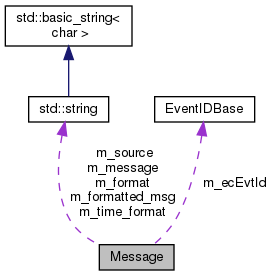
Collaboration diagram for Message:

Public Member Functions

 Message ()=default
 Default constructor. More...
 
 Message (const char *src, int type, const char *msg)
 Constructor. More...
 
 Message (std::string src, int type, std::string msg)
 Constructor. More...
 
 ~Message ()=default
 Default destructor. More...
 
const std::stringgetMessage () const
 Get the message string. More...
 
void setMessage (std::string msg)
 Set the message string. More...
 
int getType () const
 Get the message type. More...
 
void setType (int msg_type)
 Set the message type. More...
 
const std::stringgetSource () const
 Get the message source. More...
 
void setSource (std::string src)
 Set the message source. More...
 
const std::stringgetFormat () const
 Get the format string. More...
 
void setFormat (std::string msg) const
 Set the format string. More...
 
const std::stringgetTimeFormat () const
 Get the time format string. More...
 
void setTimeFormat (std::string timeFormat) const
 Set the time format string. More...
 
bool operator< (const Message &test)
 Needed to build maps. More...
 

Static Public Member Functions

static const std::string getDefaultFormat ()
 Get the default format string. More...
 
static const std::string getDefaultTimeFormat ()
 Get the default time format string. More...
 

Private Member Functions

void invalidFormat () const
 Called when an invalid format string is encountered. More...
 
void makeFormattedMsg (const std::string &format) const
 Format the message. More...
 
void decodeFormat (const std::string &format) const
 Decode format. More...
 
void sizeField (const std::string &text) const
 Truncate or pad the output string to the field width as necessary. More...
 
void setWidth (const std::string &formatArg) const
 Set the width of a stream. More...
 

Private Attributes

std::string m_message
 The message text. More...
 
std::string m_source {"UNKNOWN"}
 The message source. More...
 
int m_type {0}
 The message type/level. More...
 
std::string m_format {DEFAULT_FORMAT}
 The format string. More...
 
std::string m_time_format {DEFAULT_TIME_FORMAT}
 Time format string. More...
 
std::string m_formatted_msg
 Formatted message. More...
 
char m_fill {' '}
 Current fill character. More...
 
int m_width {0}
 Current field width. More...
 
bool m_left {true}
 The message alignment. More...
 
Event identifiers
EventContext::ContextID_t m_ecSlot {Gaudi::Hive::currentContext().slot()}
 Event slot. More...
 
EventContext::ContextEvt_t m_ecEvt {Gaudi::Hive::currentContext().evt()}
 Event number. More...
 
EventIDBase m_ecEvtId {Gaudi::Hive::currentContext().eventID()}
 Full event ID. More...
 
pthread_t m_ecThrd {pthread_self()}
 Thread ID. More...
 

Static Private Attributes

static constexpr const char * DEFAULT_FORMAT = "% F%18W%S%7W%R%T %0W%M"
 The default message format. More...
 
static constexpr const char * DEFAULT_TIME_FORMAT = "%Y-%m-%d %H:%M:%S,%f"
 The default time format (accepts strftime formatters plus %f for milliseconds). More...
 
Formatting characters
static const char FORMAT_PREFIX = '%'
 The character used to prefix formatting commands. More...
 
static const char JUSTIFY_LEFT = 'L'
 The character used to indicate start of left text justification. More...
 
static const char JUSTIFY_RIGHT = 'R'
 The character used to indicate start of right text justification. More...
 
static const char MESSAGE = 'M'
 The character used to indicate that the message should be printed. More...
 
static const char TYPE = 'T'
 The character used to indicate that the message type should be printed. More...
 
static const char TIME = 't'
 The character used to indicate that the message timestamp should be printed. More...
 
static const char UTIME = 'u'
 The character used to indicate that the message timestamp should be printed in UTC time. More...
 
static const char SOURCE = 'S'
 The character used to indicate that the message source should be printed. More...
 
static const char SLOT = 's'
 The character used to indicate that the slot number should be printed. More...
 
static const char EVTNUM = 'e'
 The character used to indicate that the event number should be printed. More...
 
static const char THREAD = 'X'
 The character used to indicate that the thread ID should be printed. More...
 
static const char EVENTID = 'E'
 The character used to indicate that the full event ID should be printed. More...
 
static const char FILL = 'F'
 The character used to indicate that the previous character is used to pad fields if the text is not long enough. More...
 
static const char WIDTH = 'W'
 The character used to indicate that the previous decimal characters should be taken as the field width. More...
 

Friends

std::ostreamoperator<< (std::ostream &stream, const Message &msg)
 Insert the message into a stream. More...
 
bool operator== (const Message &a, const Message &b)
 Insert the message into a stream. More...
 

Detailed Description

The Message class.

This class is used to contain messages which can then be formatted and sent to a message service

Author
Iain Last

Definition at line 27 of file Message.h.

Constructor & Destructor Documentation

◆ Message() [1/3]

Message::Message ( )
default

Default constructor.

◆ Message() [2/3]

Message::Message ( const char *  src,
int  type,
const char *  msg 
)

Constructor.

Definition at line 39 of file Message.cpp.

39 : m_message( msg ), m_source( src ), m_type( type ) {}
std::string m_message
The message text.
Definition: Message.h:102
std::string m_source
The message source.
Definition: Message.h:103
int m_type
The message type/level.
Definition: Message.h:104

◆ Message() [3/3]

Message::Message ( std::string  src,
int  type,
std::string  msg 
)

Constructor.

Definition at line 47 of file Message.cpp.

48  : m_message( std::move( msg ) ), m_source( std::move( src ) ), m_type( type ) {}
std::string m_message
The message text.
Definition: Message.h:102
T move(T... args)
std::string m_source
The message source.
Definition: Message.h:103
int m_type
The message type/level.
Definition: Message.h:104

◆ ~Message()

Message::~Message ( )
default

Default destructor.

Member Function Documentation

◆ decodeFormat()

void Message::decodeFormat ( const std::string format) const
private

Decode format.

Definition at line 231 of file Message.cpp.

231  {
232  if ( !format.empty() ) {
233  const char FORMAT_TYPE = format[format.length() - 1];
234  const std::string FORMAT_PARAM = format.substr( 0, format.length() - 1 );
235 
236  // Now test the format.
238  switch ( FORMAT_TYPE ) {
239  case FILL:
240  if ( FORMAT_PARAM.length() == 1 ) {
241  m_fill = FORMAT_PARAM[0];
242  } else
243  invalidFormat();
244  break;
245 
246  case TIME: {
247  sizeField( formattedTime( m_time_format ) );
248  } break;
249 
250  case UTIME: {
251  sizeField( formattedTime( m_time_format, true ) );
252  } break;
253 
254  case THREAD: {
255  std::ostringstream ost;
256  // ost << "0x" << std::hex << pthread_self();
257  ost << "0x" << std::hex << m_ecThrd;
258  const std::string& thrStr( ost.str() );
259  sizeField( thrStr );
260  } break;
261 
262  case SLOT: {
263  std::ostringstream ost;
265  sizeField( ost.str() );
266  } break;
267 
268  case EVTNUM: {
269  std::ostringstream ost;
271  sizeField( ost.str() );
272  } break;
273 
274  case EVENTID: {
275  std::ostringstream ost;
276  if ( m_ecEvtId.isValid() ) { ost << m_ecEvtId; }
277  sizeField( ost.str() );
278  } break;
279 
280  case MESSAGE:
281  sizeField( m_message );
282  break;
283 
284  case SOURCE:
285  sizeField( m_source );
286  break;
287 
288  case TYPE:
289  switch ( m_type ) {
290 #define SET( x ) \
291  case x: \
292  level = #x; \
293  break
294  SET( NIL );
295  SET( VERBOSE );
296  SET( DEBUG );
297  SET( INFO );
298  SET( WARNING );
299  SET( ERROR );
300  SET( FATAL );
301  case ALWAYS:
302  level = "SUCCESS";
303  break;
304  default:
305  level = "UNKNOWN";
306  break;
307 #undef SET
308  }
309  sizeField( level );
310  break;
311 
312  case FORMAT_PREFIX:
314  break;
315  case JUSTIFY_RIGHT:
316  m_left = false;
317  break;
318  case JUSTIFY_LEFT:
319  m_left = true;
320  break;
321  case WIDTH:
322  setWidth( FORMAT_PARAM );
323  break;
324  default:
325  invalidFormat();
326  break;
327  }
328  } else
329  invalidFormat();
330 }
static const char TYPE
The character used to indicate that the message type should be printed.
Definition: Message.h:135
bool m_left
The message alignment.
Definition: Message.h:110
static const char MESSAGE
The character used to indicate that the message should be printed.
Definition: Message.h:132
char m_fill
Current fill character.
Definition: Message.h:108
static const char JUSTIFY_LEFT
The character used to indicate start of left text justification.
Definition: Message.h:126
T empty(T... args)
void sizeField(const std::string &text) const
Truncate or pad the output string to the field width as necessary.
Definition: Message.cpp:373
GAUDI_API std::string format(const char *,...)
MsgStream format utility "a la sprintf(...)".
Definition: MsgStream.cpp:119
std::string m_formatted_msg
Formatted message.
Definition: Message.h:107
static const char THREAD
The character used to indicate that the thread ID should be printed.
Definition: Message.h:153
std::string m_time_format
Time format string.
Definition: Message.h:106
EventContext::ContextEvt_t m_ecEvt
Event number.
Definition: Message.h:115
std::string m_message
The message text.
Definition: Message.h:102
void setWidth(const std::string &formatArg) const
Set the width of a stream.
Definition: Message.cpp:358
#define SET(x)
EventIDBase m_ecEvtId
Full event ID.
Definition: Message.h:116
static const char EVENTID
The character used to indicate that the full event ID should be printed.
Definition: Message.h:156
STL class.
static constexpr ContextEvt_t INVALID_CONTEXT_EVT
Definition: EventContext.h:40
void invalidFormat() const
Called when an invalid format string is encountered.
Definition: Message.cpp:339
static constexpr ContextID_t INVALID_CONTEXT_ID
Definition: EventContext.h:39
T str(T... args)
static const char EVTNUM
The character used to indicate that the event number should be printed.
Definition: Message.h:150
EventContext::ContextID_t m_ecSlot
Event slot.
Definition: Message.h:114
bool isValid() const
Definition: EventIDBase.h:157
static const char TIME
The character used to indicate that the message timestamp should be printed.
Definition: Message.h:138
T length(T... args)
static const char JUSTIFY_RIGHT
The character used to indicate start of right text justification.
Definition: Message.h:129
static const char UTIME
The character used to indicate that the message timestamp should be printed in UTC time.
Definition: Message.h:141
static const char SLOT
The character used to indicate that the slot number should be printed.
Definition: Message.h:147
pthread_t m_ecThrd
Thread ID.
Definition: Message.h:117
static const char FILL
The character used to indicate that the previous character is used to pad fields if the text is not l...
Definition: Message.h:159
T hex(T... args)
T substr(T... args)
static const char FORMAT_PREFIX
The character used to prefix formatting commands.
Definition: Message.h:123
std::string m_source
The message source.
Definition: Message.h:103
static const char WIDTH
The character used to indicate that the previous decimal characters should be taken as the field widt...
Definition: Message.h:162
static const char SOURCE
The character used to indicate that the message source should be printed.
Definition: Message.h:144
int m_type
The message type/level.
Definition: Message.h:104

◆ getDefaultFormat()

const std::string Message::getDefaultFormat ( )
static

Get the default format string.

Definition at line 144 of file Message.cpp.

144 { return DEFAULT_FORMAT; }
static constexpr const char * DEFAULT_FORMAT
The default message format.
Definition: Message.h:166

◆ getDefaultTimeFormat()

const std::string Message::getDefaultTimeFormat ( )
static

Get the default time format string.

Definition at line 175 of file Message.cpp.

175 { return DEFAULT_TIME_FORMAT; }
static constexpr const char * DEFAULT_TIME_FORMAT
The default time format (accepts strftime formatters plus %f for milliseconds).
Definition: Message.h:169

◆ getFormat()

const std::string & Message::getFormat ( ) const

Get the format string.

Definition at line 136 of file Message.cpp.

136 { return m_format; }
std::string m_format
The format string.
Definition: Message.h:105

◆ getMessage()

const std::string & Message::getMessage ( ) const

Get the message string.

Definition at line 56 of file Message.cpp.

56 { return m_message; }
std::string m_message
The message text.
Definition: Message.h:102

◆ getSource()

const std::string & Message::getSource ( ) const

Get the message source.

Definition at line 88 of file Message.cpp.

88 { return m_source; }
std::string m_source
The message source.
Definition: Message.h:103

◆ getTimeFormat()

const std::string & Message::getTimeFormat ( ) const

Get the time format string.

Definition at line 167 of file Message.cpp.

167 { return m_time_format; }
std::string m_time_format
Time format string.
Definition: Message.h:106

◆ getType()

int Message::getType ( ) const

Get the message type.

Definition at line 72 of file Message.cpp.

72 { return m_type; }
int m_type
The message type/level.
Definition: Message.h:104

◆ invalidFormat()

void Message::invalidFormat ( ) const
private

Called when an invalid format string is encountered.

Definition at line 339 of file Message.cpp.

void makeFormattedMsg(const std::string &format) const
Format the message.
Definition: Message.cpp:194
static constexpr const char * DEFAULT_FORMAT
The default message format.
Definition: Message.h:166

◆ makeFormattedMsg()

void Message::makeFormattedMsg ( const std::string format) const
private

Format the message.

Definition at line 194 of file Message.cpp.

194  {
196  auto i = format.begin();
197  while ( i != format.end() ) {
198 
199  // Output format string until format statement found.
200  while ( i != format.end() && *i != FORMAT_PREFIX ) m_formatted_msg += *i++;
201 
202  // Test for end of format string.
203  if ( i == format.end() ) break;
204  i++;
205 
206  // Find type of formatting.
207  std::string this_format;
208  while ( i != format.end() && *i != FORMAT_PREFIX && *i != MESSAGE && *i != TYPE && *i != SOURCE && *i != FILL &&
209  *i != WIDTH && *i != TIME && *i != UTIME && *i != SLOT && *i != EVTNUM && *i != THREAD && *i != EVENTID &&
210  *i != JUSTIFY_LEFT && *i != JUSTIFY_RIGHT ) {
211  this_format += *i++;
212  }
213 
214  // Reached end of string with improper format.
215  if ( i == format.end() ) {
216  invalidFormat();
217  break;
218  }
219 
220  this_format += *i++;
221  decodeFormat( this_format );
222  }
223 }
static const char TYPE
The character used to indicate that the message type should be printed.
Definition: Message.h:135
static const char MESSAGE
The character used to indicate that the message should be printed.
Definition: Message.h:132
static const char JUSTIFY_LEFT
The character used to indicate start of left text justification.
Definition: Message.h:126
void decodeFormat(const std::string &format) const
Decode format.
Definition: Message.cpp:231
GAUDI_API std::string format(const char *,...)
MsgStream format utility "a la sprintf(...)".
Definition: MsgStream.cpp:119
std::string m_formatted_msg
Formatted message.
Definition: Message.h:107
static const char THREAD
The character used to indicate that the thread ID should be printed.
Definition: Message.h:153
T end(T... args)
static const char EVENTID
The character used to indicate that the full event ID should be printed.
Definition: Message.h:156
STL class.
void invalidFormat() const
Called when an invalid format string is encountered.
Definition: Message.cpp:339
static const char EVTNUM
The character used to indicate that the event number should be printed.
Definition: Message.h:150
T clear(T... args)
static const char TIME
The character used to indicate that the message timestamp should be printed.
Definition: Message.h:138
static const char JUSTIFY_RIGHT
The character used to indicate start of right text justification.
Definition: Message.h:129
static const char UTIME
The character used to indicate that the message timestamp should be printed in UTC time.
Definition: Message.h:141
static const char SLOT
The character used to indicate that the slot number should be printed.
Definition: Message.h:147
T begin(T... args)
static const char FILL
The character used to indicate that the previous character is used to pad fields if the text is not l...
Definition: Message.h:159
static const char FORMAT_PREFIX
The character used to prefix formatting commands.
Definition: Message.h:123
static const char WIDTH
The character used to indicate that the previous decimal characters should be taken as the field widt...
Definition: Message.h:162
static const char SOURCE
The character used to indicate that the message source should be printed.
Definition: Message.h:144

◆ operator<()

bool Message::operator< ( const Message test)

Needed to build maps.

Definition at line 116 of file Message.cpp.

116  {
117  return m_type < b.m_type || m_source < b.m_source || m_message < b.m_message;
118 }
std::string m_message
The message text.
Definition: Message.h:102
std::string m_source
The message source.
Definition: Message.h:103
int m_type
The message type/level.
Definition: Message.h:104

◆ setFormat()

void Message::setFormat ( std::string  msg) const

Set the format string.

Definition at line 153 of file Message.cpp.

153  {
154  if ( LIKELY( !format.empty() ) ) {
156  } else {
158  }
159 }
T empty(T... args)
GAUDI_API std::string format(const char *,...)
MsgStream format utility "a la sprintf(...)".
Definition: MsgStream.cpp:119
T move(T... args)
#define LIKELY(x)
Definition: Kernel.h:105
std::string m_format
The format string.
Definition: Message.h:105
static constexpr const char * DEFAULT_FORMAT
The default message format.
Definition: Message.h:166

◆ setMessage()

void Message::setMessage ( std::string  msg)

Set the message string.

Definition at line 64 of file Message.cpp.

64 { m_message = std::move( msg ); }
std::string m_message
The message text.
Definition: Message.h:102
T move(T... args)

◆ setSource()

void Message::setSource ( std::string  src)

Set the message source.

Definition at line 96 of file Message.cpp.

96 { m_source = std::move( src ); }
T move(T... args)
std::string m_source
The message source.
Definition: Message.h:103

◆ setTimeFormat()

void Message::setTimeFormat ( std::string  timeFormat) const

Set the time format string.

Definition at line 184 of file Message.cpp.

184  {
185  m_time_format = ( timeFormat.empty() ? DEFAULT_TIME_FORMAT : std::move( timeFormat ) );
186 }
T empty(T... args)
std::string m_time_format
Time format string.
Definition: Message.h:106
T move(T... args)
static constexpr const char * DEFAULT_TIME_FORMAT
The default time format (accepts strftime formatters plus %f for milliseconds).
Definition: Message.h:169

◆ setType()

void Message::setType ( int  msg_type)

Set the message type.

Definition at line 80 of file Message.cpp.

80 { m_type = msg_type; }
int m_type
The message type/level.
Definition: Message.h:104

◆ setWidth()

void Message::setWidth ( const std::string formatArg) const
private

Set the width of a stream.

Definition at line 358 of file Message.cpp.

358  {
359  // Convert string to int, if string contains digits only...
360  if ( all_digits( formatArg ) )
361  m_width = std::stoi( formatArg );
362  else
363  invalidFormat();
364 }
void invalidFormat() const
Called when an invalid format string is encountered.
Definition: Message.cpp:339
int m_width
Current field width.
Definition: Message.h:109
T stoi(T... args)

◆ sizeField()

void Message::sizeField ( const std::string text) const
private

Truncate or pad the output string to the field width as necessary.

Definition at line 373 of file Message.cpp.

373  {
374  std::string newText;
375  if ( m_width == 0 || m_width == static_cast<int>( text.length() ) ) {
376  newText = text;
377  } else {
378 
379  // Truncate the text if it is too long.
380  if ( m_width < static_cast<int>( text.length() ) ) {
381  newText = text.substr( 0, m_width );
382  for ( int i = 0, j = newText.length() - 1; i < 3 && j >= 0; ++i, --j ) newText[j] = '.';
383  }
384 
385  // Pad the text.
386  else {
387  newText = std::string( m_width, m_fill );
388  if ( m_left )
389  newText.replace( newText.begin(), newText.begin() + text.length(), text.begin(), text.end() );
390  else
391  newText.replace( newText.end() - text.length(), newText.end(), text.begin(), text.end() );
392  }
393  }
394 
395  m_formatted_msg += newText;
396 }
bool m_left
The message alignment.
Definition: Message.h:110
char m_fill
Current fill character.
Definition: Message.h:108
std::string m_formatted_msg
Formatted message.
Definition: Message.h:107
T end(T... args)
STL class.
T replace(T... args)
int m_width
Current field width.
Definition: Message.h:109
T length(T... args)
T begin(T... args)
T substr(T... args)

Friends And Related Function Documentation

◆ operator<<

std::ostream& operator<< ( std::ostream stream,
const Message msg 
)
friend

Insert the message into a stream.

Definition at line 104 of file Message.cpp.

104  {
105  msg.makeFormattedMsg( msg.m_format );
106  stream << msg.m_formatted_msg;
107  return stream;
108 }

◆ operator==

bool operator== ( const Message a,
const Message b 
)
friend

Insert the message into a stream.

Definition at line 126 of file Message.cpp.

126  {
127  return a.m_source == b.m_source && a.m_type == b.m_type && a.m_message == b.m_message;
128 }
std::string m_message
The message text.
Definition: Message.h:102
std::string m_source
The message source.
Definition: Message.h:103
int m_type
The message type/level.
Definition: Message.h:104

Member Data Documentation

◆ DEFAULT_FORMAT

constexpr const char* Message::DEFAULT_FORMAT = "% F%18W%S%7W%R%T %0W%M"
staticprivate

The default message format.

Definition at line 166 of file Message.h.

◆ DEFAULT_TIME_FORMAT

constexpr const char* Message::DEFAULT_TIME_FORMAT = "%Y-%m-%d %H:%M:%S,%f"
staticprivate

The default time format (accepts strftime formatters plus %f for milliseconds).

Definition at line 169 of file Message.h.

◆ EVENTID

const char Message::EVENTID = 'E'
staticprivate

The character used to indicate that the full event ID should be printed.

Definition at line 156 of file Message.h.

◆ EVTNUM

const char Message::EVTNUM = 'e'
staticprivate

The character used to indicate that the event number should be printed.

Definition at line 150 of file Message.h.

◆ FILL

const char Message::FILL = 'F'
staticprivate

The character used to indicate that the previous character is used to pad fields if the text is not long enough.

Definition at line 159 of file Message.h.

◆ FORMAT_PREFIX

const char Message::FORMAT_PREFIX = '%'
staticprivate

The character used to prefix formatting commands.

Definition at line 123 of file Message.h.

◆ JUSTIFY_LEFT

const char Message::JUSTIFY_LEFT = 'L'
staticprivate

The character used to indicate start of left text justification.

Definition at line 126 of file Message.h.

◆ JUSTIFY_RIGHT

const char Message::JUSTIFY_RIGHT = 'R'
staticprivate

The character used to indicate start of right text justification.

Definition at line 129 of file Message.h.

◆ m_ecEvt

EventContext::ContextEvt_t Message::m_ecEvt {Gaudi::Hive::currentContext().evt()}
private

Event number.

Definition at line 115 of file Message.h.

◆ m_ecEvtId

EventIDBase Message::m_ecEvtId {Gaudi::Hive::currentContext().eventID()}
private

Full event ID.

Definition at line 116 of file Message.h.

◆ m_ecSlot

EventContext::ContextID_t Message::m_ecSlot {Gaudi::Hive::currentContext().slot()}
private

Event slot.

Definition at line 114 of file Message.h.

◆ m_ecThrd

pthread_t Message::m_ecThrd {pthread_self()}
private

Thread ID.

Definition at line 117 of file Message.h.

◆ m_fill

char Message::m_fill {' '}
mutableprivate

Current fill character.

Definition at line 108 of file Message.h.

◆ m_format

std::string Message::m_format {DEFAULT_FORMAT}
mutableprivate

The format string.

Definition at line 105 of file Message.h.

◆ m_formatted_msg

std::string Message::m_formatted_msg
mutableprivate

Formatted message.

Definition at line 107 of file Message.h.

◆ m_left

bool Message::m_left {true}
mutableprivate

The message alignment.

Definition at line 110 of file Message.h.

◆ m_message

std::string Message::m_message
private

The message text.

Definition at line 102 of file Message.h.

◆ m_source

std::string Message::m_source {"UNKNOWN"}
private

The message source.

Definition at line 103 of file Message.h.

◆ m_time_format

std::string Message::m_time_format {DEFAULT_TIME_FORMAT}
mutableprivate

Time format string.

Definition at line 106 of file Message.h.

◆ m_type

int Message::m_type {0}
private

The message type/level.

Definition at line 104 of file Message.h.

◆ m_width

int Message::m_width {0}
mutableprivate

Current field width.

Definition at line 109 of file Message.h.

◆ MESSAGE

const char Message::MESSAGE = 'M'
staticprivate

The character used to indicate that the message should be printed.

Definition at line 132 of file Message.h.

◆ SLOT

const char Message::SLOT = 's'
staticprivate

The character used to indicate that the slot number should be printed.

Definition at line 147 of file Message.h.

◆ SOURCE

const char Message::SOURCE = 'S'
staticprivate

The character used to indicate that the message source should be printed.

Definition at line 144 of file Message.h.

◆ THREAD

const char Message::THREAD = 'X'
staticprivate

The character used to indicate that the thread ID should be printed.

Definition at line 153 of file Message.h.

◆ TIME

const char Message::TIME = 't'
staticprivate

The character used to indicate that the message timestamp should be printed.

Definition at line 138 of file Message.h.

◆ TYPE

const char Message::TYPE = 'T'
staticprivate

The character used to indicate that the message type should be printed.

Definition at line 135 of file Message.h.

◆ UTIME

const char Message::UTIME = 'u'
staticprivate

The character used to indicate that the message timestamp should be printed in UTC time.

Definition at line 141 of file Message.h.

◆ WIDTH

const char Message::WIDTH = 'W'
staticprivate

The character used to indicate that the previous decimal characters should be taken as the field width.

Definition at line 162 of file Message.h.


The documentation for this class was generated from the following files: