
|
Gaudi Framework, version v21r8 |
| Home | Generated: 17 Mar 2010 |
|
|
Gaudi Framework, version v21r8 |
| Home | Generated: 17 Mar 2010 |
#include <EventLoopMgr.h>

Public Member Functions | |
| EventLoopMgr (const std::string &nam, ISvcLocator *svcLoc) | |
| Standard Constructor. | |
| virtual | ~EventLoopMgr () |
| Standard Destructor. | |
| StatusCode | getEventRoot (IOpaqueAddress *&refpAddr) |
| Create event address using event selector. | |
| virtual StatusCode | initialize () |
| implementation of IService::initalize | |
| virtual StatusCode | reinitialize () |
| implementation of IService::reinitalize | |
| virtual StatusCode | stop () |
| implementation of IService::stop | |
| virtual StatusCode | finalize () |
| implementation of IService::finalize | |
| virtual StatusCode | nextEvent (int maxevt) |
| implementation of IService::nextEvent | |
| virtual StatusCode | executeEvent (void *par) |
| implementation of IEventProcessor::executeEvent(void* par) | |
| virtual StatusCode | executeRun (int maxevt) |
| implementation of IEventProcessor::executeRun() | |
Protected Attributes | |
| SmartIF< IDataManagerSvc > | m_evtDataMgrSvc |
| Reference to the Event Data Service's IDataManagerSvc interface. | |
| SmartIF< IDataProviderSvc > | m_evtDataSvc |
| Reference to the Event Data Service's IDataProviderSvc interface. | |
| SmartIF< IEvtSelector > | m_evtSelector |
| Reference to the Event Selector. | |
| IEvtSelector::Context * | m_evtContext |
| Event Iterator. | |
| std::string | m_evtsel |
| Event selector. | |
| SmartIF< IDataManagerSvc > | m_histoDataMgrSvc |
| Reference to the Histogram Data Service. | |
| SmartIF< IConversionSvc > | m_histoPersSvc |
| Reference to the Histogram Persistency Service. | |
| std::string | m_histPersName |
| Name of the Hist Pers type. | |
| IProperty * | m_appMgrProperty |
| Property interface of ApplicationMgr. | |
| bool | m_endEventFired |
| Flag to avoid to fire the EnvEvent incident twice in a row (and also not before the first event). | |
| bool | m_warnings |
| Flag to disable warning messages when using external input. | |
| bool | m_handleSIGINT |
| Flag to enable/disable handling of SIGINT. | |
| bool | m_handleSIGXCPU |
| Flag to enable/disable handling of SIGXCPU. | |
| unsigned int | m_eventTimeout |
| Number of seconds allowed to process a single event. | |
| std::auto_ptr< WatchdogThread > | m_watchdog |
| Pointer to the watchdog thread that checks for the event timeout. | |
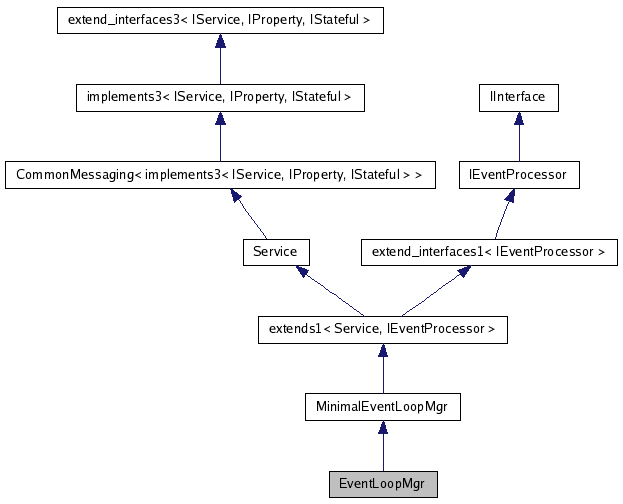
This is the default processing manager of the application manager. This object handles the minimal requirements needed by the application manager. It also handles the default user configuration setup for standard event processing.
History:
    +---------+----------------------------------------------+---------+
    |    Date |                 Comment                      | Who     |
    +---------+----------------------------------------------+---------+
    |13/12/00 | Initial version                              | M.Frank |
    +---------+----------------------------------------------+---------+
Definition at line 40 of file EventLoopMgr.h.
| EventLoopMgr::EventLoopMgr | ( | const std::string & | nam, | |
| ISvcLocator * | svcLoc | |||
| ) |
Standard Constructor.
Definition at line 177 of file EventLoopMgr.cpp.
00178 : MinimalEventLoopMgr(nam, svcLoc)
00179 {
00180   m_histoDataMgrSvc   = 0;
00181   m_histoPersSvc      = 0;
00182   m_evtDataMgrSvc     = 0;
00183   m_evtDataSvc        = 0;
00184   m_evtSelector       = 0;
00185   m_evtContext        = 0;
00186   m_endEventFired     = true;
00187
00188   // Declare properties
00189   declareProperty("HistogramPersistency", m_histPersName = "");
00190   declareProperty("EvtSel", m_evtsel );
00191   declareProperty("Warnings",m_warnings=true,
00192                   "Set this property to false to suppress warning messages");
00193
00194   declareProperty("HandleSIGINT", m_handleSIGINT = true,
00195                   "Intercept the SIGINT signal (CTRL-C) and stop the event loop.");
00196   declareProperty("HandleSIGXCPU", m_handleSIGXCPU = true,
00197                   "Intercept the SIGXCPU signal and stop the event loop (ignored on Windows).");
00198   declareProperty("EventTimeout", m_eventTimeout = 600,
00199                   "Number of seconds allowed to process a single event (0 to disable the check)");
00200 }
| EventLoopMgr::~EventLoopMgr | ( | ) | [virtual] |
Standard Destructor.
Definition at line 205 of file EventLoopMgr.cpp.
00205                               {
00206   if( m_histoDataMgrSvc ) m_histoDataMgrSvc->release();
00207   if( m_histoPersSvc ) m_histoPersSvc->release();
00208   if( m_evtDataMgrSvc ) m_evtDataMgrSvc->release();
00209   if( m_evtDataSvc ) m_evtDataSvc->release();
00210   if( m_evtSelector ) m_evtSelector->release();
00211   if( m_evtContext ) delete m_evtContext;
00212 }
| StatusCode EventLoopMgr::getEventRoot | ( | IOpaqueAddress *& | refpAddr | ) |
Create event address using event selector.
Definition at line 599 of file EventLoopMgr.cpp.
00599                                                                 {
00600   refpAddr = 0;
00601   StatusCode sc = m_evtSelector->next(*m_evtContext);
00602   if ( !sc.isSuccess() )  {
00603     return sc;
00604   }
00605   // Create root address and assign address to data service
00606   sc = m_evtSelector->createAddress(*m_evtContext,refpAddr);
00607   if( !sc.isSuccess() )  {
00608     sc = m_evtSelector->next(*m_evtContext);
00609     if ( sc.isSuccess() )  {
00610       sc = m_evtSelector->createAddress(*m_evtContext,refpAddr);
00611       if ( !sc.isSuccess() )  {
00612         MsgStream log( msgSvc(), name() );
00613         log << MSG::WARNING << "Error creating IOpaqueAddress." << endmsg;
00614       }
00615     }
00616   }
00617   return sc;
00618 }
| StatusCode EventLoopMgr::initialize | ( | ) | [virtual] |
implementation of IService::initalize
Reimplemented from MinimalEventLoopMgr.
Definition at line 217 of file EventLoopMgr.cpp.
00217                                        {
00218   // Initialize the base class
00219   StatusCode sc = MinimalEventLoopMgr::initialize();
00220   MsgStream log(msgSvc(), name());
00221   if( !sc.isSuccess() ) {
00222     log << MSG::DEBUG << "Error Initializing base class MinimalEventLoopMgr." << endmsg;
00223     return sc;
00224   }
00225
00226   // Setup access to event data services
00227   m_evtDataMgrSvc = serviceLocator()->service("EventDataSvc");
00228   if( !m_evtDataMgrSvc.isValid() )  {
00229     log << MSG::FATAL << "Error retrieving EventDataSvc interface IDataManagerSvc." << endmsg;
00230     return StatusCode::FAILURE;
00231   }
00232   m_evtDataSvc = serviceLocator()->service("EventDataSvc");
00233   if( !m_evtDataSvc.isValid() )  {
00234     log << MSG::FATAL << "Error retrieving EventDataSvc interface IDataProviderSvc." << endmsg;
00235     return StatusCode::FAILURE;
00236   }
00237
00238   // Obtain the IProperty of the ApplicationMgr
00239   SmartIF<IProperty> prpMgr(serviceLocator());
00240   if ( ! prpMgr.isValid() )   {
00241     log << MSG::FATAL << "IProperty interface not found in ApplicationMgr." << endmsg;
00242     return StatusCode::FAILURE;
00243   }
00244   else {
00245     m_appMgrProperty = prpMgr;
00246   }
00247
00248   // We do not expect a Event Selector necessarily being declared
00249   setProperty(m_appMgrProperty->getProperty("EvtSel")).ignore();
00250
00251   if( m_evtsel != "NONE" || m_evtsel.length() == 0) {
00252     m_evtSelector = serviceLocator()->service("EventSelector");
00253     if( m_evtSelector.isValid() ) {
00254       // Setup Event Selector
00255       sc=m_evtSelector->createContext(m_evtContext);
00256       if( !sc.isSuccess() )   {
00257         log << MSG::FATAL << "Can not create the event selector Context." << endmsg;
00258         return sc;
00259       }
00260     }
00261     else {
00262       log << MSG::FATAL << "EventSelector not found." << endmsg;
00263       return sc;
00264     }
00265   }
00266   else {
00267     m_evtSelector = 0;
00268     m_evtContext = 0;
00269     if ( m_warnings ) {
00270       log << MSG::WARNING << "Unable to locate service \"EventSelector\" " << endmsg;
00271       log << MSG::WARNING << "No events will be processed from external input." << endmsg;
00272     }
00273   }
00274
00275   // Setup access to histogramming services
00276   m_histoDataMgrSvc = serviceLocator()->service("HistogramDataSvc");
00277   if( !m_histoDataMgrSvc.isValid() )  {
00278     log << MSG::FATAL << "Error retrieving HistogramDataSvc." << endmsg;
00279     return sc;
00280   }
00281   // Setup histogram persistency
00282   m_histoPersSvc = serviceLocator()->service("HistogramPersistencySvc");
00283   if( !m_histoPersSvc.isValid() ) {
00284     log << MSG::WARNING << "Histograms cannot not be saved - though required." << endmsg;
00285     return sc;
00286   }
00287
00288   if (m_eventTimeout) {
00289     m_watchdog = std::auto_ptr<WatchdogThread>(
00290         new EventWatchdog(msgSvc(),
00291             "EventWatchdog",
00292             boost::posix_time::seconds(m_eventTimeout)));
00293   }
00294
00295   if (m_handleSIGINT) SignalHandler::instance().monitorSignal(SIGINT);
00296 #ifndef _WIN32
00297   if (m_handleSIGXCPU) SignalHandler::instance().monitorSignal(SIGXCPU);
00298 #endif
00299   return StatusCode::SUCCESS;
00300 }
| StatusCode EventLoopMgr::reinitialize | ( | ) | [virtual] |
implementation of IService::reinitalize
Reimplemented from MinimalEventLoopMgr.
Definition at line 304 of file EventLoopMgr.cpp.
00304                                       {
00305   MsgStream log(msgSvc(), name());
00306
00307   // Initialize the base class
00308   StatusCode sc = MinimalEventLoopMgr::reinitialize();
00309   if( !sc.isSuccess() ) {
00310     log << MSG::DEBUG << "Error Initializing base class MinimalEventLoopMgr." << endmsg;
00311     return sc;
00312   }
00313
00314   // Check to see whether a new Event Selector has been specified
00315   setProperty(m_appMgrProperty->getProperty("EvtSel"));
00316   if( m_evtsel != "NONE" || m_evtsel.length() == 0) {
00317     SmartIF<IService> theSvc(serviceLocator()->service("EventSelector"));
00318     SmartIF<IEvtSelector> theEvtSel(theSvc);
00319     if( theEvtSel.isValid() && ( theEvtSel.get() != m_evtSelector.get() ) ) {
00320       // Setup Event Selector
00321       if ( m_evtSelector.get() && m_evtContext ) {
00322         // Need to release context before switching to new event selector
00323         m_evtSelector->releaseContext(m_evtContext);
00324         m_evtContext = 0;
00325       }
00326       m_evtSelector = theEvtSel;
00327       if (theSvc->FSMState() == Gaudi::StateMachine::INITIALIZED) {
00328         sc = theSvc->reinitialize();
00329         if( !sc.isSuccess() ) {
00330           log << MSG::ERROR << "Failure Reinitializing EventSelector "
00331               << theSvc->name( ) << endmsg;
00332           return sc;
00333         }
00334       }
00335       else {
00336         sc = theSvc->sysInitialize();
00337         if( !sc.isSuccess() ) {
00338           log << MSG::ERROR << "Failure Initializing EventSelector "
00339               << theSvc->name( ) << endmsg;
00340           return sc;
00341         }
00342       }
00343       sc = m_evtSelector->createContext(m_evtContext);
00344       if( !sc.isSuccess() ) {
00345         log << MSG::ERROR << "Can not create Context "
00346             << theSvc->name( ) << endmsg;
00347         return sc;
00348       }
00349       log << MSG::INFO << "EventSelector service changed to "
00350           << theSvc->name( ) << endmsg;
00351     }
00352     else if ( m_evtSelector.isValid() ) {
00353       if ( m_evtContext ) {
00354         m_evtSelector->releaseContext(m_evtContext);
00355         m_evtContext = 0;
00356       }
00357       sc = m_evtSelector->createContext(m_evtContext);
00358       if( !sc.isSuccess() ) {
00359         log << MSG::ERROR << "Can not create Context "
00360             << theSvc->name( ) << endmsg;
00361         return sc;
00362       }
00363     }
00364   }
00365   else if ( m_evtSelector.isValid() && m_evtContext ) {
00366     m_evtSelector->releaseContext(m_evtContext);
00367     m_evtSelector = 0;
00368     m_evtContext = 0;
00369   }
00370   return StatusCode::SUCCESS;
00371 }
| StatusCode EventLoopMgr::stop | ( | ) | [virtual] |
implementation of IService::stop
Reimplemented from MinimalEventLoopMgr.
Definition at line 377 of file EventLoopMgr.cpp.
00377                                  {
00378   if ( ! m_endEventFired ) {
00379     // Fire pending EndEvent incident
00380     m_incidentSvc->fireIncident(Incident(name(),IncidentType::EndEvent));
00381     m_endEventFired = true;
00382   }
00383   return MinimalEventLoopMgr::stop();
00384 }
| StatusCode EventLoopMgr::finalize | ( | void | ) | [virtual] |
implementation of IService::finalize
Reimplemented from MinimalEventLoopMgr.
Definition at line 389 of file EventLoopMgr.cpp.
00389                                      {
00390   StatusCode sc;
00391   MsgStream log(msgSvc(), name());
00392
00393   // Finalize base class
00394   sc = MinimalEventLoopMgr::finalize();
00395   if (! sc.isSuccess()) {
00396     log << MSG::ERROR << "Error finalizing base class" << endmsg;
00397     return sc;
00398   }
00399
00400   if (m_handleSIGINT) SignalHandler::instance().ignoreSignal(SIGINT);
00401 #ifndef _WIN32
00402   if (m_handleSIGXCPU) SignalHandler::instance().ignoreSignal(SIGXCPU);
00403 #endif
00404
00405   // Save Histograms Now
00406   if ( m_histoPersSvc != 0 )    {
00407     HistogramAgent agent;
00408     sc = m_histoDataMgrSvc->traverseTree( &agent );
00409     if( sc.isSuccess() )   {
00410       IDataSelector* objects = agent.selectedObjects();
00411       // skip /stat entry!
00412       if ( objects->size() > 0 )    {
00413         IDataSelector::iterator i;
00414         for ( i = objects->begin(); i != objects->end(); i++ )    {
00415           IOpaqueAddress* pAddr = 0;
00416           StatusCode iret = m_histoPersSvc->createRep(*i, pAddr);
00417           if ( iret.isSuccess() )     {
00418             (*i)->registry()->setAddress(pAddr);
00419           }
00420           else  {
00421             sc = iret;
00422           }
00423         }
00424         for ( i = objects->begin(); i != objects->end(); i++ )    {
00425           IRegistry* reg = (*i)->registry();
00426           StatusCode iret = m_histoPersSvc->fillRepRefs(reg->address(), *i);
00427           if ( !iret.isSuccess() )    {
00428             sc = iret;
00429           }
00430         }
00431       }
00432       if ( sc.isSuccess() )    {
00433         log << MSG::INFO << "Histograms converted successfully according to request." << endmsg;
00434       }
00435       else  {
00436         log << MSG::ERROR << "Error while saving Histograms." << endmsg;
00437       }
00438     }
00439     else {
00440       log << MSG::ERROR << "Error while traversing Histogram data store" << endmsg;
00441     }
00442   }
00443
00444   // Release event selector context
00445   if ( m_evtSelector && m_evtContext )   {
00446     m_evtSelector->releaseContext(m_evtContext).ignore();
00447     m_evtContext = 0;
00448   }
00449
00450   // Release all interfaces...
00451   m_histoDataMgrSvc = 0;
00452   m_histoPersSvc    = 0;
00453
00454   m_evtSelector     = 0;
00455   m_evtDataSvc      = 0;
00456   m_evtDataMgrSvc   = 0;
00457
00458   return StatusCode::SUCCESS;
00459 }
| StatusCode EventLoopMgr::nextEvent | ( | int | maxevt | ) | [virtual] |
implementation of IService::nextEvent
Reimplemented from MinimalEventLoopMgr.
Definition at line 500 of file EventLoopMgr.cpp.
00500                                                {
00501   static int        total_nevt = 0;
00502   DataObject*       pObject = 0;
00503   StatusCode        sc(StatusCode::SUCCESS, true);
00504   MsgStream         log( msgSvc(), name() );
00505
00506   if (m_watchdog.get()) m_watchdog->start();
00507
00508   // loop over events if the maxevt (received as input) if different from -1.
00509   // if evtmax is -1 it means infinite loop
00510   for( int nevt = 0; (maxevt == -1 ? true : nevt < maxevt);  nevt++, total_nevt++) {
00511     if (m_watchdog.get()) m_watchdog->ping();
00512
00513     if (
00514         SignalHandler::instance().gotSignal(SIGINT)
00515 #ifndef _WIN32
00516         or SignalHandler::instance().gotSignal(SIGXCPU)
00517 #endif
00518         ){
00519       log << MSG::ALWAYS << "Stop of event loop after receiving a ";
00520       if (SignalHandler::instance().gotSignal(SIGINT)) {
00521         log << "SIGINT";
00522       }
00523 #ifndef _WIN32
00524       else {
00525         log << "SIGXCPU";
00526       }
00527 #endif
00528       log << " signal" << endmsg;
00529       // Clear the signal flags
00530       if (SignalHandler::instance().gotSignal(SIGINT))
00531         SignalHandler::instance().clearSignal(SIGINT);
00532 #ifndef _WIN32
00533       if (SignalHandler::instance().gotSignal(SIGXCPU))
00534         SignalHandler::instance().clearSignal(SIGXCPU);
00535 #endif
00536       break;
00537     }
00538
00539     // Check if there is a scheduled stop issued by some algorithm/service
00540     if ( m_scheduledStop ) {
00541       m_scheduledStop = false;
00542       log << MSG::ALWAYS << "Terminating event processing loop due to scheduled stop" << endmsg;
00543       break;
00544     }
00545     // Clear the event store, if used in the event loop
00546     if( 0 != total_nevt ) {
00547
00548       if ( ! m_endEventFired ) {
00549         // Fire EndEvent "Incident" (it is considered part of the clearing of the TS)
00550         m_incidentSvc->fireIncident(Incident(name(),IncidentType::EndEvent));
00551         m_endEventFired = true;
00552       }
00553       sc = m_evtDataMgrSvc->clearStore();
00554       if( !sc.isSuccess() )  {
00555         log << MSG::DEBUG << "Clear of Event data store failed" << endmsg;
00556       }
00557     }
00558
00559     // Setup event in the event store
00560     if( m_evtContext ) {
00561       IOpaqueAddress* addr = 0;
00562       // Only if there is a EventSelector
00563       sc = getEventRoot(addr);
00564       if( !sc.isSuccess() )  {
00565         log << MSG::INFO << "No more events in event selection " << endmsg;
00566         break;
00567       }
00568       // Set root clears the event data store first
00569       sc = m_evtDataMgrSvc->setRoot ("/Event", addr);
00570       if( !sc.isSuccess() )  {
00571         log << MSG::WARNING << "Error declaring event root address." << endmsg;
00572         continue;
00573       }
00574       sc = m_evtDataSvc->retrieveObject("/Event", pObject);
00575       if( !sc.isSuccess() ) {
00576         log << MSG::WARNING << "Unable to retrieve Event root object" << endmsg;
00577         break;
00578       }
00579     }
00580     else {
00581       sc = m_evtDataMgrSvc->setRoot ("/Event", new DataObject());
00582       if( !sc.isSuccess() )  {
00583         log << MSG::WARNING << "Error declaring event root DataObject" << endmsg;
00584       }
00585     }
00586     // Execute event for all required algorithms
00587     sc = executeEvent(NULL);
00588     m_endEventFired = false;
00589     if( !sc.isSuccess() ){
00590       log << MSG::ERROR << "Terminating event processing loop due to errors" << endmsg;
00591       break;
00592     }
00593   }
00594   if (m_watchdog.get()) m_watchdog->stop();
00595   return StatusCode::SUCCESS;
00596 }
| StatusCode EventLoopMgr::executeEvent | ( | void * | par | ) | [virtual] |
implementation of IEventProcessor::executeEvent(void* par)
Reimplemented from MinimalEventLoopMgr.
Definition at line 465 of file EventLoopMgr.cpp.
00465                                                   {
00466
00467   // Fire BeginEvent "Incident"
00468   m_incidentSvc->fireIncident(Incident(name(),IncidentType::BeginEvent));
00469   // An incident may schedule a stop, in which case is better to exit before the actual execution.
00470   if ( m_scheduledStop ) {
00471     MsgStream  log( msgSvc(), name() );
00472     log << MSG::ALWAYS << "Terminating event processing loop due to a stop scheduled by an incident listener" << endmsg;
00473     return StatusCode::SUCCESS;
00474   }
00475
00476   // Execute Algorithms
00477   StatusCode sc = MinimalEventLoopMgr::executeEvent(par);
00478
00479   // Check if there was an error processing current event
00480   if( !sc.isSuccess() ){
00481     MsgStream log( msgSvc(), name() );
00482     log << MSG::ERROR << "Terminating event processing loop due to errors" << endmsg;
00483   }
00484   return sc;
00485 }
| StatusCode EventLoopMgr::executeRun | ( | int | maxevt | ) | [virtual] |
implementation of IEventProcessor::executeRun()
Reimplemented from MinimalEventLoopMgr.
Definition at line 490 of file EventLoopMgr.cpp.
00490                                                    {
00491   StatusCode  sc;
00492   // initialize the base class
00493   sc = MinimalEventLoopMgr::executeRun(maxevt);
00494   return sc;
00495 }
SmartIF<IDataManagerSvc> EventLoopMgr::m_evtDataMgrSvc [protected] |
Reference to the Event Data Service's IDataManagerSvc interface.
Definition at line 45 of file EventLoopMgr.h.
SmartIF<IDataProviderSvc> EventLoopMgr::m_evtDataSvc [protected] |
Reference to the Event Data Service's IDataProviderSvc interface.
Definition at line 47 of file EventLoopMgr.h.
SmartIF<IEvtSelector> EventLoopMgr::m_evtSelector [protected] |
IEvtSelector::Context* EventLoopMgr::m_evtContext [protected] |
std::string EventLoopMgr::m_evtsel [protected] |
SmartIF<IDataManagerSvc> EventLoopMgr::m_histoDataMgrSvc [protected] |
SmartIF<IConversionSvc> EventLoopMgr::m_histoPersSvc [protected] |
std::string EventLoopMgr::m_histPersName [protected] |
IProperty* EventLoopMgr::m_appMgrProperty [protected] |
bool EventLoopMgr::m_endEventFired [protected] |
Flag to avoid to fire the EnvEvent incident twice in a row (and also not before the first event).
Definition at line 64 of file EventLoopMgr.h.
bool EventLoopMgr::m_warnings [protected] |
Flag to disable warning messages when using external input.
Definition at line 66 of file EventLoopMgr.h.
bool EventLoopMgr::m_handleSIGINT [protected] |
bool EventLoopMgr::m_handleSIGXCPU [protected] |
unsigned int EventLoopMgr::m_eventTimeout [protected] |
std::auto_ptr<WatchdogThread> EventLoopMgr::m_watchdog [protected] |
Pointer to the watchdog thread that checks for the event timeout.
Definition at line 74 of file EventLoopMgr.h.