
|
Gaudi Framework, version v21r8 |
| Home | Generated: 17 Mar 2010 |
|
|
Gaudi Framework, version v21r8 |
| Home | Generated: 17 Mar 2010 |
#include <GaudiKernel/Auditor.h>
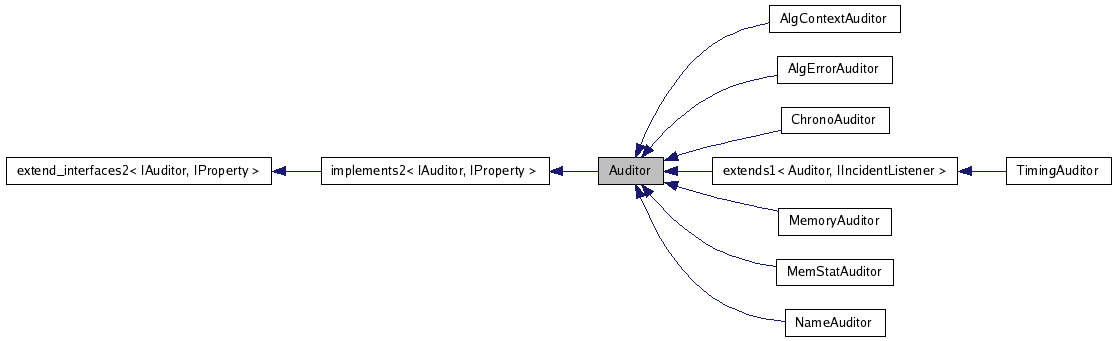

Public Member Functions | |
| Auditor (const std::string &name, ISvcLocator *svcloc) | |
| Constructor. | |
| virtual | ~Auditor () |
| Destructor. | |
| StatusCode | sysInitialize () |
| Initialization method invoked by the framework. | |
| StatusCode | sysFinalize () |
| Finalization method invoked by the framework. | |
| virtual void | before (StandardEventType, INamedInterface *) |
| The following methods are meant to be implemented by the child class... | |
| virtual void | before (StandardEventType, const std::string &) |
| virtual void | before (CustomEventTypeRef, INamedInterface *) |
| virtual void | before (CustomEventTypeRef, const std::string &) |
| virtual void | after (StandardEventType, INamedInterface *, const StatusCode &) |
| virtual void | after (StandardEventType, const std::string &, const StatusCode &) |
| virtual void | after (CustomEventTypeRef, INamedInterface *, const StatusCode &) |
| virtual void | after (CustomEventTypeRef, const std::string &, const StatusCode &) |
| virtual void | beforeInitialize (INamedInterface *) |
| virtual void | afterInitialize (INamedInterface *) |
| virtual void | beforeReinitialize (INamedInterface *) |
| virtual void | afterReinitialize (INamedInterface *) |
| virtual void | beforeExecute (INamedInterface *) |
| virtual void | afterExecute (INamedInterface *, const StatusCode &) |
| virtual void | beforeFinalize (INamedInterface *) |
| virtual void | afterFinalize (INamedInterface *) |
| virtual void | beforeBeginRun (INamedInterface *) |
| virtual void | afterBeginRun (INamedInterface *) |
| virtual void | beforeEndRun (INamedInterface *) |
| virtual void | afterEndRun (INamedInterface *) |
| virtual StatusCode | initialize () |
| virtual StatusCode | finalize () |
| virtual const std::string & | name () const |
| virtual bool | isEnabled () const |
| SmartIF< IMessageSvc > & | msgSvc () const |
| The standard message service. | |
| int | outputLevel () const |
| Retrieve the output level of current auditor. | |
| void | setOutputLevel (int level) |
| Set the output level for current auditor. | |
| SmartIF< ISvcLocator > & | serviceLocator () const |
| The standard service locator. | |
| template<class T> | |
| StatusCode | service (const std::string &name, T *&svc, bool createIf=false) const |
| Access a service by name, creating it if it doesn't already exist. | |
| virtual StatusCode | setProperty (const Property &p) |
| Set a value of a property of an auditor. | |
| virtual StatusCode | setProperty (const std::string &s) |
| Implementation of IProperty::setProperty. | |
| virtual StatusCode | setProperty (const std::string &n, const std::string &v) |
| Implementation of IProperty::setProperty. | |
| virtual StatusCode | getProperty (Property *p) const |
| Get the value of a property. | |
| virtual const Property & | getProperty (const std::string &name) const |
| Get the property by name. | |
| virtual StatusCode | getProperty (const std::string &n, std::string &v) const |
| Implementation of IProperty::getProperty. | |
| const std::vector< Property * > & | getProperties () const |
| Get all properties. | |
| template<class TYPE> | |
| StatusCode | setProperty (const std::string &name, const TYPE &value) |
| set the property form the value | |
| StatusCode | setProperties () |
| Set the auditor's properties. | |
| template<class T> | |
| Property * | declareProperty (const std::string &name, T &property, const std::string &doc="none") const |
| Declare the named property. | |
Private Member Functions | |
| Auditor (const Auditor &a) | |
| Auditor & | operator= (const Auditor &rhs) |
Private Attributes | |
| std::string | m_name |
| Auditor's name for identification. | |
| SmartIF< IMessageSvc > | m_MS |
| Message service. | |
| SmartIF< ISvcLocator > | m_pSvcLocator |
| Pointer to service locator service. | |
| PropertyMgr * | m_PropertyMgr |
| For management of properties. | |
| int | m_outputLevel |
| Auditor output level. | |
| bool | m_isEnabled |
| Auditor is enabled flag. | |
| bool | m_isInitialized |
| Auditor has been initialized flag. | |
| bool | m_isFinalized |
| Auditor has been finalized flag. | |
The only base class functionality which may be used in the constructor of a concrete auditor is the declaration of member variables as properties. All other functionality, i.e. the use of services, may be used only in initialize() and afterwards.
Definition at line 34 of file Auditor.h.
| Auditor::Auditor | ( | const std::string & | name, | |
| ISvcLocator * | svcloc | |||
| ) |
Constructor.
| name | The algorithm object's name | |
| svcloc | A pointer to a service location service |
Definition at line 14 of file Auditor.cpp.
00015 : m_name(name),
00016   m_pSvcLocator(pSvcLocator),
00017   m_isEnabled(true),
00018   m_isInitialized(false),
00019   m_isFinalized(false)
00020 {
00021   m_PropertyMgr = new PropertyMgr();
00022
00023   // Declare common Auditor properties with their defaults
00024   declareProperty( "OutputLevel", m_outputLevel = MSG::NIL);
00025   declareProperty( "Enable", m_isEnabled = true);
00026 }
| Auditor::~Auditor | ( | ) | [virtual] |
| Auditor::Auditor | ( | const Auditor & | a | ) | [private] |
| StatusCode Auditor::sysInitialize | ( | ) |
Initialization method invoked by the framework.
This method is responsible for any bookkeeping of initialization required by the framework itself.
RETURN !!!
catch Gaudi Exception
(1) perform the printout of message
(2) print the exception itself (NB! - GaudiException is a linked list of all "previous exceptions")
catch std::exception
(1) perform the printout of message
(2) print the exception itself (NB! - GaudiException is a linked list of all "previous exceptions")
(1) perform the printout
Definition at line 34 of file Auditor.cpp.
00034                                   {
00035   StatusCode sc;
00036
00037   // Bypass the initialization if the auditor is disabled or
00038   // has already been initialized.
00039   if ( isEnabled( ) && ! m_isInitialized ) {
00040
00041     // Setup the default service ... this should be upgraded so as to be configurable.
00042     if( m_pSvcLocator == 0 )
00043       return StatusCode::FAILURE;
00044
00045     // Set up message service
00046     m_MS = serviceLocator(); // get default message service
00047     if( !m_MS.isValid() )  return StatusCode::FAILURE;
00048
00049     // Set the Auditor's properties
00050     sc = setProperties();
00051     if( !sc.isSuccess() )  return StatusCode::FAILURE;
00052
00053     // Check current outputLevel to eventually inform the MessagsSvc
00054     if( m_outputLevel != MSG::NIL ) {
00055       setOutputLevel( m_outputLevel );
00056     }
00057
00058     {
00059       try{
00060         // Invoke the initialize() method of the derived class
00061         sc = initialize();
00062         if( !sc.isSuccess() )  return StatusCode::FAILURE;
00063         m_isInitialized = true;
00064
00065         return sc;
00066       }
00067       catch ( const GaudiException& Exception )
00068         {
00070           MsgStream log ( msgSvc() , name() + ".sysInitialize()" );
00071           log << MSG::FATAL << " Exception with tag=" << Exception.tag() << " is catched " << endmsg;
00073           MsgStream logEx ( msgSvc() , Exception.tag() );
00074           logEx << MSG::ERROR << Exception  << endmsg;
00075         }
00076       catch( const std::exception& Exception )
00077         {
00079           MsgStream log ( msgSvc() , name() + ".sysInitialize()" );
00080           log << MSG::FATAL << " Standard std::exception is catched " << endmsg;
00082           MsgStream logEx ( msgSvc() , name() + "*std::exception*" );
00083           logEx << MSG::ERROR << Exception.what()  << endmsg;
00084         }
00085       catch(...)
00086         {
00088           MsgStream log ( msgSvc() , name() + ".sysInitialize()" );
00089           log << MSG::FATAL << " UNKNOWN Exception is  catched " << endmsg;
00090         }
00091     }
00092   }
00094   return StatusCode::FAILURE;
00095 }
| StatusCode Auditor::sysFinalize | ( | ) |
Finalization method invoked by the framework.
This method is responsible for any bookkeeping of initialization required by the framework itself.
RETURN !!!
catch GaudiExeption
(1) perform the printout of message
(2) print the exception itself (NB! - GaudiException is a linked list of all "previous exceptions")
catch std::exception
(1) perform the printout of message
(2) print the exception itself
catch unknown exception
(1) perform the printout
Reimplemented in MemoryAuditor, and MemStatAuditor.
Definition at line 165 of file Auditor.cpp.
00165                                 {
00166   StatusCode sc = StatusCode::SUCCESS;
00167   try{
00168     //
00169     // Invoke the finalize() method of the derived class if
00170     // it has been initialized.
00171     if ( m_isInitialized && ! m_isFinalized ) {
00172       m_isFinalized = true;
00173       sc = finalize();
00174       if( !sc.isSuccess() )  return StatusCode::FAILURE;
00175     }
00176     return sc;
00177     //
00178   }
00179   catch( const GaudiException& Exception )
00180     {
00182       MsgStream log ( msgSvc() , name() + ".sysFinalize()" );
00183       log << MSG::FATAL
00184           << " Exception with tag=" << Exception.tag() << " is catched " << endmsg;
00187       MsgStream logEx ( msgSvc() , Exception.tag() );
00188       logEx << MSG::ERROR
00189             << Exception  << endmsg;
00190     }
00191   catch( const std::exception& Exception )
00192     {
00194       MsgStream log ( msgSvc() , name() + ".sysFinalize()" );
00195       log << MSG::FATAL
00196           << " Standard std::exception is caught " << endmsg;
00198       MsgStream logEx ( msgSvc() , name() + "*std::exception*" );
00199       logEx << MSG::ERROR
00200             << Exception.what()  << endmsg;
00201     }
00202   catch( ... )
00203     {
00205       MsgStream log ( msgSvc() , name() + ".sysFinalize()" );
00206       log << MSG::FATAL
00207           << " UNKNOWN Exception is caught " << endmsg;
00208     }
00210   return StatusCode::FAILURE ;
00211 }
| void Auditor::before | ( | StandardEventType | evt, | |
| INamedInterface * | obj | |||
| ) | [virtual] |
The following methods are meant to be implemented by the child class...
Reimplemented in TimingAuditor, and NameAuditor.
Definition at line 102 of file Auditor.cpp.
00102                                                                {
00103   switch (evt) {
00104   case Initialize:   beforeInitialize(obj);   break;
00105   case ReInitialize: beforeReinitialize(obj); break;
00106   case Execute:      beforeExecute(obj);      break;
00107   case BeginRun:     beforeBeginRun(obj);     break;
00108   case EndRun:       beforeEndRun(obj);       break;
00109   case Finalize:     beforeFinalize(obj);     break;
00110   case Start:        break;
00111   case Stop:         break;
00112   case ReStart:      break;
00113   default: ;// do nothing
00114   }
00115 }
| void Auditor::before | ( | StandardEventType | , | |
| const std::string & | ||||
| ) | [virtual] |
| void Auditor::before | ( | CustomEventTypeRef | , | |
| INamedInterface * | ||||
| ) | [virtual] |
| void Auditor::before | ( | CustomEventTypeRef | , | |
| const std::string & | ||||
| ) | [virtual] |
Reimplemented in TimingAuditor, ChronoAuditor, MemoryAuditor, MemStatAuditor, and NameAuditor.
Definition at line 119 of file Auditor.cpp.
| void Auditor::after | ( | StandardEventType | evt, | |
| INamedInterface * | obj, | |||
| const StatusCode & | sc | |||
| ) | [virtual] |
Reimplemented in TimingAuditor, and NameAuditor.
Definition at line 122 of file Auditor.cpp.
00122                                                                                     {
00123   switch (evt) {
00124   case Initialize:   afterInitialize(obj);   break;
00125   case ReInitialize: afterReinitialize(obj); break;
00126   case Execute:      afterExecute(obj, sc);  break;
00127   case BeginRun:     afterBeginRun(obj);     break;
00128   case EndRun:       afterEndRun(obj);       break;
00129   case Finalize:     afterFinalize(obj);     break;
00130   case Start:        break;
00131   case Stop:         break;
00132   case ReStart:      break;
00133   default: ;// do nothing
00134   }
00135 }
| void Auditor::after | ( | StandardEventType | , | |
| const std::string & | , | |||
| const StatusCode & | ||||
| ) | [virtual] |
| void Auditor::after | ( | CustomEventTypeRef | , | |
| INamedInterface * | , | |||
| const StatusCode & | ||||
| ) | [virtual] |
| void Auditor::after | ( | CustomEventTypeRef | , | |
| const std::string & | , | |||
| const StatusCode & | ||||
| ) | [virtual] |
Reimplemented in TimingAuditor, ChronoAuditor, MemoryAuditor, MemStatAuditor, and NameAuditor.
Definition at line 139 of file Auditor.cpp.
| void Auditor::beforeInitialize | ( | INamedInterface * | ) | [virtual] |
Reimplemented in AlgContextAuditor, ChronoAuditor, MemoryAuditor, and MemStatAuditor.
Definition at line 141 of file Auditor.cpp.
| void Auditor::afterInitialize | ( | INamedInterface * | ) | [virtual] |
Reimplemented in AlgContextAuditor, ChronoAuditor, MemoryAuditor, and MemStatAuditor.
Definition at line 143 of file Auditor.cpp.
| void Auditor::beforeReinitialize | ( | INamedInterface * | ) | [virtual] |
Reimplemented in ChronoAuditor, MemoryAuditor, and MemStatAuditor.
Definition at line 145 of file Auditor.cpp.
| void Auditor::afterReinitialize | ( | INamedInterface * | ) | [virtual] |
Reimplemented in ChronoAuditor, MemoryAuditor, and MemStatAuditor.
Definition at line 147 of file Auditor.cpp.
| void Auditor::beforeExecute | ( | INamedInterface * | ) | [virtual] |
Reimplemented in AlgContextAuditor, AlgErrorAuditor, ChronoAuditor, MemoryAuditor, and MemStatAuditor.
Definition at line 149 of file Auditor.cpp.
| void Auditor::afterExecute | ( | INamedInterface * | , | |
| const StatusCode & | ||||
| ) | [virtual] |
Reimplemented in AlgContextAuditor, AlgErrorAuditor, ChronoAuditor, MemoryAuditor, and MemStatAuditor.
Definition at line 151 of file Auditor.cpp.
| void Auditor::beforeFinalize | ( | INamedInterface * | ) | [virtual] |
Reimplemented in AlgContextAuditor, ChronoAuditor, MemoryAuditor, and MemStatAuditor.
Definition at line 161 of file Auditor.cpp.
| void Auditor::afterFinalize | ( | INamedInterface * | ) | [virtual] |
Reimplemented in AlgContextAuditor, ChronoAuditor, MemoryAuditor, and MemStatAuditor.
Definition at line 163 of file Auditor.cpp.
| void Auditor::beforeBeginRun | ( | INamedInterface * | ) | [virtual] |
Reimplemented in ChronoAuditor, MemoryAuditor, and MemStatAuditor.
Definition at line 153 of file Auditor.cpp.
| void Auditor::afterBeginRun | ( | INamedInterface * | ) | [virtual] |
Reimplemented in ChronoAuditor, MemoryAuditor, and MemStatAuditor.
Definition at line 155 of file Auditor.cpp.
| void Auditor::beforeEndRun | ( | INamedInterface * | ) | [virtual] |
Reimplemented in ChronoAuditor, MemoryAuditor, and MemStatAuditor.
Definition at line 157 of file Auditor.cpp.
| void Auditor::afterEndRun | ( | INamedInterface * | ) | [virtual] |
Reimplemented in ChronoAuditor, MemoryAuditor, and MemStatAuditor.
Definition at line 159 of file Auditor.cpp.
| StatusCode Auditor::initialize | ( | ) | [virtual] |
Reimplemented in TimingAuditor, AlgContextAuditor, and AlgErrorAuditor.
Definition at line 97 of file Auditor.cpp.
00097                                {
00098   return StatusCode::SUCCESS;
00099 }
| StatusCode Auditor::finalize | ( | void | ) | [virtual] |
Reimplemented in TimingAuditor, AlgContextAuditor, and AlgErrorAuditor.
Definition at line 213 of file Auditor.cpp.
00213                              {
00214   m_MS = 0; // release message service
00215   return StatusCode::SUCCESS;
00216 }
| const std::string & Auditor::name | ( | ) | const [virtual] |
| bool Auditor::isEnabled | ( | ) | const [virtual] |
| SmartIF< IMessageSvc > & Auditor::msgSvc | ( | ) | const |
The standard message service.
Returns a pointer to the standard message service. May not be invoked before sysInitialize() has been invoked.
Definition at line 226 of file Auditor.cpp.
00226                                             {
00227   return m_MS;
00228 }
| int Auditor::outputLevel | ( | ) | const [inline] |
Retrieve the output level of current auditor.
Definition at line 100 of file Auditor.h.
00100 { return m_outputLevel; }
| void Auditor::setOutputLevel | ( | int | level | ) |
| SmartIF< ISvcLocator > & Auditor::serviceLocator | ( | ) | const |
The standard service locator.
Returns a pointer to the service locator service. This service may be used by an auditor to request any services it requires in addition to those provided by default.
Definition at line 236 of file Auditor.cpp.
00236                                                     {
00237   return m_pSvcLocator;
00238 }
| StatusCode Auditor::service | ( | const std::string & | name, | |
| T *& | svc, | |||
| bool | createIf = false | |||
| ) | const [inline] |
Access a service by name, creating it if it doesn't already exist.
Definition at line 114 of file Auditor.h.
00114                                                                                     {
00115     SmartIF<T> ptr(serviceLocator()->service(name, createIf));
00116     if (ptr.isValid()) {
00117       svc = ptr.get();
00118       svc->addRef();
00119       return StatusCode::SUCCESS;
00120     }
00121     // else
00122     svc = 0;
00123     return StatusCode::FAILURE;
00124   }
| StatusCode Auditor::setProperty | ( | const Property & | p | ) | [virtual] |
Set a value of a property of an auditor.
Definition at line 256 of file Auditor.cpp.
00256                                                  {
00257   return m_PropertyMgr->setProperty(p);
00258 }
| StatusCode Auditor::setProperty | ( | const std::string & | s | ) | [virtual] |
Implementation of IProperty::setProperty.
Definition at line 259 of file Auditor.cpp.
00259                                                   {
00260   return m_PropertyMgr->setProperty(s);
00261 }
| StatusCode Auditor::setProperty | ( | const std::string & | n, | |
| const std::string & | v | |||
| ) | [virtual] |
Implementation of IProperty::setProperty.
Definition at line 262 of file Auditor.cpp.
00262                                                                       {
00263   return m_PropertyMgr->setProperty(n,v);
00264 }
| StatusCode Auditor::getProperty | ( | Property * | p | ) | const [virtual] |
Get the value of a property.
Definition at line 265 of file Auditor.cpp.
00265                                                  {
00266   return m_PropertyMgr->getProperty(p);
00267 }
| const Property & Auditor::getProperty | ( | const std::string & | name | ) | const [virtual] |
Get the property by name.
Definition at line 268 of file Auditor.cpp.
00268                                                                 {
00269   return m_PropertyMgr->getProperty(name);
00270 }
| StatusCode Auditor::getProperty | ( | const std::string & | n, | |
| std::string & | v | |||
| ) | const [virtual] |
Implementation of IProperty::getProperty.
Definition at line 271 of file Auditor.cpp.
00271                                                                        {
00272   return m_PropertyMgr->getProperty(n,v);
00273 }
| const std::vector< Property * > & Auditor::getProperties | ( | ) | const |
Get all properties.
Definition at line 274 of file Auditor.cpp.
00274                                                           {
00275   return m_PropertyMgr->getProperties();
00276 }
| StatusCode Auditor::setProperty | ( | const std::string & | name, | |
| const TYPE & | value | |||
| ) | [inline] |
set the property form the value
  std::vector<double> data = ... ;
  setProperty( "Data" , data ) ;

  std::map<std::string,double> cuts = ... ;
  setProperty( "Cuts" , cuts ) ;

  std::map<std::string,std::string> dict = ... ;
  setProperty( "Dictionary" , dict ) ;
Note: the interface IProperty allows setting of the properties either directly from other properties or from strings only
This is very convenient in resetting of the default properties in the derived classes. E.g. without this method one needs to convert everything into strings to use IProperty::setProperty
    setProperty ( "OutputLevel" , "1"    ) ;
    setProperty ( "Enable"      , "True" ) ;
    setProperty ( "ErrorMax"    , "10"   ) ;
For simple cases it is more or less ok, but for complicated properties it is just ugly..
| name | name of the property | |
| value | value of the property |
Definition at line 190 of file Auditor.h.
00192 { return Gaudi::Utils::setProperty ( m_PropertyMgr , name , value ) ; }
| StatusCode Auditor::setProperties | ( | ) |
Set the auditor's properties.
This method requests the job options service to set the values of any declared properties. The method is invoked from within sysInitialize() by the framework and does not need to be explicitly called by a concrete auditor.
Definition at line 241 of file Auditor.cpp.
00241                                   {
00242   if( m_pSvcLocator != 0 )    {
00243     IJobOptionsSvc* jos;
00244     StatusCode sc = service("JobOptionsSvc", jos);
00245     if( sc.isSuccess() )    {
00246       jos->setMyProperties( name(), this ).ignore();
00247       jos->release();
00248       return StatusCode::SUCCESS;
00249     }
00250   }
00251   return StatusCode::FAILURE;
00252 }
| Property* Auditor::declareProperty | ( | const std::string & | name, | |
| T & | property, | |||
| const std::string & | doc = "none" | |||
| ) | const [inline] |
Declare the named property.
  MyAuditor( ... )
     : Auditor ( ...  )
     , m_property1   ( ... )
     , m_property2   ( ... )
   {
     // declare the property
     declareProperty( "Property1" , m_property1 , "Doc fro property #1" ) ;

     // declare the property and attach the handler  to it
     declareProperty( "Property2" , m_property2 , "Doc for property #2" )
        -> declareUpdateHandler( &MyAlg::handler_2 ) ;

   }
| name | the property name | |
| property | the property itself, | |
| doc | the documentation string |
Definition at line 230 of file Auditor.h.
00231                                                                   {
00232         return m_PropertyMgr->declareProperty(name, property, doc);
00233   }
std::string Auditor::m_name [private] |
SmartIF<IMessageSvc> Auditor::m_MS [mutable, private] |
SmartIF<ISvcLocator> Auditor::m_pSvcLocator [mutable, private] |
PropertyMgr* Auditor::m_PropertyMgr [private] |
int Auditor::m_outputLevel [private] |
bool Auditor::m_isEnabled [private] |
bool Auditor::m_isInitialized [private] |
bool Auditor::m_isFinalized [private] |