
|
Gaudi Framework, version v21r8 |
| Home | Generated: 17 Mar 2010 |
|
|
Gaudi Framework, version v21r8 |
| Home | Generated: 17 Mar 2010 |
#include <EventCollectionSelector.h>
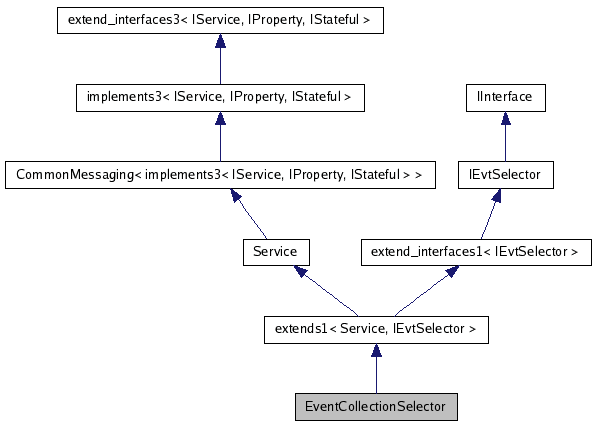
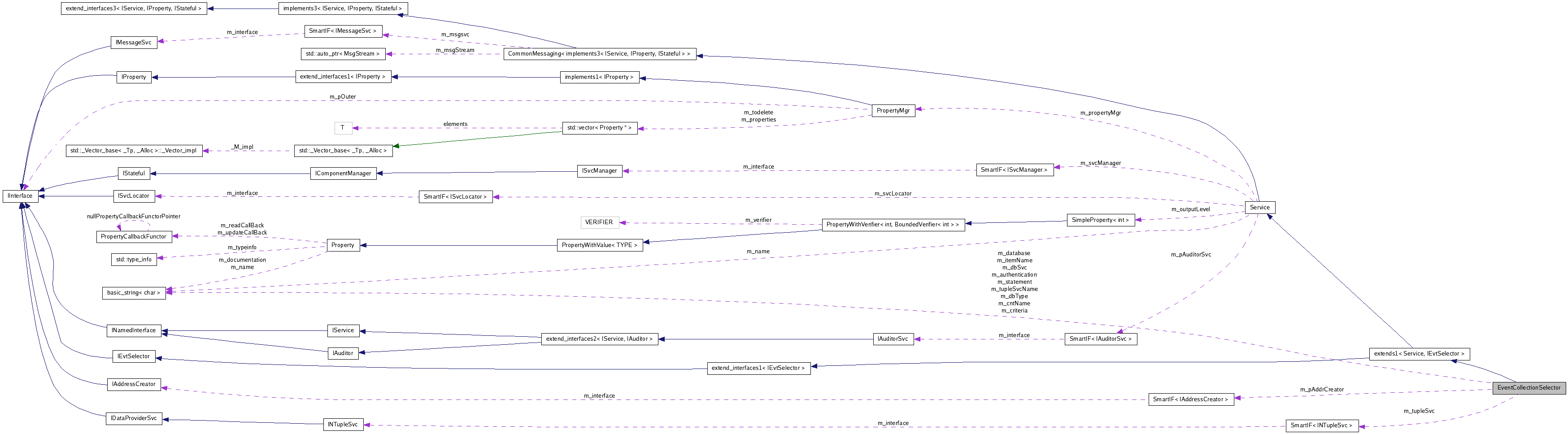
Public Member Functions | |
| virtual StatusCode | initialize () |
| Service override: Initialize service. | |
| virtual StatusCode | finalize () |
| Service override: Finalize Service. | |
| virtual StatusCode | createContext (Context *&refpCtxt) const |
| Create a new event loop context. | |
| virtual StatusCode | next (Context &refCtxt) const |
| Get next iteration item from the event loop context. | |
| virtual StatusCode | next (Context &refCtxt, int jump) const |
| Get next iteration item from the event loop context, but skip jump elements. | |
| virtual StatusCode | previous (Context &refCtxt) const |
| Get previous iteration item from the event loop context. | |
| virtual StatusCode | previous (Context &refCtxt, int jump) const |
| Get previous iteration item from the event loop context, but skip jump elements. | |
| virtual StatusCode | rewind (Context &refCtxt) const |
| Rewind the dataset. | |
| virtual StatusCode | createAddress (const Context &refCtxt, IOpaqueAddress *&refpAddr) const |
| Create new Opaque address corresponding to the current record. | |
| virtual StatusCode | releaseContext (Context *&refCtxt) const |
| Release existing event iteration context. | |
| virtual StatusCode | resetCriteria (const std::string &cr, Context &c) const |
| Will set a new criteria for the selection of the next list of events and will change the state of the context in a way to point to the new list. | |
| virtual StatusCode | last (Context &refCtxt) const |
| Access last item in the iteration. | |
| virtual StatusCode | connectCollection (MyContextType *ctxt) const |
| Connect collection to selector. | |
| virtual StatusCode | connectDataSource (const std::string &db, const std::string &typ) const |
| Connect collection's data source to selector. | |
| virtual StatusCode | connectTuple (const std::string &nam, const std::string &itName, NTuple::Tuple *&tup, NTuple::Item< IOpaqueAddress * > *&item) const |
| Connect to existing N-tuple. | |
| virtual StatusCode | connectStatement (const std::string &typ, const std::string &crit, INTuple *tuple) const |
| Connect selection statement to refine data access. | |
| virtual StatusCode | getNextRecord (NTuple::Tuple *tuple) const |
| Read next record of the N-tuple. | |
| virtual StatusCode | getPreviousRecord (NTuple::Tuple *tuple) const |
| Read next record of the N-tuple. | |
| EventCollectionSelector (const std::string &name, ISvcLocator *svcloc) | |
| Standard Constructor. | |
| ~EventCollectionSelector () | |
| Standard Destructor. | |
Protected Attributes | |
| SmartIF< INTupleSvc > | m_tupleSvc |
| Reference to Tuple service. | |
| SmartIF< IAddressCreator > | m_pAddrCreator |
| std::string | m_tupleSvcName |
| Name of the event collection service name. | |
| std::string | m_authentication |
| Authentication string (if needed). | |
| std::string | m_cntName |
| Container name. | |
| std::string | m_itemName |
| Item name. | |
| std::string | m_criteria |
| Criteria. | |
| std::string | m_database |
| Datafile name. | |
| std::string | m_dbType |
| Database type identifier. | |
| std::string | m_dbSvc |
| Database service (exclusive property with db type). | |
| std::string | m_statement |
| Selector name. | |
Classes | |
| class | MyContextType |
Basic event selector service. The event selector service itself is able to connect other services to attached streams.
History: +---------+----------------------------------------------+---------+ | Date | Comment | Who | +---------+----------------------------------------------+---------+ | 3/10/00 | Initial version | M.Frank | +---------+----------------------------------------------+---------+
Definition at line 41 of file EventCollectionSelector.h.
| EventCollectionSelector::EventCollectionSelector | ( | const std::string & | name, | |
| ISvcLocator * | svcloc | |||
| ) |
Standard Constructor.
Definition at line 79 of file EventCollectionSelector.cpp.
00080   : base_class(name, svcloc)
00081 {
00082   declareProperty("CnvService",    m_tupleSvcName = "EvtTupleSvc");
00083   declareProperty("Authentication",m_authentication= "");
00084   declareProperty("Container",     m_cntName  = "B2PiPi");
00085   declareProperty("Item",          m_itemName = "Address");
00086   declareProperty("Criteria",      m_criteria = "");
00087   declareProperty("DB",            m_database = "");
00088   declareProperty("DbType",        m_dbType   = "");
00089   declareProperty("DbService",     m_dbSvc    = "");
00090   declareProperty("Function",      m_statement= "NTuple::Selector");
00091 }
| EventCollectionSelector::~EventCollectionSelector | ( | ) |
| StatusCode EventCollectionSelector::initialize | ( | ) | [virtual] |
Service override: Initialize service.
Reimplemented from Service.
Definition at line 97 of file EventCollectionSelector.cpp.
00097                                                   {
00098   // Initialize base class
00099   StatusCode status = Service::initialize();
00100   MsgStream log(msgSvc(), name());
00101   if ( !status.isSuccess() )    {
00102     log << MSG::ERROR << "Error initializing base class Service!" << endmsg;
00103     return status;
00104   }
00105   m_pAddrCreator = serviceLocator()->service("EventPersistencySvc");
00106   if(!m_pAddrCreator.isValid()) {
00107     log << MSG::ERROR << "Unable to locate IAddressCreator interface of " << "EventPersistencySvc" << endmsg;
00108     return status;
00109   }
00110   m_tupleSvc = serviceLocator()->service(m_tupleSvcName);
00111   if( !m_tupleSvc.isValid() )   {
00112     log << MSG::ERROR << "Unable to locate INTupleSvc interface of " << m_tupleSvcName << endmsg;
00113     return status;
00114   }
00115   return status;
00116 }
| StatusCode EventCollectionSelector::finalize | ( | void | ) | [virtual] |
Service override: Finalize Service.
Reimplemented from Service.
Definition at line 252 of file EventCollectionSelector.cpp.
00252                                                 {
00253   // release services
00254   m_pAddrCreator = 0;
00255   m_tupleSvc = 0;
00256   return Service::finalize();
00257 }
| StatusCode EventCollectionSelector::createContext | ( | Context *& | refpCtxt | ) | const [virtual] |
Create a new event loop context.
| refpCtxt | [IN/OUT] Reference to pointer to store the context |
Implements IEvtSelector.
Definition at line 261 of file EventCollectionSelector.cpp.
00262 {
00263   refpCtxt = 0;
00264   std::auto_ptr<MyContextType> ctxt(new MyContextType());
00265   StatusCode status = connectCollection(ctxt.get());
00266   if( !status.isSuccess() )  {
00267     MsgStream log(msgSvc(), name());
00268     log << MSG::ERROR << "Unable to connect Collection file \"" << m_database << "\"" << endmsg;
00269     return status;
00270   }
00271   refpCtxt = ctxt.release();
00272   return StatusCode::SUCCESS;
00273 }
| StatusCode EventCollectionSelector::next | ( | Context & | refCtxt | ) | const [virtual] |
Get next iteration item from the event loop context.
| refCtxt | [IN/OUT] Reference to the context |
Implements IEvtSelector.
Definition at line 277 of file EventCollectionSelector.cpp.
00278 {
00279   return next(refCtxt, 1);
00280 }
| StatusCode EventCollectionSelector::next | ( | Context & | refCtxt, | |
| int | jump | |||
| ) | const [virtual] |
Get next iteration item from the event loop context, but skip jump elements.
| refCtxt | [IN/OUT] Reference to the context |
Implements IEvtSelector.
Definition at line 284 of file EventCollectionSelector.cpp.
00285 {
00286   MyContextType *ctxt  = dynamic_cast<MyContextType*>(&refCtxt);
00287   if ( ctxt )    {
00288     *(ctxt->item) = ctxt->addressBuffer;
00289     StatusCode sc = StatusCode::SUCCESS;
00290     for ( int i=0; i<jump && sc.isSuccess(); ++i ) {
00291       sc = getNextRecord(ctxt->tuple);
00292     }
00293     return sc;
00294   }
00295   return StatusCode::FAILURE;
00296 }
| StatusCode EventCollectionSelector::previous | ( | Context & | refCtxt | ) | const [virtual] |
Get previous iteration item from the event loop context.
| refCtxt | [IN/OUT] Reference to the context | |
| jump | [IN] Number of events to be skipped |
Implements IEvtSelector.
Definition at line 300 of file EventCollectionSelector.cpp.
00301 {
00302   return previous(refCtxt, 1);
00303 }
| StatusCode EventCollectionSelector::previous | ( | Context & | refCtxt, | |
| int | jump | |||
| ) | const [virtual] |
Get previous iteration item from the event loop context, but skip jump elements.
| refCtxt | [IN/OUT] Reference to the context | |
| jump | [IN] Number of events to be skipped |
Implements IEvtSelector.
Definition at line 307 of file EventCollectionSelector.cpp.
00308 {
00309   MyContextType *ctxt  = dynamic_cast<MyContextType*>(&refCtxt);
00310   if ( ctxt )    {
00311     *(ctxt->item) = ctxt->addressBuffer;
00312     StatusCode sc = StatusCode::SUCCESS;
00313     for ( int i=0; i<jump && sc.isSuccess(); ++i ) {
00314       sc = getPreviousRecord(ctxt->tuple);
00315     }
00316     return sc;
00317   }
00318   return StatusCode::FAILURE;
00319 }
| StatusCode EventCollectionSelector::rewind | ( | Context & | refCtxt | ) | const [virtual] |
Rewind the dataset.
| refCtxt | [IN/OUT] Reference to the context |
Implements IEvtSelector.
Definition at line 323 of file EventCollectionSelector.cpp.
00324 {
00325   return StatusCode::FAILURE;
00326 }
| StatusCode EventCollectionSelector::createAddress | ( | const Context & | refCtxt, | |
| IOpaqueAddress *& | refpAddr | |||
| ) | const [virtual] |
Create new Opaque address corresponding to the current record.
| refCtxt | [IN/OUT] Reference to the context | |
| refpAddr | [OUT] Reference to address pointer |
Implements IEvtSelector.
Definition at line 330 of file EventCollectionSelector.cpp.
00331 {
00332   const MyContextType* ctxt = dynamic_cast<const MyContextType*>(&refCtxt);
00333   if ( ctxt )   {
00334     IOpaqueAddress* pA = *(ctxt->item);
00335     if ( pA )  {
00336       IOpaqueAddress* pAddress = 0;
00337       StatusCode status = m_pAddrCreator->createAddress(pA->svcType(),
00338                                                         pA->clID(),
00339                                                         pA->par(),
00340                                                         pA->ipar(),
00341                                                         pAddress);
00342       if ( status.isSuccess() )   {
00343         refpAddr = pAddress;
00344         return StatusCode::SUCCESS;
00345       }
00346       else    {
00347         MsgStream log(msgSvc(), name());
00348         log << MSG::ERROR << "Failed to access " << pA->par()[0]
00349             << ":" << pA->par()[1]
00350             << " SvcTyp:" << long(pA->svcType())
00351             << " CLID:"   << pA->clID()
00352             << endmsg;
00353       }
00354     }
00355   }
00356   return StatusCode::FAILURE;
00357 }
| StatusCode EventCollectionSelector::releaseContext | ( | Context *& | refCtxt | ) | const [virtual] |
Release existing event iteration context.
| refCtxt | [IN/OUT] Reference to the context |
Implements IEvtSelector.
Definition at line 361 of file EventCollectionSelector.cpp.
00362 {
00363   MyContextType *ctxt  = dynamic_cast<MyContextType*>(refCtxt);
00364   if ( ctxt )   {
00365     delete ctxt;
00366     ctxt = 0;
00367     return StatusCode::SUCCESS;
00368   }
00369   return StatusCode::FAILURE;
00370 }
| StatusCode EventCollectionSelector::resetCriteria | ( | const std::string & | cr, | |
| Context & | refCtxt | |||
| ) | const [virtual] |
Will set a new criteria for the selection of the next list of events and will change the state of the context in a way to point to the new list.
Will set a new criteria for the selection of the next list of events and will change the state of the context in a way to point to the new list.
| cr | The new criteria string. | |
| c | Reference pointer to the Context object. |
Implements IEvtSelector.
Definition at line 375 of file EventCollectionSelector.cpp.
00376 {
00377   MyContextType *ctxt  = dynamic_cast<MyContextType*>(&refCtxt);
00378   if ( ctxt )   {
00379     ctxt->criteria = cr;
00380     return StatusCode::SUCCESS;
00381   }
00382   return StatusCode::FAILURE;
00383 }
| StatusCode EventCollectionSelector::last | ( | Context & | refCtxt | ) | const [virtual] |
Access last item in the iteration.
| refCtxt | [IN/OUT] Reference to the Context object. |
Implements IEvtSelector.
Definition at line 387 of file EventCollectionSelector.cpp.
00388 {
00389   return StatusCode::FAILURE;
00390 }
| StatusCode EventCollectionSelector::connectCollection | ( | MyContextType * | ctxt | ) | const [virtual] |
Connect collection to selector.
Definition at line 232 of file EventCollectionSelector.cpp.
00233 {
00234   if ( ctxt )  {
00235     StatusCode status = connectDataSource(m_database, m_dbType);
00236     if ( status.isSuccess() )   {
00237       status = connectTuple(m_cntName, m_itemName, ctxt->tuple, ctxt->item);
00238       if ( status.isSuccess() )   {
00239         status = connectStatement(m_statement, m_criteria, ctxt->tuple);
00240         if ( status.isSuccess() )   {
00241           *(ctxt->item) = 0;
00242           return status;
00243         }
00244       }
00245     }
00246     return status;
00247   }
00248   return StatusCode::FAILURE;
00249 }
| StatusCode EventCollectionSelector::connectDataSource | ( | const std::string & | db, | |
| const std::string & | typ | |||
| ) | const [virtual] |
Connect collection's data source to selector.
Definition at line 120 of file EventCollectionSelector.cpp.
00120                                                                                                   {
00121   StatusCode status = StatusCode::FAILURE;
00122   SmartIF<IDataSourceMgr> svc(m_tupleSvc);
00123   if ( svc.isValid( ) && db.length() > 0 )   {
00124     std::string ident = name() + ' ';
00125     ident += "DATAFILE='" + m_database.substr(5,m_database.length()) + "' ";
00126     if ( !m_dbSvc.empty() )
00127       ident += "SVC='" + m_dbSvc + "' ";
00128     else
00129       ident += "TYP='" + m_dbType + "' ";
00130     ident += "OPT='READ' ";
00131     if ( m_authentication.length() > 0 )    {
00132       ident += "AUTH='" + m_authentication + "' ";
00133     }
00134     status = svc->connect(ident);
00135   }
00136   return status;
00137 }
| StatusCode EventCollectionSelector::connectTuple | ( | const std::string & | nam, | |
| const std::string & | itName, | |||
| NTuple::Tuple *& | tup, | |||
| NTuple::Item< IOpaqueAddress * > *& | item | |||
| ) | const [virtual] |
Connect to existing N-tuple.
Definition at line 141 of file EventCollectionSelector.cpp.
00141                                                                                                                                                  {
00142   std::string top = "/NTUPLES/" + name() + '/' + nam;
00143   StatusCode status = m_tupleSvc->retrieveObject(top, (DataObject*&)tup);
00144   if ( status.isSuccess() )    {
00145     item = new NTuple::Item<IOpaqueAddress*>();
00146     status = tup->item(itName, *item);
00147     if ( status.isSuccess() )   {
00148       return status;
00149     }
00150     else    {
00151       MsgStream log(msgSvc(), name());
00152       log << MSG::ERROR << "Item " << itName << " is not part of the collection:" << top << endmsg;
00153     }
00154     delete item;
00155     item = 0;
00156   }
00157   else  {
00158     MsgStream err(msgSvc(), name());
00159     err << MSG::ERROR << "Cannot connect to collection:" << top << endmsg;
00160   }
00161   tup = 0;
00162   return status;
00163 }
| StatusCode EventCollectionSelector::connectStatement | ( | const std::string & | typ, | |
| const std::string & | crit, | |||
| INTuple * | tuple | |||
| ) | const [virtual] |
Connect selection statement to refine data access.
Definition at line 167 of file EventCollectionSelector.cpp.
00167                                                                                                             {
00168   std::string seltyp = typ;
00169   if ( seltyp.length() > 0 || crit.length() > 0 )   {
00170     if ( crit.length() > 0 && seltyp.length() == 0 ) seltyp = "NTuple::Selector";
00171     SmartIF<ISelectStatement> stmt(ROOT::Reflex::PluginService::Create<IInterface*>(seltyp, (IInterface*)serviceLocator()));
00172     if ( stmt.isValid( ) )    {
00173       if ( crit.length() > 0 ) stmt->setCriteria(crit);
00174       tuple->attachSelector(stmt).ignore();
00175       return StatusCode::SUCCESS;
00176     }
00177     return StatusCode::FAILURE;
00178   }
00179   return StatusCode::SUCCESS;
00180 }
| StatusCode EventCollectionSelector::getNextRecord | ( | NTuple::Tuple * | tuple | ) | const [virtual] |
Read next record of the N-tuple.
Definition at line 183 of file EventCollectionSelector.cpp.
00183                                                                             {
00184   StatusCode status = StatusCode::FAILURE;
00185   if ( 0 != tuple )   {
00186     do {
00187       status = m_tupleSvc->readRecord(tuple);
00188       if ( status.isSuccess() )   {
00189         ISelectStatement* statement = tuple->selector();
00190         bool use_it = (statement) ? (*statement)(tuple) : true;
00191         if ( use_it )   {
00192           return status;
00193         }
00194       }
00195     } while ( status.isSuccess() );
00196   }
00197   return status;
00198 }
| StatusCode EventCollectionSelector::getPreviousRecord | ( | NTuple::Tuple * | tuple | ) | const [virtual] |
Read next record of the N-tuple.
Read previous record of the N-tuple.
Definition at line 201 of file EventCollectionSelector.cpp.
00201                                                                                  {
00202   StatusCode status = StatusCode::FAILURE;
00203   if ( tuple )  {
00204     IRegistry* pReg = tuple->registry();
00205     if ( pReg )  {
00206       IOpaqueAddress* pAddr = pReg->address();
00207       if ( pAddr )  {
00208         long* ip = (long*)pAddr->ipar();
00209         do {
00210           if ( ip[1] > 1 )  {
00211             ip[1] -= 2;
00212             status = m_tupleSvc->readRecord(tuple);
00213             if ( status.isSuccess() )   {
00214               ISelectStatement* statement = tuple->selector();
00215               bool use_it = (statement) ? (*statement)(tuple) : true;
00216               if ( use_it )   {
00217                 return status;
00218               }
00219             }
00220           }
00221           else  {
00222             return StatusCode::FAILURE;
00223           }
00224         } while ( status.isSuccess() );
00225       }
00226     }
00227   }
00228   return StatusCode::FAILURE;
00229 }
SmartIF<INTupleSvc> EventCollectionSelector::m_tupleSvc [mutable, protected] |
SmartIF<IAddressCreator> EventCollectionSelector::m_pAddrCreator [mutable, protected] |
Definition at line 80 of file EventCollectionSelector.h.
std::string EventCollectionSelector::m_tupleSvcName [protected] |
std::string EventCollectionSelector::m_authentication [protected] |
std::string EventCollectionSelector::m_cntName [protected] |
std::string EventCollectionSelector::m_itemName [protected] |
std::string EventCollectionSelector::m_criteria [protected] |
std::string EventCollectionSelector::m_database [protected] |
std::string EventCollectionSelector::m_dbType [protected] |
std::string EventCollectionSelector::m_dbSvc [protected] |
Database service (exclusive property with db type).
Definition at line 96 of file EventCollectionSelector.h.
std::string EventCollectionSelector::m_statement [protected] |