
|
Gaudi Framework, version v21r9 |
| Home | Generated: 3 May 2010 |
|
|
Gaudi Framework, version v21r9 |
| Home | Generated: 3 May 2010 |
#include <GaudiAlg/GaudiHistos.h>
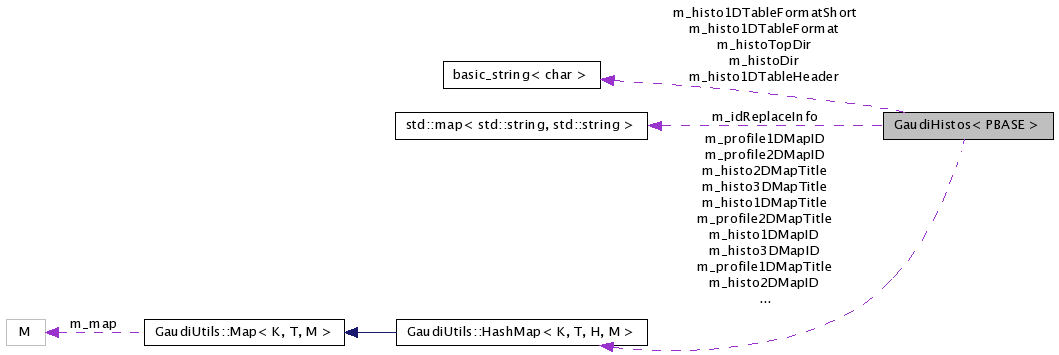
Public Types | |
| typedef GaudiAlg::HistoID | HistoID |
| the actual type for histogram identifier | |
| typedef GaudiAlg::Histo1DMapID | Histo1DMapID |
| the actual type for (ID)->(1D histogram) mapping | |
| typedef GaudiAlg::Histo1DMapTitle | Histo1DMapTitle |
| the actual type for title->(1D histogram) mapping | |
| typedef GaudiAlg::Histo2DMapID | Histo2DMapID |
| the actual type for (ID)->(2D histogram) mapping | |
| typedef GaudiAlg::Histo2DMapTitle | Histo2DMapTitle |
| the actual type for title->(2D histogram) mapping | |
| typedef GaudiAlg::Histo3DMapID | Histo3DMapID |
| the actual type for (ID)->(3D histogram) mapping | |
| typedef GaudiAlg::Histo3DMapTitle | Histo3DMapTitle |
| the actual type for title->(3D histogram) mapping | |
| typedef GaudiAlg::Profile1DMapID | Profile1DMapID |
| the actual type for (ID)->(1D profile histogram) mapping | |
| typedef GaudiAlg::Profile1DMapTitle | Profile1DMapTitle |
| the actual type for title->(1D profile histogram) mapping | |
| typedef GaudiAlg::Profile2DMapID | Profile2DMapID |
| the actual type for (ID)->(2D profile histogram) mapping | |
| typedef GaudiAlg::Profile2DMapTitle | Profile2DMapTitle |
| the actual type for title->(2D profile histogram) mapping | |
| typedef GaudiAlg::HistoBinEdges | HistoBinEdges |
| Edges for variable binning. | |
Public Member Functions | |
| AIDA::IHistogram1D * | plot1D (const double value, const std::string &title, const double low, const double high, const unsigned long bins=100, const double weight=1.0) const |
| fill the 1D histogram (book on demand) | |
| AIDA::IHistogram1D * | plot (const double value, const std::string &title, const double low, const double high, const unsigned long bins=100, const double weight=1.0) const |
| fill the 1D histogram (book on demand) | |
| AIDA::IHistogram1D * | plot1D (const double value, const Gaudi::Histo1DDef &hdef, const double weight=1.0) const |
| fill the 1D histogram (book on demand) | |
| AIDA::IHistogram1D * | plot (const double value, const Gaudi::Histo1DDef &hdef, const double weight=1.0) const |
| fill the 1D histogram (book on demand) | |
| AIDA::IHistogram1D * | plot1D (const double value, const HistoID &ID, const std::string &title, const double low, const double high, const unsigned long bins=100, const double weight=1.0) const |
| fill the 1D histogram with forced ID assignment (book on demand) | |
| AIDA::IHistogram1D * | plot (const double value, const HistoID &ID, const std::string &title, const double low, const double high, const unsigned long bins=100, const double weight=1.0) const |
| fill the 1D histogram with forced ID assignment (book on demand) | |
| AIDA::IHistogram1D * | plot1D (const double value, const HistoID &ID, const Gaudi::Histo1DDef &hdef, const double weight=1.0) const |
| fill the 1D histogram with forced ID assignment (book on demand) | |
| AIDA::IHistogram1D * | plot (const double value, const HistoID &ID, const Gaudi::Histo1DDef &hdef, const double weight=1.0) const |
| fill the 1D histogram (book on demand) | |
| template<class FUNCTION, class OBJECT> | |
| AIDA::IHistogram1D * | plot (const FUNCTION &func, OBJECT first, OBJECT last, const std::string &title, const double low, const double high, const unsigned long bins=100) const |
| fill the 1D histogram with information from [first,last) sequence | |
| template<class FUNCTION, class OBJECT> | |
| AIDA::IHistogram1D * | plot (const FUNCTION &func, OBJECT first, OBJECT last, const HistoID &ID, const std::string &title, const double low, const double high, const unsigned long bins=100) const |
| fill the 1D histogram with forced ID and information from [first,last) sequence | |
| template<class FUNCTION, class OBJECT, class WEIGHT> | |
| AIDA::IHistogram1D * | plot (const FUNCTION &func, OBJECT first, OBJECT last, const std::string &title, const double low, const double high, const unsigned long bins, const WEIGHT &weight) const |
| book and fill the 1D histogram with information from [first,last) sequence with given weight | |
| template<class FUNCTION, class OBJECT, class WEIGHT> | |
| AIDA::IHistogram1D * | plot (const FUNCTION &func, OBJECT first, OBJECT last, const HistoID &ID, const std::string &title, const double low, const double high, const unsigned long bins, const WEIGHT &weight) const |
| book and fill the 1D histogram with forced ID and information from [first,last) sequence with given weight | |
| AIDA::IHistogram1D * | plot1D (const double value, const std::string &title, const HistoBinEdges &edges, const double weight=1.0) const |
| Fill the 1D variable binning histogram (book on demand). | |
| AIDA::IHistogram1D * | plot1D (const double value, const HistoID &ID, const std::string &title, const HistoBinEdges &edges, const double weight=1.0) const |
| fill the 1D variable binning histogram with forced ID assignment (book on demand) | |
| AIDA::IHistogram2D * | plot2D (const double valueX, const double valueY, const std::string &title, const double lowX, const double highX, const double lowY, const double highY, const unsigned long binsX=50, const unsigned long binsY=50, const double weight=1.0) const |
| fill the 2D histogram (book on demand) | |
| AIDA::IHistogram2D * | plot2D (const double valueX, const double valueY, const HistoID &ID, const std::string &title, const double lowX, const double highX, const double lowY, const double highY, const unsigned long binsX=50, const unsigned long binsY=50, const double weight=1.0) const |
| fill the 2D histogram with forced ID assignment (book on demand) | |
| AIDA::IHistogram2D * | plot2D (const double valueX, const double valueY, const std::string &title, const HistoBinEdges &edgesX, const HistoBinEdges &edgesY, const double weight=1.0) const |
| Fill the 2D variable binning histogram (book on demand). | |
| AIDA::IHistogram2D * | plot2D (const double valueX, const double valueY, const HistoID &ID, const std::string &title, const HistoBinEdges &edgesX, const HistoBinEdges &edgesY, const double weight=1.0) const |
| fill the 2D variable histogram with forced ID assignment (book on demand) | |
| AIDA::IHistogram3D * | plot3D (const double valueX, const double valueY, const double valueZ, const std::string &title, const double lowX, const double highX, const double lowY, const double highY, const double lowZ, const double highZ, const unsigned long binsX=10, const unsigned long binsY=10, const unsigned long binsZ=10, const double weight=1.0) const |
| fill the 3D histogram (book on demand) | |
| AIDA::IHistogram3D * | plot3D (const double valueX, const double valueY, const double valueZ, const HistoID &ID, const std::string &title, const double lowX, const double highX, const double lowY, const double highY, const double lowZ, const double highZ, const unsigned long binsX=10, const unsigned long binsY=10, const unsigned long binsZ=10, const double weight=1.0) const |
| fill the 3D histogram with forced ID assignment (book on demand) | |
| AIDA::IHistogram3D * | plot3D (const double valueX, const double valueY, const double valueZ, const std::string &title, const HistoBinEdges &edgesX, const HistoBinEdges &edgesY, const HistoBinEdges &edgesZ, const double weight=1.0) const |
| Fill the 3D variable binning histogram (book on demand). | |
| AIDA::IHistogram3D * | plot3D (const double valueX, const double valueY, const double valueZ, const HistoID &ID, const std::string &title, const HistoBinEdges &edgesX, const HistoBinEdges &edgesY, const HistoBinEdges &edgesZ, const double weight=1.0) const |
| fill the 3D histogram with forced ID assignment (book on demand) | |
| AIDA::IProfile1D * | profile1D (const double valueX, const double valueY, const std::string &title, const double lowX, const double highX, const unsigned long binsX=100, const std::string &opt="", const double lowY=-std::numeric_limits< double >::max(), const double highY=std::numeric_limits< double >::max(), const double weight=1.0) const |
| fill the 1D profile histogram (book on demand) | |
| AIDA::IProfile1D * | profile1D (const double valueX, const double valueY, const HistoID &ID, const std::string &title, const double lowX, const double highX, const unsigned long binsX=100, const std::string &opt="", const double lowY=-std::numeric_limits< double >::max(), const double highY=std::numeric_limits< double >::max(), const double weight=1.0) const |
| fill the 1D profile histogram with forced ID assignment (book on demand) | |
| AIDA::IProfile1D * | profile1D (const double valueX, const double valueY, const std::string &title, const HistoBinEdges &edges, const double weight=1.0) const |
| fill the 1D variable binning profile histogram (book on demand) | |
| AIDA::IProfile1D * | profile1D (const double valueX, const double valueY, const HistoID &ID, const std::string &title, const HistoBinEdges &edges, const double weight=1.0) const |
| fill the 1D variable binning profile histogram with forced ID assignment (book on demand) | |
| AIDA::IProfile2D * | profile2D (const double valueX, const double valueY, const double valueZ, const std::string &title, const double lowX, const double highX, const double lowY, const double highY, const unsigned long binsX=50, const unsigned long binsY=50, const double weight=1.0) const |
| fill the 2D profile histogram (book on demand) | |
| AIDA::IProfile2D * | profile2D (const double valueX, const double valueY, const double valueZ, const HistoID &ID, const std::string &title, const double lowX, const double highX, const double lowY, const double highY, const unsigned long binsX=50, const unsigned long binsY=50, const double weight=1.0) const |
| fill the 2D profile histogram with forced ID assignment (book on demand) | |
| AIDA::IProfile2D * | profile2D (const double valueX, const double valueY, const double valueZ, const std::string &title, const HistoBinEdges &edgesX, const HistoBinEdges &edgesY, const double weight=1.0) const |
| fill the 2D variable binning profile histogram (book on demand) | |
| AIDA::IProfile2D * | profile2D (const double valueX, const double valueY, const double valueZ, const HistoID &ID, const std::string &title, const HistoBinEdges &edgesX, const HistoBinEdges &edgesY, const double weight=1.0) const |
| fill the 2D variable binning profile histogram with forced ID assignment (book on demand) | |
| AIDA::IHistogram1D * | book1D (const std::string &title, const double low=0, const double high=100, const unsigned long bins=100) const |
| book the 1D histogram | |
| AIDA::IHistogram1D * | book (const std::string &title, const double low=0, const double high=100, const unsigned long bins=100) const |
| book the 1D histogram | |
| AIDA::IHistogram1D * | book (const Gaudi::Histo1DDef &hdef) const |
| book the 1D histogram | |
| AIDA::IHistogram1D * | book1D (const HistoID &ID, const std::string &title, const double low=0, const double high=100, const unsigned long bins=100) const |
| book the 1D histogram with forced ID | |
| AIDA::IHistogram1D * | book (const HistoID &ID, const std::string &title, const double low=0, const double high=100, const unsigned long bins=100) const |
| book the 1D histogram with forced ID | |
| AIDA::IHistogram1D * | book (const HistoID &ID, const Gaudi::Histo1DDef &hdef) const |
| book the 1D histogram with forced ID | |
| AIDA::IHistogram1D * | book1D (const std::string &title, const HistoBinEdges &edges) const |
| book the 1D variable binning histogram | |
| AIDA::IHistogram1D * | book1D (const HistoID &ID, const std::string &title, const HistoBinEdges &edges) const |
| book the 1D variable binning histogram with given ID | |
| AIDA::IHistogram2D * | book2D (const std::string &title, const double lowX=0, const double highX=100, const unsigned long binsX=50, const double lowY=0, const double highY=100, const unsigned long binsY=50) const |
| book the 2D histogram | |
| AIDA::IHistogram2D * | book2D (const HistoID &ID, const std::string &title, const double lowX=0, const double highX=100, const unsigned long binsX=50, const double lowY=0, const double highY=100, const unsigned long binsY=50) const |
| book the 2D histogram with forced ID | |
| AIDA::IHistogram2D * | book2D (const std::string &title, const HistoBinEdges &edgesX, const HistoBinEdges &edgesY) const |
| book the 2D variable binning histogram | |
| AIDA::IHistogram2D * | book2D (const HistoID &ID, const std::string &title, const HistoBinEdges &edgesX, const HistoBinEdges &edgesY) const |
| book the 2D variable binning histogram with given ID | |
| AIDA::IHistogram3D * | book3D (const std::string &title, const double lowX=0, const double highX=100, const unsigned long binsX=10, const double lowY=0, const double highY=100, const unsigned long binsY=10, const double lowZ=0, const double highZ=100, const unsigned long binsZ=10) const |
| book the 3D histogram | |
| AIDA::IHistogram3D * | book3D (const HistoID &ID, const std::string &title, const double lowX=0, const double highX=100, const unsigned long binsX=10, const double lowY=0, const double highY=100, const unsigned long binsY=10, const double lowZ=0, const double highZ=100, const unsigned long binsZ=10) const |
| book the 3D histogram with forced ID | |
| AIDA::IHistogram3D * | book3D (const std::string &title, const HistoBinEdges &edgesX, const HistoBinEdges &edgesY, const HistoBinEdges &edgesZ) const |
| book the 3D variable binning histogram | |
| AIDA::IHistogram3D * | book3D (const HistoID &ID, const std::string &title, const HistoBinEdges &edgesX, const HistoBinEdges &edgesY, const HistoBinEdges &edgesZ) const |
| book the 3D variable binning histogram with given ID | |
| AIDA::IProfile1D * | bookProfile1D (const std::string &title, const double low=0, const double high=100, const unsigned long bins=100, const std::string &opt="", const double lowY=-std::numeric_limits< double >::max(), const double highY=std::numeric_limits< double >::max()) const |
| book the 1D profile histogram | |
| AIDA::IProfile1D * | bookProfile1D (const HistoID &ID, const std::string &title, const double low=0, const double high=100, const unsigned long bins=100, const std::string &opt="", const double lowY=-std::numeric_limits< double >::max(), const double highY=std::numeric_limits< double >::max()) const |
| book the 1D profile histogram | |
| AIDA::IProfile1D * | bookProfile1D (const std::string &title, const HistoBinEdges &edges) const |
| book the 1D profile histogram | |
| AIDA::IProfile1D * | bookProfile1D (const HistoID &ID, const std::string &title, const HistoBinEdges &edges) const |
| book the 1D profile histogram | |
| AIDA::IProfile2D * | bookProfile2D (const std::string &title, const double lowX=0, const double highX=100, const unsigned long binsX=50, const double lowY=0, const double highY=100, const unsigned long binsY=50) const |
| book the 2D profile histogram | |
| AIDA::IProfile2D * | bookProfile2D (const HistoID &ID, const std::string &title, const double lowX=0, const double highX=100, const unsigned long binsX=50, const double lowY=0, const double highY=100, const unsigned long binsY=50) const |
| book the 2D profile histogram with forced ID | |
| AIDA::IProfile2D * | bookProfile2D (const std::string &title, const HistoBinEdges &edgesX, const HistoBinEdges &edgesY) const |
| book the 2D profile histogram | |
| AIDA::IProfile2D * | bookProfile2D (const HistoID &ID, const std::string &title, const HistoBinEdges &edgesX, const HistoBinEdges &edgesY) const |
| book the 2D profile histogram with forced ID | |
| AIDA::IHistogram1D * | fill (AIDA::IHistogram1D *histo, const double value, const double weight, const std::string &title="") const |
| fill the 1D histogram with the value and weight | |
| AIDA::IHistogram2D * | fill (AIDA::IHistogram2D *histo, const double valueX, const double valueY, const double weight, const std::string &title="") const |
| fill the 2D histogram with the value and weight | |
| AIDA::IHistogram3D * | fill (AIDA::IHistogram3D *histo, const double valueX, const double valueY, const double valueZ, const double weight, const std::string &title="") const |
| fill the 3D histogram with the value and weight | |
| AIDA::IProfile1D * | fill (AIDA::IProfile1D *histo, const double valueX, const double valueY, const double weight, const std::string &title="") const |
| fill the 1D profile histogram with the values and weight | |
| AIDA::IProfile2D * | fill (AIDA::IProfile2D *histo, const double valueX, const double valueY, const double valueZ, const double weight, const std::string &title="") const |
| fill the 2D profile histogram with the values and weight | |
| AIDA::IHistogram1D * | histo1D (const std::string &title) const |
| access the EXISTING 1D histogram by title return the pointer to existing 1D histogram or NULL | |
| AIDA::IHistogram1D * | histo (const std::string &title) const |
| access the EXISTING 1D histogram by title | |
| AIDA::IHistogram2D * | histo2D (const std::string &title) const |
| access the EXISTING 2D histogram by title return the pointer to existing 2D histogram or NULL | |
| AIDA::IHistogram3D * | histo3D (const std::string &title) const |
| access the EXISTING 3D histogram by title return the pointer to existing 3D histogram or NULL | |
| AIDA::IProfile1D * | profile1D (const std::string &title) const |
| access the EXISTING 1D profile histogram by title return the pointer to existing 1D profile histogram or NULL | |
| AIDA::IProfile2D * | profile2D (const std::string &title) const |
| access the EXISTING 2D profile histogram by title return the pointer to existing 2D profile histogram or NULL | |
| AIDA::IHistogram1D * | histo1D (const HistoID &ID) const |
| access the EXISTING 1D histogram by ID return the pointer to existing 1D histogram or NULL | |
| AIDA::IHistogram1D * | histo (const HistoID &ID) const |
| access the EXISTING 1D histogram by ID | |
| AIDA::IHistogram2D * | histo2D (const HistoID &ID) const |
| access the EXISTING 2D histogram by ID return the pointer to existing 2D histogram or NULL | |
| AIDA::IHistogram3D * | histo3D (const HistoID &ID) const |
| access the EXISTING 3D histogram by ID return the pointer to existing 3D histogram or NULL | |
| AIDA::IProfile1D * | profile1D (const HistoID &ID) const |
| access the EXISTING 1D profile histogram by ID return the pointer to existing 1D profile histogram or NULL | |
| AIDA::IProfile2D * | profile2D (const HistoID &ID) const |
| access the EXISTING 2D profile histogram by ID return the pointer to existing 2D profile histogram or NULL | |
| bool | histoExists (const std::string &title) const |
| check the existence AND validity of the histogram with given title | |
| bool | histoExists (const HistoID &ID) const |
| check the existence AND validity of the histogram with given title | |
| unsigned int | totalNumberOfHistos () const |
| Returns the total number of histograms (of all types) currently booked. | |
| bool | produceHistos () const |
| get the flag for histogram production (property "HistoProduce") | |
| bool | fullDetail () const |
| get flag to control output level of histograms | |
| bool | checkForNaN () const |
| get the flag for NaN checks (property "HistoCheckForNan") | |
| bool | splitHistoDir () const |
| get the flag for histogram path split (property "HistoSplitDir") | |
| HistoID::NumericID | histoOffSet () const |
| get the value for histogram offset (property "HistoOffSet") | |
| const std::string & | histoTopDir () const |
| get top-level histogram directory (property "HistoTopDir") | |
| const std::string & | histoDir () const |
| get histogram directory (property "HistoDir") | |
| std::string | histoPath () const |
| get the constructed histogram path | |
| bool | histosPrint () const |
| print histograms at finalization ? | |
| bool | useNumericAutoIDs () const |
| Use old style sequencial numerical automatically assigned IDs ? | |
| int | printHistos (const MSG::Level level=MSG::ALWAYS) const |
| perform the actual printout of histograms | |
| const Histo1DMapTitle & | histo1DMapTitle () const |
| get access to the map of all 1D histograms indexed via their title | |
| const Histo1DMapID & | histo1DMapID () const |
| get access to the map of all 1D histograms index via ID | |
| const Histo2DMapTitle & | histo2DMapTitle () const |
| get access to the map of all 2D histograms indexed via their title | |
| const Histo2DMapID & | histo2DMapID () const |
| get access to the map of 2D histograms index via ID | |
| const Histo3DMapTitle & | histo3DMapTitle () const |
| get access to the map of all 3D histograms indexed via their title | |
| const Histo3DMapID & | histo3DMapID () const |
| get access to the map of all 3D histograms index via a ID | |
| const Profile1DMapTitle & | profile1DMapTitle () const |
| get access to the map of all 1D profile histograms indexed via their title | |
| const Profile1DMapID & | profile1DMapID () const |
| get access to the map of 1D profile histograms index via a ID | |
| const Profile2DMapTitle & | profile2DMapTitle () const |
| get access to the map of all 2D profile histograms indexed via their title | |
| const Profile2DMapID & | profile2DMapID () const |
| get access to the map of 2D profile histograms index via a ID | |
| void | setProduceHistos (const bool val) |
| set the flag for histogram production (property "HistoProduce") | |
| void | setFullDetail (const bool val) |
| set flag to control output level of histograms | |
| void | setCheckForNaN (const bool val) |
| set the flag for NaN checks (property "HistoCheckForNan") | |
| void | setSplitHistoDir (const bool val) |
| set the flag for histogram path split (property "HistoSplitDir") | |
| void | setHistoOffSet (const HistoID::NumericID val) |
| set a value for histogram offset (property "HistoOffSet" | |
| void | setHistoTopDir (const std::string &val) |
| set top-level histogram directory (property "HistoTopDir") | |
| void | setHistoDir (const std::string &val) |
| set histogram directory (property "HistoDir") | |
| GaudiHistos (const std::string &name, ISvcLocator *pSvcLocator) | |
| Algorithm constructor. | |
| GaudiHistos (const std::string &type, const std::string &name, const IInterface *parent) | |
| Tool constructor. | |
| virtual | ~GaudiHistos () |
| Destructor. | |
Protected Member Functions | |
| virtual StatusCode | initialize () |
| standard initialization method | |
| virtual StatusCode | finalize () |
| standard finalization method | |
| std::string | convertTitleToID (const std::string &title) const |
| Create an ID string from a title string. | |
Private Member Functions | |
| bool | noHistos () const |
| Check if all histogram maps are empty. | |
| void | initGaudiHistosConstructor () |
| Constructor initialisation and job options. | |
| void | monitorHisto (const AIDA::IBaseHistogram *hist, const HistoID &ID) const |
| Declare a histogram to the monitor service. | |
| void | newHistoID (const std::string &title, HistoID &ID) const |
| Create a new histogram ID using the given title. | |
| void | stringSearchReplace (std::string &title, const std::string &A, const std::string &B) const |
| Searches 'title' for all instancies of 'A' and replaces them with 'B'. | |
| void | printHistoHandler (Property &) |
| the handler for "HistoPrint" property | |
Private Attributes | |
| bool | m_produceHistos |
| flag to SWITCH ON/SWITCH OFF the histogrm fillling and booking | |
| bool | m_fullDetail |
| flag to control output level of histograms | |
| bool | m_checkForNaN |
| flag to control check for Nan/Finite while filling the histogram | |
| bool | m_splitHistoDir |
| split histogram directory name (very useful for Hbook) | |
| HistoID::NumericID | m_histoOffSet |
| general histogram ID offset (only works for automatically assigned numeric IDs) | |
| std::string | m_histoTopDir |
| histogram top level directory | |
| std::string | m_histoDir |
| histogram directory | |
| bool | m_histosPrint |
| print histograms at finalization | |
| bool | m_declareMoniHists |
| Flag to turn on/off the registration of histograms to the Monitoring Service. | |
| Histo1DMapTitle | m_histo1DMapTitle |
| the actual storage/access of 1D histograms by unique title | |
| Histo1DMapID | m_histo1DMapID |
| the actual storage/access of 1D histograms by unique ID | |
| Histo2DMapTitle | m_histo2DMapTitle |
| the actual storage/access of 2D histograms by unique title | |
| Histo2DMapID | m_histo2DMapID |
| the actual storage/access of 2D histograms by unique ID | |
| Histo3DMapTitle | m_histo3DMapTitle |
| the actual storage/access of 3D histograms by unique title | |
| Histo3DMapID | m_histo3DMapID |
| the actual storage/access of 3D histograms by unique ID | |
| Profile1DMapTitle | m_profile1DMapTitle |
| the actual storage/access of 1D profile histograms by unique title | |
| Profile1DMapID | m_profile1DMapID |
| the actual storage/access of 1D profile histograms by unique ID | |
| Profile2DMapTitle | m_profile2DMapTitle |
| the actual storage/access of 2D profile histograms by unique title | |
| Profile2DMapID | m_profile2DMapID |
| the actual storage/access of 2D profile histograms by unique ID | |
| std::string | m_histo1DTableFormat |
| format for printout of 1D-histograms as a table | |
| std::string | m_histo1DTableFormatShort |
| format for printout of 1D-histograms as a table | |
| std::string | m_histo1DTableHeader |
| the header for the table of 1-D historgrams | |
| bool | m_useNumericAutoIDs |
| Flag to switch back to the old style sequencial numerical automatic IDs. | |
| std::map< std::string, std::string > | m_idReplaceInfo |
| Map of strings to search and replace when using the title as the basis of automatically generated literal IDs. | |
Definition at line 51 of file GaudiHistos.h.
| typedef GaudiAlg::HistoID GaudiHistos< PBASE >::HistoID |
the actual type for histogram identifier
Reimplemented in HistoTool, GaudiTuples< GaudiHistoTool >, and GaudiTuples< GaudiHistoAlg >.
Definition at line 56 of file GaudiHistos.h.
| typedef GaudiAlg::Histo1DMapID GaudiHistos< PBASE >::Histo1DMapID |
| typedef GaudiAlg::Histo1DMapTitle GaudiHistos< PBASE >::Histo1DMapTitle |
| typedef GaudiAlg::Histo2DMapID GaudiHistos< PBASE >::Histo2DMapID |
| typedef GaudiAlg::Histo2DMapTitle GaudiHistos< PBASE >::Histo2DMapTitle |
| typedef GaudiAlg::Histo3DMapID GaudiHistos< PBASE >::Histo3DMapID |
| typedef GaudiAlg::Histo3DMapTitle GaudiHistos< PBASE >::Histo3DMapTitle |
| typedef GaudiAlg::Profile1DMapID GaudiHistos< PBASE >::Profile1DMapID |
the actual type for (ID)->(1D profile histogram) mapping
Definition at line 74 of file GaudiHistos.h.
| typedef GaudiAlg::Profile1DMapTitle GaudiHistos< PBASE >::Profile1DMapTitle |
the actual type for title->(1D profile histogram) mapping
Definition at line 76 of file GaudiHistos.h.
| typedef GaudiAlg::Profile2DMapID GaudiHistos< PBASE >::Profile2DMapID |
the actual type for (ID)->(2D profile histogram) mapping
Definition at line 79 of file GaudiHistos.h.
| typedef GaudiAlg::Profile2DMapTitle GaudiHistos< PBASE >::Profile2DMapTitle |
the actual type for title->(2D profile histogram) mapping
Definition at line 81 of file GaudiHistos.h.
| typedef GaudiAlg::HistoBinEdges GaudiHistos< PBASE >::HistoBinEdges |
| GaudiHistos< PBASE >::GaudiHistos | ( | const std::string & | name, | |
| ISvcLocator * | pSvcLocator | |||
| ) |
Algorithm constructor.
| GaudiHistos< PBASE >::GaudiHistos | ( | const std::string & | type, | |
| const std::string & | name, | |||
| const IInterface * | parent | |||
| ) |
Tool constructor.
| virtual GaudiHistos< PBASE >::~GaudiHistos | ( | ) | [inline, virtual] |
| AIDA::IHistogram1D * GaudiHistos< PBASE >::plot1D | ( | const double | value, | |
| const std::string & | title, | |||
| const double | low, | |||
| const double | high, | |||
| const unsigned long | bins = 100, |
|||
| const double | weight = 1.0 | |||
| ) | const [inline] |
fill the 1D histogram (book on demand)
     const double mass = ... ;
     plot1D( mass , "Invariant Mass" , 2.5 , 3.5 , 100 )
This example illustrates the filling of the histogram titled "InvariantMass" with value mass .
If the histogram with given title does not exist yet it will be automatically booked with parameters low equal to 2.5, parameters high equal to 3.5 and bins equal to 100.
| value | value to be filled | |
| title | histogram title (must be unique within the algorithm) | |
| low | low limit for histogram | |
| high | high limit for histogram | |
| bins | number of bins | |
| weight | weight |
Reimplemented in HistoTool.
Definition at line 131 of file GaudiHistos_1DFixedBinning.icpp.
00137 {
00138   AIDA::IHistogram1D * h(NULL);
00139   if ( produceHistos() )
00140   {
00141     // retrieve or book the histogram
00142     h = histo1D ( title ) ;
00143     if ( NULL == h ) { h = book1D  ( title , low , high , bins ) ; }
00144     // fill the histogram
00145     h = fill ( h , value , weight , title );
00146   }
00147   return h;
00148 }
| AIDA::IHistogram1D* GaudiHistos< PBASE >::plot | ( | const double | value, | |
| const std::string & | title, | |||
| const double | low, | |||
| const double | high, | |||
| const unsigned long | bins = 100, |
|||
| const double | weight = 1.0 | |||
| ) | const [inline] |
fill the 1D histogram (book on demand)
Wrapper method for the equivalent plot1D method. Retained for backwards compatibility, please use plot1D instead.
| value | value to be filled | |
| title | histogram title (must be unique within the algorithm) | |
| low | low limit for histogram | |
| high | high limit for histogram | |
| bins | number of bins | |
| weight | weight |
Definition at line 155 of file GaudiHistos.h.
| AIDA::IHistogram1D * GaudiHistos< PBASE >::plot1D | ( | const double | value, | |
| const Gaudi::Histo1DDef & | hdef, | |||
| const double | weight = 1.0 | |||
| ) | const [inline] |
fill the 1D histogram (book on demand)
     const Gaudi::Histo1DDef& hdef = ... ;

     const double mass = ... ;
     plot1D ( mass , hdef ) ;
The histogram will get a unique identifier automatically assigned which by default will be equal to the histogram title.
The histogram descriptor comes e.g. from the component properties.
| value | value to be filled | |
| hdef | histogram descriptor | |
| weight | weight |
Definition at line 208 of file GaudiHistos_1DFixedBinning.icpp.
00211 {
00212   return plot1D
00213     ( value  ,
00214       hdef.title() , hdef.lowEdge() , hdef.highEdge() , hdef.bins() ,
00215       weight ) ;
00216 }
| AIDA::IHistogram1D* GaudiHistos< PBASE >::plot | ( | const double | value, | |
| const Gaudi::Histo1DDef & | hdef, | |||
| const double | weight = 1.0 | |||
| ) | const [inline] |
fill the 1D histogram (book on demand)
Wrapper method for the equivalent plot1D method. Retained for backwards compatibility, please use plot1D instead.
| value | value to be filled | |
| hdef | histogram descriptor | |
| weight | weight |
Definition at line 205 of file GaudiHistos.h.
| AIDA::IHistogram1D * GaudiHistos< PBASE >::plot1D | ( | const double | value, | |
| const HistoID & | ID, | |||
| const std::string & | title, | |||
| const double | low, | |||
| const double | high, | |||
| const unsigned long | bins = 100, |
|||
| const double | weight = 1.0 | |||
| ) | const [inline] |
fill the 1D histogram with forced ID assignment (book on demand)
     const double mass = ... ;
     plot1D( mass , 15 , "Invariant Mass" , 2.5 , 3.5 , 100 )
This example illustrates the filling of the 1D histogram ID=15 titled "Invariant Mass" with value mass .
If the histogram with given ID does not exist yet it will be automatically booked with parameters low equal to 2.5, parameters high equal to 3.5 and bins equal to 100.
It is also possible to use literal IDs. For example :-
     const double mass = ... ;
     plot1D( mass , "mass" , "Invariant Mass" , 2.5 , 3.5 , 100 )
Will book the same histogram, using the id "mass".
It is also possible using literal IDs, to place histograms in sub-directories from the main histogram directory, using for example :-
     const double mass = ... ;
     plot1D( mass , "subdir/mass" , "Invariant Mass" , 2.5 , 3.5 , 100 )
Which will create the histogram "mass" in the sub-directory "subdir". Histograms can also be created in sub-directories with numeric IDs if IDs such as "subdir/1" are used.
| value | value to be filled | |
| ID | histogram identifier | |
| title | histogram title (must be unique within the algorithm) | |
| low | low limit for histogram | |
| high | high limit for histogram | |
| bins | number of bins | |
| weight | weight |
Reimplemented in HistoTool.
Definition at line 155 of file GaudiHistos_1DFixedBinning.icpp.
00162 {
00163   AIDA::IHistogram1D* h(NULL);
00164   if ( produceHistos() )
00165   {
00166     // retrieve or book the histogram
00167     h = histo1D ( ID ) ;
00168     if ( NULL == h ) {  h = book1D ( ID , title , low , high , bins ) ; }
00169     // fill
00170     h = fill ( h , value , weight , title ) ;
00171   }
00172   return h;
00173 }
| AIDA::IHistogram1D* GaudiHistos< PBASE >::plot | ( | const double | value, | |
| const HistoID & | ID, | |||
| const std::string & | title, | |||
| const double | low, | |||
| const double | high, | |||
| const unsigned long | bins = 100, |
|||
| const double | weight = 1.0 | |||
| ) | const [inline] |
fill the 1D histogram with forced ID assignment (book on demand)
Wrapper method for the equivalent plot1D method. Retained for backwards compatibility, please use plot1D instead.
| value | value to be filled | |
| ID | histogram identifier | |
| title | histogram title (must be unique within the algorithm) | |
| low | low limit for histogram | |
| high | high limit for histogram | |
| bins | number of bins | |
| weight | weight |
Definition at line 301 of file GaudiHistos.h.
| AIDA::IHistogram1D * GaudiHistos< PBASE >::plot1D | ( | const double | value, | |
| const HistoID & | ID, | |||
| const Gaudi::Histo1DDef & | hdef, | |||
| const double | weight = 1.0 | |||
| ) | const [inline] |
fill the 1D histogram with forced ID assignment (book on demand)
     // get the histogram descriptor
     const Gaudi::Histo1DDef& hdef = ... ;

     // get the histogram ID
     const HistoID ID = ... ;

     const double mass = ... ;
     plot1D ( mass , ID , hdef  )
| value | value to be filled | |
| ID | histogram identifier | |
| hdef | histogram descriptor | |
| weight | weight |
Definition at line 223 of file GaudiHistos_1DFixedBinning.icpp.
00227 {
00228   return plot1D
00229     ( value  , ID ,
00230       hdef.title() , hdef.lowEdge() , hdef.highEdge() , hdef.bins() ,
00231       weight ) ;
00232 }
| AIDA::IHistogram1D* GaudiHistos< PBASE >::plot | ( | const double | value, | |
| const HistoID & | ID, | |||
| const Gaudi::Histo1DDef & | hdef, | |||
| const double | weight = 1.0 | |||
| ) | const [inline] |
fill the 1D histogram (book on demand)
Wrapper method for the equivalent plot1D method. Retained for backwards compatibility, please use plot1D instead.
| value | value to be filled | |
| ID | histogram identifier | |
| hdef | histogram descriptor | |
| weight | weight |
Definition at line 355 of file GaudiHistos.h.
| AIDA::IHistogram1D* GaudiHistos< PBASE >::plot | ( | const FUNCTION & | func, | |
| OBJECT | first, | |||
| OBJECT | last, | |||
| const std::string & | title, | |||
| const double | low, | |||
| const double | high, | |||
| const unsigned long | bins = 100 | |||
| ) | const [inline] |
fill the 1D histogram with information from [first,last) sequence
  std::vector<double> v = ... ;

  plot( sin                 , // function
        v.begin() , v.end() , // sequence
        " bla-bla "         , // title
        -1. , 1.0           , // low and high limits
        100                 ) // number of bins
  Particles* p = ... ;

  plot( PT                  , // function
        p->begin()  , p->end() , // sequence
        " bla-bla "         , // title
        -1. , 1.0           , // low and high limits
        100                 ) ; // number of bins
PT can be any function or function object for which the expression PT(p) , with p of type Particle* have some sense and can be evaluated to the values, which is convertible to double
| func | function to be plotted | |
| first | begin of the sequence | |
| last | end of the sequence | |
| title | histogram title | |
| low | low limit for histogram | |
| high | high limit for histogram | |
| bins | number of bins for histogram |
Definition at line 427 of file GaudiHistos.h.
00434   {
00435     AIDA::IHistogram1D* h(0);
00436     if ( produceHistos() )
00437     {
00438       // retrieve or book the histogram
00439       h = histo1D ( title ) ;
00440       if ( 0 == h )     { h = book1D  ( title , low , high , bins ); }
00441       // fill histogram
00442       while( first != last && 0 != h  )
00443       { h = fill ( h , func( *first ) , 1.0 , title  ) ; ++first ; }
00444     }
00445     return h ;
00446   }
| AIDA::IHistogram1D* GaudiHistos< PBASE >::plot | ( | const FUNCTION & | func, | |
| OBJECT | first, | |||
| OBJECT | last, | |||
| const HistoID & | ID, | |||
| const std::string & | title, | |||
| const double | low, | |||
| const double | high, | |||
| const unsigned long | bins = 100 | |||
| ) | const [inline] |
fill the 1D histogram with forced ID and information from [first,last) sequence
  std::vector<double> v = ... ;

  // Example with numeric ID
  plot( sin                 ,   // function
        v.begin() , v.end() ,   // sequence
        100 , " bla-bla "   ,   // ID and title
        -1. , 1.0           ,   // low and high limits
        100                 );  // number of bins

  // Example with literal ID
  plot( sin                 ,   // function
        v.begin() , v.end() ,   // sequence
        "sin" , " bla-bla " ,   // ID and title
        -1. , 1.0           ,   // low and high limits
        100                 );  // number of bins
Sequence, objects and function can be non-trivial:
  Particles* p = ... ;

  plot( PT                  ,   // function
        p->begin()   , p->end() , // sequence
        100 , " bla-bla "   ,   // ID and title
        -1. , 1.0           ,   // low and high limits
        100                 ) ; // number of bins
| func | function to be plotted | |
| first | begin of the sequence | |
| last | end of the sequence | |
| ID | histogram identifier | |
| title | histogram title | |
| low | low limit for histogram | |
| high | high limit for histogram | |
| bins | number of bins for histogram |
Definition at line 505 of file GaudiHistos.h.
00513   {
00514     AIDA::IHistogram1D* h(0);
00515     if ( produceHistos() )
00516     {
00517       // retrieve or book the histogram
00518       h = histo1D ( ID ) ;
00519       if ( 0 == h )     { h = book1D  ( ID , title , low , high , bins ); }
00520       // fill histogram
00521       while( first != last && 0 != h )
00522       { h = fill( h , func( *first ) , 1.0 , title  ) ; ++first ; }
00523     }
00524     return h;
00525   }
| AIDA::IHistogram1D* GaudiHistos< PBASE >::plot | ( | const FUNCTION & | func, | |
| OBJECT | first, | |||
| OBJECT | last, | |||
| const std::string & | title, | |||
| const double | low, | |||
| const double | high, | |||
| const unsigned long | bins, | |||
| const WEIGHT & | weight | |||
| ) | const [inline] |
book and fill the 1D histogram with information from [first,last) sequence with given weight
  std::vector<double> v = ... ;

  plot( sin                 ,   // function
        v.begin() , v.end() ,   // sequence
        " bla-bla "         ,   // title
        -1. , 1.0           ,   // low and high limits
        100                 ,   // number of bins
        tanh                );  // weight function
  Particles* p = ... ;

  plot( PT                  ,  // function
        p->begin()  , p->end() , // sequence
        " bla-bla "         ,   // title
        -1. , 1.0           ,   // low and high limits
        100                 ,   // number of bins
        MASS                ) ; // weight function
PT and MASS can be any function or function object for which the expressions PT(p) and MASS with p of type Particle* have some sense and can be evaluated to the values, which is convertible to double
| first | begin of the sequence | |
| last | end of the sequence | |
| title | histogram title | |
| func | function to be plotted | |
| low | low limit for histogram | |
| high | high limit for histogram | |
| bins | number of bins for histogram | |
| weight | weight function |
Definition at line 597 of file GaudiHistos.h.
00605   {
00606     AIDA::IHistogram1D* h(0);
00607     if ( produceHistos() )
00608     {
00609       // retrieve or book the histogram
00610       h = histo1D ( title ) ;
00611       if ( 0 == h ) { h = book1D  ( title , low , high , bins ); }
00612       // fill histogram
00613       while ( first != last && 0 != h )
00614       { h = fill ( h                 ,
00615                    func   ( *first ) ,
00616                    weight ( *first ) , title  ) ; ++first ; }
00617     }
00618     return h;
00619   }
| AIDA::IHistogram1D* GaudiHistos< PBASE >::plot | ( | const FUNCTION & | func, | |
| OBJECT | first, | |||
| OBJECT | last, | |||
| const HistoID & | ID, | |||
| const std::string & | title, | |||
| const double | low, | |||
| const double | high, | |||
| const unsigned long | bins, | |||
| const WEIGHT & | weight | |||
| ) | const [inline] |
book and fill the 1D histogram with forced ID and information from [first,last) sequence with given weight
  std::vector<double> v = ... ;

  // example with numerical ID
  plot( sin                 ,   // function
        v.begin() , v.end() ,   // sequence
        100 , " bla-bla "   ,   // ID and title
        -1. , 1.0           ,   // low and high limits
        100                 ,   // number of bins
        sinh                );  // weight function

  // example with literal ID
  plot( sin                 ,   // function
        v.begin() , v.end() ,   // sequence
        "sin" , " bla-bla "   ,   // ID and title
        -1. , 1.0           ,   // low and high limits
        100                 ,   // number of bins
        sinh                );  // weight function
  Particles* p = ... ;

  plot( PT                  ,   // function
        p->begin()   , p->end() , // sequence
        100 , " bla-bla "   ,   // ID and title
        -1. , 1.0           ,   // low and high limits
        100                 ,   // number of bins
        MASS                ) ; // weight function
PT and MASS can be any function or function object for which the expressions PT(p) and MASS with p of type Particle* have some sense and can be evaluated to the values, which is convertible to double
| first | begin of the sequence | |
| last | end of the sequence | |
| ID | histogram identifier | |
| title | histogram title | |
| func | function to be plotted | |
| low | low limit for histogram | |
| high | high limit for histogram | |
| bins | number of bins for histogram | |
| weight | weight function |
Definition at line 689 of file GaudiHistos.h.
00698   {
00699     AIDA::IHistogram1D* h(0);
00700     if ( produceHistos() )
00701     {
00702       // retrieve or book the histogram
00703       h = histo1D ( ID ) ;
00704       if ( 0 == h ) { h = book1D  ( ID , title , low , high , bins ); }
00705       // fill histogram
00706       while( first != last && 0 != h )
00707       { h  = fill ( h                 ,
00708                     func   ( *first ) ,
00709                     weight ( *first ) , title  ) ; ++first ; }
00710     }
00711     return h ;
00712   }
| AIDA::IHistogram1D * GaudiHistos< PBASE >::plot1D | ( | const double | value, | |
| const std::string & | title, | |||
| const HistoBinEdges & | edges, | |||
| const double | weight = 1.0 | |||
| ) | const [inline] |
Fill the 1D variable binning histogram (book on demand).
     const GaudiAlg::HistoBinEdges edges = ...;
     const double mass = ... ;
     plot1D( mass , "Invariant Mass" , edges )
This example illustrates the filling of the histogram titled "InvariantMass" with value mass.
If the histogram with given title does not exist yet it will be automatically booked with the given histogram bin edges.
| value | value to be filled | |
| title | histogram title (must be unique within the algorithm) | |
| edges | The histogram bin edges | |
| weight | weight |
Definition at line 91 of file GaudiHistos_1DVariableBinning.icpp.
00095 {
00096   AIDA::IHistogram1D * h(NULL);
00097   if ( produceHistos() )
00098   {
00099     // retrieve or book the histogram
00100     h = histo1D ( title ) ;
00101     if ( NULL == h ) { h = book1D ( title , edges ) ; }
00102     // fill the histogram
00103     h = fill ( h , value , weight , title );
00104   }
00105   return h;
00106 }
| AIDA::IHistogram1D * GaudiHistos< PBASE >::plot1D | ( | const double | value, | |
| const HistoID & | ID, | |||
| const std::string & | title, | |||
| const HistoBinEdges & | edges, | |||
| const double | weight = 1.0 | |||
| ) | const [inline] |
fill the 1D variable binning histogram with forced ID assignment (book on demand)
     const GaudiAlg::HistoBinEdges edges = ...;
     const double mass = ... ;
     plot1D( mass , 15 , "Invariant Mass" , edges )
This example illustrates the filling of the 1D histogram ID=15 titled "Invariant Mass" with value mass.
If the histogram with given ID does not exist yet it will be automatically booked with the given histogram bin edges.
It is also possible to use literal IDs. For example :-
     const GaudiAlg::HistoBinEdges edges = ...;
     const double mass = ... ;
     plot1D( mass , "mass" , "Invariant Mass" , edges )
Will book the same histogram, using the id "mass".
It is also possible using literal IDs, to place histograms in sub-directories from the main histogram directory, using for example :-
     const GaudiAlg::HistoBinEdges edges = ...;
     const double mass = ... ;
     plot1D( mass , "subdir/mass" , "Invariant Mass" , edges )
Which will create the histogram "mass" in the sub-directory "subdir". Histograms can also be created in sub-directories with numeric IDs if IDs such as "subdir/1" are used.
| value | value to be filled | |
| ID | histogram identifier | |
| title | histogram title (must be unique within the algorithm) | |
| edges | The histogram bin edges | |
| weight | weight |
Definition at line 113 of file GaudiHistos_1DVariableBinning.icpp.
00118 {
00119   AIDA::IHistogram1D* h(NULL);
00120   if ( produceHistos() )
00121   {
00122     // retrieve or book the histogram
00123     h = histo1D ( ID ) ;
00124     if ( NULL == h ) {  h = book1D ( ID , title , edges ) ; }
00125     // fill
00126     h = fill ( h , value , weight , title ) ;
00127   }
00128   return h;
00129 }
| AIDA::IHistogram2D * GaudiHistos< PBASE >::plot2D | ( | const double | valueX, | |
| const double | valueY, | |||
| const std::string & | title, | |||
| const double | lowX, | |||
| const double | highX, | |||
| const double | lowY, | |||
| const double | highY, | |||
| const unsigned long | binsX = 50, |
|||
| const unsigned long | binsY = 50, |
|||
| const double | weight = 1.0 | |||
| ) | const [inline] |
fill the 2D histogram (book on demand)
     const double mass1 = ... ;
     const double mass2 = ... ;
     plot2D( mass1, mass2,
            "Invariant Mass2 versus Mass1" ,2.5 ,3.5, 4.5, 5.5, 100, 200 );
This example illustrates the filling of the 2D histogram titled "Invariant Mass2 versus Mass1" with values mass1 and mass2 .
If the histogram with given title does not exist yet it will be automatically booked with parameters lowX equal to 2.5, highX equal to 3.5, lowY equal to 4.5, highY equal to 5.5, binsX equal to 100 and binsY equal to 200.
| valueX | x value to be filled | |
| valueY | y value to be filled | |
| title | histogram title (must be unique within the algorithm) | |
| lowX | low x limit for histogram | |
| highX | high x limit for histogram | |
| lowY | low y limit for histogram | |
| highY | high y limit for histogram | |
| binsX | number of bins in x | |
| binsY | number of bins in y | |
| weight | weight |
Reimplemented in HistoTool.
Definition at line 144 of file GaudiHistos_2DFixedBinning.icpp.
00154 {
00155   AIDA::IHistogram2D * h(NULL);
00156   if ( produceHistos() )
00157   {
00158     // retrieve or book the histogram
00159     h = histo2D ( title ) ;
00160     if ( NULL == h )
00161     { h = book2D ( title , lowX , highX , binsX , lowY , highY , binsY ) ; }
00162     // fill the histogram
00163     h = fill ( h , valueX , valueY , weight , title ) ;
00164   }
00165   return h;
00166 }
| AIDA::IHistogram2D * GaudiHistos< PBASE >::plot2D | ( | const double | valueX, | |
| const double | valueY, | |||
| const HistoID & | ID, | |||
| const std::string & | title, | |||
| const double | lowX, | |||
| const double | highX, | |||
| const double | lowY, | |||
| const double | highY, | |||
| const unsigned long | binsX = 50, |
|||
| const unsigned long | binsY = 50, |
|||
| const double | weight = 1.0 | |||
| ) | const [inline] |
fill the 2D histogram with forced ID assignment (book on demand)
     const double mass1 = ... ;
     const double mass2 = ... ;
     plot2D( mass1, mass2, 15,
             "Invariant Mass2 versus Mass1" ,2.5 ,3.5, 4.5, 5.5, 100, 200 );
This example illustrates the filling of the 2D histogram ID=15 titled "Invariant Mass2 versus Mass1" with values mass1 and mass2 .
If the histogram with given title does not exist yet it will be automatically booked with parameters lowX equal to 2.5, highX equal to 3.5, lowY equal to 4.5, highY equal to 5.5, binsX equal to 100 and binsY equal to 200.
It is also possible to use literal IDs. For example :-
     const double mass1 = ... ;
     const double mass2 = ... ;
     plot2D( mass1, mass2, "mass",
             "Invariant Mass2 versus Mass1" ,2.5 ,3.5, 4.5, 5.5, 100, 200 );
Will book the same histogram, using the id "mass".
It is also possible using literal IDs, to place histograms in sub-directories from the main histogram directory, using for example :-
     const double mass1 = ... ;
     const double mass2 = ... ;
     plot2D( mass1, mass2, "subdir/mass",
             "Invariant Mass2 versus Mass1" ,2.5 ,3.5, 4.5, 5.5, 100, 200 );
Which will create the histogram "mass" in the sub-directory "subdir". Histograms can also be created in sub-directories with numeric IDs if IDs such as "subdir/1" are used.
| valueX | x value to be filled | |
| valueY | y value to be filled | |
| ID | Histogram ID to use | |
| title | histogram title (must be unique within the algorithm) | |
| lowX | low x limit for histogram | |
| highX | high x limit for histogram | |
| lowY | low y limit for histogram | |
| highY | high y limit for histogram | |
| binsX | number of bins in x | |
| binsY | number of bins in y | |
| weight | weight |
Reimplemented in HistoTool.
Definition at line 172 of file GaudiHistos_2DFixedBinning.icpp.
00183 {
00184   AIDA::IHistogram2D * h(NULL);
00185   // produce histograms ?
00186   if ( produceHistos() )
00187   {
00188     // retrieve or book the histogram
00189     h = histo2D ( ID ) ;
00190     if ( NULL == h ) { h = book2D ( ID   , title ,
00191                                  lowX , highX , binsX ,
00192                                  lowY , highY , binsY ) ; }
00193     // fill the histogram
00194     h = fill ( h , valueX , valueY , weight , title ) ;
00195   }
00196   return h;
00197 }
| AIDA::IHistogram2D * GaudiHistos< PBASE >::plot2D | ( | const double | valueX, | |
| const double | valueY, | |||
| const std::string & | title, | |||
| const HistoBinEdges & | edgesX, | |||
| const HistoBinEdges & | edgesY, | |||
| const double | weight = 1.0 | |||
| ) | const [inline] |
Fill the 2D variable binning histogram (book on demand).
     const GaudiAlg::HistoBinEdges edgesX = ...;
     const GaudiAlg::HistoBinEdges edgesY = ...;
     const double mass1 = ... ;
     const double mass2 = ... ;
     plot2D( mass1, mass2,
            "Invariant Mass2 versus Mass1" , edgesX, edgesY );
This example illustrates the filling of the 2D histogram titled "Invariant Mass2 versus Mass1" with values mass1 and mass2 .
If the histogram with given title does not exist yet it will be automatically booked with the given histogram bin edges.
| valueX | x value to be filled | |
| valueY | y value to be filled | |
| title | histogram title (must be unique within the algorithm) | |
| edgesX | The histogram x bin edges | |
| edgesY | The histogram y bin edges | |
| weight | weight |
Definition at line 95 of file GaudiHistos_2DVariableBinning.icpp.
00101 {
00102   AIDA::IHistogram2D * h(NULL);
00103   if ( produceHistos() )
00104   {
00105     // retrieve or book the histogram
00106     h = histo2D ( title ) ;
00107     if ( NULL == h ) { h = book2D ( title , edgesX , edgesY ) ; }
00108     // fill the histogram
00109     h = fill ( h , valueX , valueY , weight , title );
00110   }
00111   return h;
00112 }
| AIDA::IHistogram2D * GaudiHistos< PBASE >::plot2D | ( | const double | valueX, | |
| const double | valueY, | |||
| const HistoID & | ID, | |||
| const std::string & | title, | |||
| const HistoBinEdges & | edgesX, | |||
| const HistoBinEdges & | edgesY, | |||
| const double | weight = 1.0 | |||
| ) | const [inline] |
fill the 2D variable histogram with forced ID assignment (book on demand)
     const GaudiAlg::HistoBinEdges edgesX = ...;
     const GaudiAlg::HistoBinEdges edgesY = ...;
     const double mass1 = ... ;
     const double mass2 = ... ;
     plot2D( mass1, mass2, 15,
             "Invariant Mass2 versus Mass1", edgesX, edgesY );
This example illustrates the filling of the 2D histogram ID=15 titled "Invariant Mass2 versus Mass1" with values mass1 and mass2 .
If the histogram with given title does not exist yet it will be automatically booked with the given histogram bin edges.
It is also possible to use literal IDs. For example :-
     const GaudiAlg::HistoBinEdges edgesX = ...;
     const GaudiAlg::HistoBinEdges edgesY = ...;
     const double mass1 = ... ;
     const double mass2 = ... ;
     plot2D( mass1, mass2, "mass",
             "Invariant Mass2 versus Mass1", edgesX, edgesY );
Will book the same histogram, using the id "mass".
It is also possible using literal IDs, to place histograms in sub-directories from the main histogram directory, using for example :-
     const GaudiAlg::HistoBinEdges edgesX = ...;
     const GaudiAlg::HistoBinEdges edgesY = ...;
     const double mass1 = ... ;
     const double mass2 = ... ;
     plot2D( mass1, mass2, "subdir/mass",
             "Invariant Mass2 versus Mass1", edgesX, edgesY );
Which will create the histogram "mass" in the sub-directory "subdir". Histograms can also be created in sub-directories with numeric IDs if IDs such as "subdir/1" are used.
| valueX | x value to be filled | |
| valueY | y value to be filled | |
| ID | Histogram ID to use | |
| title | histogram title (must be unique within the algorithm) | |
| edgesX | The histogram x bin edges | |
| edgesY | The histogram y bin edges | |
| weight | weight |
Definition at line 119 of file GaudiHistos_2DVariableBinning.icpp.
00126 {
00127   AIDA::IHistogram2D * h(NULL);
00128   if ( produceHistos() )
00129   {
00130     // retrieve or book the histogram
00131     h = histo2D ( ID ) ;
00132     if ( NULL == h ) {  h = book2D ( ID , title , edgesX , edgesY ) ; }
00133     // fill
00134     h = fill ( h , valueX , valueY , weight , title ) ;
00135   }
00136   return h;
00137 }
| AIDA::IHistogram3D * GaudiHistos< PBASE >::plot3D | ( | const double | valueX, | |
| const double | valueY, | |||
| const double | valueZ, | |||
| const std::string & | title, | |||
| const double | lowX, | |||
| const double | highX, | |||
| const double | lowY, | |||
| const double | highY, | |||
| const double | lowZ, | |||
| const double | highZ, | |||
| const unsigned long | binsX = 10, |
|||
| const unsigned long | binsY = 10, |
|||
| const unsigned long | binsZ = 10, |
|||
| const double | weight = 1.0 | |||
| ) | const [inline] |
fill the 3D histogram (book on demand)
     const double X = ... ;
     const double Y = ... ;
     const double Z = ... ;
     plot3D( X, Y, Z, "Space Points" ,
            2.5 , 3.5 ,
            4.5 , 5.5 ,
            6.5 , 7.5 ,
            10, 20, 30 );
This example illustrates the filling of the 3D histogram titled "Space Points" with values X, Y and Z.
If the histogram with given title does not exist yet it will be automatically booked with parameters lowX equal to 2.5, highX equal to 3.5, lowY equal to 4.5, highY equal to 5.5, lowZ equal to 6.5, highZ equal to 7.5, binsX equal to 10, binsY equal to 20 and binsZ equal to 30.
| valueX | x value to be filled | |
| valueY | y value to be filled | |
| valueZ | z value to be filled | |
| title | histogram title (must be unique within the algorithm) | |
| lowX | low x limit for histogram | |
| highX | high x limit for histogram | |
| lowY | low y limit for histogram | |
| highY | high y limit for histogram | |
| lowZ | low z limit for histogram | |
| highZ | high z limit for histogram | |
| binsX | number of bins in x | |
| binsY | number of bins in y | |
| binsZ | number of bins in z | |
| weight | weight |
Reimplemented in HistoTool.
Definition at line 161 of file GaudiHistos_3DFixedBinning.icpp.
00175 {
00176   AIDA::IHistogram3D * h(0);
00177   if ( produceHistos() )
00178   {
00179     // retrieve or book the histogram
00180     h = histo3D ( title ) ;
00181     if ( 0 == h ) { h = book3D ( title ,
00182                                  lowX , highX , binsX ,
00183                                  lowY , highY , binsY ,
00184                                  lowZ , highZ , binsZ ) ; }
00185     // fill the histogram
00186     h = fill ( h , valueX , valueY , valueZ , weight , title ) ;
00187   }
00188   return h;
00189 }
| AIDA::IHistogram3D * GaudiHistos< PBASE >::plot3D | ( | const double | valueX, | |
| const double | valueY, | |||
| const double | valueZ, | |||
| const HistoID & | ID, | |||
| const std::string & | title, | |||
| const double | lowX, | |||
| const double | highX, | |||
| const double | lowY, | |||
| const double | highY, | |||
| const double | lowZ, | |||
| const double | highZ, | |||
| const unsigned long | binsX = 10, |
|||
| const unsigned long | binsY = 10, |
|||
| const unsigned long | binsZ = 10, |
|||
| const double | weight = 1.0 | |||
| ) | const [inline] |
fill the 3D histogram with forced ID assignment (book on demand)
     const double X = ... ;
     const double Y = ... ;
     const double Z = ... ;
     plot3D( X, Y, Z,
            15 , "Space Points" ,
             2.5 ,3.5, 4.5, 5.5, 6.5, 7.5, 10, 20, 30 );
This example illustrates the filling of the 3D histogram ID=15 titled "Space Points" with values X, Y and Z.
If the histogram with given title does not exist yet it will be automatically booked with parameters lowX equal to 2.5, highX equal to 3.5, lowY equal to 4.5, highY equal to 5.5, lowZ equal to 6.5, highZ equal to 7.5, binsX equal to 10, binsY equal to 20 and binsZ equal to 30.
It is also possible to use literal IDs. For example :-
     const double X = ... ;
     const double Y = ... ;
     const double Z = ... ;
     plot3D( X, Y, Z,
            "space", "Space Points" ,
              2.5 ,3.5, 4.5, 5.5, 6.5, 7.5, 10, 20, 30 );
Will book the same histogram, using the id "space".
It is also possible using literal IDs, to place histograms in sub-directories from the main histogram directory, using for example :-
     const double X = ... ;
     const double Y = ... ;
     const double Z = ... ;
     plot3D( X, Y, Z,
             "subdir/space", "Space Points" ,
             2.5 ,3.5, 4.5, 5.5, 6.5, 7.5, 10, 20, 30 );
Which will create the histogram "space" in the sub-directory "subdir". Histograms can also be created in sub-directories with numeric IDs if IDs such as "subdir/1" are used.
| valueX | x value to be filled | |
| valueY | y value to be filled | |
| valueZ | z value to be filled | |
| ID | Histogram ID to use | |
| title | histogram title (must be unique within the algorithm) | |
| lowX | low x limit for histogram | |
| highX | high x limit for histogram | |
| lowY | low y limit for histogram | |
| highY | high y limit for histogram | |
| lowZ | low z limit for histogram | |
| highZ | high z limit for histogram | |
| binsX | number of bins in x | |
| binsY | number of bins in y | |
| binsZ | number of bins in z | |
| weight | weight |
Reimplemented in HistoTool.
Definition at line 195 of file GaudiHistos_3DFixedBinning.icpp.
00210 {
00211   AIDA::IHistogram3D * h(0);
00212   if ( produceHistos() )
00213   {
00214     // retrieve or book the histogram
00215     h = histo3D ( ID ) ;
00216     if ( 0 == h ) { h = book3D ( ID , title ,
00217                                  lowX , highX , binsX ,
00218                                  lowY , highY , binsY ,
00219                                  lowZ , highZ , binsZ ) ; }
00220     // fill the histogram
00221     h = fill ( h , valueX , valueY , valueZ , weight , title ) ;
00222   }
00223   return h;
00224 }
| AIDA::IHistogram3D * GaudiHistos< PBASE >::plot3D | ( | const double | valueX, | |
| const double | valueY, | |||
| const double | valueZ, | |||
| const std::string & | title, | |||
| const HistoBinEdges & | edgesX, | |||
| const HistoBinEdges & | edgesY, | |||
| const HistoBinEdges & | edgesZ, | |||
| const double | weight = 1.0 | |||
| ) | const [inline] |
Fill the 3D variable binning histogram (book on demand).
     const GaudiAlg::HistoBinEdges edgesX = ...;
     const GaudiAlg::HistoBinEdges edgesY = ...;
     const GaudiAlg::HistoBinEdges edgesZ = ...;
     const double X = ... ;
     const double Y = ... ;
     const double Z = ... ;
     plot3D( X, Y, Z, "Space Points", edgesX, edgesY, edgesZ );
This example illustrates the filling of the 3D histogram titled "Space Points" with values X, Y and Z.
If the histogram with given title does not exist yet it will be automatically booked with the given histogram bin edges.
| valueX | x value to be filled | |
| valueY | y value to be filled | |
| valueZ | z value to be filled | |
| title | histogram title (must be unique within the algorithm) | |
| edgesX | The histogram x bin edges | |
| edgesY | The histogram y bin edges | |
| edgesZ | The histogram z bin edges | |
| weight | weight |
Definition at line 99 of file GaudiHistos_3DVariableBinning.icpp.
00107 {
00108   AIDA::IHistogram3D * h(NULL);
00109   if ( produceHistos() )
00110   {
00111     // retrieve or book the histogram
00112     h = histo3D ( title ) ;
00113     if ( NULL == h ) { h = book3D ( title , edgesX , edgesY , edgesZ ) ; }
00114     // fill the histogram
00115     h = fill ( h , valueX , valueY , valueZ , weight , title );
00116   }
00117   return h;
00118 }
| AIDA::IHistogram3D * GaudiHistos< PBASE >::plot3D | ( | const double | valueX, | |
| const double | valueY, | |||
| const double | valueZ, | |||
| const HistoID & | ID, | |||
| const std::string & | title, | |||
| const HistoBinEdges & | edgesX, | |||
| const HistoBinEdges & | edgesY, | |||
| const HistoBinEdges & | edgesZ, | |||
| const double | weight = 1.0 | |||
| ) | const [inline] |
fill the 3D histogram with forced ID assignment (book on demand)
     const GaudiAlg::HistoBinEdges edgesX = ...;
     const GaudiAlg::HistoBinEdges edgesY = ...;
     const GaudiAlg::HistoBinEdges edgesZ = ...;
     const double X = ... ;
     const double Y = ... ;
     const double Z = ... ;
     plot3D( X, Y, Z, "Space Points", edgesX, edgesY, edgesZ );
This example illustrates the filling of the 3D histogram ID=15 titled "Space Points" with values X, Y and Z.
If the histogram with given title does not exist yet it will be automatically booked with the given histogram bin edges and histogram ID.
It is also possible to use literal IDs. For example :-
     const GaudiAlg::HistoBinEdges edgesX = ...;
     const GaudiAlg::HistoBinEdges edgesY = ...;
     const GaudiAlg::HistoBinEdges edgesZ = ...;
     const double X = ... ;
     const double Y = ... ;
     const double Z = ... ;
     plot3D( X, Y, Z,
             "space", "Space Points" ,
             edgesX, edgesY, edgesZ );
Will book the same histogram, using the id "space".
It is also possible using literal IDs, to place histograms in sub-directories from the main histogram directory, using for example :-
     const GaudiAlg::HistoBinEdges edgesX = ...;
     const GaudiAlg::HistoBinEdges edgesY = ...;
     const GaudiAlg::HistoBinEdges edgesZ = ...;
     const double X = ... ;
     const double Y = ... ;
     const double Z = ... ;
     plot3D( X, Y, Z,
             "subdir/space", "Space Points" ,
             edgesX, edgesY, edgesZ );
Which will create the histogram "space" in the sub-directory "subdir". Histograms can also be created in sub-directories with numeric IDs if IDs such as "subdir/1" are used.
| valueX | x value to be filled | |
| valueY | y value to be filled | |
| valueZ | z value to be filled | |
| ID | Histogram ID to use | |
| title | histogram title (must be unique within the algorithm) | |
| edgesX | The histogram x bin edges | |
| edgesY | The histogram y bin edges | |
| edgesZ | The histogram z bin edges | |
| weight | weight |
Definition at line 125 of file GaudiHistos_3DVariableBinning.icpp.
00134 {
00135   AIDA::IHistogram3D * h(NULL);
00136   if ( produceHistos() )
00137   {
00138     // retrieve or book the histogram
00139     h = histo3D ( ID ) ;
00140     if ( NULL == h ) {  h = book3D ( ID , title , edgesX , edgesY , edgesZ ) ; }
00141     // fill
00142     h = fill ( h , valueX , valueY , valueZ , weight , title ) ;
00143   }
00144   return h;
00145 }
| AIDA::IProfile1D * GaudiHistos< PBASE >::profile1D | ( | const double | valueX, | |
| const double | valueY, | |||
| const std::string & | title, | |||
| const double | lowX, | |||
| const double | highX, | |||
| const unsigned long | binsX = 100, |
|||
| const std::string & | opt = "", |
|||
| const double | lowY = -std::numeric_limits<double>::max(), |
|||
| const double | highY = std::numeric_limits<double>::max(), |
|||
| const double | weight = 1.0 | |||
| ) | const [inline] |
fill the 1D profile histogram (book on demand)
     const double mass1 = ... ;
     const double mass2 = ... ;
     profile1D( mass1, mass2, "Invariant Mass2 versus Mass1" ,2.5 ,3.5, 100 );
This example illustrates the filling of the 1D profile histogram titled "Invariant Mass2 versus Mass1" with values mass1 and mass2 .
If the histogram with given title does not exist yet it will be automatically booked with parameters lowX equal to 2.5, highX equal to 3.5, binsX equal to 100
| valueX | x value to be filled | |
| valueY | y value to be filled | |
| title | histogram title (must be unique within the algorithm) | |
| lowX | low x limit for histogram | |
| highX | high x limit for histogram | |
| binsX | number of bins in x | |
| opt | the options, used for evaluation of errors | |
| lowY | the min cut-off for y-values | |
| highY | the max cut-off for y-values | |
| weight | weight |
Definition at line 142 of file GaudiHistos_1DProfFixedBinning.icpp.
00152 {
00153   AIDA::IProfile1D * h(NULL);
00154   if ( produceHistos() )
00155   {
00156     // retrieve or book the histogram
00157     h = profile1D ( title ) ;
00158     if ( NULL == h )
00159     { h = bookProfile1D ( title , lowX , highX , binsX , opt , lowY , highY ) ; }
00160     // fill the histogram
00161     h = fill ( h , valueX , valueY , weight , title ) ;
00162   }
00163   return h;
00164 }
| AIDA::IProfile1D * GaudiHistos< PBASE >::profile1D | ( | const double | valueX, | |
| const double | valueY, | |||
| const HistoID & | ID, | |||
| const std::string & | title, | |||
| const double | lowX, | |||
| const double | highX, | |||
| const unsigned long | binsX = 100, |
|||
| const std::string & | opt = "", |
|||
| const double | lowY = -std::numeric_limits<double>::max(), |
|||
| const double | highY = std::numeric_limits<double>::max(), |
|||
| const double | weight = 1.0 | |||
| ) | const [inline] |
fill the 1D profile histogram with forced ID assignment (book on demand)
     const double mass1 = ... ;
     const double mass2 = ... ;
     profile1D( mass1, mass2,
             15, "Invariant Mass2 versus Mass1" ,2.5 ,3.5, 100 );
This example illustrates the filling of the 1D profile histogram with ID=15 titled "Invariant Mass2 versus Mass1" with values mass1 and mass2 .
If the histogram with given title does not exist yet it will be automatically booked with parameters lowX equal to 2.5, highX equal to 3.5, binsX equal to 100
It is also possible to use literal IDs. For example :-
     const double mass1 = ... ;
     const double mass2 = ... ;
     profile1D( mass1, mass2,
             "mass", "Invariant Mass2 versus Mass1" ,2.5 ,3.5, 100 );
Will book the same histogram, using the id "mass".
It is also possible using literal IDs, to place histograms in sub-directories from the main histogram directory, using for example :-
     const double mass1 = ... ;
     const double mass2 = ... ;
     profile1D( mass1, mass2,
        "subdir/mass", "Invariant Mass2 versus Mass1" ,2.5 ,3.5, 100 );
Which will create the histogram "mass" in the sub-directory "subdir". Histograms can also be created in sub-directories with numeric IDs if IDs such as "subdir/1" are used.
| valueX | x value to be filled | |
| valueY | y value to be filled | |
| ID | histogram identifier | |
| title | histogram title (must be unique within the algorithm) | |
| lowX | low x limit for histogram | |
| highX | high x limit for histogram | |
| binsX | number of bins in x | |
| opt | the options, used for evaluation of errors | |
| lowY | the min cut-off for y-values | |
| highY | the max cut-off for y-values | |
| weight | weight |
Definition at line 170 of file GaudiHistos_1DProfFixedBinning.icpp.
00181 {
00182   AIDA::IProfile1D * h(NULL);
00183   if ( produceHistos() )
00184   {
00185     // retrieve or book the histogram
00186     h = profile1D ( ID ) ;
00187     if ( NULL == h )
00188     { h = bookProfile1D ( ID , title , lowX , highX , binsX , opt , lowY , highY ) ; }
00189     // fill the histogram
00190     h = fill ( h , valueX , valueY , weight , title ) ;
00191   }
00192   return h;
00193 }
| AIDA::IProfile1D * GaudiHistos< PBASE >::profile1D | ( | const double | valueX, | |
| const double | valueY, | |||
| const std::string & | title, | |||
| const HistoBinEdges & | edges, | |||
| const double | weight = 1.0 | |||
| ) | const [inline] |
fill the 1D variable binning profile histogram (book on demand)
     const GaudiAlg::HistoBinEdges edges = ...;
     const double mass1 = ... ;
     const double mass2 = ... ;
     profile1D( mass1, mass2, "Invariant Mass2 versus Mass1", edges );
This example illustrates the filling of the 1D profile histogram titled "Invariant Mass2 versus Mass1" with values mass1 and mass2 .
If the histogram with given title does not exist yet it will be automatically booked with the given histogram bin edges.
| valueX | x value to be filled | |
| valueY | y value to be filled | |
| title | histogram title (must be unique within the algorithm) | |
| edges | The histogram bin edges | |
| weight | weight |
Definition at line 89 of file GaudiHistos_1DProfVariableBinning.icpp.
00094 {
00095   AIDA::IProfile1D * h(NULL);
00096   if ( produceHistos() )
00097   {
00098     // retrieve or book the histogram
00099     h = profile1D ( title ) ;
00100     if ( NULL == h )
00101     { h = bookProfile1D ( title , edges ) ; }
00102     // fill the histogram
00103     h = fill ( h , valueX , valueY , weight , title ) ;
00104   }
00105   return h;
00106 }
| AIDA::IProfile1D * GaudiHistos< PBASE >::profile1D | ( | const double | valueX, | |
| const double | valueY, | |||
| const HistoID & | ID, | |||
| const std::string & | title, | |||
| const HistoBinEdges & | edges, | |||
| const double | weight = 1.0 | |||
| ) | const [inline] |
fill the 1D variable binning profile histogram with forced ID assignment (book on demand)
     const GaudiAlg::HistoBinEdges edges = ...;
     const double mass1 = ... ;
     const double mass2 = ... ;
     profile1D( mass1, mass2,
             15, "Invariant Mass2 versus Mass1", edges );
This example illustrates the filling of the 1D profile histogram with ID=15 titled "Invariant Mass2 versus Mass1" with values mass1 and mass2 .
If the histogram with given ID does not exist yet it will be automatically booked with the given histogram bin edges.
It is also possible to use literal IDs. For example :-
     const GaudiAlg::HistoBinEdges edges = ...;
     const double mass1 = ... ;
     const double mass2 = ... ;
     profile1D( mass1, mass2,
             "mass", "Invariant Mass2 versus Mass1", edges );
Will book the same histogram, using the id "mass".
It is also possible using literal IDs, to place histograms in sub-directories from the main histogram directory, using for example :-
     const GaudiAlg::HistoBinEdges edges = ...;
     const double mass1 = ... ;
     const double mass2 = ... ;
     profile1D( mass1, mass2,
        "subdir/mass", "Invariant Mass2 versus Mass1", edges );
Which will create the histogram "mass" in the sub-directory "subdir". Histograms can also be created in sub-directories with numeric IDs if IDs such as "subdir/1" are used.
| valueX | x value to be filled | |
| valueY | y value to be filled | |
| ID | histogram identifier | |
| title | histogram title (must be unique within the algorithm) | |
| edges | The histogram bin edges | |
| weight | weight |
Definition at line 112 of file GaudiHistos_1DProfVariableBinning.icpp.
00118 {
00119   AIDA::IProfile1D * h(NULL);
00120   if ( produceHistos() )
00121   {
00122     // retrieve or book the histogram
00123     h = profile1D ( ID ) ;
00124     if ( NULL == h )
00125     { h = bookProfile1D ( ID , title , edges ) ; }
00126     // fill the histogram
00127     h = fill ( h , valueX , valueY , weight , title ) ;
00128   }
00129   return h;
00130 }
| AIDA::IProfile2D * GaudiHistos< PBASE >::profile2D | ( | const double | valueX, | |
| const double | valueY, | |||
| const double | valueZ, | |||
| const std::string & | title, | |||
| const double | lowX, | |||
| const double | highX, | |||
| const double | lowY, | |||
| const double | highY, | |||
| const unsigned long | binsX = 50, |
|||
| const unsigned long | binsY = 50, |
|||
| const double | weight = 1.0 | |||
| ) | const [inline] |
fill the 2D profile histogram (book on demand)
     const double X = ... ;
     const double Y = ... ;
     const double Z = ... ;
     profile2( X, Y, Z, "Space Points" ,2.5 ,3.5, 4.5, 5.5, 10, 20 );
This example illustrates the filling of the 2D profile histogram titled "Space Points" with values X, Y and Z.
If the histogram with given title does not exist yet it will be automatically booked with parameters lowX equal to 2.5, highX equal to 3.5, lowY equal to 4.5, highY equal to 5.5, binsX equal to 10, binsY equal to 20.
| valueX | x value to be filled | |
| valueY | y value to be filled | |
| valueZ | z value to be filled | |
| title | histogram title (must be unique within the algorithm) | |
| lowX | low x limit for histogram | |
| highX | high x limit for histogram | |
| lowY | low y limit for histogram | |
| highY | high y limit for histogram | |
| binsX | number of bins in x | |
| binsY | number of bins in y | |
| weight | weight |
Definition at line 145 of file GaudiHistos_2DProfFixedBinning.icpp.
00156 {
00157   AIDA::IProfile2D * h(0);
00158   if ( produceHistos() )
00159   {
00160     // retrieve or book the histogram
00161     h = profile2D ( title ) ;
00162     if ( 0 == h ) { h = bookProfile2D ( title ,
00163                                         lowX , highX , binsX ,
00164                                         lowY , highY , binsY ) ; }
00165     // fill the histogram
00166     h = fill ( h , valueX , valueY , valueZ , weight , title ) ;
00167   }
00168   return h;
00169 }
| AIDA::IProfile2D * GaudiHistos< PBASE >::profile2D | ( | const double | valueX, | |
| const double | valueY, | |||
| const double | valueZ, | |||
| const HistoID & | ID, | |||
| const std::string & | title, | |||
| const double | lowX, | |||
| const double | highX, | |||
| const double | lowY, | |||
| const double | highY, | |||
| const unsigned long | binsX = 50, |
|||
| const unsigned long | binsY = 50, |
|||
| const double | weight = 1.0 | |||
| ) | const [inline] |
fill the 2D profile histogram with forced ID assignment (book on demand)
     const double X = ... ;
     const double Y = ... ;
     const double Z = ... ;
     profile2D( X, Y, Z, 15, "Space Points" ,2.5 ,3.5, 4.5, 5.5, 10, 20 );
This example illustrates the filling of the 2D profile histogram with ID=15 titled "Space Points" with values X, Y and Z.
If the histogram with given title does not exist yet it will be automatically booked with parameters lowX equal to 2.5, highX equal to 3.5, lowY equal to 4.5, highY equal to 5.5, binsX equal to 10, binsY equal to 20.
It is also possible to use literal IDs. For example :-
     const double X = ... ;
     const double Y = ... ;
     const double Z = ... ;
     profile2D( X, Y, Z, "space", "Space Points" ,2.5 ,3.5, 4.5, 5.5, 10, 20 );
Will book the same histogram, using the id "space".
It is also possible using literal IDs, to place histograms in sub-directories from the main histogram directory, using for example :-
     const double X = ... ;
     const double Y = ... ;
     const double Z = ... ;
     profile2D( X, Y, Z,
                "subdir/space", "Space Points" ,2.5 ,3.5, 4.5, 5.5, 10, 20 );
Which will create the histogram "space" in the sub-directory "subdir". Histograms can also be created in sub-directories with numeric IDs if IDs such as "subdir/1" are used.
| valueX | x value to be filled | |
| valueY | y value to be filled | |
| valueZ | z value to be filled | |
| ID | histogram identifier | |
| title | histogram title (must be unique within the algorithm) | |
| lowX | low x limit for histogram | |
| highX | high x limit for histogram | |
| lowY | low y limit for histogram | |
| highY | high y limit for histogram | |
| binsX | number of bins in x | |
| binsY | number of bins in y | |
| weight | weight |
Definition at line 175 of file GaudiHistos_2DProfFixedBinning.icpp.
00187 {
00188   AIDA::IProfile2D * h(0);
00189   if ( produceHistos() )
00190   {
00191     // retrieve or book the histogram
00192     h = profile2D ( ID ) ;
00193     if ( 0 == h ) { h = bookProfile2D ( ID , title ,
00194                                         lowX , highX , binsX ,
00195                                         lowY , highY , binsY ) ; }
00196     // fill the histogram
00197     h = fill ( h , valueX , valueY , valueZ , weight , title ) ;
00198   }
00199   return h;
00200 }
| AIDA::IProfile2D * GaudiHistos< PBASE >::profile2D | ( | const double | valueX, | |
| const double | valueY, | |||
| const double | valueZ, | |||
| const std::string & | title, | |||
| const HistoBinEdges & | edgesX, | |||
| const HistoBinEdges & | edgesY, | |||
| const double | weight = 1.0 | |||
| ) | const [inline] |
fill the 2D variable binning profile histogram (book on demand)
     const GaudiAlg::HistoBinEdges edgesX = ...;
     const GaudiAlg::HistoBinEdges edgesY = ...;
     const double X = ... ;
     const double Y = ... ;
     const double Z = ... ;
     profile2D( X, Y, Z, "Space Points", edgesX, edgesY );
This example illustrates the filling of the 2D profile histogram titled "Space Points" with values X, Y and Z.
If the histogram with given title does not exist yet it will be automatically booked with the given histogram bin edges.
| valueX | x value to be filled | |
| valueY | y value to be filled | |
| valueZ | z value to be filled | |
| title | histogram title (must be unique within the algorithm) | |
| edgesX | The histogram x bin edges | |
| edgesY | The histogram x bin edges | |
| weight | weight |
Definition at line 93 of file GaudiHistos_2DProfVariableBinning.icpp.
00100 {
00101   AIDA::IProfile2D * h(NULL);
00102   if ( produceHistos() )
00103   {
00104     // retrieve or book the histogram
00105     h = profile2D ( title ) ;
00106     if ( NULL == h ) { h = bookProfile2D ( title, edgesX, edgesY ) ; }
00107     // fill the histogram
00108     h = fill ( h , valueX , valueY , valueZ , weight , title ) ;
00109   }
00110   return h;
00111 }
| AIDA::IProfile2D * GaudiHistos< PBASE >::profile2D | ( | const double | valueX, | |
| const double | valueY, | |||
| const double | valueZ, | |||
| const HistoID & | ID, | |||
| const std::string & | title, | |||
| const HistoBinEdges & | edgesX, | |||
| const HistoBinEdges & | edgesY, | |||
| const double | weight = 1.0 | |||
| ) | const [inline] |
fill the 2D variable binning profile histogram with forced ID assignment (book on demand)
     const GaudiAlg::HistoBinEdges edgesX = ...;
     const GaudiAlg::HistoBinEdges edgesY = ...;
     const double X = ... ;
     const double Y = ... ;
     const double Z = ... ;
     profile2( X, Y, Z, "Space Points", edgesX, edgesY );
This example illustrates the filling of the 2D profile histogram titled "Space Points" with values X, Y and Z.
If the histogram with given ID does not exist yet it will be automatically booked with the given histogram bin edges.
It is also possible to use literal IDs. For example :-
     const double X = ... ;
     const double Y = ... ;
     const double Z = ... ;
     profile2D( X, Y, Z, "space", "Space Points", edgesX, edgesY );
Will book the same histogram, using the id "mass".
It is also possible using literal IDs, to place histograms in sub-directories from the main histogram directory, using for example :-
     const double X = ... ;
     const double Y = ... ;
     const double Z = ... ;
     profile2D( X, Y, Z,
                "subdir/space", "Space Points", edgesX, edgesY );
Which will create the histogram "mass" in the sub-directory "subdir". Histograms can also be created in sub-directories with numeric IDs if IDs such as "subdir/1" are used.
| valueX | x value to be filled | |
| valueY | y value to be filled | |
| valueZ | z value to be filled | |
| ID | histogram identifier | |
| title | histogram title (must be unique within the algorithm) | |
| edgesX | The histogram x bin edges | |
| edgesY | The histogram y bin edges | |
| weight | weight |
Definition at line 117 of file GaudiHistos_2DProfVariableBinning.icpp.
00125 {
00126   AIDA::IProfile2D * h(NULL);
00127   if ( produceHistos() )
00128   {
00129     // retrieve or book the histogram
00130     h = profile2D ( ID ) ;
00131     if ( NULL == h ) { h = bookProfile2D ( ID , title , edgesX , edgesY ) ; }
00132
00133     // fill the histogram
00134     h = fill ( h , valueX , valueY , valueZ , weight , title ) ;
00135   }
00136   return h;
00137 }
| AIDA::IHistogram1D * GaudiHistos< PBASE >::book1D | ( | const std::string & | title, | |
| const double | low = 0, |
|||
| const double | high = 100, |
|||
| const unsigned long | bins = 100 | |||
| ) | const [inline] |
book the 1D histogram
The histogram will be assigned a unique identifier
| title | histogram title (must be unique within the algorithm) | |
| low | low limit for histogram | |
| high | high limit for histogram | |
| bins | number of bins |
Reimplemented in HistoTool.
Definition at line 8 of file GaudiHistos_1DFixedBinning.icpp.
00012 {
00013   // exist?
00014   AIDA::IHistogram1D* hist = histo1D ( title ) ;
00015   // histogram is already booked
00016   if( NULL != hist      )                    { return hist ; } // RETURN !!
00017
00018   // propose the histogram ID
00019   HistoID ID;
00020   newHistoID( title, ID );
00021
00022   // Create a new histogram and return
00023   return this -> book1D ( ID, title, low, high, bins );
00024 }
| AIDA::IHistogram1D* GaudiHistos< PBASE >::book | ( | const std::string & | title, | |
| const double | low = 0, |
|||
| const double | high = 100, |
|||
| const unsigned long | bins = 100 | |||
| ) | const [inline] |
book the 1D histogram
Wrapper method for the equivalent book1D method. Retained for backwards compatibility, please use book1D instead.
| title | histogram title (must be unique within the algorithm) | |
| low | low limit for histogram | |
| high | high limit for histogram | |
| bins | number of bins |
Definition at line 2032 of file GaudiHistos.h.
| AIDA::IHistogram1D * GaudiHistos< PBASE >::book | ( | const Gaudi::Histo1DDef & | hdef | ) | const [inline] |
book the 1D histogram
The histogram will be assigned a unique identifier
| hdef | histogram description/definition |
Definition at line 180 of file GaudiHistos_1DFixedBinning.icpp.
00181 {
00182   return book1D ( hdef.title    () ,
00183                   hdef.lowEdge  () ,
00184                   hdef.highEdge () ,
00185                   hdef.bins     () ) ;
00186 }
| AIDA::IHistogram1D * GaudiHistos< PBASE >::book1D | ( | const HistoID & | ID, | |
| const std::string & | title, | |||
| const double | low = 0, |
|||
| const double | high = 100, |
|||
| const unsigned long | bins = 100 | |||
| ) | const [inline] |
book the 1D histogram with forced ID
| ID | unique histogram ID | |
| title | histogram title (must be unique within the algorithm) | |
| low | low limit for histogram | |
| high | high limit for histogram | |
| bins | number of bins |
Reimplemented in HistoTool.
Definition at line 30 of file GaudiHistos_1DFixedBinning.icpp.
00035 {
00036   // Check ID
00037   if (ID.undefined())
00038   {
00039     this->Error("Undefined Histogram ID : Title='"+title+"'");
00040     return NULL;
00041   }
00042
00043   // exist?
00044   AIDA::IHistogram1D* hist = histo1D ( ID ) ;
00045   // histogram is already booked
00046   if ( NULL != hist       )                  { return hist ; } // RETURN !!
00047
00048   // Histogram title
00049   const std::string & htitle =
00050     ( title.empty() ? "Unnamed 1D Histogram ID="+ID.idAsString() : title ) ;
00051
00052   // book the histogram
00053   if ( ID.numeric() )
00054   {
00055     hist = this->histoSvc() -> book ( histoPath()  ,
00056                                       ID.numericID() ,
00057                                       htitle       ,
00058                                       bins         ,
00059                                       low          ,
00060                                       high         ) ;
00061   }
00062   else if ( ID.literal() )
00063   {
00064     hist = this->histoSvc() -> book ( histoPath()+"/"+
00065                                       ID.literalID() ,
00066                                       htitle         ,
00067                                       bins           ,
00068                                       low            ,
00069                                       high         ) ;
00070   }
00071
00072   // check OK
00073   if( NULL == hist )
00074   { this->Error( "IHistogram1D* points to NULL! ID='" + ID.idAsString() +
00075                  "' title='"+htitle+"'" ) ; return NULL; } // RETURN !!
00076
00077   // add histogram into histogram storages
00078   m_histo1DMapID    [ ID    ] = hist ;
00079   m_histo1DMapTitle [ title ] = hist ;
00080
00081   // Declare to monitoring service
00082   monitorHisto( Gaudi::Utils::Histos::toBase ( hist ) , ID );
00083
00084   // Printout and return
00085   if ( this->msgLevel(MSG::DEBUG) )
00086   { this->debug() << "Booked 1D Histogram : ID='" << ID
00087                   << "' Path=" << histoPath()
00088                   << " Title='"
00089                   << Gaudi::Utils::Histos::htitle ( hist )
00090                   << "'" << endmsg; }
00091   return hist ;
00092 }
| AIDA::IHistogram1D* GaudiHistos< PBASE >::book | ( | const HistoID & | ID, | |
| const std::string & | title, | |||
| const double | low = 0, |
|||
| const double | high = 100, |
|||
| const unsigned long | bins = 100 | |||
| ) | const [inline] |
book the 1D histogram with forced ID
Wrapper method for the equivalent book1D method. Retained for backwards compatibility, please use book1D instead.
| ID | unique histogram ID | |
| title | histogram title (must be unique within the algorithm) | |
| low | low limit for histogram | |
| high | high limit for histogram | |
| bins | number of bins |
Definition at line 2082 of file GaudiHistos.h.
| AIDA::IHistogram1D * GaudiHistos< PBASE >::book | ( | const HistoID & | ID, | |
| const Gaudi::Histo1DDef & | hdef | |||
| ) | const [inline] |
book the 1D histogram with forced ID
| ID | unique histogram ID | |
| hdef | histogram descriptor |
Definition at line 193 of file GaudiHistos_1DFixedBinning.icpp.
00195 {
00196   return book1D ( ID               ,
00197                   hdef.title    () ,
00198                   hdef.lowEdge  () ,
00199                   hdef.highEdge () ,
00200                   hdef.bins     () ) ;
00201 }
| AIDA::IHistogram1D * GaudiHistos< PBASE >::book1D | ( | const std::string & | title, | |
| const HistoBinEdges & | edges | |||
| ) | const [inline] |
book the 1D variable binning histogram
The histogram will be assigned a unique identifier
| title | histogram title (must be unique within the algorithm) | |
| edges | The histogram bin edges |
Definition at line 8 of file GaudiHistos_1DVariableBinning.icpp.
00010 {
00011   // exist?
00012   AIDA::IHistogram1D* hist = histo1D ( title ) ;
00013   // histogram is already booked
00014   if( NULL != hist      )                      { return hist ; } // RETURN !!
00015
00016   // propose the histogram ID
00017   HistoID ID;
00018   newHistoID( title, ID );
00019
00020   // Create a new histogram and return
00021   return this -> book1D ( ID, title, edges );
00022 }
| AIDA::IHistogram1D * GaudiHistos< PBASE >::book1D | ( | const HistoID & | ID, | |
| const std::string & | title, | |||
| const HistoBinEdges & | edges | |||
| ) | const [inline] |
book the 1D variable binning histogram with given ID
| ID | unique histogram ID | |
| title | histogram title (must be unique within the algorithm) | |
| edges | The histogram bin edges |
Definition at line 28 of file GaudiHistos_1DVariableBinning.icpp.
00031 {
00032   // Check ID
00033   if (ID.undefined())
00034   {
00035     this->Error("Undefined Histogram ID : Title='"+title+"'");
00036     return NULL;
00037   }
00038
00039   // exist?
00040   AIDA::IHistogram1D* hist = histo1D ( ID ) ;
00041   // histogram is already booked
00042   if ( NULL != hist       )                    { return hist ; } // RETURN !!
00043
00044   // Histogram title
00045   const std::string & htitle =
00046     ( title.empty() ? "Unnamed 1D Histogram ID="+ID.idAsString() : title ) ;
00047
00048   // book the histogram
00049   if ( ID.numeric() )
00050   {
00051     hist = this->histoSvc() -> book ( histoPath()  ,
00052                                       ID.numericID() ,
00053                                       htitle       ,
00054                                       edges     ) ;
00055   }
00056   else if ( ID.literal() )
00057   {
00058     hist = this->histoSvc() -> book ( histoPath()+"/"+
00059                                       ID.literalID() ,
00060                                       htitle         ,
00061                                       edges        ) ;
00062   }
00063
00064   // check OK
00065   if( NULL == hist )
00066   { this->Error( "IHistogram1D* points to NULL! ID='" + ID.idAsString() +
00067                  "' title='"+htitle+"'" ) ; return NULL; } // RETURN !!
00068
00069   // add histogram into histogram storages
00070   m_histo1DMapID    [ ID    ] = hist ;
00071   m_histo1DMapTitle [ title ] = hist ;
00072
00073   // Declare to monitoring service
00074   monitorHisto( Gaudi::Utils::Histos::toBase ( hist ) , ID );
00075
00076   // Printout and return
00077   if ( this->msgLevel(MSG::DEBUG) )
00078   { this->debug() << "Booked 1D Histogram : ID='" << ID
00079                   << "' Path=" << histoPath()
00080                   << " Title='"
00081                   << Gaudi::Utils::Histos::htitle ( hist )
00082                   << "'" << endmsg; }
00083   return hist ;
00084 }
| AIDA::IHistogram2D * GaudiHistos< PBASE >::book2D | ( | const std::string & | title, | |
| const double | lowX = 0, |
|||
| const double | highX = 100, |
|||
| const unsigned long | binsX = 50, |
|||
| const double | lowY = 0, |
|||
| const double | highY = 100, |
|||
| const unsigned long | binsY = 50 | |||
| ) | const [inline] |
book the 2D histogram
The histogram will be assigned a unique identifier
| title | histogram title (must be unique within the algorithm) | |
| lowX | low x limit for histogram | |
| highX | high x limit for histogram | |
| binsX | number of bins in x | |
| lowY | low y limit for histogram | |
| highY | high y limit for histogram | |
| binsY | number of bins in y |
Reimplemented in HistoTool.
Definition at line 8 of file GaudiHistos_2DFixedBinning.icpp.
00015 {
00016   // exist?
00017   AIDA::IHistogram2D* hist = histo2D ( title ) ;
00018   // histogram is already booked
00019   if( NULL != hist      )                { return hist ; } // RETURN !!
00020
00021   // propose the histogram ID
00022   HistoID ID;
00023   newHistoID( title, ID );
00024
00025   // Create a new histogram and return
00026   return this -> book2D ( ID, title, lowX, highX, binsX, lowY, highY, binsY );
00027 }
| AIDA::IHistogram2D * GaudiHistos< PBASE >::book2D | ( | const HistoID & | ID, | |
| const std::string & | title, | |||
| const double | lowX = 0, |
|||
| const double | highX = 100, |
|||
| const unsigned long | binsX = 50, |
|||
| const double | lowY = 0, |
|||
| const double | highY = 100, |
|||
| const unsigned long | binsY = 50 | |||
| ) | const [inline] |
book the 2D histogram with forced ID
| ID | unique histogram ID | |
| title | histogram title (must be unique within the algorithm) | |
| low | low limit for histogram | |
| high | high limit for histogram | |
| bins | number of bins |
Reimplemented in HistoTool.
Definition at line 33 of file GaudiHistos_2DFixedBinning.icpp.
00041 {
00042   // Check ID
00043   if (ID.undefined())
00044   {
00045     this->Error("Undefined Histogram ID : Title='"+title+"'");
00046     return NULL;
00047   }
00048
00049   // exist?
00050   AIDA::IHistogram2D* hist = histo2D( ID ) ;
00051   // histogram is already booked
00052   if( NULL != hist       )                  { return hist ; } // RETURN !!
00053
00054   // Histogram title
00055   const std::string & htitle =
00056     ( title.empty() ? "Unnamed 2D Histogram ID="+ID.idAsString() : title ) ;
00057
00058   // book the histogram
00059   if ( ID.numeric() )
00060   {
00061     hist = this->histoSvc() -> book ( histoPath()  ,
00062                                       ID.numericID() ,
00063                                       htitle       ,
00064                                       binsX        ,
00065                                       lowX         ,
00066                                       highX        ,
00067                                       binsY        ,
00068                                       lowY         ,
00069                                       highY        ) ;
00070   }
00071   else if ( ID.literal() )
00072   {
00073     hist = this->histoSvc() -> book ( histoPath()+"/"+
00074                                       ID.literalID() ,
00075                                       htitle       ,
00076                                       binsX        ,
00077                                       lowX         ,
00078                                       highX        ,
00079                                       binsY        ,
00080                                       lowY         ,
00081                                       highY        ) ;
00082   }
00083
00084   // Check OK
00085   if( NULL == hist )
00086   { this->Error( "IHistogram2D* points to NULL! ID='" + ID.idAsString() +
00087                  "' title='"+htitle+"'" ) ; return NULL; } // RETURN !!
00088
00089   // add histogram into histogram storages
00090   m_histo2DMapID    [ ID    ] = hist ;
00091   m_histo2DMapTitle [ title ] = hist ;
00092
00093   // Declare to monitoring service
00094   monitorHisto( Gaudi::Utils::Histos::toBase ( hist) , ID );
00095
00096   // Printout and return
00097   if ( this->msgLevel(MSG::DEBUG) )
00098   { this->debug() << "Booked 2D Histogram : ID='"
00099                   << ID << "' Path=" << histoPath()
00100                   << " Title='"
00101                   << Gaudi::Utils::Histos::htitle ( hist )
00102                   << "'" << endmsg; }
00103   // return
00104   return hist ;
00105 }
| AIDA::IHistogram2D * GaudiHistos< PBASE >::book2D | ( | const std::string & | title, | |
| const HistoBinEdges & | edgesX, | |||
| const HistoBinEdges & | edgesY | |||
| ) | const [inline] |
book the 2D variable binning histogram
The histogram will be assigned a unique identifier
| title | histogram title (must be unique within the algorithm) | |
| edgesX | The histogram x bin edges | |
| edgesY | The histogram y bin edges |
Definition at line 8 of file GaudiHistos_2DVariableBinning.icpp.
00011 {
00012   // exist?
00013   AIDA::IHistogram2D * hist = histo2D ( title ) ;
00014   // histogram is already booked
00015   if ( NULL != hist      )                  { return hist ; } // RETURN !!
00016
00017   // propose the histogram ID
00018   HistoID ID;
00019   newHistoID( title, ID );
00020
00021   // Create a new histogram and return
00022   return this -> book2D ( ID, title, edgesX, edgesY );
00023 }
| AIDA::IHistogram2D * GaudiHistos< PBASE >::book2D | ( | const HistoID & | ID, | |
| const std::string & | title, | |||
| const HistoBinEdges & | edgesX, | |||
| const HistoBinEdges & | edgesY | |||
| ) | const [inline] |
book the 2D variable binning histogram with given ID
| ID | unique histogram ID | |
| title | histogram title (must be unique within the algorithm) | |
| edgesX | The histogram x bin edges | |
| edgesY | The histogram y bin edges |
Definition at line 29 of file GaudiHistos_2DVariableBinning.icpp.
00033 {
00034   // Check ID
00035   if (ID.undefined())
00036   {
00037     this->Error("Undefined Histogram ID : Title='"+title+"'");
00038     return NULL;
00039   }
00040
00041   // exist?
00042   AIDA::IHistogram2D * hist = histo2D ( ID ) ;
00043   // histogram is already booked
00044   if ( NULL != hist       )                 { return hist ; } // RETURN !!
00045
00046   // Histogram title
00047   const std::string & htitle =
00048     ( title.empty() ? "Unnamed 2D Histogram ID="+ID.idAsString() : title ) ;
00049
00050   // book the histogram
00051   if ( ID.numeric() )
00052   {
00053     hist = this->histoSvc() -> book ( histoPath()  ,
00054                                       ID.numericID() ,
00055                                       htitle       ,
00056                                       edgesX       ,
00057                                       edgesY       ) ;
00058   }
00059   else if ( ID.literal() )
00060   {
00061     hist = this->histoSvc() -> book ( histoPath()+"/"+
00062                                       ID.literalID() ,
00063                                       htitle         ,
00064                                       edgesX         ,
00065                                       edgesY         ) ;
00066   }
00067
00068   // check OK
00069   if( NULL == hist )
00070   { this->Error( "IHistogram2D* points to NULL! ID='" + ID.idAsString() +
00071                  "' title='"+htitle+"'" ) ; return NULL; } // RETURN !!
00072
00073   // add histogram into histogram storages
00074   m_histo2DMapID    [ ID    ] = hist ;
00075   m_histo2DMapTitle [ title ] = hist ;
00076
00077   // Declare to monitoring service
00078   monitorHisto( Gaudi::Utils::Histos::toBase ( hist ) , ID );
00079
00080   // Printout and return
00081   if ( this->msgLevel(MSG::DEBUG) )
00082   { this->debug() << "Booked 2D Histogram : ID='" << ID
00083                   << "' Path=" << histoPath()
00084                   << " Title='"
00085                   << Gaudi::Utils::Histos::htitle ( hist )
00086                   << "'" << endmsg; }
00087   return hist ;
00088 }
| AIDA::IHistogram3D * GaudiHistos< PBASE >::book3D | ( | const std::string & | title, | |
| const double | lowX = 0, |
|||
| const double | highX = 100, |
|||
| const unsigned long | binsX = 10, |
|||
| const double | lowY = 0, |
|||
| const double | highY = 100, |
|||
| const unsigned long | binsY = 10, |
|||
| const double | lowZ = 0, |
|||
| const double | highZ = 100, |
|||
| const unsigned long | binsZ = 10 | |||
| ) | const [inline] |
book the 3D histogram
The histogram will be assigned a unique identifier
| title | histogram title (must be unique within the algorithm) | |
| lowX | low x limit for histogram | |
| highX | high x limit for histogram | |
| binsX | number of bins in x | |
| lowY | low y limit for histogram | |
| highY | high y limit for histogram | |
| binsY | number of bins in y | |
| lowZ | low y limit for histogram | |
| highZ | high y limit for histogram | |
| binsZ | number of bins in y |
Reimplemented in HistoTool.
Definition at line 8 of file GaudiHistos_3DFixedBinning.icpp.
00018 {
00019   // exist?
00020   AIDA::IHistogram3D* hist = histo3D ( title ) ;
00021   // histogram is already booked
00022   if( 0 != hist      )                           { return hist ; } // RETURN !!
00023
00024   // propose the histogram ID
00025   HistoID ID;
00026   newHistoID( title, ID );
00027
00028   // Create a new histogram and return
00029   return this -> book3D ( ID, title,
00030                           lowX, highX, binsX,
00031                           lowY, highY, binsY,
00032                           lowZ, highZ, binsZ );
00033 }
| AIDA::IHistogram3D * GaudiHistos< PBASE >::book3D | ( | const HistoID & | ID, | |
| const std::string & | title, | |||
| const double | lowX = 0, |
|||
| const double | highX = 100, |
|||
| const unsigned long | binsX = 10, |
|||
| const double | lowY = 0, |
|||
| const double | highY = 100, |
|||
| const unsigned long | binsY = 10, |
|||
| const double | lowZ = 0, |
|||
| const double | highZ = 100, |
|||
| const unsigned long | binsZ = 10 | |||
| ) | const [inline] |
book the 3D histogram with forced ID
| ID | unique histogram ID | |
| title | histogram title (must be unique within the algorithm) | |
| lowX | low x limit for histogram | |
| highX | high x limit for histogram | |
| binsX | number of bins in x | |
| lowY | low y limit for histogram | |
| highY | high y limit for histogram | |
| binsY | number of bins in y | |
| lowZ | low y limit for histogram | |
| highZ | high y limit for histogram | |
| binsZ | number of bins in y |
Reimplemented in HistoTool.
Definition at line 39 of file GaudiHistos_3DFixedBinning.icpp.
00050 {
00051   // Check ID
00052   if (ID.undefined())
00053   {
00054     this->Error("Undefined Histogram ID : Title='"+title+"'");
00055     return NULL;
00056   }
00057
00058   // exist?
00059   AIDA::IHistogram3D* hist = histo3D( ID ) ;
00060   // histogram is already booked
00061   if( 0 != hist       )                        { return hist ; } // RETURN !!
00062
00063   // Histogram title
00064   const std::string & htitle =
00065     ( title.empty() ? "Unnamed 3D Histogram ID="+ID.idAsString() : title ) ;
00066
00067   // book the histogram
00068   if ( ID.numeric() )
00069   {
00070     hist = this->histoSvc() -> book ( histoPath()  ,
00071                                       ID.numericID() ,
00072                                       htitle       ,
00073                                       binsX        ,
00074                                       lowX         ,
00075                                       highX        ,
00076                                       binsY        ,
00077                                       lowY         ,
00078                                       highY        ,
00079                                       binsZ        ,
00080                                       lowZ         ,
00081                                       highZ        ) ;
00082   }
00083   else if ( ID.literal() )
00084   {
00085     hist = this->histoSvc() -> book ( histoPath()+"/"+
00086                                       ID.literalID() ,
00087                                       htitle       ,
00088                                       binsX        ,
00089                                       lowX         ,
00090                                       highX        ,
00091                                       binsY        ,
00092                                       lowY         ,
00093                                       highY        ,
00094                                       binsZ        ,
00095                                       lowZ         ,
00096                                       highZ        ) ;
00097   }
00098
00099   // Check OK
00100   if( 0 == hist )
00101   { this->Error( "IHistogram3D* points to NULL! ID='" + ID.idAsString() +
00102                  "' title='"+htitle+"'" ) ; return 0; } // RETURN !!
00103
00104   // add histogram into histogram storages
00105   m_histo3DMapID    [ ID    ] = hist ;
00106   m_histo3DMapTitle [ title ] = hist ;
00107
00108   // Declare to monitoring service
00109   monitorHisto( Gaudi::Utils::Histos::toBase ( hist ) , ID );
00110
00111   // Printout and return
00112   if ( this->msgLevel(MSG::DEBUG) )
00113   { this->debug() << "Booked 3D Histogram : ID='"
00114                   << ID << "' Path=" << histoPath()
00115                   << " Title='"
00116                   << Gaudi::Utils::Histos::htitle ( hist )
00117                   << "'" << endmsg; }
00118   return hist ;
00119 }
| AIDA::IHistogram3D * GaudiHistos< PBASE >::book3D | ( | const std::string & | title, | |
| const HistoBinEdges & | edgesX, | |||
| const HistoBinEdges & | edgesY, | |||
| const HistoBinEdges & | edgesZ | |||
| ) | const [inline] |
book the 3D variable binning histogram
The histogram will be assigned a unique identifier
| title | histogram title (must be unique within the algorithm) | |
| edgesX | The histogram x bin edges | |
| edgesY | The histogram y bin edges | |
| edgesZ | The histogram z bin edges |
Definition at line 8 of file GaudiHistos_3DVariableBinning.icpp.
00012 {
00013   // exist?
00014   AIDA::IHistogram3D * hist = histo3D ( title ) ;
00015   // histogram is already booked
00016   if( NULL != hist      )                   { return hist ; } // RETURN !!
00017
00018   // propose the histogram ID
00019   HistoID ID;
00020   newHistoID( title, ID );
00021
00022   // Create a new histogram and return
00023   return this -> book3D ( ID, title, edgesX, edgesY, edgesZ );
00024 }
| AIDA::IHistogram3D * GaudiHistos< PBASE >::book3D | ( | const HistoID & | ID, | |
| const std::string & | title, | |||
| const HistoBinEdges & | edgesX, | |||
| const HistoBinEdges & | edgesY, | |||
| const HistoBinEdges & | edgesZ | |||
| ) | const [inline] |
book the 3D variable binning histogram with given ID
| ID | unique histogram ID | |
| title | histogram title (must be unique within the algorithm) | |
| edgesX | The histogram x bin edges | |
| edgesY | The histogram y bin edges | |
| edgesZ | The histogram z bin edges |
Definition at line 30 of file GaudiHistos_3DVariableBinning.icpp.
00035 {
00036   // Check ID
00037   if (ID.undefined())
00038   {
00039     this->Error("Undefined Histogram ID : Title='"+title+"'");
00040     return NULL;
00041   }
00042
00043   // exist?
00044   AIDA::IHistogram3D * hist = histo3D ( ID ) ;
00045   // histogram is already booked
00046   if ( NULL != hist       )                 { return hist ; } // RETURN !!
00047
00048   // Histogram title
00049   const std::string & htitle =
00050     ( title.empty() ? "Unnamed 3D Histogram ID="+ID.idAsString() : title ) ;
00051
00052   // book the histogram
00053   if ( ID.numeric() )
00054   {
00055     hist = this->histoSvc() -> book ( histoPath()  ,
00056                                       ID.numericID() ,
00057                                       htitle       ,
00058                                       edgesX       ,
00059                                       edgesY       ,
00060                                       edgesZ       ) ;
00061   }
00062   else if ( ID.literal() )
00063   {
00064     hist = this->histoSvc() -> book ( histoPath()+"/"+
00065                                       ID.literalID() ,
00066                                       htitle         ,
00067                                       edgesX         ,
00068                                       edgesY         ,
00069                                       edgesZ         ) ;
00070   }
00071
00072   // check OK
00073   if( NULL == hist )
00074   { this->Error( "IHistogram3D* points to NULL! ID='" + ID.idAsString() +
00075                  "' title='"+htitle+"'" ) ; return NULL; } // RETURN !!
00076
00077   // add histogram into histogram storages
00078   m_histo3DMapID    [ ID    ] = hist ;
00079   m_histo3DMapTitle [ title ] = hist ;
00080
00081   // Declare to monitoring service
00082   monitorHisto( Gaudi::Utils::Histos::toBase ( hist ) , ID );
00083
00084   // Printout and return
00085   if ( this->msgLevel(MSG::DEBUG) )
00086   { this->debug() << "Booked 3D Histogram : ID='" << ID
00087                   << "' Path=" << histoPath()
00088                   << " Title='"
00089                   << Gaudi::Utils::Histos::htitle ( hist )
00090                   << "'" << endmsg; }
00091   return hist ;
00092 }
| AIDA::IProfile1D * GaudiHistos< PBASE >::bookProfile1D | ( | const std::string & | title, | |
| const double | low = 0, |
|||
| const double | high = 100, |
|||
| const unsigned long | bins = 100, |
|||
| const std::string & | opt = "", |
|||
| const double | lowY = -std::numeric_limits<double>::max(), |
|||
| const double | highY = std::numeric_limits<double>::max() | |||
| ) | const [inline] |
book the 1D profile histogram
The histogram will be assigned a unique identifier
| title | histogram title (must be unique within the algorithm) | |
| low | low limit for histogram | |
| high | high limit for histogram | |
| bins | number of bins | |
| opt | the options, used for evaluation of errors | |
| lowY | the min cut-off for y-values | |
| highY | the max cut-off for y-values |
Definition at line 6 of file GaudiHistos_1DProfFixedBinning.icpp.
00013 {
00014   // exist?
00015   AIDA::IProfile1D* hist = profile1D ( title ) ;
00016   // histogram is already booked
00017   if( NULL != hist      )                       { return hist ; } // RETURN !!
00018
00019   // propose the histogram ID
00020   HistoID ID;
00021   newHistoID( title, ID );
00022
00023   // Book the histo and return
00024   return this -> bookProfile1D ( ID, title, low, high, bins , opt , lowY , highY );
00025 }
| AIDA::IProfile1D * GaudiHistos< PBASE >::bookProfile1D | ( | const HistoID & | ID, | |
| const std::string & | title, | |||
| const double | low = 0, |
|||
| const double | high = 100, |
|||
| const unsigned long | bins = 100, |
|||
| const std::string & | opt = "", |
|||
| const double | lowY = -std::numeric_limits<double>::max(), |
|||
| const double | highY = std::numeric_limits<double>::max() | |||
| ) | const [inline] |
book the 1D profile histogram
The histogram will be assigned a unique identifier
| title | histogram title (must be unique within the algorithm) | |
| edges | The histogram bin edges | |
| low | low limit for histogram | |
| high | high limit for histogram | |
| bins | number of bins | |
| opt | the options, used for evaluation of errors | |
| lowY | the min cut-off for y-values | |
| highY | the max cut-off for y-values |
Definition at line 31 of file GaudiHistos_1DProfFixedBinning.icpp.
00039 {
00040   // Check ID
00041   if (ID.undefined())
00042   {
00043     this->Error("Undefined Histogram ID : Title='"+title+"'");
00044     return NULL;
00045   }
00046
00047   // exist?
00048   AIDA::IProfile1D* hist = profile1D ( ID ) ;
00049   // histogram is already booked
00050   if( NULL != hist       )                  { return hist ; } // RETURN !!
00051
00052   // Histogram title
00053   const std::string & htitle =
00054     ( title.empty() ?
00055       "Unnamed 1D Profile Histogram ID="+ID.idAsString() : title ) ;
00056
00057   // book the histogram
00058   if ( ID.numeric() )
00059   {
00060     hist = this->histoSvc() -> bookProf ( histoPath()  ,
00061                                           ID.numericID() ,
00062                                           htitle       ,
00063                                           bins         ,
00064                                           low          ,
00065                                           high         ,
00066                                           lowY         ,
00067                                           highY        ,
00068                                           opt          ) ;
00069   }
00070   else if ( ID.literal() )
00071   {
00072     hist = this->histoSvc() -> bookProf ( histoPath()+"/"+
00073                                           ID.literalID() ,
00074                                           htitle       ,
00075                                           bins         ,
00076                                           low          ,
00077                                           high         ,
00078                                           lowY         ,
00079                                           highY        ,
00080                                           opt          ) ;
00081   }
00082
00083   // test ok
00084   if( NULL == hist )
00085   { this->Error( "IProfile1D* points to NULL! ID='" + ID.idAsString() +
00086                  "' title='"+htitle+"'" ) ; return NULL; } // RETURN !!
00087
00088   // add histogram into histogram storages
00089   m_profile1DMapID    [ ID    ] = hist ;
00090   m_profile1DMapTitle [ title ] = hist ;
00091
00092   // Declare to monitoring service
00093   monitorHisto( Gaudi::Utils::Histos::toBase ( hist ) , ID );
00094
00095   // printout and return
00096   if ( this->msgLevel(MSG::DEBUG) )
00097   { this->debug() << "Booked 1D Profile Histogram : ID='"
00098                   << ID << "' Path=" << histoPath()
00099                   << " Title='"
00100                   << Gaudi::Utils::Histos::htitle ( hist )
00101                   << "'" << endmsg; }
00102   return hist ;
00103 }
| AIDA::IProfile1D * GaudiHistos< PBASE >::bookProfile1D | ( | const std::string & | title, | |
| const HistoBinEdges & | edges | |||
| ) | const [inline] |
book the 1D profile histogram
The histogram will be assigned a unique identifier
| title | histogram title (must be unique within the algorithm) | |
| edges | The histogram bin edges |
Definition at line 6 of file GaudiHistos_1DProfVariableBinning.icpp.
00008 {
00009   // exist?
00010   AIDA::IProfile1D* hist = profile1D ( title ) ;
00011   // histogram is already booked
00012   if ( NULL != hist ) { return hist ; } // RETURN !!
00013
00014   // propose the histogram ID
00015   HistoID ID;
00016   newHistoID( title, ID );
00017
00018   // Book the histo and return
00019   return this -> bookProfile1D ( ID, title, edges );
00020 }
| AIDA::IProfile1D * GaudiHistos< PBASE >::bookProfile1D | ( | const HistoID & | ID, | |
| const std::string & | title, | |||
| const HistoBinEdges & | edges | |||
| ) | const [inline] |
book the 1D profile histogram
The histogram will be assigned a unique identifier
| title | histogram title (must be unique within the algorithm) | |
| edges | The histogram bin edges |
Definition at line 26 of file GaudiHistos_1DProfVariableBinning.icpp.
00029 {
00030   // Check ID
00031   if (ID.undefined())
00032   {
00033     this->Error("Undefined Histogram ID : Title='"+title+"'");
00034     return NULL;
00035   }
00036
00037   // exist?
00038   AIDA::IProfile1D* hist = profile1D ( ID ) ;
00039   // histogram is already booked
00040   if ( NULL != hist ) { return hist ; } // RETURN !!
00041
00042   // Histogram title
00043   const std::string & htitle =
00044     ( title.empty() ?
00045       "Unnamed 1D Profile Histogram ID="+ID.idAsString() : title ) ;
00046
00047   // book the histogram
00048   if ( ID.numeric() )
00049   {
00050     hist = this->histoSvc() -> bookProf ( histoPath()    ,
00051                                           ID.numericID() ,
00052                                           htitle         ,
00053                                           edges          ) ;
00054   }
00055   else if ( ID.literal() )
00056   {
00057     hist = this->histoSvc() -> bookProf ( histoPath()+"/"+
00058                                           ID.literalID() ,
00059                                           htitle         ,
00060                                           edges          ) ;
00061   }
00062
00063   // test ok
00064   if( NULL == hist )
00065   { this->Error( "IProfile1D* points to NULL! ID='" + ID.idAsString() +
00066                  "' title='"+htitle+"'" ) ; return NULL; } // RETURN !!
00067
00068   // add histogram into histogram storages
00069   m_profile1DMapID    [ ID    ] = hist ;
00070   m_profile1DMapTitle [ title ] = hist ;
00071
00072   // Declare to monitoring service
00073   monitorHisto( Gaudi::Utils::Histos::toBase ( hist ) , ID );
00074
00075   // printout and return
00076   if ( this->msgLevel(MSG::DEBUG) )
00077   { this->debug() << "Booked 1D Profile Histogram : ID='"
00078                   << ID << "' Path=" << histoPath()
00079                   << " Title='"
00080                   << Gaudi::Utils::Histos::htitle ( hist )
00081                   << "'" << endmsg; }
00082   return hist ;
00083 }
| AIDA::IProfile2D * GaudiHistos< PBASE >::bookProfile2D | ( | const std::string & | title, | |
| const double | lowX = 0, |
|||
| const double | highX = 100, |
|||
| const unsigned long | binsX = 50, |
|||
| const double | lowY = 0, |
|||
| const double | highY = 100, |
|||
| const unsigned long | binsY = 50 | |||
| ) | const [inline] |
book the 2D profile histogram
The histogram will be assigned a unique identifier
| title | histogram title (must be unique within the algorithm) | |
| lowX | low x limit for histogram | |
| highX | high x limit for histogram | |
| binsX | number of bins in x | |
| lowY | low y limit for histogram | |
| highY | high y limit for histogram | |
| binsY | number of bins in y |
Definition at line 6 of file GaudiHistos_2DProfFixedBinning.icpp.
00013 {
00014   // exist?
00015   AIDA::IProfile2D* hist = profile2D ( title ) ;
00016   // histogram is already booked
00017   if( 0 != hist      )                          { return hist ; } // RETURN !!
00018
00019   // propose the histogram ID
00020   HistoID ID;
00021   newHistoID( title, ID );
00022
00023   // book histogram and return
00024   return this -> bookProfile2D ( ID, title, lowX, highX, binsX, lowY, highY, binsY );
00025 }
| AIDA::IProfile2D * GaudiHistos< PBASE >::bookProfile2D | ( | const HistoID & | ID, | |
| const std::string & | title, | |||
| const double | lowX = 0, |
|||
| const double | highX = 100, |
|||
| const unsigned long | binsX = 50, |
|||
| const double | lowY = 0, |
|||
| const double | highY = 100, |
|||
| const unsigned long | binsY = 50 | |||
| ) | const [inline] |
book the 2D profile histogram with forced ID
| ID | unique histogram ID | |
| title | histogram title (must be unique within the algorithm) | |
| lowX | low x limit for histogram | |
| highX | high x limit for histogram | |
| binsX | number of bins in x | |
| lowY | low y limit for histogram | |
| highY | high y limit for histogram | |
| binsY | number of bins in y |
Definition at line 31 of file GaudiHistos_2DProfFixedBinning.icpp.
00039 {
00040   // Check ID
00041   if (ID.undefined())
00042   {
00043     this->Error("Undefined Histogram ID : Title='"+title+"'");
00044     return NULL;
00045   }
00046
00047   // exist?
00048   AIDA::IProfile2D* hist = profile2D ( ID ) ;
00049   // histogram is already booked
00050   if( 0 != hist )                               { return hist ; } // RETURN !!
00051
00052   // Histogram title
00053   const std::string & htitle =
00054     ( title.empty() ?
00055       "Unnamed 2D Profile Histogram ID="+ID.idAsString() : title ) ;
00056
00057   // book the histogram
00058   if ( ID.numeric() )
00059   {
00060     hist = this->histoSvc() -> bookProf ( histoPath() ,
00061                                           ID.numericID() ,
00062                                           htitle      ,
00063                                           binsX       ,
00064                                           lowX        ,
00065                                           highX       ,
00066                                           binsY       ,
00067                                           lowY        ,
00068                                           highY        ) ;
00069   }
00070   else if ( ID.literal() )
00071   {
00072     hist = this->histoSvc() -> bookProf ( histoPath()+"/"+
00073                                           ID.literalID() ,
00074                                           htitle      ,
00075                                           binsX       ,
00076                                           lowX        ,
00077                                           highX       ,
00078                                           binsY       ,
00079                                           lowY        ,
00080                                           highY        ) ;
00081   }
00082
00083   // test OK
00084   if( 0 == hist )
00085   { this->Error( "IProfile2D* points to NULL! ID='" + ID.idAsString() +
00086                  "' title='"+htitle+"'" ) ; return 0; } // RETURN !!
00087
00088   // add histogram into histogram storages
00089   m_profile2DMapID    [ ID    ] = hist ;
00090   m_profile2DMapTitle [ title ] = hist ;
00091
00092   // Declare to monitoring service
00093   monitorHisto( Gaudi::Utils::Histos::toBase ( hist ) , ID );
00094
00095   // printout and return
00096   if ( this->msgLevel(MSG::DEBUG) )
00097   {  this->debug() << "Booked 2D Profile Histogram : ID='" << ID
00098                    << "' Path=" << histoPath()
00099                    << " Title='"
00100                    << Gaudi::Utils::Histos::htitle ( hist )
00101                    << "'" << endmsg; }
00102   return hist ;
00103 }
| AIDA::IProfile2D * GaudiHistos< PBASE >::bookProfile2D | ( | const std::string & | title, | |
| const HistoBinEdges & | edgesX, | |||
| const HistoBinEdges & | edgesY | |||
| ) | const [inline] |
book the 2D profile histogram
The histogram will be assigned a unique identifier
| title | histogram title (must be unique within the algorithm) | |
| edgesX | x bin edges | |
| edgesY | y bin edges |
Definition at line 6 of file GaudiHistos_2DProfVariableBinning.icpp.
00009 {
00010   // exist?
00011   AIDA::IProfile2D* hist = profile2D ( title ) ;
00012   // histogram is already booked
00013   if( NULL != hist      )                     { return hist ; } // RETURN !!
00014
00015   // propose the histogram ID
00016   HistoID ID;
00017   newHistoID( title, ID );
00018
00019   // book histogram and return
00020   return this -> bookProfile2D ( ID, title, edgesX, edgesY );
00021 }
| AIDA::IProfile2D * GaudiHistos< PBASE >::bookProfile2D | ( | const HistoID & | ID, | |
| const std::string & | title, | |||
| const HistoBinEdges & | edgesX, | |||
| const HistoBinEdges & | edgesY | |||
| ) | const [inline] |
book the 2D profile histogram with forced ID
| ID | unique histogram ID | |
| title | histogram title (must be unique within the algorithm) | |
| edgesX | x bin edges | |
| edgesY | y bin edges |
Definition at line 27 of file GaudiHistos_2DProfVariableBinning.icpp.
00031 {
00032   // Check ID
00033   if (ID.undefined())
00034   {
00035     this->Error("Undefined Histogram ID : Title='"+title+"'");
00036     return NULL;
00037   }
00038
00039   // exist?
00040   AIDA::IProfile2D* hist = profile2D ( ID ) ;
00041   // histogram is already booked
00042   if( NULL != hist )                         { return hist ; } // RETURN !!
00043
00044   // Histogram title
00045   const std::string & htitle =
00046     ( title.empty() ?
00047       "Unnamed 2D Profile Histogram ID="+ID.idAsString() : title ) ;
00048
00049   // book the histogram
00050   if ( ID.numeric() )
00051   {
00052     hist = this->histoSvc() -> bookProf ( histoPath() ,
00053                                           ID.numericID() ,
00054                                           htitle      ,
00055                                           edgesX      ,
00056                                           edgesY      ) ;
00057   }
00058   else if ( ID.literal() )
00059   {
00060     hist = this->histoSvc() -> bookProf ( histoPath()+"/"+
00061                                           ID.literalID() ,
00062                                           htitle      ,
00063                                           edgesX      ,
00064                                           edgesY      ) ;
00065   }
00066
00067   // test OK
00068   if( NULL == hist )
00069   { this->Error( "IProfile2D* points to NULL! ID='" + ID.idAsString() +
00070                  "' title='"+htitle+"'" ) ; return NULL; } // RETURN !!
00071
00072   // add histogram into histogram storages
00073   m_profile2DMapID    [ ID    ] = hist ;
00074   m_profile2DMapTitle [ title ] = hist ;
00075
00076   // Declare to monitoring service
00077   monitorHisto( Gaudi::Utils::Histos::toBase ( hist ) , ID );
00078
00079   // printout and return
00080   if ( this->msgLevel(MSG::DEBUG) )
00081   {  this->debug() << "Booked 2D Profile Histogram : ID='" << ID
00082                    << "' Path=" << histoPath()
00083                    << " Title='"
00084                    << Gaudi::Utils::Histos::htitle ( hist )
00085                    << "'" << endmsg; }
00086   return hist ;
00087 }
| AIDA::IHistogram1D * GaudiHistos< PBASE >::fill | ( | AIDA::IHistogram1D * | histo, | |
| const double | value, | |||
| const double | weight, | |||
| const std::string & | title = "" | |||
| ) | const [inline] |
fill the 1D histogram with the value and weight
| histo | 1D histogram to be filled | |
| value | value to be put into the histogram | |
| weight | weight to be used | |
| title | histogram title (to be used for error report) |
Reimplemented in HistoTool.
Definition at line 98 of file GaudiHistos_1DFixedBinning.icpp.
00102 {
00103   if ( NULL != histo && produceHistos() )
00104   {
00105     if ( !checkForNaN() )
00106     { Gaudi::Utils::Histos::fill ( histo , value , weight ) ; }
00107     else if  ( lfin ( value ) && lfin ( weight ) )
00108     { Gaudi::Utils::Histos::fill ( histo , value , weight ) ; }
00109     else if  ( lnan ( value ) || lnan ( weight ) )
00110     {
00111       this -> Warning
00112         ("fill():: 'NaN'      value is skipped from the histogram '"
00113          + Gaudi::Utils::Histos::htitle ( histo , title ) + "'" ) ;
00114     }
00115     else
00116     {
00117       this -> Warning
00118         ("fill():: 'Infinite' value is skipped from the histogram '"
00119          + Gaudi::Utils::Histos::htitle ( histo , title ) + "'" ) ;
00120     }
00121   }
00122   // return
00123   return histo ;
00124 }
| AIDA::IHistogram2D * GaudiHistos< PBASE >::fill | ( | AIDA::IHistogram2D * | histo, | |
| const double | valueX, | |||
| const double | valueY, | |||
| const double | weight, | |||
| const std::string & | title = "" | |||
| ) | const [inline] |
fill the 2D histogram with the value and weight
| histo | 2D histogram to be filled | |
| valueX | x value to be put into the histogram | |
| valueY | y value to be put into the histogram | |
| weight | weight to be used | |
| title | histogram title (to be used for error report) |
Reimplemented in HistoTool.
Definition at line 111 of file GaudiHistos_2DFixedBinning.icpp.
00116 {
00117   if ( NULL != histo && produceHistos() )
00118   {
00119     if ( !checkForNaN() )
00120     { Gaudi::Utils::Histos::fill ( histo , valueX , valueY , weight ) ; }
00121     else if  ( lfin ( valueX ) && lfin ( valueY ) && lfin ( weight ) )
00122     { Gaudi::Utils::Histos::fill ( histo , valueX , valueY , weight ) ; }
00123     else if  ( lnan ( valueX ) || lnan ( valueY ) || lnan ( weight ) )
00124     {
00125       this -> Warning
00126         ("fill():: 'NaN'      value is skipped from the histogram '"
00127          + Gaudi::Utils::Histos::htitle ( histo , title ) + "'" ) ;
00128     }
00129     else
00130     {
00131       this -> Warning
00132         ("fill():: 'Infinite' value is skipped from the histogram '"
00133          + Gaudi::Utils::Histos::htitle ( histo , title ) + "'" ) ;
00134     }
00135   }
00136   // return
00137   return histo ;
00138 }
| AIDA::IHistogram3D * GaudiHistos< PBASE >::fill | ( | AIDA::IHistogram3D * | histo, | |
| const double | valueX, | |||
| const double | valueY, | |||
| const double | valueZ, | |||
| const double | weight, | |||
| const std::string & | title = "" | |||
| ) | const [inline] |
fill the 3D histogram with the value and weight
| histo | 3D histogram to be filled | |
| valueX | x value to be put into the histogram | |
| valueY | y value to be put into the histogram | |
| valueZ | z value to be put into the histogram | |
| weight | weight to be used | |
| title | histogram title (to be used for error report) |
Reimplemented in HistoTool.
Definition at line 125 of file GaudiHistos_3DFixedBinning.icpp.
00131 {
00132   if ( 0 != histo && produceHistos() )
00133   {
00134     if ( !checkForNaN() )
00135     { Gaudi::Utils::Histos::fill ( histo , valueX , valueY , valueZ , weight ) ; }
00136     else if  ( lfin ( valueX ) && lfin ( valueY ) &&
00137                lfin ( valueZ ) && lfin ( weight ) )
00138     { Gaudi::Utils::Histos::fill ( histo , valueX , valueY , valueZ , weight ) ; }
00139     else if  ( lnan ( valueX ) || lnan ( valueY ) ||
00140                lnan ( valueZ ) || lnan ( weight ) )
00141     {
00142       this -> Warning
00143         ("fill():: 'NaN'      value is skipped from the histogram '"
00144          + Gaudi::Utils::Histos::htitle ( histo , title  ) + "'" ) ;
00145     }
00146     else
00147     {
00148       this -> Warning
00149         ("fill():: 'Infinite' value is skipped from the histogram '"
00150          + Gaudi::Utils::Histos::htitle ( histo , title  ) + "'" ) ;
00151     }
00152   }
00153   // return
00154   return histo ;
00155 }
| AIDA::IProfile1D * GaudiHistos< PBASE >::fill | ( | AIDA::IProfile1D * | histo, | |
| const double | valueX, | |||
| const double | valueY, | |||
| const double | weight, | |||
| const std::string & | title = "" | |||
| ) | const [inline] |
fill the 1D profile histogram with the values and weight
| histo | 1D profile histogram to be filled | |
| valueX | x value to be put into the histogram | |
| valueY | y value to be put into the histogram | |
| weight | weight to be used | |
| title | histogram title (to be used for error report) |
Definition at line 109 of file GaudiHistos_1DProfFixedBinning.icpp.
00114 {
00115   if ( NULL != histo && produceHistos() )
00116   {
00117     if ( !checkForNaN() )
00118     { Gaudi::Utils::Histos::fill ( histo , valueX , valueY , weight ); }
00119     else if  ( lfin ( valueX ) && lfin ( valueY ) && lfin ( weight ) )
00120     { Gaudi::Utils::Histos::fill ( histo , valueX , valueY , weight ); }
00121     else if  ( lnan ( valueX ) || lnan ( valueY ) || lnan ( weight ) )
00122     {
00123       this -> Warning
00124         ("fill():: 'NaN'      value is skipped from the histogram '"
00125          + Gaudi::Utils::Histos::htitle ( histo , title  ) + "'" ) ;
00126     }
00127     else
00128     {
00129       this -> Warning
00130         ("fill():: 'Infinite' value is skipped from the histogram '"
00131          + Gaudi::Utils::Histos::htitle ( histo , title  ) + "'" ) ;
00132     }
00133   }
00134   // return
00135   return histo ;
00136 }
| AIDA::IProfile2D * GaudiHistos< PBASE >::fill | ( | AIDA::IProfile2D * | histo, | |
| const double | valueX, | |||
| const double | valueY, | |||
| const double | valueZ, | |||
| const double | weight, | |||
| const std::string & | title = "" | |||
| ) | const [inline] |
fill the 2D profile histogram with the values and weight
| histo | 2D profile histogram to be filled | |
| valueX | x value to be put into the histogram | |
| valueY | y value to be put into the histogram | |
| valueZ | z value to be put into the histogram | |
| weight | weight to be used | |
| title | histogram title (to be used for error report) |
Definition at line 109 of file GaudiHistos_2DProfFixedBinning.icpp.
00115 {
00116   if ( 0 != histo && produceHistos() )
00117   {
00118     if ( !checkForNaN() )
00119     { Gaudi::Utils::Histos::fill ( histo , valueX , valueY , valueZ , weight ); }
00120     else if  ( lfin ( valueX ) && lfin ( valueY ) &&
00121                lfin ( valueZ ) && lfin ( weight ) )
00122     { Gaudi::Utils::Histos::fill ( histo , valueX , valueY , valueZ , weight ); }
00123     else if  ( lnan ( valueX ) || lnan ( valueY ) ||
00124                lnan ( valueZ ) || lnan ( weight ) )
00125     {
00126       this -> Warning
00127         ("fill():: 'NaN'      value is skipped from the histogram '"
00128          + Gaudi::Utils::Histos::htitle ( histo , title ) + "'" ) ;
00129     }
00130     else
00131     {
00132       this -> Warning
00133         ("fill():: 'Infinite' value is skipped from the histogram '"
00134          + Gaudi::Utils::Histos::htitle ( histo , title ) + "'" ) ;
00135     }
00136   }
00137   // return
00138   return histo ;
00139 }
| AIDA::IHistogram1D* GaudiHistos< PBASE >::histo1D | ( | const std::string & | title | ) | const [inline] |
access the EXISTING 1D histogram by title return the pointer to existing 1D histogram or NULL
Reimplemented in HistoTool.
Definition at line 2572 of file GaudiHistos.h.
02573   {
02574     Histo1DMapTitle::const_iterator found = histo1DMapTitle().find( title ) ;
02575     return ( histo1DMapTitle().end() == found ? 0 : found->second );
02576   }
| AIDA::IHistogram1D* GaudiHistos< PBASE >::histo | ( | const std::string & | title | ) | const [inline] |
access the EXISTING 1D histogram by title
Wrapper method for the equivalent histo1D method. Retained for backwards compatibility, please use histo1D instead.
return the pointer to existing 1D histogram or NULL
Definition at line 2585 of file GaudiHistos.h.
02586   {
02587     return histo1D( title );
02588   }
| AIDA::IHistogram2D* GaudiHistos< PBASE >::histo2D | ( | const std::string & | title | ) | const [inline] |
access the EXISTING 2D histogram by title return the pointer to existing 2D histogram or NULL
Reimplemented in HistoTool.
Definition at line 2593 of file GaudiHistos.h.
02594   {
02595     Histo2DMapTitle::const_iterator found = histo2DMapTitle().find( title ) ;
02596     return ( histo2DMapTitle().end() == found ? 0 : found->second );
02597   }
| AIDA::IHistogram3D* GaudiHistos< PBASE >::histo3D | ( | const std::string & | title | ) | const [inline] |
access the EXISTING 3D histogram by title return the pointer to existing 3D histogram or NULL
Reimplemented in HistoTool.
Definition at line 2602 of file GaudiHistos.h.
02603   {
02604     Histo3DMapTitle::const_iterator found = histo3DMapTitle().find( title ) ;
02605     return ( histo3DMapTitle().end() == found ? 0 : found->second );
02606   }
| AIDA::IProfile1D* GaudiHistos< PBASE >::profile1D | ( | const std::string & | title | ) | const [inline] |
access the EXISTING 1D profile histogram by title return the pointer to existing 1D profile histogram or NULL
Definition at line 2611 of file GaudiHistos.h.
02612   {
02613     Profile1DMapTitle::const_iterator found = profile1DMapTitle().find( title ) ;
02614     return ( profile1DMapTitle().end() == found ? 0 : found->second );
02615   }
| AIDA::IProfile2D* GaudiHistos< PBASE >::profile2D | ( | const std::string & | title | ) | const [inline] |
access the EXISTING 2D profile histogram by title return the pointer to existing 2D profile histogram or NULL
Definition at line 2620 of file GaudiHistos.h.
02621   {
02622     Profile2DMapTitle::const_iterator found = profile2DMapTitle().find( title ) ;
02623     return ( profile2DMapTitle().end() == found ? 0 : found->second );
02624   }
| AIDA::IHistogram1D * GaudiHistos< PBASE >::histo1D | ( | const HistoID & | ID | ) | const [inline] |
access the EXISTING 1D histogram by ID return the pointer to existing 1D histogram or NULL
Reimplemented in HistoTool.
Definition at line 394 of file GaudiHistos.icpp.
00395 {
00396   AIDA::IHistogram1D * h(NULL);
00397   //
00398   Histo1DMapID::const_iterator found = histo1DMapID().find( ID ) ;
00399   //
00400   h = ( histo1DMapID().end() == found ? NULL : found->second );
00401   //
00402   return h ;
00403 }
| AIDA::IHistogram1D* GaudiHistos< PBASE >::histo | ( | const HistoID & | ID | ) | const [inline] |
access the EXISTING 1D histogram by ID
Wrapper method for the equivalent histo1D method. Retained for backwards compatibility, please use histo1D instead.
return the pointer to existing 1D histogram or NULL
Definition at line 2640 of file GaudiHistos.h.
| AIDA::IHistogram2D * GaudiHistos< PBASE >::histo2D | ( | const HistoID & | ID | ) | const [inline] |
access the EXISTING 2D histogram by ID return the pointer to existing 2D histogram or NULL
Reimplemented in HistoTool.
Definition at line 408 of file GaudiHistos.icpp.
00409 {
00410   AIDA::IHistogram2D * h(NULL);
00411   //
00412   Histo2DMapID::const_iterator found = histo2DMapID().find( ID ) ;
00413   //
00414   h = ( histo2DMapID().end() == found ? NULL : found->second );
00415   //
00416   return h;
00417 }
| AIDA::IHistogram3D * GaudiHistos< PBASE >::histo3D | ( | const HistoID & | ID | ) | const [inline] |
access the EXISTING 3D histogram by ID return the pointer to existing 3D histogram or NULL
Reimplemented in HistoTool.
Definition at line 422 of file GaudiHistos.icpp.
00423 {
00424   AIDA::IHistogram3D * h(NULL);
00425   //
00426   Histo3DMapID::const_iterator found = histo3DMapID().find( ID ) ;
00427   h = ( histo3DMapID().end() == found ? NULL : found->second );
00428   //
00429   return h;
00430 }
| AIDA::IProfile1D * GaudiHistos< PBASE >::profile1D | ( | const HistoID & | ID | ) | const [inline] |
access the EXISTING 1D profile histogram by ID return the pointer to existing 1D profile histogram or NULL
Definition at line 435 of file GaudiHistos.icpp.
00436 {
00437   AIDA::IProfile1D * h(NULL);
00438   //
00439   Profile1DMapID::const_iterator found = profile1DMapID().find( ID ) ;
00440   //
00441   h = ( profile1DMapID().end() == found ? NULL : found->second );
00442   //
00443   return h;
00444 }
| AIDA::IProfile2D * GaudiHistos< PBASE >::profile2D | ( | const HistoID & | ID | ) | const [inline] |
access the EXISTING 2D profile histogram by ID return the pointer to existing 2D profile histogram or NULL
Definition at line 449 of file GaudiHistos.icpp.
00450 {
00451   AIDA::IProfile2D * h(NULL);
00452   //
00453   Profile2DMapID::const_iterator found = profile2DMapID().find( ID ) ;
00454   //
00455   h = ( profile2DMapID().end() == found ? NULL : found->second );
00456   //
00457   return h;
00458 }
| bool GaudiHistos< PBASE >::histoExists | ( | const std::string & | title | ) | const [inline] |
check the existence AND validity of the histogram with given title
Reimplemented in HistoTool.
Definition at line 2668 of file GaudiHistos.h.
02669   {
02670     return
02671       ( 0 != histo     ( title ) ||
02672         0 != histo2D   ( title ) ||
02673         0 != histo3D   ( title ) ||
02674         0 != profile1D ( title ) ||
02675         0 != profile2D ( title ) );
02676   }
| bool GaudiHistos< PBASE >::histoExists | ( | const HistoID & | ID | ) | const [inline] |
check the existence AND validity of the histogram with given title
Reimplemented in HistoTool.
Definition at line 2679 of file GaudiHistos.h.
02680   {
02681     return
02682       ( 0 != histo     ( ID ) ||
02683         0 != histo2D   ( ID ) ||
02684         0 != histo3D   ( ID ) ||
02685         0 != profile1D ( ID ) ||
02686         0 != profile2D ( ID ) );
02687   }
| unsigned int GaudiHistos< PBASE >::totalNumberOfHistos | ( | ) | const [inline] |
Returns the total number of histograms (of all types) currently booked.
Definition at line 463 of file GaudiHistos.icpp.
00464 {
00465   return
00466     histo1DMapID   () . size () +
00467     histo2DMapID   () . size () +
00468     histo3DMapID   () . size () +
00469     profile1DMapID () . size () +
00470     profile2DMapID () . size () ;
00471 }
| bool GaudiHistos< PBASE >::produceHistos | ( | ) | const [inline] |
get the flag for histogram production (property "HistoProduce")
Definition at line 2694 of file GaudiHistos.h.
02694 { return m_produceHistos ; }
| bool GaudiHistos< PBASE >::fullDetail | ( | ) | const [inline] |
get flag to control output level of histograms
Definition at line 2696 of file GaudiHistos.h.
02696 { return m_fullDetail ; }
| bool GaudiHistos< PBASE >::checkForNaN | ( | ) | const [inline] |
get the flag for NaN checks (property "HistoCheckForNan")
Definition at line 2698 of file GaudiHistos.h.
02698 { return m_checkForNaN ; }
| bool GaudiHistos< PBASE >::splitHistoDir | ( | ) | const [inline] |
get the flag for histogram path split (property "HistoSplitDir")
Definition at line 2700 of file GaudiHistos.h.
02700 { return m_splitHistoDir ; }
| HistoID::NumericID GaudiHistos< PBASE >::histoOffSet | ( | ) | const [inline] |
get the value for histogram offset (property "HistoOffSet")
Definition at line 2702 of file GaudiHistos.h.
02702 { return m_histoOffSet ; }
| const std::string& GaudiHistos< PBASE >::histoTopDir | ( | ) | const [inline] |
get top-level histogram directory (property "HistoTopDir")
Definition at line 2704 of file GaudiHistos.h.
02704 { return m_histoTopDir ; }
| const std::string& GaudiHistos< PBASE >::histoDir | ( | ) | const [inline] |
get histogram directory (property "HistoDir")
Definition at line 2706 of file GaudiHistos.h.
02706 { return m_histoDir ; }
| std::string GaudiHistos< PBASE >::histoPath | ( | ) | const [inline] |
get the constructed histogram path
Definition at line 2708 of file GaudiHistos.h.
02709   {
02710     const std::string path = histoTopDir() + histoDir();
02711     return ( splitHistoDir() ? dirHbookName(path) : path );
02712   }
| bool GaudiHistos< PBASE >::histosPrint | ( | ) | const [inline] |
print histograms at finalization ?
Definition at line 2714 of file GaudiHistos.h.
02714 { return m_histosPrint ; }
| bool GaudiHistos< PBASE >::useNumericAutoIDs | ( | ) | const [inline] |
Use old style sequencial numerical automatically assigned IDs ?
Definition at line 2716 of file GaudiHistos.h.
02716 { return m_useNumericAutoIDs; }
| int GaudiHistos< PBASE >::printHistos | ( | const MSG::Level | level = MSG::ALWAYS |
) | const [inline] |
perform the actual printout of histograms
| level | The message level to print at |
Definition at line 224 of file GaudiHistos.icpp.
00225 {
00226   using namespace Gaudi::Utils::Histos ;
00227
00228   if ( noHistos() )
00229   {
00230     if ( this->msgLevel(MSG::DEBUG) )
00231     { this->msgStream(level) << "No histograms are booked" << endmsg ; }
00232     return 0 ;                                                        // RETURN
00233   }
00234
00235   MsgStream & msg = this->msgStream(level);
00236
00237   // Printout all histograms
00238
00239   Gaudi::Utils::Histos::Table table
00240     ( m_histo1DTableFormat ,
00241       m_histo1DTableHeader ) ;
00242
00243   if ( !histo1DMapID().empty() )
00244   {
00245     msg << "List of booked 1D histograms in directory         "
00246         << "\"" << histoPath() << "\" :-"  ;
00247
00248     if ( !table.header().empty() )
00249     {
00250       msg << std::endl << Gaudi::Utils::Histos::format
00251         ( "ID" , table.header() , m_histo1DTableFormatShort ) ;
00252     }
00253     // temporary map to keep ordered IDs
00254     typedef std::map<HistoID,const AIDA::IHistogram1D*> OrderedMapType;
00255     OrderedMapType OrderedMap ( histo1DMapID().begin() , histo1DMapID().end() );
00256     //
00257     for ( OrderedMapType::const_iterator entry = OrderedMap.begin() ;
00258           OrderedMap.end() != entry ; ++entry )
00259     {
00260       const AIDA::IHistogram1D* aida = entry->second ;
00261       if ( NULL == aida )
00262       { this->error() << "IHistogram1D points to NULL" << endmsg ; continue ; }
00263       // format and print the row
00264       msg << std::endl << table.toString
00265         ( aida                      ,
00266           HistoID ( entry->first )  ,
00267           m_histo1DTableFormatShort ) ;
00268     }
00269     msg << endmsg ;
00270   }
00271   // ==========================================================================
00272   if ( !histo2DMapID().empty() )
00273   {
00274     msg << "List of booked 2D histograms in directory         "
00275         << "\"" << histoPath() << "\" :-" ;
00276
00277     // temporary map to keep ordered IDs
00278     typedef std::map<HistoID,const AIDA::IHistogram2D*> OrderedMapType;
00279     OrderedMapType OrderedMap ( histo2DMapID().begin() , histo2DMapID().end() ) ;
00280     //
00281     for ( OrderedMapType::const_iterator entry = OrderedMap.begin() ;
00282           OrderedMap.end() != entry ; ++entry )
00283     {
00284       const AIDA::IHistogram2D* aida = entry->second ;
00285       if ( NULL == aida )
00286       { this->error() << "IHistogram2D points to NULL" << endmsg ; continue ; }
00287       msg << std::endl
00288           << GaudiAlg::Print2D::toString ( aida , entry->first );
00289     }
00290     msg << endmsg ;
00291   }
00292   // ==========================================================================
00293   if ( !histo3DMapID().empty() )
00294   {
00295     msg << "List of booked 3D histograms in directory         "
00296         << "\"" << histoPath() << "\" :-" ;
00297     // temporary map to keep ordered IDs
00298     typedef std::map<HistoID,const AIDA::IHistogram3D*> OrderedMapType;
00299     OrderedMapType OrderedMap ( histo3DMapID().begin() , histo3DMapID().end() ) ;
00300     //
00301     for ( OrderedMapType::const_iterator entry = OrderedMap.begin() ;
00302           OrderedMap.end() != entry ; ++entry )
00303     {
00304       const AIDA::IHistogram3D* aida = entry->second ;
00305       if ( NULL == aida )
00306       { this->error() << "IHistogram3D points to NULL" << endmsg ; continue ; }
00307       msg << std::endl << GaudiAlg::Print3D::toString ( aida , entry->first );
00308     }
00309     msg << endmsg ;
00310   }
00311   // ==========================================================================
00312   if ( !profile1DMapID().empty() )
00313   {
00314     msg << "List of booked 1D profile histograms in directory "
00315         << "\"" << histoPath() << "\" :-" ;
00316     // temporary map to keep ordered IDs
00317     typedef std::map<HistoID,const AIDA::IProfile1D*> OrderedMapType;
00318     OrderedMapType OrderedMap ( profile1DMapID().begin() , profile1DMapID().end() ) ;
00319     //
00320     for ( OrderedMapType::const_iterator entry = OrderedMap.begin() ;
00321           OrderedMap.end() != entry ; ++entry )
00322     {
00323       const AIDA::IProfile1D*   aida = entry->second ;
00324       if ( NULL == aida )
00325       { this->error() << "IProfile1D points to NULL" << endmsg ; continue ; }
00326       msg << std::endl << GaudiAlg::Print1DProf::toString  ( aida , entry->first );
00327     }
00328     msg << endmsg ;
00329   }
00330   // ==========================================================================
00331   if ( !profile2DMapID().empty() )
00332   {
00333     msg << "List of booked 2D profile histograms in directory "
00334         << "\"" << histoPath() << "\" :-" ;
00335     // temporary map to keep ordered IDs
00336     typedef std::map<HistoID,const AIDA::IProfile2D*> OrderedMapType;
00337     OrderedMapType OrderedMap ( profile2DMapID().begin() , profile2DMapID().end() ) ;
00338     //
00339     for ( OrderedMapType::const_iterator entry = OrderedMap.begin() ;
00340           OrderedMap.end() != entry ; ++entry )
00341     {
00342       const AIDA::IProfile2D*   aida = entry->second ;
00343       if ( NULL == aida )
00344       { this->error() << "IProfile2D points to NULL" << endmsg ; continue ; }
00345       msg << std::endl << GaudiAlg::Print2DProf::toString ( aida , entry->first );
00346     }
00347     msg << endmsg ;
00348   }
00349   //
00350   return this->totalNumberOfHistos() ;
00351 }
| const Histo1DMapTitle& GaudiHistos< PBASE >::histo1DMapTitle | ( | ) | const [inline] |
get access to the map of all 1D histograms indexed via their title
Using this method one can inspect e.g. a list of active histograms
  const Histo1DMapTitle& histos = histo1DMapTitle() ;
  // iterate over the map!
  for ( Histo1DMapTitle::const_iterator entry = histos.begin() ;
        histos.end() != entry ; ++entry  )
     {
        // histogram title
        const std::string&   title = entry->first ;
        // histogram itself
        AIDA::IHistogram1D* hist  = entry->second ;
        if( 0 == hist )  { continue ; }                // ATTENTION!

        std::cout << " Histogram title " << title << std::endl ;

     }
Definition at line 2751 of file GaudiHistos.h.
02751 { return m_histo1DMapTitle; }
| const Histo1DMapID& GaudiHistos< PBASE >::histo1DMapID | ( | ) | const [inline] |
get access to the map of all 1D histograms index via ID
  const Histo1DMap& histos = histo1DMap () ;
  // iterate over the map!
  for ( Histo1DMap::const_iterator entry = histos.begin() ;
        histos.end() != entry ; ++entry  )
     {
        // histogram ID
        const HistoID        ID = entry->first ;
        // histogram itself
        AIDA::IHistogram1D* h  = entry->second ;
        if ( 0 == h ) { continue ;}

        std::cout << " Histogram ID    " << ID
                  << " Histogram title " << h->title() << std::endl ;

     }
Definition at line 2777 of file GaudiHistos.h.
02777 { return m_histo1DMapID ; }
| const Histo2DMapTitle& GaudiHistos< PBASE >::histo2DMapTitle | ( | ) | const [inline] |
get access to the map of all 2D histograms indexed via their title
Using this method one can inspect e.g. a list of active histograms
  const Histo2DMapTitle& histos = histo2DMapTitle() ;
  // iterate over the map!
  for ( Histo2DMapTitle::const_iterator entry = histos.begin() ;
        histos.end() != entry ; ++entry  )
     {
        // histogram title
        const std::string&   title = entry->first ;
        // histogram itself
        AIDA::IHistogram2D* hist  = entry->second ;
        if( 0 == hist )  { continue ; }                // ATTENTION!

        std::cout << " Histogram title " << title << std::endl ;

     }
Definition at line 2806 of file GaudiHistos.h.
02806 { return m_histo2DMapTitle ; }
| const Histo2DMapID& GaudiHistos< PBASE >::histo2DMapID | ( | ) | const [inline] |
get access to the map of 2D histograms index via ID
  const Histo2DMapID& histos = histo2DMapID () ;

  // iterate over the map!
  for ( Histo2DMapID::const_iterator entry = histos.begin() ;
        histos.end() != entry ; ++entry  )
     {
        // histogram ID
        const HistoID        ID = entry->first ;
        // histogram itself
        AIDA::IHistogram2D* h  = entry->second ;
        if ( 0 == h ) { continue ;}

        std::cout << " Histogram ID    " << ID
                  << " Histogram title " << h->title() << std::endl ;

     }
Definition at line 2832 of file GaudiHistos.h.
02832 { return m_histo2DMapID ; }
| const Histo3DMapTitle& GaudiHistos< PBASE >::histo3DMapTitle | ( | ) | const [inline] |
get access to the map of all 3D histograms indexed via their title
Using this method one can inspect e.g. a list of active histograms
  const Histo3DMapTitle& histos = histo3DMapTitle() ;
  // iterate over the map!
  for ( Histo3DMapTitle::const_iterator entry = histos.begin() ;
        histos.end() != entry ; ++entry  )
     {
        // histogram title
        const std::string&   title = entry->first ;
        // histogram itself
        AIDA::IHistogram3D* hist  = entry->second ;
        if( 0 == hist )  { continue ; }                // ATTENTION!

        std::cout << " Histogram title " << title << std::endl ;

     }
Definition at line 2861 of file GaudiHistos.h.
02861 { return m_histo3DMapTitle ; }
| const Histo3DMapID& GaudiHistos< PBASE >::histo3DMapID | ( | ) | const [inline] |
get access to the map of all 3D histograms index via a ID
  const Histo3DMapID& histos = histo3DMapID() ;

  // iterate over the map!
  for ( Histo3DMapID::const_iterator entry = histos.begin() ;
        histos.end() != entry ; ++entry  )
     {
        // histogram ID
        const HistoID        ID = entry->first ;
        // histogram itself
        AIDA::IHistogram3D* h  = entry->second ;
        if ( 0 == h ) { continue ;}

        std::cout << " Histogram ID    " << ID
                  << " Histogram title " << h->title() << std::endl ;

     }
Definition at line 2887 of file GaudiHistos.h.
02887 { return m_histo3DMapID; }
| const Profile1DMapTitle& GaudiHistos< PBASE >::profile1DMapTitle | ( | ) | const [inline] |
get access to the map of all 1D profile histograms indexed via their title
Using this method one can inspect e.g. a list of active histograms
  const Profile1DMapTitle& histos = profile1DMapTitle() ;
  // iterate over the map!
  for ( Profile1DMapTitle::const_iterator entry = histos.begin() ;
        histos.end() != entry ; ++entry  )
     {
        // histogram title
        const std::string&   title = entry->first ;
        // histogram itself
        AIDA::IProfile1D* hist  = entry->second ;
        if( 0 == hist )  { continue ; }                // ATTENTION!

        std::cout << " Histogram title " << title << std::endl ;

     }
Definition at line 2916 of file GaudiHistos.h.
02916 { return m_profile1DMapTitle; }
| const Profile1DMapID& GaudiHistos< PBASE >::profile1DMapID | ( | ) | const [inline] |
get access to the map of 1D profile histograms index via a ID
  const Profile1DMapID& histos = profile1DMapID() ;

  // iterate over the map!
  for ( Profile1DMapID::const_iterator entry = histos.begin() ;
        histos.end() != entry ; ++entry  )
     {
        // histogram ID
        const HistoID        ID = entry->first ;
        // histogram itself
        AIDA::IProfile1D* h  = entry->second ;
        if ( 0 == h ) { continue ;}

        std::cout << " Histogram ID    " << ID
                  << " Histogram title " << h->title() << std::endl ;

     }
Definition at line 2942 of file GaudiHistos.h.
02942 { return m_profile1DMapID; }
| const Profile2DMapTitle& GaudiHistos< PBASE >::profile2DMapTitle | ( | ) | const [inline] |
get access to the map of all 2D profile histograms indexed via their title
Using this method one can inspect e.g. a list of active histograms
  const Profile2DMapTitle& histos = profile2DMapTitle() ;
  // iterate over the map!
  for ( Profile2DMapTitle::const_iterator entry = histos.begin() ;
        histos.end() != entry ; ++entry  )
     {
        // histogram title
        const std::string&   title = entry->first ;
        // histogram itself
        AIDA::IProfile2D* hist  = entry->second ;
        if( 0 == hist )  { continue ; }                // ATTENTION!

        std::cout << " Histogram title " << title << std::endl ;

     }
Definition at line 2971 of file GaudiHistos.h.
02971 { return m_profile2DMapTitle; }
| const Profile2DMapID& GaudiHistos< PBASE >::profile2DMapID | ( | ) | const [inline] |
get access to the map of 2D profile histograms index via a ID
  const Profile2DMapID& histos = profile2DMapID() ;

  // iterate over the map!
  for ( Profile2DMapID::const_iterator entry = histos.begin() ;
        histos.end() != entry ; ++entry  )
     {
        // histogram ID
        const HistoID        ID = entry->first ;
        // histogram itself
        AIDA::IProfile2D* h  = entry->second ;
        if ( 0 == h ) { continue ;}

        std::cout << " Histogram ID    " << ID
                  << " Histogram title " << h->title() << std::endl ;

     }
Definition at line 2997 of file GaudiHistos.h.
02997 { return m_profile2DMapID; }
| void GaudiHistos< PBASE >::setProduceHistos | ( | const bool | val | ) | [inline] |
set the flag for histogram production (property "HistoProduce")
Definition at line 3002 of file GaudiHistos.h.
03002 { m_produceHistos = val ; }
| void GaudiHistos< PBASE >::setFullDetail | ( | const bool | val | ) | [inline] |
set flag to control output level of histograms
Definition at line 3004 of file GaudiHistos.h.
03004 { m_fullDetail = val ; }
| void GaudiHistos< PBASE >::setCheckForNaN | ( | const bool | val | ) | [inline] |
set the flag for NaN checks (property "HistoCheckForNan")
Definition at line 3006 of file GaudiHistos.h.
03006 { m_checkForNaN = val ; }
| void GaudiHistos< PBASE >::setSplitHistoDir | ( | const bool | val | ) | [inline] |
set the flag for histogram path split (property "HistoSplitDir")
Definition at line 3008 of file GaudiHistos.h.
03008 { m_splitHistoDir = val ; }
| void GaudiHistos< PBASE >::setHistoOffSet | ( | const HistoID::NumericID | val | ) | [inline] |
set a value for histogram offset (property "HistoOffSet"
Definition at line 3010 of file GaudiHistos.h.
03011 { m_histoOffSet = val ; }
| void GaudiHistos< PBASE >::setHistoTopDir | ( | const std::string & | val | ) | [inline] |
set top-level histogram directory (property "HistoTopDir")
Definition at line 3014 of file GaudiHistos.h.
03014 { m_histoTopDir = val ; }
| void GaudiHistos< PBASE >::setHistoDir | ( | const std::string & | val | ) | [inline] |
set histogram directory (property "HistoDir")
Definition at line 3017 of file GaudiHistos.h.
03017 { m_histoDir = val ; }
| StatusCode GaudiHistos< PBASE >::initialize | ( | ) | [inline, protected, virtual] |
standard initialization method
Reimplemented in GaudiHistoAlg, GaudiHistoTool, GaudiTupleAlg, GaudiTupleTool, GaudiTuples< GaudiHistoTool >, and GaudiTuples< GaudiHistoAlg >.
Definition at line 131 of file GaudiHistos.icpp.
00132 {
00133   // initialize base class
00134   const StatusCode sc = PBASE::initialize();
00135   if ( sc.isFailure() ) return sc;
00136
00137   // produce histograms?
00138   if ( !produceHistos() )
00139   {
00140     this->debug() << "Histogram production is switched OFF" << endmsg;
00141     return sc;
00142   }
00143
00144   // check the validity of histogram service
00145   if ( this->histoSvc() == NULL )
00146   { return this->Error("initialize():: IHistogramSvc* is invalid"); }
00147
00148   // Warn if the user has decided to use numerical automatic IDs
00149   if ( useNumericAutoIDs() )
00150   {
00151     this ->
00152       Warning( "Using numerical automatic IDs. These are not guaranteed to be totally deterministic. Use with care...",
00153                StatusCode::SUCCESS );
00154   }
00155
00156   // Finally, print the location histogram will be written to
00157   this->Print
00158     ( "The histogram path is set to be '" + histoPath() + "'",
00159       StatusCode( StatusCode::SUCCESS, true )  , MSG::DEBUG );
00160
00161   return sc;
00162 }
| StatusCode GaudiHistos< PBASE >::finalize | ( | void | ) | [inline, protected, virtual] |
standard finalization method
Reimplemented in GaudiHistoAlg, GaudiHistoTool, GaudiTupleAlg, GaudiTupleTool, GaudiTuples< GaudiHistoTool >, and GaudiTuples< GaudiHistoAlg >.
Definition at line 173 of file GaudiHistos.icpp.
00174 {
00175
00176   if ( produceHistos() )
00177   {
00178
00179     // Count how many histos of each type
00180     if ( !noHistos() )
00181     {
00182       const unsigned int n1D  = histo1DMapID   () . size () ;
00183       const unsigned int n2D  = histo2DMapID   () . size () ;
00184       const unsigned int n3D  = histo3DMapID   () . size () ;
00185       const unsigned int n1DP = profile1DMapID () . size () ;
00186       const unsigned int n2DP = profile2DMapID () . size () ;
00187       const unsigned int total = n1D+n2D+n3D+n1DP+n2DP;
00188       if ( total>0 )
00189       {
00190         this->always() << "Booked " << total << " Histogram(s) : ";
00191         if ( n1D>0  ) this->always() << "1D=" << n1D << " ";
00192         if ( n2D>0  ) this->always() << "2D=" << n2D << " ";
00193         if ( n3D>0  ) this->always() << "3D=" << n3D << " ";
00194         if ( n1DP>0 ) this->always() << "1DProf=" << n1DP << " ";
00195         if ( n2DP>0 ) this->always() << "2DProf=" << n2DP << " ";
00196         this->always() << endmsg;
00197       }
00198     }
00199
00200     // detailed printing
00201     if ( histosPrint() ) { printHistos() ; }
00202
00203   }
00204
00205   // clear all maps
00206   m_histo1DMapTitle   . clear () ;
00207   m_histo2DMapTitle   . clear () ;
00208   m_histo3DMapTitle   . clear () ;
00209   m_histo1DMapID      . clear () ;
00210   m_histo2DMapID      . clear () ;
00211   m_histo3DMapID      . clear () ;
00212   m_profile1DMapTitle . clear () ;
00213   m_profile2DMapTitle . clear () ;
00214   m_profile1DMapID    . clear () ;
00215   m_profile2DMapID    . clear () ;
00216
00217   // finalize base class
00218   return PBASE::finalize();
00219 }
| bool GaudiHistos< PBASE >::noHistos | ( | ) | const [inline, private] |
Check if all histogram maps are empty.
Definition at line 356 of file GaudiHistos.icpp.
00357 {
00358   return ( histo1DMapTitle   () . empty() &&
00359            histo2DMapTitle   () . empty() &&
00360            histo3DMapTitle   () . empty() &&
00361            profile1DMapTitle () . empty() &&
00362            profile2DMapTitle () . empty() &&
00363            histo1DMapID      () . empty() &&
00364            histo2DMapID      () . empty() &&
00365            histo3DMapID      () . empty() &&
00366            profile1DMapID    () . empty() &&
00367            profile2DMapID    () . empty() );
00368 }
| void GaudiHistos< PBASE >::initGaudiHistosConstructor | ( | ) | [inline, private] |
Constructor initialisation and job options.
Definition at line 55 of file GaudiHistos.icpp.
00056 {
00057   // SWITCH ON/OFF the histograms
00058   this->declareProperty
00059     ( "HistoProduce"          ,
00060       m_produceHistos = true  ,
00061       "Swith on/off the production of histograms "   ) ;
00062   // print the histograms at finalization
00063   this->declareProperty
00064     ( "HistoPrint"            ,
00065       m_histosPrint   = false ,
00066       "Switch on/off the printout of histograms at finalization"    )
00067     -> declareUpdateHandler ( &GaudiHistos<PBASE>::printHistoHandler, this ) ;
00068   // check for NaN/Finite
00069   this->declareProperty
00070     ( "HistoCheckForNaN"      ,
00071       m_checkForNaN   = true  ,
00072       "Swicth on/off the checks for NaN and Infinity for histogram fill" ) ;
00073   // for HBOOK persistency, 'true' can be useful
00074   this->declareProperty
00075     ( "HistoSplitDir"         ,
00076       m_splitHistoDir = false ,
00077       "Split long directory names into short pieces (suitable for HBOOK)" );
00078   // general OffSet for histogram ID
00079   this->declareProperty
00080     ( "HistoOffSet"           ,
00081       m_histoOffSet   =   0   ,
00082       "OffSet for automatically assigned histogram numerical identifiers " ) ;
00083   // top level histogram directory
00084   this->declareProperty
00085     ( "HistoTopDir"           ,
00086       m_histoTopDir   =   ""  ,
00087       "Top level histogram directory (take care that it ends with '/')" ) ;
00088   // histogram directory
00089   this->declareProperty
00090     ( "HistoDir"             ,
00091       m_histoDir      = this->name() ,
00092       "Histogram Directory" ) ;
00093   // control output level of histograms
00094   this->declareProperty ( "FullDetail"            , m_fullDetail    = false ) ;
00095   // monitor histograms
00096   this->declareProperty ( "MonitorHistograms"     , m_declareMoniHists = true ) ;
00097   // format for 1D-histograms printout
00098   this->declareProperty
00099     ( "FormatFor1DHistoTable" ,
00100       m_histo1DTableFormat   = Gaudi::Utils::Histos::Formats::format () ,
00101       "Format string for printout of 1D histograms"      ) ;
00102   // "short" format for 1D-histograms printout
00103   this->declareProperty
00104     ( "ShortFormatFor1DHistoTable" ,
00105       m_histo1DTableFormatShort   = " | %1$-25.25s %2%"  ,
00106       "Format string for printout of 1D histograms"      ) ;
00107   // the header for 1D-histogram tabkle
00108   this->declareProperty
00109     ( "HeaderFor1DHistoTable" ,
00110       m_histo1DTableHeader   = Gaudi::Utils::Histos::Formats::header () ,
00111       "The table header for printout of 1D histograms "  ) ;
00112   this->declareProperty
00113     ( "UseSequencialNumericAutoIDs", m_useNumericAutoIDs = false,
00114       "Flag to allow users to switch back to the old style of creating numerical automatic IDs" );
00115   m_idReplaceInfo.clear();
00116   m_idReplaceInfo["/"] = "=SLASH=";
00117   this->declareProperty
00118     ( "AutoStringIDPurgeMap", m_idReplaceInfo,
00119       "Map of strings to search and replace when using the title as the basis of automatically generated literal IDs" );
00120 }
| void GaudiHistos< PBASE >::monitorHisto | ( | const AIDA::IBaseHistogram * | hist, | |
| const HistoID & | ID | |||
| ) | const [inline, private] |
Declare a histogram to the monitor service.
Uses the histogram ID as the 'name' sent to the monitor service and the histogram title as the long description
Definition at line 374 of file GaudiHistos.icpp.
00376 {
00377   if ( hist && m_declareMoniHists )
00378   {
00379     if ( this->msgLevel(MSG::DEBUG) )
00380     {
00381       this->debug() << "Monitoring histogram '"
00382                     << ID.idAsString() << "' desc = '"
00383                     << Gaudi::Utils::Histos::htitle(hist) << "'" << endmsg;
00384     }
00385     this->declareInfo ( histoPath()+"/"+ID.idAsString() ,
00386                         hist            ,
00387                         Gaudi::Utils::Histos::htitle(hist) ) ;
00388   }
00389 }
| void GaudiHistos< PBASE >::newHistoID | ( | const std::string & | title, | |
| HistoID & | ID | |||
| ) | const [inline, private] |
Create a new histogram ID using the given title.
| [in] | title | Histogram title |
| [out] | ID | The ID to use for the new histogram |
Definition at line 477 of file GaudiHistos.icpp.
00479 {
00480   if ( useNumericAutoIDs() || title.empty() )
00481   {
00482     if ( !useNumericAutoIDs() )
00483     {
00484       this -> Warning( "Cannot generate automatic literal ID from an empty title ! Using numeric ID instead for histogram ID",
00485                        StatusCode::SUCCESS );
00486     }
00487     // propose the histogram ID (always numeric)
00488     ID = HistoID( totalNumberOfHistos() + 1 + histoOffSet() );
00489     // adjust the proposed ID
00490     while ( histoExists( ID ) ) { ID = HistoID ( ID.numeric() + 1 ) ; }
00491   }
00492   else
00493   {
00494     // use the title to create a unique literal ID
00495     ID = HistoID( this->convertTitleToID(title) );
00496     // Just in case ...
00497     while ( histoExists( ID ) ) { ID = HistoID(ID.idAsString()+"_"); }
00498   }
00499 }
| void GaudiHistos< PBASE >::stringSearchReplace | ( | std::string & | title, | |
| const std::string & | A, | |||
| const std::string & | B | |||
| ) | const [inline, private] |
Searches 'title' for all instancies of 'A' and replaces them with 'B'.
Definition at line 520 of file GaudiHistos.icpp.
00523 {
00524   std::string::size_type slash = title.find_first_of ( A ) ;
00525   while ( std::string::npos != slash )
00526   {
00527     title = title.substr(0,slash) + B + title.substr(slash+A.size());
00528     slash = title.find_first_of( A );
00529   }
00530 }
| std::string GaudiHistos< PBASE >::convertTitleToID | ( | const std::string & | title | ) | const [inline, protected] |
Create an ID string from a title string.
Definition at line 504 of file GaudiHistos.icpp.
00505 {
00506   // clean up the ID string for all unwanted characters
00507   std::string tmp_id = title;
00508   for ( std::map<std::string,std::string>::const_iterator i =
00509           m_idReplaceInfo.begin() ; i != m_idReplaceInfo.end(); ++i )
00510   {
00511     stringSearchReplace( tmp_id, i->first, i->second );
00512   }
00513   return tmp_id;
00514 }
| void GaudiHistos< PBASE >::printHistoHandler | ( | Property & | ) | [inline, private] |
the handler for "HistoPrint" property
Definition at line 535 of file GaudiHistos.icpp.
00536 {
00537   // no action if not yet initialized
00538   if ( this -> FSMState() < Gaudi::StateMachine::INITIALIZED ) { return ; }
00539   if ( this -> histosPrint() ) { this -> printHistos ( MSG::ALWAYS ) ; }
00540 }
bool GaudiHistos< PBASE >::m_produceHistos [private] |
flag to SWITCH ON/SWITCH OFF the histogrm fillling and booking
Definition at line 3096 of file GaudiHistos.h.
bool GaudiHistos< PBASE >::m_fullDetail [private] |
bool GaudiHistos< PBASE >::m_checkForNaN [private] |
flag to control check for Nan/Finite while filling the histogram
Definition at line 3100 of file GaudiHistos.h.
bool GaudiHistos< PBASE >::m_splitHistoDir [private] |
split histogram directory name (very useful for Hbook)
Definition at line 3102 of file GaudiHistos.h.
HistoID::NumericID GaudiHistos< PBASE >::m_histoOffSet [private] |
general histogram ID offset (only works for automatically assigned numeric IDs)
Definition at line 3104 of file GaudiHistos.h.
std::string GaudiHistos< PBASE >::m_histoTopDir [private] |
std::string GaudiHistos< PBASE >::m_histoDir [private] |
bool GaudiHistos< PBASE >::m_histosPrint [private] |
bool GaudiHistos< PBASE >::m_declareMoniHists [private] |
Flag to turn on/off the registration of histograms to the Monitoring Service.
Definition at line 3112 of file GaudiHistos.h.
Histo1DMapTitle GaudiHistos< PBASE >::m_histo1DMapTitle [mutable, private] |
the actual storage/access of 1D histograms by unique title
Definition at line 3115 of file GaudiHistos.h.
Histo1DMapID GaudiHistos< PBASE >::m_histo1DMapID [mutable, private] |
the actual storage/access of 1D histograms by unique ID
Definition at line 3117 of file GaudiHistos.h.
Histo2DMapTitle GaudiHistos< PBASE >::m_histo2DMapTitle [mutable, private] |
the actual storage/access of 2D histograms by unique title
Definition at line 3120 of file GaudiHistos.h.
Histo2DMapID GaudiHistos< PBASE >::m_histo2DMapID [mutable, private] |
the actual storage/access of 2D histograms by unique ID
Definition at line 3122 of file GaudiHistos.h.
Histo3DMapTitle GaudiHistos< PBASE >::m_histo3DMapTitle [mutable, private] |
the actual storage/access of 3D histograms by unique title
Definition at line 3125 of file GaudiHistos.h.
Histo3DMapID GaudiHistos< PBASE >::m_histo3DMapID [mutable, private] |
the actual storage/access of 3D histograms by unique ID
Definition at line 3127 of file GaudiHistos.h.
Profile1DMapTitle GaudiHistos< PBASE >::m_profile1DMapTitle [mutable, private] |
the actual storage/access of 1D profile histograms by unique title
Definition at line 3130 of file GaudiHistos.h.
Profile1DMapID GaudiHistos< PBASE >::m_profile1DMapID [mutable, private] |
the actual storage/access of 1D profile histograms by unique ID
Definition at line 3132 of file GaudiHistos.h.
Profile2DMapTitle GaudiHistos< PBASE >::m_profile2DMapTitle [mutable, private] |
the actual storage/access of 2D profile histograms by unique title
Definition at line 3135 of file GaudiHistos.h.
Profile2DMapID GaudiHistos< PBASE >::m_profile2DMapID [mutable, private] |
the actual storage/access of 2D profile histograms by unique ID
Definition at line 3137 of file GaudiHistos.h.
std::string GaudiHistos< PBASE >::m_histo1DTableFormat [private] |
std::string GaudiHistos< PBASE >::m_histo1DTableFormatShort [private] |
std::string GaudiHistos< PBASE >::m_histo1DTableHeader [private] |
bool GaudiHistos< PBASE >::m_useNumericAutoIDs [private] |
Flag to switch back to the old style sequencial numerical automatic IDs.
Definition at line 3146 of file GaudiHistos.h.
std::map<std::string,std::string> GaudiHistos< PBASE >::m_idReplaceInfo [private] |
Map of strings to search and replace when using the title as the basis of automatically generated literal IDs.
Definition at line 3150 of file GaudiHistos.h.